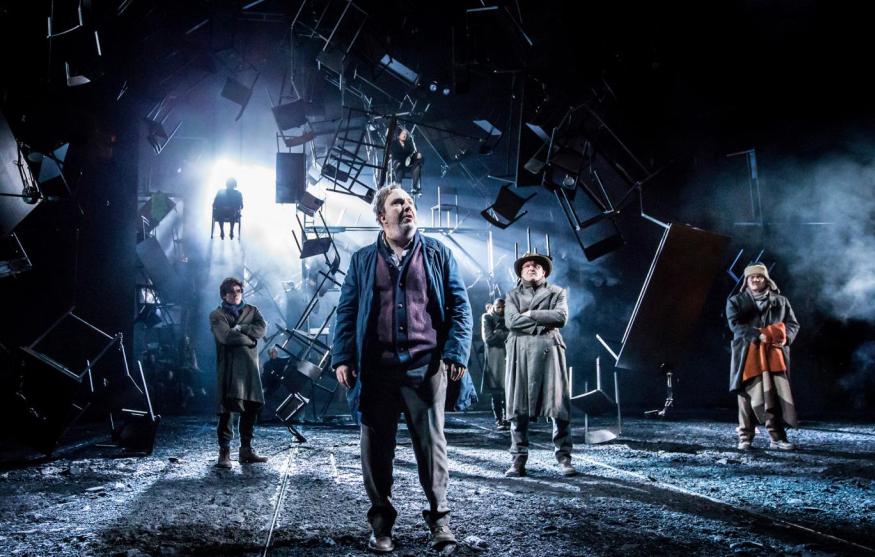
Fix was the third of my three-shows-in-three-nights experience and, rather appropriately, about addiction: already I was feeling the neurotransmitters charging up at the ritual of picking up a ticket, taking a seat, watching another world in front of me. It's devised and performed by Worklight Theatre, and on an overnight trip to Exeter I took the chance to see it at the Bike Shed Theatre - my first visit to this atmospheric, cavern-like space in Fore Street. I'd already been to a couple of shows at the pop-up Boat Shed Theatre at the quay, and was glad to get acquainted with the permanent version.
Anyway, Fix is based on two years of research into addiction, which was distilled here into a three-hander, switching rapidly between scenes with musical interludes. Rianna Dearden played a counsellor (researching for a PhD), and we followed, in glimpses, the story of two addictions: a gambling addict named Zach (played by Finley Cormack), who is distracted from looking after his infant daughter by a gambling app; and Maggie (Fiona Whitelaw), wife of a porn addict. The stories are interleaved with information about the biochemistry of addiction, delivered at terrific pace and with terrific energy (so terrific I struggled to keep up at times). The music was delivered on two guitars with all three of the cast singing, and the songs recast the language of addiction study in a beguiling way. The opening number celebrated the powers of dopamine. One turned phrases from a porn site into a kind of rap, and another told us about the number of licensed betting shops in the UK ('There are 8700 casinos ...' it started, but I'm afraid an internal switch turned on Katie Melua, 'There are Nine Million Bicycles in Beijing'). The company made great use of the small space, sitting on small wooden crates also used for percussion, and presented a fast-moving hour of emotional rollercoaster from hilarity to despair. It seemed just the right kind of space for this sort of punchy info-drama. I'll look forward to more from Worklight and more visits to the Bike Shed. What a pleasure, too, to meet Mumbai theatre practitioner Sapan Saran, who is embarking on a tour of small theatre spaces in the West Country - an inspirational project, indeed, and I trust an enjoyable one.
Showing posts with label Theatre. Show all posts
Monday, 18 September 2017
Betrayal
'Jerry is a literary agent; Emma runs an art gallery; Robert is a publisher. Emma and Robert are married and Jerry is Robert's best friend, but Emma and Jerry have a seven-year affair and Robert has secrets of his own.'
Thus the flyer for Pinter's Betrayal, at Salisbury Playhouse, and it's all too easy to imagine a terrible play based on it, a middle-class soap opera involving arty people in Hampstead getting in and out of bed with each other. But it's a fascinatingly involving piece, not least for its technique of telling the story backwards, at each regressive step throwing everything into further doubt. What is this love story we are being shown? By the end we see it starts as a drunken declaration and fizzles out in boredom. Was there love along the way? Maybe, yet we are increasingly aware that behind every statement there is an evasion, or a deception. There was certainly desire, with Emma escaping from something and Jerry perhaps avoiding a disconnect in his own marriage he does not want to address (or perhaps just arrogant enough to think he can have everything). Passion is surrounded by puzzle. Who knew what when? What further deceptions are taking place behind the scenes? Is Emma really just having drinks with Casey? Is Jerry's wife really just friends with her doctor colleague?In whose kitchen was a child thrown and caught? Pinter's trademark silences and pauses are filled with the sound of people searching for a foothold in an emotional landscape of ice and fog.
A capable cast found the drama of the words, and the gaps between them. Emma (played by Kirsty Besterman - lovely to see her again here after Separate Tables) found a convincing spectrum from cool and controlling to utterly disconsolate. There was a real hint at something nasty not quite being shown in her marriage to Robert (Robert Hands), who seems to accept her affair with icy insouciance and yet exudes real menace. A brooding violence is internalised and expressed in insinuating verbal attack. His speech about squash had the effect of a brutal attack, while the Venice hotel scene projected a palpable tension. Jerry (Robert Mountford) played the lover, pinging like a squash ball between the other two. The Salisbury Playhouse has a very wide stage, and the production made full use of it: this might be thought to work against the intimate nature of the drama, but I thought it actually worked well, the spaces between the actors bringing out the emotional distances between them, enhanced by ambient sound effects.
Betrayal is based on Pinter's own affair with Joan Bakewell. Rather knowingly, it has jokes about authors writing novels based on their own domestic lives. It has a slight period feel to it now, taking us to a time when we used traveller's cheques, and actually wrote letters to each other. And do literary agents earn so much that they can afford to buy, or rent, a flat in Kilburn purely for the occasional adulterous afternoon? Perhaps easier then than now. Yet it remains fresh, as it is not really about a particular affair, or even romantic affairs at all, but the nature of our dealings with each other, where our knowledge of our lives is only ever partial and every ordinary word casts a long and troubling shadow.
Golem
A couple of years ago, I attended a seminar by 1927 theatre company at the National Theatre. They create what might be called mixed media theatre: live acting and music against a background of hand-painted animation and claymation. Interaction between performers and projected animation - for example, an actor waters a plant which then, in projection, blossoms - requires precise spacing and timing. A curious mixture of hi-tech and play, creating a sense of wonder. I was intrigued by the workshop and so was delighted when I had a chance to see the 1927 show Golem on tour at the Nuffield, Southampton.
A Golem, in Jewish folklore, is a being created entirely from inanimate matter - claymation on a mythical level. The show uses the idea to create a fable about our relationship with helpful artificial gadgets, which soon come to dominate us: another variation on the Frankenstein story. Tied into this was a theatrical exploration of the corrupting effects of materialism and the culture's injunction to be forever buying into the latest brand: 'Keep up with the times, or you'll be left behind' repeated Golem's mellifluous voice (oddly, it's the exact same voice that tells me all my Tesco points add up). Human relations are sacrificed in the continued urge to look after number one. Human beings are simply marks for the corporations who use the Golem to market their products.
All of which makes it sound preachy. But Golem is a captivating experience, far too lively to become solemn, and often humorous. The animation, inflected by a Weimar Expressionist aesthetic, took us to a distant place which provided a distorted reflection of our own world. The acting style drew on silent cinema's language of gestures and heavy expressions, with striking wardrobe design to match: in his golem-induced quest to look good, the main character, Robbie, initially a shy nerd, ends up looking like a spaceman. But his ascent of fashion is at the cost of rejecting a woman, and the feelings that went with that relationship. Cartoon-style voices, often following exactly marked rhythms, further heighten the effect.
As the show progresses, Golem goes through rebrands, shaping human needs to corporate ends, until there is nothing left of us. The show felt like a dream, mixing the grotesque (the sleazy dance club) and the satirical with wildly inventive imagery (I loved the sequence of the Golem factory), leading us to a terrifying concluding vision of a posthuman world, where man and golem seem to have merged. The servant becomes the master, the inanimate clay has now sucked the soul out of all of us. A technologically masterful show about the dangers of technology.
Sunday, 2 October 2016
The Threepenny Opera
I was up at the National Theatre at the weekend for the New Views teachers' course, and a trip to The Threepenny Opera was thrown in. Never one to turn down an evening with Brecht and Weill featuring gangsters, beggars and prostitutes, I happily grabbed the ticket, realizing I'd only ever heard, but never seen, this Weimar masterpiece. Once, when the earth was in an earlier stage of its development, I wrote an A Level thesis, unpretentiously entitled 'Art in the Weimar Republic: Development and Dissemination'. Memories flooded in of the Bauhaus, of the Expressionists, and of those merry souls Beckmann, Grosz and Dix. The designers had clearly been looking at the same images: the look of Celia Peachum here, for example, was clearly modelled on Dix's portrait of Anita Berber, and Peachum's hairpiece was the exact same style as sported by Dix's wife Martha. Although the piece had been transposed in the script to London (not, perhaps, such a leap from the festering rancour of 20s Berlin to modern hard-Brexiting Britain), it was a German twenties visual we saw, and all the stronger for it. As for the work itself, it's hard to get a grip on. Taking off from Gay's A Beggar's Opera, which parodied the operatic conventions of the day with a story featuring a highwayman as hero and a medley of popular songs, The Threepenny Opera is a satire based on satire. It's very very knowing and self-conscious about what it's doing. Over its own genesis the work turned from being mainly a musical to a play with musical numbers, the main credit shifting from Weill to Brecht. What is it now? An anti-musical, perhaps one might call it, a feel-bad show (as MacHeath reminded us, verfremdungheitingly out of character, when we dutifully came back for the second half). It promises at the outset that no moral ending is envisaged, and throughout laughs knowingly at its own operatic formulae. Choruses, duos, arias are all poured out in a thick tar of cabaret songs, delivered with a snarl, and rendered naughtily delightful by an exhilarating set of obscene lyrics provided by translator / adapter Simon Stephens. And at the end, a deus ex machina and a parting moral are provided, the first for a laugh and the second for, perhaps, real. Brechtian alienation is a more dynamic thing than we are sometimes told, I think: instead of keeping us at a kind of arm's length from emotional engagement, it draws us in and then pushes us away again. Passages of bleak realism are undercut with a caustic joke or piece of knowing stage action; a storyline involves us then calls attention to its unreality.
The production itself made full use of the Olivier space, building up from a backstage look of platforms and flats to some clever designs, which quickly assemble and equally quickly collapse. Rory Kinnear was a suitably seductive MacHeath, who we can't hate as much as we know we should (I hear what he did at Kandahar and I still want him to escape - what's wrong with me? Aha! thus is the Brechtian mirror held up to my self-contradicting little mind). That's partly because those after him are if anything even worse, and because the world of sewers can, logically, only produce the sewer-dwelling rodent. There is a problem, though, in hammering on at length about how squalid and corrupt the world is and I must admit, by the end of the very long first half the songs were starting to sound pretty much the same as each other and to say the same things over and over again. Powerfully delivered, though. Nice - by which I mean not nice - movement work, neat differentiation of characters among MacHeath's gang, some fine choreography in, for example, the arrest of our vile yet strangely dashing hero. Still, that first half did feel long. The second was tighter, the story coiling around us. There was no escaping the sense of the play's bold, blustery bigness by the end. Great programme essay, too, by Dan Rebellato, on why we need Brecht today. His first reason is that Brecht is fun - it's the fun of kicking over a sandcastle and making, say, a sand abattoir instead. That sort of fun. But what was left after the fun, that evening? A sense of self-satisfaction at having seen a European classic at the National? Is the socially probing mischief lost among the well-heeled theatregoers of today's London theatre? Has the anti-classic simply joined the dinner party as another member of the canon? Well, Brecht would want me to be leaving with that kind of question, I suppose, hastening down the tunnel past Imax to catch the 10.35, developing and disseminating as I go.
Labels:
Drama,
Literature,
Music,
Plays,
Theatre,
Theatre Review
Sunday, 17 April 2016
Les Blancs
The script is the final text adapted by Robert Nemiroff, Hansberry's husband. From the script alone, it must be said it is in several passages thuddingly didactic, with scenes that would be handy in a textbook of colonial history and international politics. Characters fall neatly into types that illuminate positions in the conflict: the bad English Major, the good doctor at the Mission who nonetheless sees that in the wider scheme of things he is part-healer, part agent of a genocide brought about by making Africans live a particular kind of life. Other characters have the same typological recognisability: the wise Cassandra-like English woman, the African dealing with his own identity crisis, the onlooking journalist trying to understand it all on behalf of the audience. Their various attitudes are delivered with the subtlety of a megaphone. This is quite different from, say, Friel's Translations, another play about history, colonialism and independence (or, say, Elizabeth Bowen's novel The Last September). One feels this Brechtian epic would be an improving read, and indeed I feel I should read it as I don't imagine I took in on a single viewing all of the ideas being energetically exchanged. At least the arguments do not go all one way, and there is a genuine sense of difficulty, as we are reminded of the suffering of innocents on all sides. The points one can immediately think of for and against taking up arms are all stated by some character or other, though I think it is significant that while we see before us the murderous conduct of the Major we only hear about the slaughters committed by rebels. Weirdly, the wise old white woman appears to give permission for Tshembe to join his brothers in their fight for liberation, one which begins with fratricide. So if you wanted to find colonial arguments that the natives are not up to the job of self-government, you wouldn't have to look very hard here. Hansberry did not have a chance to visit Africa, and there is a feeling of intellectualising distance in the character typology here. Playwrights 'on the ground' like Athol Fugard and Wole Soyinka can take us closer - I am imagining, of course - to the idiom and domestic circumstances of African life. Having said all that, the cast, led by Danny Sapani as Tshembe, work wonders in bringing emotional colour and nuance to a text that could easily come across as clunky and predictable.
The production, directed by Yael Farber, makes the most of the Olivier stage to bring out the epic sweep of the play. The Mission compound is surrounded by great dark spaces which suggest the vast territory of the state and continent beyond. A Ngqoko Cultural Group act as a Chorus, providing African language and music between and during scenes; and there is much excitingly choreographed movement to balance the wordy script, with the speechless emaciated female figure representing the spirit of Africa providing a visual anchor to the whole production. As is common these days, there is a constant ambient score and soundscape. Live theatre moves inexorably in the direction of film. The revolving stage is kept very busy and seemed to me to be over-used. It can be very effective at suggesting the passage of time or breaking up the scenes, but I don't see why it has to keep going during scenes themselves. One passage of dialogue between the journalist and the older lady Madame Neilsen turned into a kind of game of hide and seek as they clambered around the mission building as it span around. Why? That doesn't help me follow what is being said, instead it distracts my attention from it. Towards the end it looked like the stage would whack into a character's legs, but of course he moved at the right time. (Apparently on the first preview the revolve stopped working altogether and some of the audience begged to see the rest of the play without it. Request denied.) The production team of 28 (that's twenty-eight) created a gallery of effects - especially spectacular at the conclusion - that lengthened the play to three hours, which I imagine is longer than the author had in mind
Towards the end there is a rousing speech by a rebel leader urging his people to 'Kill them all'. This conveys a sense of the Greek-like ineluctability of tragedy when a people feel driven to extreme measures (it has been carefully spelled out to us that all peaceful intents at negotiation have been rebuffed; I wonder if real historical cases are quite so clear). It was disquieting to see this a day after the bombing of Brussels airport by a group with presumably the same mindset. Curious, too, to see a play with so much dialogue that in the end despairs of dialogue altogether, either between cultures or within families. I got the feeling that this is a work which was still finding its final form at the author's death, and the 'final text' can only be an approximation to something more subtle and poised that might have resulted. Or not. Subtlety and poise might be responses altogether too comfortable for the issues under scrutiny here. It is not a bad thing to be returned to a Brechtian idea that drama can teach and provoke.
Sunday, 13 March 2016
The Encounter
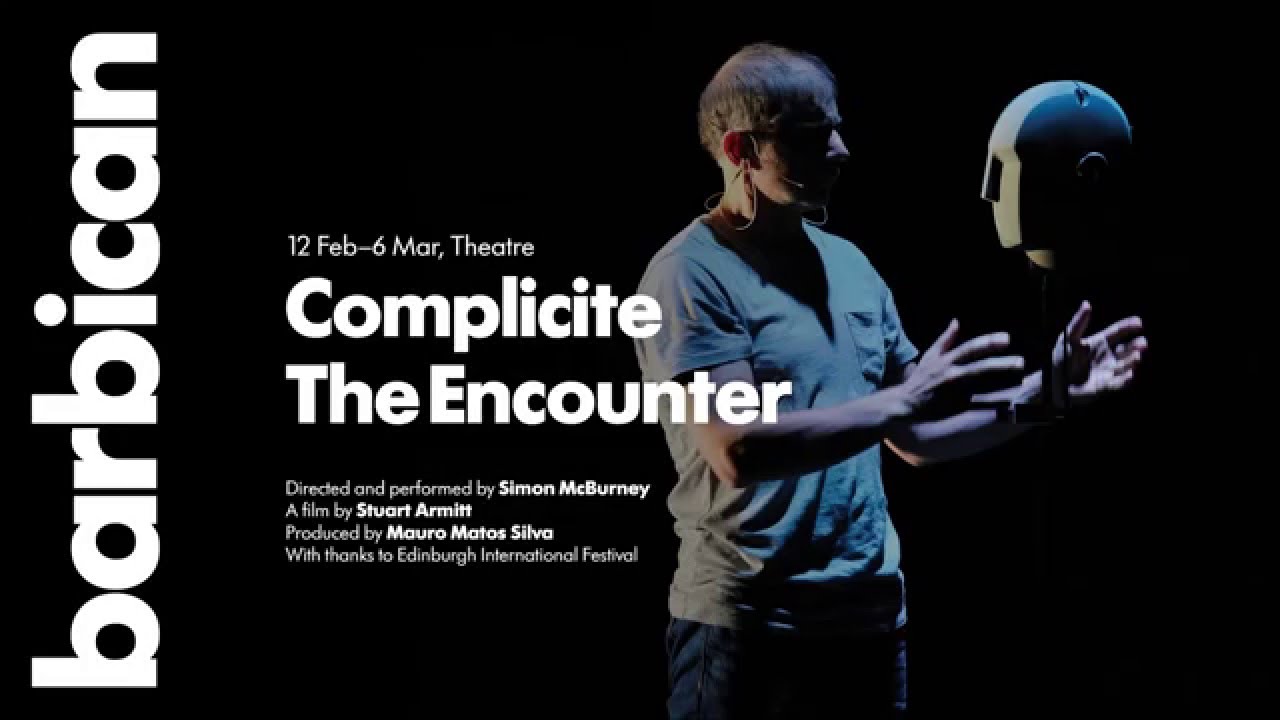
Years ago I listened, mesmerised, to a radio drama called Mnemonic, about the frozen body of Otzi the Iceman, who died some 5,000 years ago. Scientists speculated, other voices added a poetic commentary, and the story was spliced with a parallel love story from the director / narrator's experience. The theme was memory, and how imagination works with and recreates memory in our excavations from the near and distant past. Excavating this listening experience, I can't remember if then I would have recognised the voice of actor Simon McBurney (as I certainly would now), or how much if anything I knew of his company Théâtre de Complicité, makers of works which weave stories from found materials - what is now called devised drama - and bringing in techniques from the latest stage technology to traditional mime to make the stories ring. I'm pretty sure I had no idea that what I was listening to was a stage work, as it seemed to speak so directly through sound.The latest Complicité production is The Encounter, a one-man show performed by McBurney. It's based on a book about the experiences of photojournalist Loren McIntyre in the Amazon in 1969. An experienced traveller, McIntyre didn't mark a path back to his plane and ended up as a kind of prisoner-guest of the Mayoruba tribe, deep in the jungle. In his time with them, he finds the tribe on a journey, erasing their settlements and destroying their belongings, as they follow the river in an attempt to go back to the beginning, to remove themselves from time. Only out of time will they be safe from the invasions of the white man and modernity. Even more remarkably, McIntyre finds he can communicate with the headman, whom he calls Barnacle, without speaking. This telepathic channel is referred to by one Indian (the only one he can communicate with verbally, through the mutual language of Portuguese) as 'the old language'. McIntyre called it 'Amazon beaming', the title of a book by his friend Petru Popescu which is the main source for the production. He never experienced it again, and never made a big deal out of it. In fact, it only came to light in a discussion, years later, about the problems of communicating with Indians when there is no mutual tongue. Nothing in the recounting suggests it was a boast or an exaggeration or a fabrication. McIntyre was a highly successful and by all accounts rather retiring explorer and had no need to embellish his real-life experiences.
The Encounter stages this story with no pretence at realism. McBurney plays himself, McIntyre and other parts including the likeable Portuguese-speaking Cambio and uses simple mime techniques: a long pole becomes an aeroplane, an arrow, a thorn bush, and plastic water bottles are enough to evoke the tools and accessories of a whole tribe. Less simple is the remarkable 'binaural' sound technology which sends different sound channels into each ear: the audience is required to wear headphones throughout the performance. There is a mixture between live, recorded and looped sound, often overlaid with music. Walking through a mound of tape is recorded to represent the sound of walking or dancing in the jungle, simple vocal sounds are relayed and superimposed to create an aural tapestry of the Amazon at night. Sidelight throws deep shadow which is enough to suggest the depths of the jungle, and there are some vivid light effects on the giant canvas at the back. But the techniques and technology are not sitting up to be admired in this show. They serve themes of communication, rapacious modernity against the primeval world of the Indians, and take in the voices of anthropologists, mathematicians and the actor's invisible daughter who can't get to sleep.
I couldn't get to see it in London, but thankfully caught it on the final day of the live stream. I watched it in the late afternoon and then almost immediately in the evening (using up all the data allowance of my phone). It was simply a spell-binding experience, stimulating, moving, thought-provoking. It seemed to me that whether I 'believed' the mythology of the tribe, or the strange phenomenon of beaming, was beside the point. What matters is what is being said through the material about connections across individuals and cultures, about time, and the need to get lost and find home again, and find it changed. McBurney's performance is a wonder. The Chieftain's's words outlived the broadcast. They are holding us still in time... Some of us are friends ...
Sunday, 28 February 2016
A Raisin in the Sun
Over the evening, I felt a growing awareness of the nature of the Youngers' condition. Beneatha's boyfriends represent - perhaps a little obviously - the avenues available to her: return to Africa and the adoption of a clear ancestral identity; or assimilation into modern American life. Her intellectual questioning attitude leads her into trouble with her mother and her men. The dangers of free-thinking youth is not a race-restricted problem, needless to say. Meanwhile Walter is driven to distraction by his condition of servitude but lacks the savviness and education needed to make a go of business. His lack of preparation and tendency to fantasise make him dangerously vulnerable to exploitation. When Lena spends a portion of the insurance money on a down payment for a house, it looks as though a door has been opened for the Youngers. But the house is in a white neighbourhood, and the purchase leads to a visit from a representative of the 'Clayborne Park' community attempting to buy them out. 'Racial prejudice doesn't come into it,' of course.
It was a delight to see a traditional well-made play, introducing the characters then setting the spinning wheel going and leading us through their purgatory to a fateful decision, which takes them into a future full of risk - including, it is broadly hinted, actual physical risk. Hansberry wrote Raisin at the young age of 28 and it was, apparently, the first play by a black writer on Broadway, where it was produced in 1959. At that point, the question of what would happen to the Youngers after the final curtain was a question to the audience. Not that it has gone away, of course. Eclipse Theatre Company, who are taking their fine production on tour, is committed to drama and theatre-based projects which raise awareness of inequality and other race-related issues. Uneasily, I recalled I had been at a rather grand establishment dinner the evening before and I don't remember seeing a single black face there. And then there is the furore over this year's Oscars... So the work of Eclipse Company and other similar outfits is as necessary as ever.
This production was satisfyingly true to the work's origins: a drab single-room set, simple lighting plot, clear characterisation and full-blooded attack on the climactic speeches which may seem a little melodramatic now, but were part of the dramatic rhetoric of the time. It was entirely respectful to the aesthetics of the work, as conceived by the author. No production razzmatazz or modernising was needed to help us understand or feel the ideas and passions of the play. I must say it came as a refreshing relief after the National's ostentatiously lavish As You Like It to be reminded what can be done with a standard fourth wall set-up without a battery of special effects. The play itself is a tremendous work of social theatre: Walter Younger should be as well-known to English audiences as Willy Loman. Indeed they are similar in several ways: dreamers, victims of society but with enough flaws to make us edgy and stop the flow of easy sentiment. The whole ensemble worked beautifully together to create a gripping and moving evening of theatre. Fine work from the smaller parts along with the leads. This was another great night at the Nuffield, Southampton. We feel so lucky to be within easy distance of this venue, showing some of the best work currently being done on the British stage. It brought back memories of Jacobs-Jenkins Neighbors, another remarkable play about the black experience in America, which I also saw at the Nuffield. If you happen to come on this post and are considering getting a ticket to A Raisin in the Sun, don't hesitate!
Saturday, 27 February 2016
As You Like It, National Theatre
I start with Lizzie Clachan's set because this is what really lodges in the memory. The Olivier certainly invites such huge design-led productions, and the NT economics presumably make it possible. Perhaps West End expectations make it necessary. Every play I have seen in this space recently has had a staging hugely in excess of what the text actually requires. You start to wonder how the price of a ticket is divided: how much of a £40 seat goes to superfluous non-speaking actors who, in this case, sit first at a desk, then among the trees or pad around as sheep? (Or how about the policemen in Man and Superman who appeared for 1 minute of a 3-hour play?) How much then goes to the machinery which makes such a colossal mechanism work? Or to the creative team of 13 (what does an 'Artistic Collaborator' do?)? We are getting close to the point where the directors outnumber the speaking actors, like the physios and psychs on a test cricket tour.
Well, all this extravagance could have overwhelmed the play itself, but the acting was thankfully strong enough to distract us from the set and its population of extras. Actually, this was a particularly clearly delivered production: every sentence was doing some work and made sense of. Joe Bannister was a likeable Orlando, Rosalie Craig a feisty Rosalind. The complicated stage business around the wrestling smothered their initial meeting, and this Rosalind was always more in control than she was giddy with Cupid's dart. Orlando's 'I can no longer live by thinking' rang out with a pathos I had not felt in it before. Celia (Patsy Ferran) and Oliver (Phillip Arditti) were miraculously convincing in their love-at-first-sight moment and generally a delight to behold. Touchstone (Mark Benton) wasn't funny, but I defy anyone to find this character funny, whoever plays him. Sixteenth-century logic-chopping wit is as dead as a Monty Python parrot. But I'm glad this rather unpleasant fool got a clonk on the nose from William at the end of that horrid little scene. Jaques (Paul Chahidi) was done interestingly, with the seven ages speech delivered as a kind of improvisation upon an idea, bringing refreshing spontaneity to this tired set piece. Much facial expression suggested some kind of condition explaining the character's melancholy. The production ended by working its charms, with no attempt to disguise the preposterous ending, and a full-scale all-singing-all-dancing finale in gorgeous costumes.
Briefly mentioned among the padding with which NT surrounds its live screenings was the fact that this was a 1599 play - that astonishing year which saw this, Julius Caesar and most likely the beginning of work on Hamlet, as Shak and Co. moved across the river and into the Globe. A feature on the history of performance in the NT was really nothing more than a few reminiscences of how awesome it is to play that space by whoever they could round up. More on 1599 would have been instructive. Mighty things were on hand at this point in Will Shak's life - meta-theatre (we need to see a production where boys are playing girls playing boys seducing men to see what got Puritans hot under the collar), fluidity of character - you are who you decide to be in the given moment - and forays across and around the frontiers of serious and comic. As for stunning sets, if we have clever people to make them and the London crowd are happy to pay pretty prices to be wowed by them, then I suppose they will continue. You can always go the Globe or Sam Wanamaker for something barer. As you like it, indeed. But I remember warmly a recent workshop at the National itself on 'simple, effective' design and I would like to see something there soon in the Olivier or Lyttleton using a couple of tables and a chair or two. Go on, NT creatives, I dare you.
Monday, 2 November 2015
The Glass Menagerie
There was a strong design element to the production, credited to someone evidently so eminent that he is known simply as Ultz. The stage, framed by moving boards, resembled a film screen, picking up on Tom's escapist obsession with going to the movies. Tom himself spent most of the time either in front of the stage or in the audience, leading us through his 'memory play' as it played before us. Subdued colours and dim lighting produced a monochrome effect suggesting memory haze and early film. There were captions, slides and live streaming of Tom himself, and a set of metal steps for the fire escape from the family's apartment, also representing the escape route for Tom and a kind of bridge between past and present. Lighting and sound were used to tremendous atmospheric effect, and there were some ravishingly beautiful moments with candles, windblown curtains and the glowing glass unicorn.
There's always a danger that such directorial and designer cleverness overwhelms the play, or suggests a lack of confidence in it - as I think happened in Lyndsey Turner's Hamlet - but here the ideas were thought through and brought out Williams's poetic vision without distracting from it. Acting throughout was terrific. Dannie Lee Wynter played Tom with a caustic confidence, gradually revealing his character's insecurities and tragic inadequacy as family provider. Belinda Lang portrayed his mother Amanda with great understanding, showing a character who is at the same time insufferable yet understandable in her anxieties. The scene between Laura (Pearl Chanda) and her gentleman caller Mr O'Connor (Wilf Scolding) was totally compelling, touching and finally devastating. All in all, a remarkable piece of ensemble acting and a bold, committed production. The Nuffield moves towards Christmas fare now, but I'm very glad we caught this, and thankful I listened to two people who recommended it. Why some people in Winchester think you have to go to London to see good theatre is a mystery which passes understanding.
Tuesday, 27 October 2015
Flare Path
This production by the Original Theatre Company brought out the play's strengths to great effect. Rattigan had a genius for exploring the depths of emotion swirling away beneath English reserve, and an apparent belief in the victory of traditional decency over personal gratification. He had a sympathy for those who cannot live up to ideals their culture sets for them which still touches the heartstrings today. He was also a great craftsman, and Flare Path moves irresistibly through exposition and development to two climactic moments. One of these is based on reading a letter. Rattigan liked the dramatic power of documents. One thinks of Crocker-Harris reading the inscription to his book in The Browning Version, the newspaper report that crowns The Winslow Boy, and the rather different one in Separate Tables. Less conducive to modern tastes is the sentimentality. The final scenes just seem too soft, but to a wartime audience who of course did not know how things would end, there must have been fairly strict boundaries to what was palatable: Rattigan had difficulties even getting the play put on because theatre managers felt the public did not want a piece about war. Then there is the patronising habit of making working class characters figures of fun (and shrewish Maudie, with her endless prattle about bus timetables, is hardly even fun today). No point being too stern about this: after all Shakespeare had his rustic clowns to give us a break from the verse of the nobles. The idea that only the educated few have complex interior lives has a long ancestry. Back to the show, there was terrific ensemble acting throughout, and no point really in picking out individual names.
The performance was compelling and finally very moving, partly because it turned one's mind to the historical realities. I'm sure my Battle of Britain veteran grandfather would have approved, and I'm glad his grandson knows a bit more now about the life that crews and officers endured. Although in many ways a period piece, Flare Path - when given a production as strong as this one - still does a vital job of bringing its fast-receding period to life. Presumably theatres in 1942 would not have had the sound and lighting effects that we enjoyed at Theatre Royal Winchester. But then they would not have needed much help in imagining them. The play ends with a wartime song, 'I don't want to join the airforce'. I suppose in its original London run, the audience, stirred but not shaken, would have joined in.
Saturday, 24 October 2015
Hamlet (Cumberbatch)
We went to see Hamlet in what is rapidly becoming my favourite way of seeing London productions - streamed from the theatre onto a cinema screen, cutting out the expense and fatigue of travel and bringing you up close to the acting. It was particularly appropriate to this record-breaking-sold-out-within-minutes production directed by Lyndsey Turner and starring Benedict Cumberbatch. For this show had so many cinematic effects, it felt like watching a film turned into a stage play and then turned back into a film again. Lyndsey Turner was working with Designer Es Devlin; their last collaboration, which I saw in the NT Lyttleton, was Caryl Churchill's A Light Shining in Buckinghamshire. Both productions in their joint vision have featured a large and well-stocked banqueting table and large amounts of earth (in neither case required by the texts, both of which can be performed on a nearly empty stage). The Turner-Devlin Hamlet was set a vast palace interior and used Richteresque ambient music to underscore the emotions of the scenes. There were chases under strobe, freeze frames and a stunning dust-storm at the end of the long first half, leaving the palace a half-sunk ruin for the second, symbolising the moral decay of Claudius and Denmark no doubt. Heaven knows how many lighting cues there were; the whole thing was certainly visually exciting to watch, with a wardrobe ranging from evening dress to modern military and a delightful large toy fort.I start with the look of the thing because that did, over time, become a distraction. Shakespeare's verse is deeply visual because it was written for a less furnished stage than a lavish London show would dare to put before us. A clever design can accentuate the feelings of a work, but it mustn't work against the words themselves. Here it did. when Claudius is giving his first speech on the death of the old Hamlet and his marriage to Gertrude, we shouldn't be gawping at ornate evening dress and weird table props. There were moments when what we saw and what we heard took us in different directions. For example, we saw in mime Hamlet put on an Indian head-dress in what appeared to be an affectionate, playful scene with Ophelia. But then we saw Ophelia reporting Hamlet's appearance (2.1), 'My lord, as I was sewing in my closet'. But what she was describing was not what we had just been seeing at all. What were we to make of this? Was the idea that she was making it up? But why would she do that? Then there is design and stage business when none is really needed. Consider the brief scene about the fight for a scrap of land in Poland, setting us up for 'How all occasions do inform against me' (4.4). It's an odd afterthought of a scene in any case, and hardly needs a whole military camp with soldiers in tents blowing on their fingers to bring it alive. This is theatre adapted to the hyper-visual world of the modern audience, I suppose. But it must first and foremost adapt itself to the text. The Players scene (shortened to lose the dumb show) didn't work simply because in order to see the lovely mini-stage on the stage we couldn't see Claudius, and everything is meant to be about his reaction (the camera helped us cinemagoers a bit).
All this can be justified by theatre's constant need to recreate itself, and the changing expectations of a younger audience (it was great to see some youngsters at Vue Cinema when we saw it, apparently there of their own volition and not part of a school trip; if Cumberbatch brought them and cool visuals held them then that's an undiluted good). But that brings me to a further grumble. If you're going to bring Shakespeare to the people, then it really should be Shakespeare, untampered with. In this showing, the opening battlement scene was lost and sort of transposed into Hamlet's meeting with Horatio; but that first scene, amongst other things, establishes Horatio's character as the studious sceptic, a foil for Hamlet's more intuitive cast of mind. Polonius was heavily cut. His first speech amounted to 'He hath. my lord. I do beseech you, give him leave to go.' In the text you'd get in a bookshop, we get: 'He hath, my lord, wrung from me my slow leave / By laboursome petition ...' and so on in leisured rhetorical fashion. Notice how this speech characterises Polonius as a windbag, a trait developed in his advice to Laertes (also edited), his spying on Laertes (cut entirely), and his meeting with Hamlet (reduced). In this production, Polonius was in fact turned into a model of concision, making the Queen's exasperated 'More matter, with less art' quite meaningless. Shakespeare's character of Polonius had been turned into a fairly nondescript elderly courtier. But of course, we must concede, Shakespeare's company cut, and we must regard the texts we have as flexible things, at best approximations to what the first audience heard. Still, I don't think flexibility should reach to simplifying and modernising the words themselves. Instead of 'Good Hamlet, cast thy nighted colour off', we got 'nightly colour'. Why? Is 'nighted' really too brain-achingly tough to figure out, especially when he's wearing black? Accents shifted. Claudius gave 'comméndable' in the modern stress, against the metre of the line, but the correct 'perséver' a couple of lines later. We heard, or I think I heard heard, 'Things rank in nature possess it merely', and I contend that the missing 'do' matters. In Gertrude's description of Ophelia's death the 'hoar' leaves were kindly translated for us into 'pale'. Unless I am mistaken, every mention of a Polack was nervously corrected to 'Polish'. Everything was delivered in the modern naturalistic style: Gertrude's 'I thought thy bride-bed to have decked, sweet maid' had at least two heavy pauses breaking up the line, just to take one example among many. Well, this is Shakespeare today and it can bring lines alive in unexpected ways. I don't think I'd ever really registered 'The sun no sooner shall the mounains touch' (4.1) but something about its delivery on this occasion put the image vividly in my mind. This is why one goes to Shakespeare repeatedly. I wonder if there will be a swing towards a more verse-oriented delivery of Shakespeare in coming years. Perhaps I should forget these reservations and get into the flow. Perhaps. But orchestras don't change Mozart's notes, and art galleries don't alter their masterpieces to make them easier to a modern sensibility. There is something indicative of a deep lack of confidence in altering the thing you are bringing to the public, however slightly. Wedges continue to have thin ends.
All that being said, I did enjoy this Hamlet and was glad I went. There were some excellent performances. Ciaran Hinds was a menacing Claudius, and Karl Johnson was brilliant, doubling as Ghost and Gravedigger and getting both parts across vividly. Sian Brooke was an affecting Ophelia, making her frankly tedious mad scenes into something touching, especially when she went to the piano, and Matthew Steer was an amusing Rosencrantz. Benedict Cumberbatch himself was full of vocal and physical energy, bringing across Hamlet's relish of exercise both mental and physical just as he is saying he has had enough of it all. In fact his action-packed performance perhaps diverted us from the point that the play revolves around his hesitation, his in-action when it comes to the moment of vengeance. But this is just hard to get. How many in a modern audience are worried that they might go to Judgement unconfessed? Yet the failure to kill Claudius while he is a-praying revolves around this. Cumberbatch made sense of the soliloquies and his Hamlet overall was humorous, genial and engaging. I did find the music, the antics, the imaginative staging, the cool visuals exciting. And there were moments which came across effectively and poignantly - 'there's providence in the fall of a sparrow' struck me as a particularly well-tuned moment. But after the immediate excitement had faded I felt the production tried a little too hard to be like a movie and lost the intimate verbal drama of Shakespeare's creation. Somewhere at the back of my mind was a speech by Steven Berkoff reported in the paper that same day, on how young actors these days don't know or care about the history and traditions of their craft. I don't know whether that is true, but practitioners can always benefit from opening themselves to older styles. Also in my mind, a letter to the paper a while back wondering why it is that while musicians work hard to fathom what Beethoven meant by a phrase or passage and try to bring it out in performance, productions of plays and operas often push the author to one side and 'interpret' their material into some bizarre places, and sometimes out of recognition. There must be an answer to that, but I can't think what it is. Perhaps it's to do with markets, directors and designers needing to have a brand. We mustn't overstate the role of the 'creative team' as it's unfailingly called these days. I love directing plays, but I can't see it as a creative act comparable to writing one. Shakespeare is the Creator we should be left thinking about. All unresolved issues pattering round the brain. Hamlet, more than any other work, at least gets you thinking.
Monday, 10 August 2015
24 Hour Plays, New Greenham Arts Centre, Newbury 1st August 2015
On Saturday August 1st five theatre companies
performed short original plays in New Greenham Arts Centre. All five companies
were made up of performers between the ages of 15 and 21, and all the plays had
been written and rehearsed over the last 24 hours. The venture was the initiative of actor
Kristoffer Huball. After a day’s workshop for everyone in a range of theatre
skills on Monday, the nominated writers were then given short notice of a theme
and turned up at the ominous-sounding 101 on Friday for a night’s work script-writing,
inspired by props offered by their actors. After drafting, storyboarding,
redrafting, and developing through the night, writers handed over their scripts
to actors and directors, who had a single day to turn them into a live performance.
The emphasis was on independent thinking by talented young people, with
suggestions from professional mentors Nigel Munson, Chris Harrison, Nadia Nadif
and James Roselman.
Winchester were first up, with Broken News, written by Samuel Morley (who also did the lighting
for the evening) and directed by Henry Fuller. This was the most light-hearted
show of the evening, featuring an interplanetary news team ‘scooping’ a
non-existent supernova on a distant star. The cast of five put their characters
over clearly and there was some delightful mime involving spaceships and space
suits. The tone changed abruptly with Kennett School’s Appreciation, a monologue by Maveric Hearn about family tragedy.
This was sensitively delivered by Adam Smith, who convincingly played more than
one character. The Young Corn Exchange followed with The Rose, a Grimm-like parable by Scarlett Quinton, performed by
Becky Lillycrop and Adam Taylor, who made striking use of space and movement
and covered a range of emotions. St Bart’s School followed with Abi Smith’s Testament of the Imprisoned 2, a prison
drama in which director Parry Bates drew some subtle ensemble acting from his
all-female cast. Last on the bill was Trinity School’s The Beak Tail of Two Penguins, written by Luke Stevens and directed
by John Creed. Molly Fairchild-Smith and Adam Taylor played eco-conscious
space-travelling penguins in a piece which started as high comedy and ended
somewhere much darker.
All the teams made maximum use of minimal means – no
costumes, few props and some basic furniture were enough to create whole worlds
in the audience’s imaginations. They had clearly relished the 24-hour challenge
and the end result was strong, focussed theatre which will live in the memory.
At the end Kristoffer Huball encouraged all the actors to form companies and
keep putting new work out there. With
cuts everywhere, there is much to be worried
about in the performing arts at the moment; but seeing the wealth of
talent on show in Newbury, there is clearly a lot to be excited about ,too.
Wednesday, 16 July 2014
Catch-22
Fred & Alice
As You Like It (SATF)
Wednesday, 28 May 2014
'Tis Pity She's a Whore
This version of 'Tis Pity updates to modern dress, with Anabella a contemporary teenage girl and her bedroom the single setting for the action - not so very different from the bare Jacobean stage where time and space equally collapse into a single platform and the audience are similarly required to 'see' the different settings of the action. Second time around, I noticed the attention to detail in the room: red cd player, red lampshade, red book cover .. Exciting opening choreography, creating a sense of a girl both empowered and controlled by the surrounding male culture. It's easy to get this sort of thing wrong and start with clever staging, but this production had clearly started with deep thought about the language and characters and worked outwards from there.
Every detail of staging had a reason for being there, and though some speeches were given a modern twist (Hippolita's offer of herself in marriage to Vasques becomes a full-on seduction scene, Soranzo's already horrible beating becomes something unspeakable) it was never twisted out of credibility and the business brought out the nastiness that seeps from between the lines of Ford's writing. Easy, too, for frantically inventive staging to become a distraction from the core action and speech, but only once - Hippolita at the party - did the interpretation take over from the text for me (it took the second viewing to figure out how all the things going on fitted together), suggesting a certain lack of interest in the niceties of remitting breach of betrothal in the seventeenth-century and a desire to give us something busy to look at instead.
Notes. Plenty of circular movement, inevitable when a bed is plonked in the middle of the stage, and devastating deployment of the bathroom offstage. Effective use of onstage singing, an object lesson in juxtaposition (eg something atrocious happening against soft music offstage). Speech hard to discern over the music at times, Friar and Cardinal looked out of place as the Catholic context of the original doesn't belong in the secular hedonistic world of this interpretation (how many students these day go around with a tutor Friar in tow?). There should be some kind of quota on how many tops can be ripped off enthusiastically in the space of two hours, as there was a diminishing return in the constant revelation of torsos. Will Alexander a terrifying Vasques, honey-voiced and brutal; Orlando James and Eve Ponsonby convincing throughout as the doomed brother and sister. Overall impression one of excitement at the spectacle, a creeping sense that, yes, these people are really psychopathically sick, and an overpowering atmosphere of corruption - all in the Jacobean spirit. Or part of it: this production of a not-frequently-performed play omitted entirely the comic subplot and made other cuts, most oddly to the ending - so we were listening to a symphony with sections of the orchestra missing. But what it set out to do it achieved wonderfully well: it yanked this piece out of its cosy heritage habitat and made the material visceral, shocking and affecting to a contemporary audience using the full resources of its company. Hit the target, one might say.
The Duchess of Malfi
Watching it on TV had plenty of advantages: you could see the expressions close up, the sound quality was excellent and the thrilling bareness of the satge had even more impact on a screen, usually so crowded with detail. The production was preceded by a documentary by Steven Shapiro, full of enthusiasm, who offered some unilluminating interviews with star actors and presented the thesis that the author of The White Devil and The Duchess of Malfi might have been someone of a not altogether sunny disposition. Two pages of an Arden / Mermaid introduction would give you more information. The TV introduction by Andrew Marr seemed to be vaguely inspired by the Proms and added nothing at all apart from plot spoilers and a stupefyingly condescending warning not to alter our TV sets when the stage goes dark. Thanks, W1A!
The verse was well delivered throughout: I haven't seen the Duchess for 12 years (Salisbury, 2002 to be precise - excellent show), but the strange similes and distinctive seventeenth-century treatment of the verse line brought it all back: compass, tennis balls, medlar trees, pyramids... what a unique consciousness is here. Throughout I kept realizing what Eliot got from the period, not that he made any secret of it. A world-weary Bosola, going through the motions of seeking preferment and sinking further into self-disgust. Ferdinand was really compelling: that moment when the strange repeated laughs signal he's flipping will stay with me. Gemma Arterton was excellent as the Duchess, upright alabaster among the ruins, far better than the reviews I'd seen had led me to expect (I wonder, by the by, if £60 seats have the effect of turning viewers and reviewers into bogus connoisseurs of how Jacobean drama ought to be interpreted, which is something we know very little about indeed). Shafts of comedy (the doctor) piercing but also drawing attention to the darkness. Only thing I didn't like was the music: it was beautiful and beautifully played, but a distraction from the action - the opening was ludicrously over-extended - and far too sweet to bring out the moods of the piece. But I'm delighted that the BBC are now doing this, sparing us the cost of an NT Live showing, and quiver with anticipation for more.
By the way, have just come across Peter Kirwan's impressive early modern drama in performance blog, Bardathon.
Monday, 26 May 2014
Rich Hall
The Curious Incident of the Dog in the Night-Time
Coming to it from a 'what could we do here?' perspective, there was much to pick up. Simple furniture, expressive use of staging and the immensely powerful deployment of features like the train set and chalk drawing. Loved the physical side, with Frantic Assembly providing some moves that were effective because not over-used. Well-judged music, again economically employed. And of course, the acting was pitch-perfect throughout, Luke Treadaway, although clearly somewhat more than fifteen, making a deeply sympathetic Christopher (his and has been going round in my head all day). The play gave a convincing account of the world from Christopher's point of view and from outside as well. Effective doubling by a small company. All of this is theatre that any school should aim at. But the programmed light systems and the underground scene would take some replicating, I imagine.
It was lovely to to be reminded of the novel's story. There were some deeply moving moments, like the mother's monologue near the end of Act One and the ending, and serious and comic played off each other beautifully throughout. In the novel, the digressions on maths conundrums like Conway's Soldiers and the Monty Hall problem were part of the fascination, but these couldn't really be staged; something like it was left until the problem explanations at the end, but we had to leave before we heard them. How many plots are there in literature? Twenty? Seven? Essentially there's just one, which is always to do with someone trying to overcome obstacles to achieve something - the story of human life - and this novel and play give us an elemental version of this tale. I have no idea how clinically accurate it is. Mark Haddon says he wasn't writing about autisim, but difference. Would seasoned police officers and transport workers really be so nonplussed by a character like Christopher, though? Surely they see all types over a week? Perhaps they're better prepared now than when Curious Incident appeared, and both book and play have something to do with that. No explanation on stage of the title; perhaps it is assumed that a modern audience knows its Holmes stories well enough not to need any.
Saturday, 24 May 2014
Tonight at 8.30 (Trio 1)
Taking these pieces together, one catches Coward at the tailend of a classical tradition in which tragedy is reserved for the privileged and the working man is a clown; and while he is not Ibsen he does subvert this in interesting ways: the Red Peppers acquire a kind of grandeur in their valiant attempt to 'keep it fresh, keep it fragrant' and the acidic portrait of decadence among the (precariously) privileged makes one think of Ivy Compton-Burnett or Henry Green's Party Going. Again I was struck by correspondences to later writers: We Were Dancing gave a foretaste of Pinter's The Lover, the minute verbal analysis of emotional currents in An Astonished Heart has something in common with, say, Albee's A Delicate Balance; while Red Peppers could be an early sketch for Osborne's The Entertainer (both were astute critics of a world they were nostalgic for). Coming back to the show after a week, I could better appreciate the mixture of period and modern in the performance: imitating Coward's clipped diction and the postures captured in the programme photos would have drenched it in sepia; while observing Coward's rhythms with the contemporary voice certainly brought out the rawness and immediacy of the emotional situations. Staging was clear and unfussy, the acting wondrously versatile. Hugely enjoyed Tonight at 8.30, delighted it started at The Nuffield, and hope it has a really succesful tour. More good stuff to come at The Nuffield - looking forward to Rich Hall tomorrow, Cheek by Jowl (saw them a few days ago in Oxford) on Tuesday and Catch-22 in a couple of weeks.
Subscribe to:
Posts (Atom)