Showing posts with label Renaissance. Show all posts

Monday, 22 February 2016

Botticelli, Dante's Inferno

The Courtauld is presently exhibiting thirty of Dante's drawings illustrating scenes from Dante's Divine Comedy. Dante wrote his vision of hell, purgatory and heaven when in exile from Florence, between (approximately) 1308 and 1320. Botticelli's drawings are dated to c.1480-1495, by which time the poem was a national Florentine treasure. It is thought that Botticelli's drawings were made for Lorenzo di Pierfrancesco, who is also thought to have received, variously by gift or direct commission, the same artist's Pallas Athene Training a Centaur, Primavera and Birth of Venus. Fortunate fellow, though as a Medici I suppose you felt entitled to such reminders of your magnificence. In time, the Dante drawings wound up in the collection of the 12th Duke of Hamilton, who was obliged by financial distress to sell them - along with other manuscripts - to a national collection in Berlin in 1882. The Courtauld exhibition brings together drawings and manuscripts, including the sumptuous 'Hamilton Bible', in a show entitled 'Botticelli and Treasures from the Hamilton Collection'.

It is believed that Botticelli originally planned to colour the Dante illustrations, but that at an early stage in the project this scheme was abandoned. Certainly one does not regret the absence of colour in these designs, where the formal qualities of line and composition convey an overwhelmingly vivid impression of Dante's visionary experience and its moral lessons. Often multiple events crowd the same page, as in Inferno 8 (5th Circle of Hell), where Phlegyas rows souls to the underworld, Dante berates one forlorn figure clinging onto the boat, and is subsequently embraced by Virgil, who congratulates him for his virtuous outrage. Around the poet and his guide contorted souls writhe, howl and moan. In the bottom corner, the pair arrive at the city of Dis (Abandon Hope ...), to be met by a group of grinning, winged and horned devils. There is a splendid Disney-like demon smiling straight out at us from another tower. It's hard not to smile back, and to a modern eye the whole infernal scenario has a certain amusing charm. Everywhere, hands and gestures sketch emotional states like members of  the Pina Bausch dance troupe. The Inferno drawings are so crowded with detail that one can only list some of the most memorable figures: the monster Geryon, with a man's head, dragon's body and scorpion's tale; or the terrific drawing of the simonists (Inferno 19) disappearing headfirst into holes in the ground, giving us the bizarre sight of Dante lecturing the splayed legs of Pope Nicholas III. Dante does quite a lot of berating and altogether comes over as quite a bruiser, not the gentle poetic soul of romantic representations. Presiding over this theatre of cruelty - and the Inferno is an intensely mean and cruel book - is the full-page Lucifer, whose three heads crunch up the bodies of Judas and, startlingly for those who come to the story via Shakespeare, Caesar's assassins Brutus and Cassius. These conspirators annoyed Dante and other medievals for getting in the way of a stable empire under a strong ruler.


In the Purgatory drawings, souls take on more individual characteristics. The devils drift away and there is generally more space on the page. We see the proud weighed down by stones (thus they can't stand proud, another attraction of the drawings is that with a bit of help from the label they are easy to read), and the envious with their eyes sewn shut, among whom Dante receives the metaphysical light of revelation from an angel. Punishments are mirror opposites of the sins committed: thus, the slothful in life become whirling, frenzied mobs stampeding around (Purgatory 18), and gluttons are reborn as emaciated figures resisting the temptations of water and the fruit of an upside-down tree. The Divine Comedy reads as a  legal compendium, covering all possible cases: even in heaven, we meet those who broke their vows, though through no fault of their own, a strange little lawyerly subclause one feels. As Dante enters Paradise, he is accompanied by Beatrice, and the more realized worlds of Inferno and Purgatorio fade out to leave abstract designs of cosmic spheres through which the happy couple glide. There's a lovely fade-out as we leave them, tiny couples on a cloud, disappearing from mortal view.


It's funny how things overlap. I caught this exhibition in a break from the excellent National Theatre Drama Teachers Conference over the river. On the same evening, we were given tickets to Sarah Kane's Cleansed - an updated Inferno, though here the torments and cruelty are unexplained, not drawn into any comprehensible modern scheme; nor was there anything really to recreate the tension between the delicacy of the drawing and the roughness of the content that we find in Botticelli. From faith in art and God to the modern loss of these, je suppose. And the next day, I was fortunate enough to attend a presentation by 1927 theatre company. Their work seemed in the tradition of the drawings, too: 1927 combine music, actors and animation in productions which look back to silent film and early cartoons. The expressive, opened out bodies, the eyes, and the interaction between animated and real figures of their works (Golem, for example) are pure Botticelli, pure Dante. A replacement bus service from Basingstoke made the journey through various underworlds complete.

Tuesday, 16 July 2013

The Petrarchan Sonnet

Here's a brief guide to the form of sonnet known as the Petrarchan. Of interest, perhaps, to students of poetry and the general reader.

Like many poetic forms and terms, the sonnet is Italian in origin. It was used by the fourteenth-century Italian poet Petrarch (1304-74), and introduced to England in the sixteenth century by the poets Sir Thomas Wyatt (1503-42)and Surrey (full name Henry Howard, Earl of Surrey, ?1517-47). They made translations of Petrarch and wrote English sonnets which employed his rhyme scheme.
Basic form
The basic shape of the Petrarchan sonnet is 8 lines (the octave or octet) + 6 lines (the sestet). The octave is composed of two quatrains, closely linked by just two rhyme sounds: abbaabba. The sestet has various rhyme forms, using either two or three rhyme sounds: cdcdcd, cde cde  etc. Many variations are permitted, but the sonnet should not end with a couplet. The English iambic pentameter line is the standard metre. In graphic form, here is the rhyme scheme of a sonnet divided into octave and a sestet, the setet itself divided into two tercets liniked by rhyme.
  1. ___________ a
  2. ___________ b
  3. ___________ b
  4. ___________ a
  5. ___________ a
  6. ___________ b
  7. ___________ b
  8. ___________ a
     9. ____________ c
     10. ___________ d
     11. ___________ c

     12. ___________ d
     13. ___________ c
     14. ___________ d


One thing to look out for in a sonnet is the turn (Italian volta), the point between the octave and sestet, where the sonnet moves from one rhyme group to another.  With the change in rhyme scheme may come a change in subject  matter.  So in the second, shorter half, the poet may change register, comment on the first half (perhaps presenting it as an analogy), answer it, resolve its tensions or heighten them, or reverse  the feeling altogether, among many other strategies.
A sonnet is a little too long for simple lyrical expression, but too short to tell a complex narrative. It therefore suits short argument, and the representation of an internal mental / emotional experience, often involving conflicting feelings.  This figuring of an internal passage of thought invites metaphorical language. Originally, the predominant theme was love, with the Petrarchan lover in joy and agony, burning and freezing at the sight of his beautiful / remote beloved. Wyatt and Surrey were courtly poets, writing about the delicate sensitivities of the courtly lover. Later writers have adopted the form for a wide range of subjects. Rhyming is harder in English than Italian, so the form also represents a formidable technical challenge to the poet. The discipline of the form seems to be an effective way of presenting strong emotional content.
Here are some examples of English sonnets using the Petrarchan form.
Wyatt
The long love that in my heart doth harbor
And in mine heart doth keep his residence,
Into my face presseth with bold pretense,
And there campeth, displaying his banner.
She that me learneth to love and to suffer,
And wills that my trust and lust's negligence
Be reined by reason, shame, and reverence,
With his hardiness taketh displeasure.
Wherewith love to the heart's forest he fleeth,
Leaving his enterprise with pain and cry,
And there him hideth and not appeareth.
What may I do when my master feareth
But in the field with him to live and die?
For good is the life ending faithfully.

Let's look at this without reference to the Italian model. It stands or falls as a poem in English, after all. I like the way it gets on with telling its story straightaway. Each line in the first quatrain tells us about a new event, an internal experience figured in imagery. 'Long love' - the length is felt through the double stress, which lengthens the vowels and gives the liquid 'l' sound its full value ('l' does seem to have an erotic feel to it: the lovely long-legged lady whiplash; Nabokov comments on this at the start of Lolita). The poet / lover is talking about love felt for a long time, and along with this temporal sense we get a spatial one: we see a long ship in harbour (inactive, frustrated). Like a royal visitor, Love takes up residence in the heart, which we might see in line 2 as a country house (nobles were supposed to keep these vast houses just in case the monarch decided to honour them by living there with the attendant swarm of court locusts; is there a passing echo of a castle keep?). But then, in lines three to four, something happens. Bored of harbouring and residing - a passive, skulking state - Love announces himself. He presses into the lover's face: he must have made some sign (A smile? A blush? A leer? Can I buy you a drink?) to the Lady. Love is out in the open, exposed, displaying his banner like an army in its camp.

Huge faux pas! The second quatrain looks at the Lady's reaction to this boldness. She's not pleased. He should have been a proper English gentleman, reserved and repressed. She has been teaching him to love in painful discretion ('to love and to suffer') int he best traditions of courtly love, where love is a debilitating illness which can drive you crazy. The phrase 'trust and lust's negligence' doesn't quite work for me: the double rhyme is an awkward jingle, and I can see how he has neglected his 'trust' (she trusted him to keep quiet), but not his lust, whatever sense of 'lust' we take (at that time it could mean vigorous and healthy). Maybe the 'r' allteration is a little overdone, too. But the great debate with Wyatt is how much this rough metre and sound is deliberate, and how much a sign of apprenticeship. we've seen how he departs from iambic opentameter right at the start with 'The long love', and the jingly-jangly sound of these lines could possibly convey some of the nervousness of the lover. We notice, anyway, that the second quatrain, like the first, is a complete sentence; but while the first quatrain had a fresh clause in each line, each with its precise verb (harbour ... keep), this has just one. The whole construction builds to that tremendous disapproval: 'taketh displeasure'.

We're now at the volta, the turning point between the octave and the sestet, and sure enough we get a dramatic development. Love, abashed at the beloved's displeasure, flees 'into the heart's forest' (giving us the millionth pun on heart and 'hart' (deer), the Elizabethan equivalent of rhyming 'love' and 'stars above'). It's a remarkable figuring forth of an internal seizure, the actual experience of turning inwards in shame. (And it reminds me of an episode of The Simpsons, in which Lisa disappoints a suitor on camera: 'Freeze it there,' says Bart. 'You can see the exact moment when his heart breaks!'). 'Pain and cry' is the image of the internal wound, the freeze frame instant where the lover gives up. Wyatt has a cdccdd rhyme going on here, making the sestet a compact merging of triple rhymes. In the last lines Love transmutes again (Love has been a ship, a royal visitor, a herald or king displaying his banner, a hunted quarry), this time into a master whom the lover, faithful servant, must follow even unto death, as Kent follows Lear. The Lover is loyal, and with this stoical virtue, huddled under the bedclothes, a pitiful wreck, he leaves us. The poem is an elaborate game of codes, all based on the court: the visitation, battle campaigns, the accepted code of practice of courtly love, the hunt, the duty of service. All translated into the poetic code of the sonnet, which puts it all togetehr in a little drama of love and rejection. What is remarkable is that through all the elaborateness, the rhymes and alliterations and witty double senses, we do feel something real going on: the poem gets at the psychology of love in a way that reaches beyond the Renaissance community of understanding: love can take over us, be a bore even. It can be martial and predatory - a ship, a herald of war - but it can be awfully embarrassing, too, and, when dismissed, takes us over in self-pity and absurd self-dramatisation. The artifice of the sonnet is a gateway to the genuine.


Milton

When I consider how my light is spent
     Ere half my days in this dark world and wide,
     And that one talent which is death to hide
     Lodged with me useless, though my soul more bent
To serve therewith my Maker, and present
     My true account, lest he returning chide,
     "Doth God exact day-labour, light denied?"
     I fondly ask. But Patience, to prevent
That murmur, soon replies: "God doth not need
     Either man's work or his own gifts: who best
     Bear his mild yoke, they serve him best. His state
Is kingly; thousands at his bidding speed
     And post o'er land and ocean without rest:
     They also serve who only stand and wait."


Wordsworth, "London, 1802"

Milton! thou shouldst be living at this hour:

England hath need of thee: she is a fen

Of stagnant waters: altar, sword, and pen,

Fireside, the heroic wealth of hall and bower,

Have forfeited their ancient English dower

Of inward happiness. We are selfish men;

Oh! raise us up, return to us again;

And give us manners, virtue, freedom, power.

Thy soul was like a Star, and dwelt apart;

Thou hadst a voice whose sound was like the sea:

Pure as the naked heavens, majestic, free,

So didst thou travel on life's common way,

In cheerful godliness; and yet thy heart

The lowliest duties on herself did lay.


Amy Lowell ‘A Fixed Idea’


What torture lurks within a single thought
When grown too constant, and however kind,
However welcome still, the weary mind
Aches with its presence. Dull remembrance taught
Remembers on unceasingly; unsought
The old delight is with us but to find
That all recurring joy is pain refined,
Become a habit, and we struggle, caught.
You lie upon my heart as on a nest,
Folded in peace, for you can never know
How crushed I am with having you at rest
Heavy upon my life. I love you so
You bind my freedom from its rightful quest.
In mercy lift your drooping wings and go.

Sunday, 29 April 2012

Renaissance Utopias

Writers on politics like Machiavelli and Bodin treated the study of government as a science, based on the study of human behaviour in history. Next to this empirical approach, another way of thinking about the organisation of states was offered by the genre of the utopia – the idealised perfect society. The Utopia, as a sustained exercise in thought, is a product of the Renaissance, though some important roots can be traced: first, the monastic tradition encouraged Christians to think of human individuals and communities as perfectible, capable of living in harmony and pursuing the common good. Secondly, the writings of antiquity, particularly The Republic of Plato, inspired humanists to consider society in ideal terms. This idealised society is also portrayed in the various versions of the Golden Age in Renaissance literature, though while these emphasise the perfect society as existing in the past, the utopia is generically distinct in describing a society notionally existing in the present or the future.

A third inducement to contemplation of the utopian society was the explorations and  discoveries of the early modern period, which revealed that forms of society and modes of living were not universal but contingent on location and history. There was, it seemed, nothing inevitable about the social and political arrangements of the West, and humans were evidently capable of organising themselves in societies in many different ways.  These various influences are visible in the most famous work in the genre, the Utopia of Thomas More.  About a century later, the New World is once more the setting for the New Atlantis of Francis Bacon, which is further informed by technological advances and the new scientific method. As well as being interesting texts in their own right, these two books illustrate important strands of thought in Renaissance thinking which are reflected in many different kinds of writing.

File:Isola di Utopia Moro.jpg
Illustration to More, Utopia, 1516. Image:Wikipedia
Thomas More (1478-1535) wrote his Utopia in Latin, for an educated audience: its original title is De optimo reipublicae statu, deque nova insula Utopia (On the best form of Republic, and the new island Utopia, published 1516). In the kind of Latin wordplay relished by More, Erasmus and their fellow humanists, More gave as the etymology of ‘utopia’ the Greek ou-topos, meaning ‘no place’, suggesting such a state of affairs was impossible; but the title may also be a pun on eu-topos, or ‘happy place’. More started by writing Book II, a description of the imaginary island of Utopia. This is a communist society, in the sense that all goods are held in common, and individual greed has been overcome by a general pursuit of the common good. Time is rationally organised, as is space. Utopia was made into an island by its first King, who dug a channel (using slave labour, accepted as inevitable by More) to separate it from the mainland. Hence the space of Utopia is a self-contained polis, demarcated geographically from the continent and cut off from contaminating external influence; its economy is self-sufficient, leaving it free from the interchange of goods and ideas.  In Utopia, gold is tuned into an object of scorn by being used for prisoners’ chains and chamber pots. Utopians are allowed freedom of religion, provided they do not proselytise violently, and it is expected that through the use of reason most will eventually be drawn to the worship of the Christian gods by the obvious merits of that creed. Inhabitants are defined by their function, with everyone being employed according to their aptitude. Public takes precedent over private, with common goods like education organized collectively, and private spheres which might threaten social harmony repressed. As supremely rational beings, the Utopians systematically avoid suffering, since it has no value, and labour for the common good.

Such is Utopia the ‘happy place’. But it is also an impossible ‘no-place’, and More underlines this point by adding a prefatory first book. Here he recounts how on a diplomatic trip (which really took place) he was introduced to the traveller Ralph Hythloday, who had visited Utopia and describes it to him (the recent voyages of Amerigo Vespucci to America, made famous in Vespucci’s account published in 1507, are mentioned). Hythloday’s name is another pun, constructed from Greek words meaning ‘a skilled conveyor of nonsense’. By putting the description of Utopia into the mouth of Hythloday, More achieves an ironical distancing effect, dialogically voicing praise of the ideal commonwealth and scepticism of its viability in the same work. (The choice of Latin creates another kind of distance, keeping the work in the safe hands of readers who enjoy Greek puns and are unlikely to be stirred to revolt by any of its sentiments.) In the persona of Hythloday, More is also able in the Conclusion of the work to make explicit criticisms of European society, and especially England. In an energetic polemic, he condemns private property and repressive laws which serve the ruling class, and asks why those who contribute most to the commonwealth, such as farmers, should suffer indigence. Returning to the voice of More the narrator, Utopia is objected to, yet in terms which lead us to suspect further irony:

... But my chief objection was to the basis of their whole system, that is, their communal living and their moneyless economy. This one thing alone takes away all the nobility, magnificence, splendour and majesty which (in the popular view) are the true ornaments and glory of any commonwealth.

How is our interpretation of this affected by the parenthetical ‘in the popular view’? This seems to imply that, from the point of view of the learned narrator and his audience, admiration of ‘splendour’ is a vulgar concern. And what are we to make of the fact that More was himself for many years tempted to forego public life and pursue the ‘communal living and ... moneyless economy’ of a monastic vocation? The ending finely balances scepticism and admiration, idealism and realism:

Meanwhile, while I can hardly agree with everything he said (though he is a man of unquestionable learning and enormous experience of human affairs), yet I freely confess that in the Utopian commonwealth there are many features that in our own societies I would like rather than expect to see.

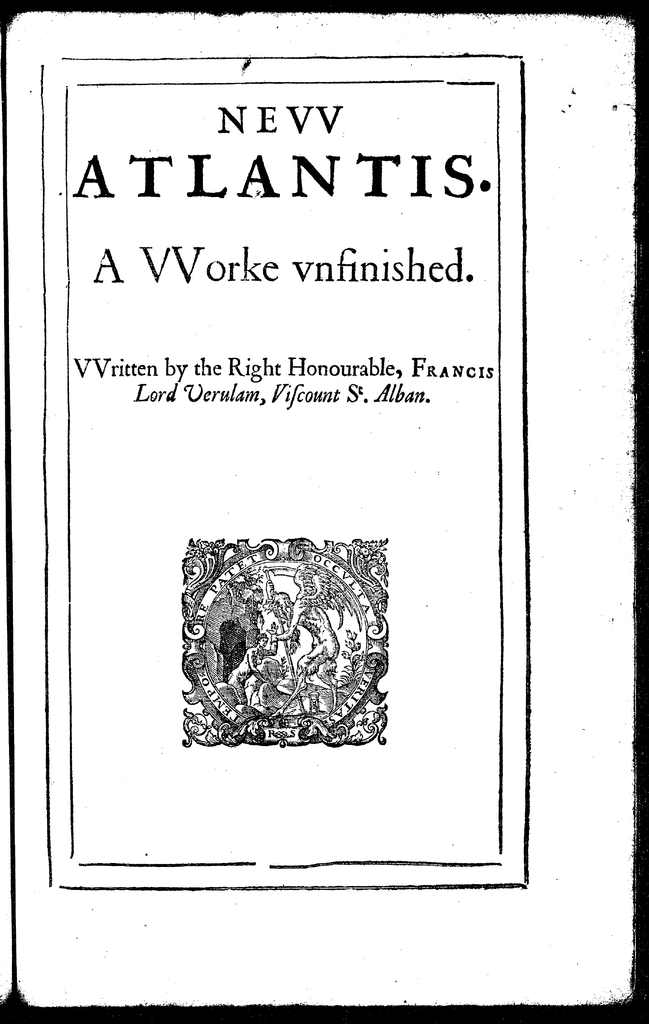
Like More’s Utopia, Bacon’s New Atlantis (1627) is set in the newly discovered world. His Atlantis is an island called Bensalem in the North Pacific, settled by Europeans.  The elite of the island are educated at a scientific academy, ‘the House of Salomon, which is described to the traveller by one of its Fathers. The purpose of the House of Salomon is succinctly explained: ‘The end of our foundation is the knowledge of causes, and secret motions of things; and the enlarging of the bounds of human empire, to the effecting of all things possible’. The discovery of causes and first principles is here linked to the technical imperative of man reinforcing his dominion over nature – ‘the enlarging of the bounds of human empire’. The description of the House of Salomon is a clear and engaging account of the conception of the new, experimental science. Much of its activity is concerned with the study of natural phenomena and their artificial reproduction: for example, meteorological effects, light and life itself are all generated by human means. The division of labour among the Fellows of the House embraces all stages of science: knowledge is gathered from travel, from books and experiment; it is then tabulated and applied. ‘Lastly, we have those that raise the former discoveries by experiments into greater observations, axioms, and aphorism. These we call Interpreters of Nature’. This is what we would call the establishment of first principles. Scientific knowledge is gathered progressively and cumulatively and leads to greater and greater technical dominance by man over his environment. In its emphasis on fabrication, on using artificial means to imitate and improve on raw nature, the New Atlantis looks back to Elizabethan aesthetics; at the same time, its pursuit of knowledge through experiment and hypothesis describes the methodology that would later be institutionalised by the Royal Society, founded in 1660.

The utopias of More and Bacon show a continuing faith in the humanist model of man: properly educated, man can exercise his reason to construct a just and reasonable world; by using his knowledge, he can control his natural environment. The vision is implicitly godless: by their own means, humans can control their own destiny, and need not look to divine salvation to be freed from their limitations. The different visions of More and Bacon are also political statements, in presenting a contrast to real English society and institutions; at the same time, the genre has a built-in scepticism: utopias present some ideal scheme, at the same time reminding us that these exist ‘nowhere’. The possibilities of a brave new world, perfectly organized, and the undermining of this vision by the recognition of human fallibility, is explored dramatically by Shakespeare in The Tempest: here it is Prospero’s magic rather than Baconian science which acts upon the external world, but its motives and results are ambiguous, and the human vices leading to conflict are not clearly reformed. The European vision of utopia is put in the mouth of the counsellor Gonzalo and made to seem both intoxicating and impossible – a theatrical version of the ironic distancing effects achieved by More:

GON:  I’ the commonwealth I would by contraries

Execute all things. For no kind of traffic

Would I admit; no name of magistrate;

Letters should not be known; riches, poverty,

And use of service, none; contract, succession,

Bourn, bound of land, tilth, vineyard, none;

No use of metal, corn, or wine, or oil;

No occupation, all men idle, all;

And women too - but innocent and pure;

No sovereignty -


SEB:    Yet he would be king on’t.


ANT: The latter end of his commonwealth forgets the beginning.


GON:  All things in common nature should produce

Without sweat or endeavour. Treason, felony,

Sword, pike, knife, gun, or need of any engine,

Would I not have; but nature should bring forth,

Of its own kind all foison, all abundance,

To feed my innocent people.


SEB:  No marrying ‘mong his subjects?

ANT:  None, man; all idle: whores and knaves. (II.i. 153-72)


The cross-currents of golden vision and worldly scepticism return us to one of the central tensions in Renaissance thought. Endowed with the faculty of reason and imagination, man can apprehend perfection; yet fallen from grace into vice, humans are ‘whores and knaves’, drawn towards dissension and destruction, their dreams of communist or technical paradises existing only in the mind.

Tuesday, 3 April 2012

The Renaissance: History of an Idea

'The Renaissance' is one of the most frequently used terms in cultural history, but the idea itself has been subject to much examination and discussion. Here is a summary of some of the key points in the debate.


The Idea of Renaissance

Claims that the fourteenth century witnessed some kind of cultural rebirth in Europe go back to the period itself. The Italian poet Petrarch (1307-74) saw the rinascimento as the revival of the values of the classical world, after the barbarian invasion of Rome and the ensuing chaos of the Dark Ages. Petrarch lived in what has been called ‘the calamitous fourteenth century’ - calamities which included, among other things, the Hundred Years War, the ‘Babylonian captivity’ of the papacy in Avignon, and the horrors of the Black Death. Contrasting the glories of ancient Rome with this miserable present, Petrarch divided history into two periods, historiae antiquae, which ended with the ending of the Roman Republic, and historiae novae, from the Roman Imperial period onwards. This was an unorthodox view, as it placed pagans in the period of light and Christians in the darkness. Petrarch yearned for a return to the spirit and letters of ancient Rome. Addressing his own poem Africa (composed 1338) he says:

For you, if you should long outlive me, as my soul hopes and wishes, there is perhaps a better age in store; this slumber of forgetfulness will not last forever. After the darkness has been dispelled, our grandsons will be able to walk back into the pure radiance of the past. (Africa, IX, 453-7)

The achievement of the Florentines in restoring the light was saluted by the (Florentine) humanist Marsilio Ficino (1433-99):

If we are to call any age golden, it is beyond doubt that age which brings forth golden talents in different places. That such is true of this our age [one] will hardly doubt. For this century, like a golden age, has restored to light the liberal arts, which were almost extinct: grammar, poetry, rhetoric, painting, sculpture, architecture, music ...

In his Lives of the Artists (1550), the artist and writer Vasari presented the history of northern Italian art as an upward journey, leading away from the stylized forms of the Middle Ages to the magnificent realistic art of Michelangelo. This journey was led by a series of heroic artists of genius. Through them, as Vasari tells the story, the glories of the ancient world had been reborn.  Such comments are not attempts at objective history. They appear in writings such as letters or manifestos, where poets promote their activities and seek patrons. Vasari’s Lives is also a work of propaganda: it was dedicated to the Grand Duke of Tuscany and thus naturally extols the greatness of that region.

Effusions of enthusiasm such as these are not the same as claims that the age as a whole can be characterised as a rebirth, or re-naissance of ancient thought. The use of the word ‘Renaissance’ as a serious historical term really starts in the nineteenth century. The French historian Michelet famously called the Renaissance a time of ‘the discovery of the world and the discovery of man’. In this period, Michelet points out, man looked outwards at the world around him: he explored in ships, investigated with science, and celebrated natural objects in art. At the same time, people looked inwards at themselves: in the plays of Shakespeare, or the essays of Montaigne, we see an unprecedented representation and examination of individual human consciousness. This thesis was further developed by the Swiss historian Burckhardt in his massively influential The Civilization of the Renaissance in Italy (1860). For Burckhardt, the Renaissance was the birth of the modern age: medieval certainties about man, the world and God faded away, and the modern individual emerged – equipped to enquire and reason, to trade and to express himself through his behaviour and creative work.

            How convincing are these various claims? They have certainly been influential. Petrarch’s picture of a noble classical age, lost in the ‘Middle Ages’ and revived in the rinascimento has ingrained itself in the Western sense of history. Yet there is much to be said against it. Above all, it discounts the cultural achievements of the so-called ‘Middle Ages’. Latin culture could hardly be reborn in Petrarch’s time, since it had never died: Europe is built on the ruins of Rome, and throughout the Middle Ages we see Roman influence: in language, education, customs and the law. At certain points, such as the ‘Carolingian Renaissance’ of the ninth century and the ‘twelfth century Renaissance’ involving scholars like John of Salisbury, classical writings had been intensively studied: indeed, the manuscripts that Petrarch and others were ‘discovering’ were earlier medieval copies, largely owing to scribal activity under Charlemagne. The image of a brilliant rebirth, so persuasively painted by Petrarch and his followers, may be more self-advertisement than historical fact.

            The theses of Michelet and Burckhardt have also been disputed by later writers. Was the Renaissance really the birth of modernity? Medieval practices and beliefs did not disappear but continued throughout the Renaissance period. As for the examination and celebration of the natural world, we can see these clearly in the work of a medieval scholar like Roger Bacon and the poetry of St Francis. Seen in this light, the Renaissance could be seen as a development of the medieval world rather than a departure from it. Perhaps the single greatest invention of the Renaissance - printing - came from the medieval guild system. Equally, Renaissance characteristics can be found in cultural achievements of the eighteenth century and even into the present. At both ends, the chronology is highly problematic.

            In short, while Michelet and Burckhardt draw our attention to important phenomena of the period, they also select out a great deal. Moreover, their books are based on a theory of history that is also controversial: this is the idea - inspired by the German philosopher Hegel - that an age has a Zeitgeist (Spirit of the Age) - an underlying essence or character which unifies its various parts. Moreover, in the Hegelian view, history is teleological: that is to say, it is moving in a certain meaningful direction. This assumption underlies the nineteenth-century historians’ emphasis on the Renaissance as a progression from past to present. This notion, too, which links with the outlook of Vasari and others, is contentious.


For these reasons, some historians and critics have avoided the term ‘Renaissance’, and preferred to employ the label ‘Early Modern’ for broadly the same period. A book like this one could also be called ‘English Reformation Literature’, since the ideas of Reformation theology had at least as much impact on the English in these centuries as the models of classical culture - and possibly more. Nevertheless, the Renaissance is a convenient term for denoting a certain period, and we can use it without committing ourselves to the thesis elaborated by Burckhardt and other historians. A period term may be used for practical convenience; indeed without them, study becomes next to impossible.

            The foregoing discussion is not intended to imply that the writers discussed may be in any way dismissed. Vasari’s Lives is one of the great books of the West. Burckhardt’s book, the result of five tears’ exhaustive travel, reading and note-taking, is still indispensable for the serious student of the Renaissance, precisely because of the discussion it has provoked. And while it has been seriously revised in the light of later scholarship, it has not been comprehensively demolished. Some contemporary writers on the Renaissance still, with various important qualifications, see the period as representing a profoundly significant shift in Western man’s modes of thinking and living. The debate on what we mean by ‘The Renaissance’ is still ongoing.


Further Reading

A classic defence of the label ‘Renaissance’ as applied to Italian art is: Erwin Panofsky, Renaissance and Renascences in Western Art (London: Paladin, 1970), ch. 1 ‘Renaissance – Self-Definition or Self-Deception?’, 1-35.

See also the first two essays in A G Dickens and others, Background to the English Renaissance. Introductory Lectures (London: Gray-Mills, 1974): E H Gombrich, ‘The Renaissance – Period or Movement?’, 9-30; J R Hale, ‘The Renaissance Label’, 31-42.

A modern summary of the debate is given by Margaret L King, The Renaissance in Europe (London: Laurence King, 2003), ‘Introduction: The Idea of the Renaissance’, viii-xv.

'The Renaissance' on In Our Time: excellent discussion by Francis Ames-Lewis, Peter Burke and Evelyn Welch.

Saturday, 31 March 2012

Renaissance Religious Drama

English drama in the Renaissance turned from the sacred to the secular. Over the sixteenth century, medieval religious plays gave way to the worldly subject matter of the Elizabethan and Jacobean stage. This shift is marked by continuity as much as departure, however, and Renaissance drama frequently adopts ideas from late medieval theatre. Under pressures which made the production of religious plays all but impossible, Renaissance dramatists transformed some of the traditional character types and situations of native drama into new secular versions, and thus appealed to an audience whose imagination had been formed by the old mysteries, saint plays and moralities.

Mystery Plays

Before the Reformation, practically all plays in England were explicitly religious. Dramatic performances were overseen by the Church, and their function was to celebrate Christian festivals and instruct audiences about the scriptures and church teachings. The great mystery cycles told the story of Christian history from Creation to Doomsday, the central element of which is man’s relation to God – from the Fall from Grace, to Redemption through the sacrifice of Christ, and finally the attainment of Salvation by repentance and atonement. The mystery plays were performed by amateurs in public spaces in the towns after which the various cycles are named – most famously Chester, York, Wakefield, and Coventry. Having perhaps reached their height in the fourteenth centuries, the mystery cycles continued into the sixteenth century and were still being performed into the life of Shakespeare. But their influence was fading, and the various forces ranged against them makes their eventual extinction seemed inevitable.

These forces were primarily political. When in 1533 Henry VIII broke with Rome and had himself proclaimed supreme governor of the Church in England, plays fell under the jurisdiction of the monarch, not the Pope. Now that religious ideas were politically highly sensitive, it was safer for dramatists to turn to other forms, such as classically based plays. With their close associations with Rome, the mystery plays were naturally objects of suspicion for the authorities. Their colour, festivity and exuberance was at odds with the strand of Protestantism which exhorted the faithful to look beyond the pleasures of the world and contemplate their own imminent mortality, while the story of salvation they told could not be reconciled with the Calvinist creed of predestination. Indeed, the fact that mystery cycles continued to be performed for some decades after the break with Rome is testament to their popularity. In the reign of Elizabeth I, anti-Catholic feelings grew: the activities of the Spanish inquisition in the 1560s, the Catholic rebellion in the north of 1569, the formal excommunication of Elizabeth by the Pope (1570), the St Bartholemew’s Day Massacre (1572) and the formation of the Catholic League (1585) with the express pupose of extinguishing Protestantism in England all fostered a violent anti-Catholic feeling and led to the end of the mystery plays. The Chester cycle ended in 1574 (interestingly, the Mayor was summoned before the Privy Council in 1575 to explain why an illegal performance had been permitted, and pleaded that the citizens had demanded it), York and Wakefield in 1576 and Coventry in 1581.

Besides these changes in the political and religious climate, certain cultural shifts may also have made the mystery plays anomalous. Originally, performances of these dramatisations of the scriptures may well have been more formal and stylised, recognisably linked to the solemn enactment of the liturgy in church. With the rise of humanism and naturalism, however, this formalism and sanctity was eroded by more robust and irreverent characterisation of wicked or minor characters: hence Noah’s wife, the three shepherds before they behold Christ, Cain and Herod all arise as naturally expressive, human types. Such characterisation was incompatible with the more abstract presentation of holiness, and so God and Christ ceased to appear in the dramas, which were perhaps becoming an occasion for popular mirth and festivity rather than a pious contemplation of the great mysteries. This worldliness was echoed in staging which responded to public desire for a gorgeous pageant: individual plays were usually financed by particular guilds, who no doubt competed with each other to put on the most colourful show. Ironically, it is these elements of the mysteries, arguably at odds with their original purpose, which were the most influential on later drama: Shakespeare’s Shylock is recognisably based on the lively devils of earlier mysteries; the provision of an enjoyable spectacle was taken up by the London companies, for whom the wardrobe was the single greatest expenditure. The popularity of the morality play, satisfying a taste for drama as polemic, also contributed to the demise of biblical drama. Finally, the dominance of the professional London-based companies over taste and repertoire can only have hastened the demise of the provincial, amateur theatre represented by the mysteries.

Morality Plays

Like the mysteries, morality plays instructed their mainly illiterate audience through theatrical entertainment. But while mystery and miracle plays dramatize stories from the Bible and the lives of the saints, morality plays deal with the struggle between vices and virtues for the soul of man – a drama of internal spiritual struggle known as psychomachia. In this way conceptual issues could be made concrete and memorable. Moralities are essentially dramatized sermons, and their characters are personified abstractions representing such things as Charity, Pride, Wealth, Death, Humility and so forth. Their stories are not related to any specific days in the Church calendar, and  could thus be performed at any time. As in the mystery and miracle dramas, performers were often amateurs from the guilds, playing to popular audiences in yards, guildhalls and other extempore settings.

About thirty morality plays survive. From the fifteenth century among the best known are The Castle of Perseverance (c.1415), in which the soul is a castle besieged by the forces of the devil, Mankind and Everyman (c.1495). The genre continued into the sixteenth century, often taking on clear political resonances. In Skelton’s Magnifycence (c.1515) ‘a prince of great might’ (Magnificence) dismisses Measure and is led astray by Vices (including Counterfeit Countenance and Cloaked Collusion), before being rescued and returned to greatness by Charity, Good Hope and Perseverance. The play is a clear satirical attack on Cardinal Wolsey and his lavish spending habits. John Bale’s King Johan (1539) took the morality form even further by having named characters: his protagonist is the historical King John, who struggles to save Widow England and her son blind Commonalty from Sedition and the Roman Catholic Church. John is beset by Vices who are also personally identified: Usurped Power (the Pope), Sedition (Archbishop Stephen Langton), and Private Wealth (Cardinal Pandolpho). A parallel is intended with Henry VIII’s own contest with the Papacy. Unattractive propaganda though it is,  King Johan is the first play to make use of themes from English history, and thus represents a link between medieval abstract moralities and the later history plays of Marlowe and Shakespeare.

In the court of Henry VIII the morality play effectively merges with the Interlude. Examples of ‘moral interludes’ include the anonymous Hickscorner (c.1513) and Wever’s Lusty Juventus (c.1510). Moral interludes include individuals as well as allegorical types among the characters, and depict the Vices in increasingly comic terms: Pride, Gluttony and Self-Love are characterised as clowns and buffoons. The rise of the Vice to star performer is attested in other ways: while morality plays usually involve a lot of doubling of parts, the Vice was played by only one actor, who would be the most accomplished player. The actor playing the Vice also collected money from spectators at halls and innyards: it was his performance that drew in the crowds and the money. Unsurprisingly, it is the figure of the Vice whonis most readily recognisable in later Renaissance drama: examples are the servant Miles, who rides on the devil’s back in Robert Greene’s Friar Bacon and Friar Bungay (1594), the main character the Jew Barabas in Marlowe’s The Jew of Malta (c.1589) and Wagenr in Dr Faustus (c.1588). The latter play also shows the influence of the old moralities in the debates of the Good and Bad Angels and the presentation of the seven deadly sins. Various Shakespearean characters can also be traced back to the anarchic morality Vice: Hal refers to Falstaff as ‘that reverend Vice, that grey Iniquity’ (1 Henry IV, 2.5.413); Richard III declares ‘Thus, like the formal vice Iniquity, / I moralize two meanings in one word’ (3.1.82); and Hamlet refers to his uncle Claudius as ‘a vice of kings’ (3.4.88). In Shakespeare echoes of the morality vice range from the childlike Puck in A Midsummer Night’s Dream to Othello’s tormentor, the villainous Iago and to the scheming and vengeful Edmund in King Lear. In such characters Shakespeare picks up on and develops possibilities latent in the simple morality dramas: the contending feelings of attraction and repulsion that the Vice induces in us, the mixture villains can present of attractive qualities (cleverness, observation, humour, realism) with depraved moral intentions, and the spectrum of human wrongdoing, from playful mischief  to utter malevolence.

Besides the figure of the Vice, combining laughter with literally devilish action, morality plays influenced later Renaissance drama in other ways.  They establish the idea of psychomachia as the central action. From Marlowe’s Faustus to Shakespeare’s Macbeth and Hamlet, it is this dramatic conflict within the main character that is the focus of the drama. Morality plays and interludes also incorporate topical material concerning government and social order as subjects for drama. Hamlet’s description of players as ‘the abstract [summing-up] and brief chronicles of the time’ (2.2.481) could be used of earlier plays such as Skelton’s that used the morality form as a device to comment on contemporary matters. The earlier dramas also employed stage conventions that lived on in the scenes and gestures of later works. Powerful scenarios such as that of Edgar, disguised as the beggar Poor Tom, leading his blinded father Gloucester in King Lear must have awakened memories of personifications of Mankind and the virtuous agents that seek to help him in distress. Some scenes, such as the knocking at the door of the castle in Macbeth after Duncan’s murder look even further back: in this case, there is a clear allusion to the mystery plays showing the Harrowing of Hell – the scene in which Christ after his crucifixion visits hell with St Michael to save the souls of those in purgatory, terrifying the devils within.


Protestant Drama

Some writers in the earlier part of our period used the form of medieval religious dramas as a vehicle for Protestant propaganda. John Bale (1495-1563), an ex-Carmelite monk turned zealous Protestant, wrote several plays (all c.1538-40) violently attacking Catholicism. God’s Promises is a Protestant mystery cycle, comprising seven scenes in which biblical figures obtain a renewal of the covenant from God. The flavour of Three Laws is suggested by stage directions stipulating that Sodomy should appear dressed as a monk, Ambition as a bishop, and Hypocrisy as a Greyfriar. King Johan energetically cheers on Henry VIII’s battle with the papacy. These works found little official favour, however, and on the fall of his patron Thomas Cromwell, Bale was forced to flee the country. Religious polemic on stage was perceived as dangerous: it threatened to undermine the control of religious thought by the authorities, and could moreover lead to public affray. Such presumably were the motives behind the 1543 Act banning ‘interpretations of Scripture ... contrary to the doctrine set forth, or to be set forth, by the King’s Majesty.’ In the reign of Edward VI (1547-1553) the state turned more decisively to Calvinist Protestantism and the influence of this theology can be found in some plays. Jacob and Esau (c.1557), possibly by Nicholas Udall, clearly presents the Calvinist doctrine of predestination. In the Prologue we are told that ‘Jacob was chosen and Esau reprobate’ and Isaac says in prayer to God: ‘Of thy iustice, whom it pleaseth thee, thou doest reiect, / Of thy mercy, whom [it] pleaseth thee, thou doest electe’ (ll.1473-4). Scholars have debated how closely the theology of the play conforms to Calvinism, but the general presence of the central idea is clear, as it is in A new enterlude ... of the life and repentaunce of Marie Magdalene (printed 1566) by Lewis Wager. In this Protestant adaptation of the Catholic saint play, Mary Magdalene is saved despite her depraved past because she is elect. The utter despair of discovering that the route to salvation is closed is dramatized in The Conflict of Conscience (c.1580) by Nathaniel Woodes, in which the hero Philologus realizes that he is not elect. Theological differences over the doctrine of predestination can be found in the texts of Marlowe’s Doctor Faustus (both of these appeared after his death, and incorporate material clearly added later, so neither is a secure guide to the first performance): in the A Text (1604) the Good Angel says ‘Never too late, if Faustus can repent’. In Calvinist terms, the reprobate, or unelected, is unable to repent because God witholds the grace needed for this – Claudius’s inability to repent although he wishes to (Hamlet, 3.3.36-72) may similarly indicate his predestined damnation. The B Text of Faustus (1616) changes ‘can repent’ to ‘will repent’, with the implication  that repentance lies in the will of Faustus: his faith rests with him and is not predetermined.

Doctor Faustus (c.1588) was the last overtly religious play to appear on the Renaissance stage. Acting companies and their managers must have felt that treatment of doctrine was simply too dangerous for the public stage. The Old Testament, in particular the Apocrypha, provided safely uncontroversial material for some plays (Thomas Garter, Godly Susannah (1568); George Peele, The Love of King David and Fair Bathsheba (1594)), and the histories of Josephus furnished the source for Lady Elizabeth Carew’s Mariana, the Fair Queen of Jewry (1613). But religious drama effectively disappeared from the stage. Milton’s Samson Agonistes (1671) is a closet drama, intended for private reading, not public performance.  But the absence of religious subject matter should not lead us into supposing that religious preoccupations disappeared from the theatrical imagination. Clearly they did not: damnation, repentance and the old Catholic concept of purgatory are openly referred to in Macbeth and Hamlet, the battles of vice and virtue are played out in Jonson’s Volpone and The Alchemist, doting idolatry is transmuted into comedy in A Midsumer Night’s Dream, Puritans are satirized, and the inner life of moral decision and spiritual feeling is an essential element of Renaissance drama. While doctrine and dogma cannot be explicitly mentioned in these plays, they unmistakably present to us the spectacle of man as a religious animal.


Thursday, 29 March 2012

Renaissance Political Philosophy

Renaissance art and literature often shows a deep interest in politics, the arrangement of human society. Many of Shakespeare's plays, for example, investigate ways of managing and mismanaging states, and the consequences of decisions made at the top. This is most obviously the case with the History Plays, but it is also at the centre of the tragedies (King Lear begins with the disastrously bad idea of fragmenting a state) and even a romance like The Tempest, where the island setting works as a commentary on the ordering of a commonwealth and the duties of a ruler. The note below on political philosophies in the early modern period may, I hope, give a helpful idea of the main ideas in circulation.


The sixteenth and seventeenth centuries saw the rise of the modern state. The general model was that of authoritarian monarchies ruling over extended territories, protected by permanent armies. These armies had to be funded from taxes, which in turn necessitated a central bureaucracy. This arrangement in turn required some theoretical justification, which was provided by writings on forms of government, which we would now call political philosophy. In the Tudor period, some of these were in the medieval tradition of Advice to Princes: the deeds of great men of the past were held up as case studies, and princes were encouraged to practise the Christian virtues of  Faith, Hope, Charity, Temperance, Fortitude, Prudence and Justice. In addition were the princely virtues of liberality, magnificence, clemency, honour and the keeping of good faith. In English the Mirror for Magistrates (first published 1559), a collection initially of nineteen English poems by various hands, had this purpose: the falls of great men of the past are held up for examination (typically, these leaders are ghosts examining themselves in a mirror) so that present-day magistrates can learn from the errors of their forebears.  Plutarch’s Lives, in the 1579 translation of Sir Thomas North (1535-c.1601), similarly used biography as a way of inculcating moral awareness, especially in those of positions of power.

Narratives with a moral purpose did not, though, study the workings of the state as a whole. Interest in this subject was induced by the real changes in political organisation of the time, and by the study of ancient texts. For Italian humanists such as Leonardo Bruni (1370-1444) and Coluccio Salutati (1331-1406), the writings of the ancients provided a model of how the public realm might be organised. These writings might take the form of treatises, like Plato’s Republic and Laws, which theorised about the organisation of the realm, or histories like Livy’s, which described states in action. Underlying the ‘civic humanism’ which applied ancient writings to present political realities was a powerful belief in the capacities of human will and reason. Through these, man can improve his condition; by the right exercise of reason, humans can amend imperfections such as injustice and inequality, and strive for a perfect polity in this life. Like the medieval books of advice to princes, the humanist belief in a better future modelled on the wisdom of antiquity posited humans as perfectible creatures, designed to use reason to serve their higher needs and capable of moral improvement. Plato, Aristotle, and St Thomas all hold that the good functioning of the state depends on the virtues of governors and citizens: to be virtuous is to be honest, sincere, just and pious; and man, as a rational creature, can be educated to put the general good before his own. Such sentiments perhaps found their purest expression in the genre of the utopia. Their idealism was countered, however, by the realism of the two most important theorists of politics of the sixteenth century, Niccolò Machiavelli (1469-1527) and Jean Bodin (1530-1596).

Machiavelli’s short book The Prince (1513) had a powerful and lasting impact. It was written in exile, as the author, an experienced diplomat who had served at the courts of France and Rome, had been deposed from his post in the Chancellery of Florence in 1512. Machiavelli contemplated the birth of the modern state - the word replaces res publica in the first page of The Prince – which had left the Italian peninsula behind. Power lay with the big nation states such as France and Spain (and, increasingly, England) while Italy (which was not a nation state until the nineteenth century) was a conglomeration of fundamentally weak small states, squabbled over by the larger powers of France and the Holy Roman Empire. Although immersed in humanist culture, with a deep knowledge of Cicero, Boethius, Seneca and Livy, Machiavelli did not share the Humanist faith in the innate goodness of man, which will ensure the eventual triumph of virtue. For him, experience shows that a ruler following moral precepts, such as those espoused in books of Advice to Princes, would only achieve disaster. In The Prince, Machiavelli sets out to answer the question: what is the best way to organize a cohesive and permanent state, and thereby best ensure for its citizens some degree of liberty and security? The task of the book is to provide a practical answer to this question, not a theoretical ideal one in the tradition of Plato.

In Machiavelli’s project, experience is to be taken as the guide. A knowledge of history and attentive observation of human affairs are fundamental necessities, and reflection on them will yield reliable maxims. One such reflection is that man is not a rational creature, designed to do good and live well. Experience tells us that man is perfidious: he can be wicked and envious, and the best response to that is not to attempt to reform him by an idealist education but to manage him appropriately and form the state on the realistic basis of how humans actually are, not how we would like them to be. Machiavelli’s doctrine of the reason of state holds that all means necessary must be employed to establish a powerful state in the collective interest; since humans are essentially selfish, they will pursue their own needs rather than the general wellbeing, and so must be compelled, by whatever means, to do the right thing. In the course of pursuing the greater good building the commonweal, the Prince is justified in doing wrong, including acts of violence and terror. For Machiavelli, virtù is not an abstract list of moral principles but the excellence particular to the ruler - that is, his success in achieving the intended goal. Hence the doctrine that ‘the end justifies the means’.

The type of state that will best ensure the collective good is a secondary concern. In The Prince Machiavelli argues for a principality. In the Discourses on Livy (1513), he praises the Roman republic (a republic being a commonwealth where power is distributed and not invested in one single leader). The overriding concern is the primacy of the collective over the individual good. A good republic makes the power of the state superior to that of factions; its leader - whose individual power will be limited by the constitution - will strengthen the state, for example through laws imposing conformity on the multitude: religion can explicitly be used for this end. A republic can draw on the best elements of monarchy, aristocracy and democracy to achieve the best possible balance between nobility and the people. In both The Prince and the Discourses, Machiavelli refuses to idealize human nature. His aim is to find the best possible system of government on the basis of what we know humans to be like. His method of obtaining general precepts from observation has led to him being considered the founder of politics as an empirical science. The Prince was not published in England until 1640, but it was well known to writers before that. In several sixteenth-century writings, ‘Machiavel’ is the diabolical bogeyman ‘old Nick’: this is the figure we see in the character of Lorenzo in Kyd’s Spanish Tragedy and as the Prologue to Marlowe’s Jew of Malta.  These characterisations owe much to French anti-Florentine propaganda, and to post-Reformation hostility to Italian states in England itself. They certainly do not indicate a general refutation in England of Machiavelli’s picture of human nature, which must have been confirmed by ordinary experience. A Machiavellian concern with the real behaviour of flawed humans in distant and recent history can be seen in works like Marlowe’s The Massacre at Paris and Tamburlaine, in Shakespeare’s Henry VI plays and Jonson’s Sejanus. Bacon wrote: ‘We are much beholden to Machiavel and others, that write what men do and not what they ought to do’ (Anatomy of Learning (1605), II.xxii.9).

As we have seen, Machiavelli drew on history as the best introduction to politics, a method he continued in his history of Florence (1525). The same approach was taken by the French writer Jean Bodin (1530-1596), in his Methodus ad facilem historiarum cognitionem (Method for the Easy Understanding of History, 1566). Like Machiavelli, Bodin was concerned with real events rather than ideal concepts: in this book his interests include the effects of geography on different peoples, the way a state functions as an institution, and how international relations may be influenced by economic factors. Bodin’s interest in inflation gives him some claim to be the founder of the science of political economy. His most sustained study of statecraft is the Six Livres de la République (1576), published ten years later in an extended Latin version.  This work is an extended justification of absolutism. It was based on the observation of the bloody conflict between the Huguenots (French Protestants) and the Catholic League, which had caused appalling misery to the French people. Bodin saw the monarch as a necessary balancing figure, beyond parties and sects: absolutism was the best defence against anarchy and civil strife, and the security it brought was the precondition for tolerance, an ideal which Bodin promoted. Just as a family needs a paterfamilias, Bodin argued, a state naturally requires a supreme authority: this sovereignty, however, is a concept, not a person. It is ‘the supreme power over citizens and subjects, not limited by the law’ (I.8), since it is itself the law-maker. Sovereignty might lie with the person of the monarch, but it can equally well lie with an assembly: its chief responsibilities are to create judges, legislate and declare war; it is inalienable and indivisible, though it can delegate certain executive functions. How sovereignty is to be acquired, and whether power gained through violence itself legitimises the governing authority remain obscure points. But the main message of the work, in contrast to certain elements of Platonic philosophy and the utopian communism described by More, is that absolute power is the most natural defence of civil peace.

It will be noted that neither Machiavelli nor Bodin were arguing for anything resembling democracy. Such suffrage as existed, such as in the Republican government of Florence in the fifteenth century, was inevitably controlled by a few powerful families such as the Medici. The argument that the forceful exercise of power by the sovereign over the whole state was the best available form of government is echoed in the numerous books on government of the period. Many of these are in Latin, such as John Case’s Sphaera Civitatis (1588), a commentary on Aristotle’s Politics which recommends the perfect monarch as the ideal form of government. In English, Part I of Sir Thomas Elyot’s The Boke Named the Governour (1531) accepts that society is a hierarchical pyramid, with a single ruler at the top. Monarchy is described as the most natural and best form of government, and its divine sanction is clearly shown in the Bible. In the seventeenth century, absolutism was once again recommended by Thomas Hobbes in Leviathan (1648). The natural state of things is one of ‘war of all against all’ as individuals struggle to meet their basic needs. Life in this natural state is ‘solitary, poor, nasty, brutish, and short’ (xiii). In order to live as a community, individuals need to give authority to a sovereign authority, preferably a monarch. This is the beginnings of social contract theory: individuals resign many of their freedoms to an authority, which in turn protects them as a collective body. Social contract theory was further developed by John Locke (1632-1704) in Two Treatises on Government (1690), and, later, by Rousseau.

Political ideas are particularly liable to be diminished by summary: to reduce Machiavelli to the quote ‘the end justifies the means’ or Hobbes to ‘nature is red in tooth and claw’ is to turn a rich and organic process of thought into a single glib formulation. The books of Machiavelli, Elyot and Hobbes all reward study not as background to literature but as literary texts in themselves, making subtle and expressive use of language through the stylistic and logical devices of rhetoric and logical argument. In texts more usually studied in literature courses, the forms of government and their flaws are a frequent theme: Shakespeare’s Roman plays investigate and dramatise the use, misuse and varied distribution of power. They certainly do not advocate popular rule, whatever the vices of rulers: a classless and democratic society was unthinkable as a practical option, except in the fantastic world of utopias, and we should beware of hopefully making the values of Renaissance texts correspond to our own. It can be helpful to remember that the Renaissance was haunted by the threat of civil war: the Wars of the Roses – described in Samuel Daniel’s long poem The Civil Wars (1609), among other works - were not a distant memory in England; and the Thirty Years war and wars of religion in France of the sixteenth century were a reminder of the calamities ensuing on the absence of a central authority. Shakespeare’s Henry IV plays paint a vivid picture of the miseries of internecine struggle: ‘No more the thirsty entrance of this soil / Shall daub her lips with her own children’s blood’ (H41, I.i., 5-6). In his epic Pharsalia, on the civil war between Julius Caesar and Pompey, the Roman poet Lucan (39-65 AD) inspired numerous seventeenth-century writers, and Hobbes’s advocacy of absolutism was a response to the travails of England’s own civil wars. While Milton’s defence of regicide (The Tenure of Kings and Magistrates, 1649) seems to have had little influence beyond the Commonwealth period, a lasting strand of republican thought has been traced in England by the scholar David Norbrook.  Political ideas were in any event central to literary activity in the Renaissance; and politically intended critical enquiries, such as those pursued by cultural materialism remind us that the poetic and the political are inseparable.


Further Reading
Machiavelli, The Prince
Andrew Edward, Jean Bodin on Sovereignty, Republics of Letters
Mikael Hornqvist, 'Renaissance Political Philosophy', from The Oxford Handbook of the History of Political Philosophy (2011).

David Norbrook, Writing the English Republic (Cambridge: CUP, 1999). Quentin Skinner: The Foundations of Modern Political Thought, 2 vols. (Cambridge: CUP, 1978). Vol1, The Renaissance; Vol 2, The Age of Reformation. Machiavelli: A Very Short Introduction (Oxford UP, 1981).