 I'm delighted to be involved in this short guide to reading poetry. It was quite a collaborative effort. I was able to draw on excellent work by Andrew Hodgson, the thoughts of Caroline Moore, and the editorial work of Jon Connell. The result is intended to be accessible for readers from 13 upwards. It's published simultaneously with the snappy, sensible guide How to Write Well by journalist Tim de Lisle. Connell Guides aim to help those facing exams, but to go well beyond exam mentality. If this helps readers young or old find or refresh their confidence and pleasure in poetry, then it will have done its job.
Showing posts with label Poetry. Show all posts
Showing posts with label Poetry. Show all posts
Sunday, 4 June 2017
How to Read a Poem
I'm delighted to be involved in this short guide to reading poetry. It was quite a collaborative effort. I was able to draw on excellent work by Andrew Hodgson, the thoughts of Caroline Moore, and the editorial work of Jon Connell. The result is intended to be accessible for readers from 13 upwards. It's published simultaneously with the snappy, sensible guide How to Write Well by journalist Tim de Lisle. Connell Guides aim to help those facing exams, but to go well beyond exam mentality. If this helps readers young or old find or refresh their confidence and pleasure in poetry, then it will have done its job.Thursday, 10 April 2014
John Berkavitch, Shame
 Spoken-word performance events - poetry slams, hip-hop recitations - are big at the moment, at any rate in the uncloistered urban scene. There's a great scene in Bad Education where the wannabe trendy head takes some pupils to a basement rap contest and excitedly joins in to general agony. Well, that's me in a few months, I'm sure. I'm a neophyte in such matters, but the name of Kate Tempest is known to me, and the text of Brand New Ancients and the YouTube trailer for me have left me hungry for more. John Berkavitch until two days ago was another name off my radar. I went to his Shame performance at Winchester on the strength of a twitter 'Don't miss' recommendation, written by someone who then didn't turn up himself. Perhaps that is the way of things these days.
Shame began - after a brief warm-up act - with an invitation to audience members to speak in public about their most shameful experiences. After the awkward silence thus created, Berkavitch launched into his piece, a series of interlocking autobiographical episodes of cowardice, selfishness, and humiliation. Three breakdancers accompanied him in various physical theatre configurations and provided short interludes of dance moves. A backing track provided musical atmosphere without being intrusive, and there was a programme of lighting and projections provided by a simple set of projectors around the performance area. With no technician in sight, the performance must have been synchronised exactly with this scheme (which makes one wonder what would have happened if an audience member had indeed volunteered a lengthy confessional speech, or the repartee had gone on longer than expected).
I found my attention engaged throughout: variations in the types of story and age perspectives involved provided variety under the overall thematic heading. There was a great deal more humour than the publicity material would lead one to expect, which made me reflect on how much comedy is indeed based on addressing our fears of disgrace. Visually I thought the physical side worked very well, conjuring up scenarios without overdoing things: I liked the coffee machine (though couldn't see the point of these café interludes) and the bike, in particular. The miming of things like tight suits and a young boy's anger was subtle and delightful. There must have been a great deal of technical preparation involved, yet the piece felt fresh and spontaneous. There seemed to be a mismatch between the realistic, often mundane, text and the heightened language of the visuals; I'd expected something more trance-like or hypnotically rhythmic in line with my unformed ideas about what hip-hop poetry might be. A small audience made me embarrassed about Winchester's provincial indifference to experimental work, but then again there was a kind of club feeling between us which helped with the intimate feel of the work. And while I enjoyed - if that is the word - the stories, I didn't feel the show did anything with the idea of shame or really explored how it informs and shapes us, besides recycling examples of it. No one took up the renewed invitation at the end to share embarrassing scenes from their life with the others, but I left feeling that spoken word events, with exciting stage movement and lighting and projection designs like this, are something we should be looking into imitating at school level. Theatre has a valuable role as a forum in which we can confront and work through matters that are important and difficult on a personal level. Reverence for the canon, after all, soon becomes an easy excuse for not thinking or creating anything new, a way of hiding from oneself under the excuse of culture.
Monday, 31 March 2014
Blood Wedding
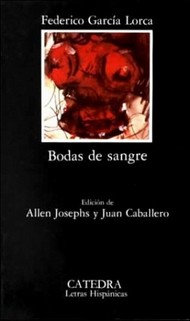 Drama on 3 recently broadcast Lorca's rural trilogy (Yerma, The House of Bernarda Alba, Blood Wedding). I was only able to catch Blood Wedding, in Ted Hughes's version, first broadcast in 2008. I think the first encounter I had with Bodas de Sangre was the opera by Nicola LeFanu, which Rosie Williams led a trip to all the way back in 1992 (my wife and I still merrily sing the first jolting line, 'Give me the knife' to each other, at appropriate moments). Reading the original later brought home to me Lorca's absolutely precise theatrical language: symbolic colours, in both scenery and language, the brusque and controlled rhythms of the writing, the purity of the whole conception. Lorca was not a poet who did occasional theatre. He was a prolific playwright, saturated in the repertoire, and a founder member of a company, La Barraca, which took Spanish classics to remote places. In Bodas de Sangre, the sense of the visual and physical is as strong as the verbal - with a radio play, the imagination becomes the designer, conjuring sun-drenched plains and moonlit forests at the prompting of the words.
Now that we're so familiar with TV realism, these symbolist works of nearly a century ago have a peculiar freshness. Hughes's account is surely right to lift the work beyond Spain (where a real event in Almeria inspired it) to a universal plane: feuds, love, the battle between passion and social pressures are, after all, part of the human experience from Andalucía to the Andes and beyond. The northern accents of the radio version fell nicely into place. Every time I experience it, the opening out into the dream world after the lovers flee seems magical: the voices of Death and the Moon, the shimmering imagery, the homing in of the inevitable and tragic conclusion. There are various complete versions in Spanish on YouTube, including a 1938 film and Carlos Saura's. Indeed, YT seems very rich in complete Lorca plays in general. In these days of gender transfer, I can't help feeling an all-male Bernarda Alba could have real force if done completely straight. Has anyone ever tried it?
Tuesday, 16 July 2013
The Petrarchan Sonnet
Here's a brief guide to the form of sonnet known as the Petrarchan. Of interest, perhaps, to students of poetry and the general reader.
Like many poetic forms and terms, the sonnet is Italian in origin. It was used by the fourteenth-century Italian poet Petrarch (1304-74), and introduced to England in the sixteenth century by the poets Sir Thomas Wyatt (1503-42)and Surrey (full name Henry Howard, Earl of Surrey, ?1517-47). They made translations of Petrarch and wrote English sonnets which employed his rhyme scheme.
9. ____________ c
10. ___________ d
11. ___________ c
12. ___________ d
13. ___________ c
14. ___________ d
Like many poetic forms and terms, the sonnet is Italian in origin. It was used by the fourteenth-century Italian poet Petrarch (1304-74), and introduced to England in the sixteenth century by the poets Sir Thomas Wyatt (1503-42)and Surrey (full name Henry Howard, Earl of Surrey, ?1517-47). They made translations of Petrarch and wrote English sonnets which employed his rhyme scheme.
Basic form
The basic shape of the Petrarchan sonnet is 8 lines (the octave or octet) + 6 lines (the sestet).
The octave is composed of two quatrains,
closely linked by just two rhyme sounds: abbaabba.
The sestet has various rhyme forms, using either two or three rhyme sounds: cdcdcd, cde cde etc. Many variations are permitted, but the
sonnet should not end with a couplet. The English iambic pentameter line is the standard
metre. In graphic form, here is the rhyme scheme of a sonnet divided into octave and a sestet, the setet itself divided into two tercets liniked by rhyme.
- ___________ a
- ___________ b
- ___________ b
- ___________ a
- ___________ a
- ___________ b
- ___________ b
- ___________ a
10. ___________ d
11. ___________ c
12. ___________ d
13. ___________ c
14. ___________ d
One thing to look out for in a sonnet is the turn (Italian volta), the point between the octave and sestet, where the sonnet
moves from one rhyme group to another.
With the change in rhyme scheme may come a change in subject matter.
So in the second, shorter half, the poet may change register, comment on
the first half (perhaps presenting it as an analogy), answer it, resolve its
tensions or heighten them, or reverse
the feeling altogether, among many other strategies.
A sonnet is a little too long for simple lyrical expression,
but too short to tell a complex narrative. It therefore suits short argument, and the representation of an
internal mental / emotional experience, often involving conflicting
feelings. This figuring of an internal
passage of thought invites metaphorical
language. Originally, the predominant theme was love, with the Petrarchan lover in joy and agony,
burning and freezing at the sight of his beautiful / remote beloved. Wyatt and
Surrey were courtly poets, writing
about the delicate sensitivities of the courtly
lover. Later writers have adopted the form for a wide range of subjects.
Rhyming is harder in English than Italian, so the form also represents a
formidable technical challenge to the poet. The discipline of the form seems to
be an effective way of presenting strong emotional content.
Here are some examples of English sonnets using the
Petrarchan form.
Wyatt
The long
love that in my heart doth harbor
And in
mine heart doth keep his residence,
Into my
face presseth with bold pretense,
And there
campeth, displaying his banner.
She that
me learneth to love and to suffer,
And wills
that my trust and lust's negligence
Be reined
by reason, shame, and reverence,
With his
hardiness taketh displeasure.
Wherewith
love to the heart's forest he fleeth,
Leaving
his enterprise with pain and cry,
And there
him hideth and not appeareth.
What may
I do when my master feareth
But in
the field with him to live and die?
For good
is the life ending faithfully.
Let's look at this without reference to the Italian model. It stands or falls as a poem in English, after all. I like the way it gets on with telling its story straightaway. Each line in the first quatrain tells us about a new event, an internal experience figured in imagery. 'Long love' - the length is felt through the double stress, which lengthens the vowels and gives the liquid 'l' sound its full value ('l' does seem to have an erotic feel to it: the lovely long-legged lady whiplash; Nabokov comments on this at the start of Lolita). The poet / lover is talking about love felt for a long time, and along with this temporal sense we get a spatial one: we see a long ship in harbour (inactive, frustrated). Like a royal visitor, Love takes up residence in the heart, which we might see in line 2 as a country house (nobles were supposed to keep these vast houses just in case the monarch decided to honour them by living there with the attendant swarm of court locusts; is there a passing echo of a castle keep?). But then, in lines three to four, something happens. Bored of harbouring and residing - a passive, skulking state - Love announces himself. He presses into the lover's face: he must have made some sign (A smile? A blush? A leer? Can I buy you a drink?) to the Lady. Love is out in the open, exposed, displaying his banner like an army in its camp.
Huge faux pas! The second quatrain looks at the Lady's reaction to this boldness. She's not pleased. He should have been a proper English gentleman, reserved and repressed. She has been teaching him to love in painful discretion ('to love and to suffer') int he best traditions of courtly love, where love is a debilitating illness which can drive you crazy. The phrase 'trust and lust's negligence' doesn't quite work for me: the double rhyme is an awkward jingle, and I can see how he has neglected his 'trust' (she trusted him to keep quiet), but not his lust, whatever sense of 'lust' we take (at that time it could mean vigorous and healthy). Maybe the 'r' allteration is a little overdone, too. But the great debate with Wyatt is how much this rough metre and sound is deliberate, and how much a sign of apprenticeship. we've seen how he departs from iambic opentameter right at the start with 'The long love', and the jingly-jangly sound of these lines could possibly convey some of the nervousness of the lover. We notice, anyway, that the second quatrain, like the first, is a complete sentence; but while the first quatrain had a fresh clause in each line, each with its precise verb (harbour ... keep), this has just one. The whole construction builds to that tremendous disapproval: 'taketh displeasure'.
We're now at the volta, the turning point between the octave and the sestet, and sure enough we get a dramatic development. Love, abashed at the beloved's displeasure, flees 'into the heart's forest' (giving us the millionth pun on heart and 'hart' (deer), the Elizabethan equivalent of rhyming 'love' and 'stars above'). It's a remarkable figuring forth of an internal seizure, the actual experience of turning inwards in shame. (And it reminds me of an episode of The Simpsons, in which Lisa disappoints a suitor on camera: 'Freeze it there,' says Bart. 'You can see the exact moment when his heart breaks!'). 'Pain and cry' is the image of the internal wound, the freeze frame instant where the lover gives up. Wyatt has a cdccdd rhyme going on here, making the sestet a compact merging of triple rhymes. In the last lines Love transmutes again (Love has been a ship, a royal visitor, a herald or king displaying his banner, a hunted quarry), this time into a master whom the lover, faithful servant, must follow even unto death, as Kent follows Lear. The Lover is loyal, and with this stoical virtue, huddled under the bedclothes, a pitiful wreck, he leaves us. The poem is an elaborate game of codes, all based on the court: the visitation, battle campaigns, the accepted code of practice of courtly love, the hunt, the duty of service. All translated into the poetic code of the sonnet, which puts it all togetehr in a little drama of love and rejection. What is remarkable is that through all the elaborateness, the rhymes and alliterations and witty double senses, we do feel something real going on: the poem gets at the psychology of love in a way that reaches beyond the Renaissance community of understanding: love can take over us, be a bore even. It can be martial and predatory - a ship, a herald of war - but it can be awfully embarrassing, too, and, when dismissed, takes us over in self-pity and absurd self-dramatisation. The artifice of the sonnet is a gateway to the genuine.
Let's look at this without reference to the Italian model. It stands or falls as a poem in English, after all. I like the way it gets on with telling its story straightaway. Each line in the first quatrain tells us about a new event, an internal experience figured in imagery. 'Long love' - the length is felt through the double stress, which lengthens the vowels and gives the liquid 'l' sound its full value ('l' does seem to have an erotic feel to it: the lovely long-legged lady whiplash; Nabokov comments on this at the start of Lolita). The poet / lover is talking about love felt for a long time, and along with this temporal sense we get a spatial one: we see a long ship in harbour (inactive, frustrated). Like a royal visitor, Love takes up residence in the heart, which we might see in line 2 as a country house (nobles were supposed to keep these vast houses just in case the monarch decided to honour them by living there with the attendant swarm of court locusts; is there a passing echo of a castle keep?). But then, in lines three to four, something happens. Bored of harbouring and residing - a passive, skulking state - Love announces himself. He presses into the lover's face: he must have made some sign (A smile? A blush? A leer? Can I buy you a drink?) to the Lady. Love is out in the open, exposed, displaying his banner like an army in its camp.
Huge faux pas! The second quatrain looks at the Lady's reaction to this boldness. She's not pleased. He should have been a proper English gentleman, reserved and repressed. She has been teaching him to love in painful discretion ('to love and to suffer') int he best traditions of courtly love, where love is a debilitating illness which can drive you crazy. The phrase 'trust and lust's negligence' doesn't quite work for me: the double rhyme is an awkward jingle, and I can see how he has neglected his 'trust' (she trusted him to keep quiet), but not his lust, whatever sense of 'lust' we take (at that time it could mean vigorous and healthy). Maybe the 'r' allteration is a little overdone, too. But the great debate with Wyatt is how much this rough metre and sound is deliberate, and how much a sign of apprenticeship. we've seen how he departs from iambic opentameter right at the start with 'The long love', and the jingly-jangly sound of these lines could possibly convey some of the nervousness of the lover. We notice, anyway, that the second quatrain, like the first, is a complete sentence; but while the first quatrain had a fresh clause in each line, each with its precise verb (harbour ... keep), this has just one. The whole construction builds to that tremendous disapproval: 'taketh displeasure'.
We're now at the volta, the turning point between the octave and the sestet, and sure enough we get a dramatic development. Love, abashed at the beloved's displeasure, flees 'into the heart's forest' (giving us the millionth pun on heart and 'hart' (deer), the Elizabethan equivalent of rhyming 'love' and 'stars above'). It's a remarkable figuring forth of an internal seizure, the actual experience of turning inwards in shame. (And it reminds me of an episode of The Simpsons, in which Lisa disappoints a suitor on camera: 'Freeze it there,' says Bart. 'You can see the exact moment when his heart breaks!'). 'Pain and cry' is the image of the internal wound, the freeze frame instant where the lover gives up. Wyatt has a cdccdd rhyme going on here, making the sestet a compact merging of triple rhymes. In the last lines Love transmutes again (Love has been a ship, a royal visitor, a herald or king displaying his banner, a hunted quarry), this time into a master whom the lover, faithful servant, must follow even unto death, as Kent follows Lear. The Lover is loyal, and with this stoical virtue, huddled under the bedclothes, a pitiful wreck, he leaves us. The poem is an elaborate game of codes, all based on the court: the visitation, battle campaigns, the accepted code of practice of courtly love, the hunt, the duty of service. All translated into the poetic code of the sonnet, which puts it all togetehr in a little drama of love and rejection. What is remarkable is that through all the elaborateness, the rhymes and alliterations and witty double senses, we do feel something real going on: the poem gets at the psychology of love in a way that reaches beyond the Renaissance community of understanding: love can take over us, be a bore even. It can be martial and predatory - a ship, a herald of war - but it can be awfully embarrassing, too, and, when dismissed, takes us over in self-pity and absurd self-dramatisation. The artifice of the sonnet is a gateway to the genuine.
Milton
When
I consider how my light is spent
Ere half my days in this dark world and wide,
And that one talent which is death to hide
Lodged with me useless, though my soul more bent
To serve therewith my Maker, and present
My true account, lest he returning chide,
"Doth God exact day-labour, light denied?"
I fondly ask. But Patience, to prevent
That murmur, soon replies: "God doth not need
Either man's work or his own gifts: who best
Bear his mild yoke, they serve him best. His state
Is kingly; thousands at his bidding speed
And post o'er land and ocean without rest:
They also serve who only stand and wait."
Ere half my days in this dark world and wide,
And that one talent which is death to hide
Lodged with me useless, though my soul more bent
To serve therewith my Maker, and present
My true account, lest he returning chide,
"Doth God exact day-labour, light denied?"
I fondly ask. But Patience, to prevent
That murmur, soon replies: "God doth not need
Either man's work or his own gifts: who best
Bear his mild yoke, they serve him best. His state
Is kingly; thousands at his bidding speed
And post o'er land and ocean without rest:
They also serve who only stand and wait."
Wordsworth,
"London, 1802"
Milton!
thou shouldst be living at this hour:
England
hath need of thee: she is a fen
Of
stagnant waters: altar, sword, and pen,
Fireside,
the heroic wealth of hall and bower,
Have
forfeited their ancient English dower
Of inward
happiness. We are selfish men;
Oh! raise
us up, return to us again;
And give
us manners, virtue, freedom, power.
Thy soul
was like a Star, and dwelt apart;
Thou
hadst a voice whose sound was like the sea:
Pure as
the naked heavens, majestic, free,
So didst
thou travel on life's common way,
In
cheerful godliness; and yet thy heart
The
lowliest duties on herself did lay.
Amy
Lowell ‘A Fixed Idea’
|

Thursday, 20 September 2012
T S Eliot, Poems 1920
 Surely the first thing that strikes anyone on looking at the selection from Poems, 1920 is that they are extraordinarily difficult. In 'Gerontion' and the quatrain poems, Eliot uses dislocation: we seem to slide suddenly from one scene, or voice, or topic, or image to another, and the link is not at all clear. Then there is the obstacle course of quotations and allusions - in 'Burbank' a whole heap of them - which defy us to recognise and make sense of them. On top of this are difficulties in language, such as the tortuous syntax of 'Gerontion', and the abstruse vocabulary ('Polypohiloprogenitive' etc.). As if that were not enough, we have strange names to makes sense of (Princess Volupine, the 'characters' in 'Gerontion'), references to classical myth ('Sweeney among the Nightingales') and obscure theology ('Mr Eliot's Sunday Morning Service'), and a lack of clear subject matter. And the voice with which the poems are delivered seems frequently to change in tone - from ironic and sardonic to philosophical to, occasionally, lyrical (the description of the painting in 'Mr Eliot's Sunday Morning Service'). It is comforting to discover that the best-read critics and scholars have found these poems
 extremely hard - even impossible - to fathom. Some have seen them as a bit of a dead end in Eliot's work (he never returned to this tight quatrain form for more than a few lines), an experimental phase between Prufrock and 'The Waste Land'.
Difficulty is itself an important aspect of Eliot's work, so we should pause and consider it. He himself took the view that modern poetry had to be complex if it was to present a truthful representation of modern experience. Here he is, in a lecture published in 1921:
It is not a permanent necessity that poets should be interested in philosophy, or in any other subject. We can only say that it appears likely that poets in our civilization, as it exists at present, must be difficult. Our civilization comprehends great variety and complexity, and this variety and complexity, playing upon a refined sensibility, must produce various and complex results. The poet must become more and more comprehensive, more allusive, more indirect, in order to force, to dislocate if necessary, language into his meaning. ('The Metaphysical Poets')
Why, we might ask following Eliot, should poetry be easy? Scientists don't expect the material world to deliver its secrets up easily; and if art is a comparable investigation into the human world of culture and civilization, then that, too is likely to be as dense and exacting as scientific research (Eliot compares the creative act to a scientific experiment in 'Tradition and the Individual Talent'). This is especially the case when that culture lies shattered into fragments after the cataclysm of World War One.
Here are some links to commentaries on the 1920 poems as a whole, and some of the individual poems.
Poems, 1920
Nigel Alderman, 'Where are the eagles and the trumpets?': the strange case of Eliot's missing quatrains - on the quatrain poems as a group. Accessible from JSTOR here.
Heather Bryant Jordan, Ara vos Prec: A Rescued Volume
Individual Poems
Critical interpretations of Gerontion
Thomas Day, analysis of 'Gerontion' in agenda poetry
Skylar Hamel, essay on The Hippopotamus
Cummings Guide, Sweeney Among the Nightingales
Gabriel Ellsworth, Analysis of 'Mr Eliot's Sunday Morning Service'
Keith Sagar, link on this page to Sagar's paper on 'Prufrock Supine and Sweeney Erect'
Saturday, 8 September 2012
Rhetoric: Examples of Schemes
Rhetoric: the art of persuasive speech. Or perhaps we might say, the art of expressive speech, in which language is shaped, 'figured', into configurations that compel our attention. Of the hundreds of figures of speech listed in reference works, only a few (metaphor, simile, alliteration) are in regular use in literary study. Here is a list of a few others: getting acquainted with them can certainly sharpen our sense of form in writing, and that perception of form can in turn - on a good day - help us to get a precise idea of the nature of the thought being expressed, and how its formal contours give it a rhythm and emotional current.
Rhetorical figures can be divided into schemes and tropes. Put simply, schemes deal with the shape of a sentence, tropes with the use of individual words. Schemes themselves can be subdivided, as follows:
Schemes of Balance
Parallelism Words, phrases or clauses with a similar structure:
Government of the people, by the people, for the people
I watched television and my wife read a book [Two clauses around and: the structure of each clause is Pronoun + transitive verb + object]
Players who abuse the opposition or maim the referee will not be selected in future. [Sentence includes two parallel phrases: abuse the opposition, maim the referee, both transitive verb + object]
Parallelism can convey the effect of being composed, in mind and speech, poised, in charge of one's material. Notice the various parallel phrases and clauses in the opening of Burke's Thoughts on the Cause of the Present Discontents:
It is an undertaking of some degree of delicacy to examine into the cause of public disorders. If a man happens not to succeed in such an enquiry, he will be thought weak and visionary; if he touches the true grievance, there is a danger that he may come near to persons of weight and consequence, who will rather be exasperated at the discovery of their errors, than thankful for the occasion of correcting them. If he should be obliged to blame the favourites of the people, he will be considered as the tool of power; if he censures those in power, he will be looked on as an instrument of faction.
One way of making clear the parts of text working in parallel is to place them in a column, to see how the elements of speech map onto each other:
If a man happens not to succeed
If he touches [If + subject + verb / verbal phrase
weak and visionary
weight and consequence [Two terms bound as a couplet, a pair of adjectives and a pair of nouns. Notice that in both pairs, a short Anglo-Saxon word is followed by a longer Latinate one]
exasperated at the discovery
thankful for the occasion [adj + preposition + noun]
And the last sentence (or period, as Burke might have considered it) consists of two balanced sentences (If clause, main clause), themselves pivoted on a semi-colon and containing parallel constructions (the tool of power / an instrument of faction)
Isocolon
When the parallelism is exact:
The louder he talked of his honour, the faster we counted our spoons.
To our right is the hard road to virtue, on our left lies the pretty path to perdition.
Antithesis
Contrasting ideas, whose relation is pointed by their position in parallel structures:
The fool thinks he is clever; the wise man knows he is ignorant.
That's one small step for a man, one giant leap for mankind.
Schemes of Unusual Word Order (Hyperbaton)
Anastrophe
Inversion of usual word order:
Slowly flows the stream
Those I fight I do not hate, those I defend I do not love.
Parenthesis
Start a sentence, then interrupt its natural flow with something else, even a complete sentence:
This crime - and I use this word deliberately - must be punished.
When he is angry - something which I am sorry to say occurs quite often - he loses all sense of proportion.
Apposition
Two things side by side, one explaining or modifying the other. (In Latin, of course, they can be some way from each other)
Ted, the village postman, has just been arrested. ['the village postman' is in apposition to 'Ted' - it saves using the relative clause ' who is the village postman']
Schemes of Omission
Ellipsis
Missing out a word or words which the reader has to 'fill in' from context.
I must to England [Obviously, 'I must go' is intended]
If you want a harder essay title, fine.
Idleness is the main vice of the young, wasted effort of the middle-aged, and despair of the old.
Asyndeton
Missing conjunctions between successive clauses.
I came, I saw, I conquered.
You were warned. You ignored this warning. You must be punished.
The teams went onto the field, the referee blew his whistle. The game had begun.
Polysyndeton
Opposite of asyndeton: lots of conjunctions.
And God said, Let there be light. And there was light. And God saw the light, that it was good.
It was cold and dark and silent and suddenly we felt very scared.
I entered the room although it was dark and atood very still but heard nothing.
Schemes of Repetition
Alliteration
Repeated initial or medial consonants. A useful sound effect:
Bruised and bloody, but not beaten.
A lovely, long, lazy summer afternoon.
Assonance
Repeated vowel sounds in stressed words, surrounded by different consonants.
An old, mad, blind, despised and dying king. [It's the 'i' sound in blind that gets repeated here]
Sing with a voice of joy.
The hard, dark path.
Anaphora
Starting successive clauses with the same word or words.
We shall fight on the beaches, we shall fight on the landing grounds, we shall fight in the fields and in the streets, we shall fight in the hills.
Epistrophe
Ending successive clauses with the same word or words.
I don't like cricket. I don't play cricket. I don't want to hear another word about cricket.
Epanalepsis
Same word at beginning and end.
Blood will have blood.
Year chases year, decay pursues decay.
Anadiplosis
End a clause with a word, and begin the next clause with the same word.
Cars have parts, parts need repairs, and repairs are expensive.
Climax
Words, phrases or clauses arranged in order of increasing importance.
I serve my employer, my family, my country and my God.
Antimetabole
An ABBA structure where words are repeated in inverse order.
Ask not what your country can do for you, but what you can do for your country.
Chiasmus
ABBA structure where grammatical structures or parts of speech are repeated inversely.
We proceeded at night, and by day we slept.
It's easy to make friends; to lose them is difficult.
Another post will give a list of tropes and reading recommendations.
Rhetorical figures can be divided into schemes and tropes. Put simply, schemes deal with the shape of a sentence, tropes with the use of individual words. Schemes themselves can be subdivided, as follows:
Schemes of Balance
Parallelism Words, phrases or clauses with a similar structure:
Government of the people, by the people, for the people
I watched television and my wife read a book [Two clauses around and: the structure of each clause is Pronoun + transitive verb + object]
Players who abuse the opposition or maim the referee will not be selected in future. [Sentence includes two parallel phrases: abuse the opposition, maim the referee, both transitive verb + object]
Parallelism can convey the effect of being composed, in mind and speech, poised, in charge of one's material. Notice the various parallel phrases and clauses in the opening of Burke's Thoughts on the Cause of the Present Discontents:
It is an undertaking of some degree of delicacy to examine into the cause of public disorders. If a man happens not to succeed in such an enquiry, he will be thought weak and visionary; if he touches the true grievance, there is a danger that he may come near to persons of weight and consequence, who will rather be exasperated at the discovery of their errors, than thankful for the occasion of correcting them. If he should be obliged to blame the favourites of the people, he will be considered as the tool of power; if he censures those in power, he will be looked on as an instrument of faction.
One way of making clear the parts of text working in parallel is to place them in a column, to see how the elements of speech map onto each other:
If a man happens not to succeed
If he touches [If + subject + verb / verbal phrase
weak and visionary
weight and consequence [Two terms bound as a couplet, a pair of adjectives and a pair of nouns. Notice that in both pairs, a short Anglo-Saxon word is followed by a longer Latinate one]
exasperated at the discovery
thankful for the occasion [adj + preposition + noun]
And the last sentence (or period, as Burke might have considered it) consists of two balanced sentences (If clause, main clause), themselves pivoted on a semi-colon and containing parallel constructions (the tool of power / an instrument of faction)
Isocolon
When the parallelism is exact:
The louder he talked of his honour, the faster we counted our spoons.
To our right is the hard road to virtue, on our left lies the pretty path to perdition.
Antithesis
Contrasting ideas, whose relation is pointed by their position in parallel structures:
The fool thinks he is clever; the wise man knows he is ignorant.
That's one small step for a man, one giant leap for mankind.
Schemes of Unusual Word Order (Hyperbaton)
Anastrophe
Inversion of usual word order:
Slowly flows the stream
Those I fight I do not hate, those I defend I do not love.
Parenthesis
Start a sentence, then interrupt its natural flow with something else, even a complete sentence:
This crime - and I use this word deliberately - must be punished.
When he is angry - something which I am sorry to say occurs quite often - he loses all sense of proportion.
Apposition
Two things side by side, one explaining or modifying the other. (In Latin, of course, they can be some way from each other)
Ted, the village postman, has just been arrested. ['the village postman' is in apposition to 'Ted' - it saves using the relative clause ' who is the village postman']
Schemes of Omission
Ellipsis
Missing out a word or words which the reader has to 'fill in' from context.
I must to England [Obviously, 'I must go' is intended]
If you want a harder essay title, fine.
Idleness is the main vice of the young, wasted effort of the middle-aged, and despair of the old.
Asyndeton
Missing conjunctions between successive clauses.
I came, I saw, I conquered.
You were warned. You ignored this warning. You must be punished.
The teams went onto the field, the referee blew his whistle. The game had begun.
Polysyndeton
Opposite of asyndeton: lots of conjunctions.
And God said, Let there be light. And there was light. And God saw the light, that it was good.
It was cold and dark and silent and suddenly we felt very scared.
I entered the room although it was dark and atood very still but heard nothing.
Schemes of Repetition
Alliteration
Repeated initial or medial consonants. A useful sound effect:
Bruised and bloody, but not beaten.
A lovely, long, lazy summer afternoon.
Assonance
Repeated vowel sounds in stressed words, surrounded by different consonants.
An old, mad, blind, despised and dying king. [It's the 'i' sound in blind that gets repeated here]
Sing with a voice of joy.
The hard, dark path.
Anaphora
Starting successive clauses with the same word or words.
We shall fight on the beaches, we shall fight on the landing grounds, we shall fight in the fields and in the streets, we shall fight in the hills.
Epistrophe
Ending successive clauses with the same word or words.
I don't like cricket. I don't play cricket. I don't want to hear another word about cricket.
Epanalepsis
Same word at beginning and end.
Blood will have blood.
Year chases year, decay pursues decay.
Anadiplosis
End a clause with a word, and begin the next clause with the same word.
Cars have parts, parts need repairs, and repairs are expensive.
Climax
Words, phrases or clauses arranged in order of increasing importance.
I serve my employer, my family, my country and my God.
Antimetabole
An ABBA structure where words are repeated in inverse order.
Ask not what your country can do for you, but what you can do for your country.
Chiasmus
ABBA structure where grammatical structures or parts of speech are repeated inversely.
We proceeded at night, and by day we slept.
It's easy to make friends; to lose them is difficult.
Another post will give a list of tropes and reading recommendations.
Monday, 14 May 2012
T S Eliot: Prufrock and Other Observations
With a writer as densely allusive and suggestive as T S Eliot, we can sink happily into the details of each particular poem, without ever feeling we have quite touched the seabed. This is an intensely rewarding activity, of course, but it also calls out for a complementary panoramic view of the work, in which we view poems next to each other and get a sense of the poet's general preoccupations. I offer here some thoughts on the first section of the Selected Poems (Faber), Prufrock and Other Observations (1917). This is a remarkable first collection, in which the poet speaks with a fully achieved voice, in a formally innovative style, and assays the great themes that we will see worked on again across the oeuvre.
Prufrock and Other Observations (1917). Observations? It gives the poet a distant air: he is not the Romantic poet expressing his emotional life, but a detached, clinical observer of his times. This is Eliot's impersonal poet, reserved and elusive, using the masks of personae rather than speaking in his own voice: there are many such masks in the Selected Poems: Prufrock, Gerontion, the voices of 'The Waste Land', Simeon ... Eliot is writing dramatic monologues in the tradition of Browning, but with a modern twist. His speakers are ghostly, phantasmal, barely characters at all perhaps beyond the poem they are in. After the psychotic swagger of Browning's Duke in 'My Last Duchess' we get the traumatised voice of Prufrock, vehicle for the doubts and hesitations of modern man, consumed by early twentieth-century angst. For a curious thing about some of the great modernists - Eliot, Pound, Lawrence - is that they hated the modern world. They were really anti-modernists, seeking in the past the order and vitality and sense which they felt had been drained out of the Western world. The contemporary scene they regarded with horror: it was, literally, a waste land, a spiritual desert life is savaged, mechanised, brutalised, rendered meaningless by the loss of a shared cultural tradition. One of the preoccupations we meet in the first volume is this sense of disenchantment: other ages might have known the grace and loveliness of the mermaids, but they are silent now. The later religious poems can be read as a search for a way out of this disenchantment, back to grace, beauty and meaning.
The air of coldness of the title of Prufrock and Other Observations clashes with the warmth of the dedication, to Eliot's friend Jean Verdenal, who died in the First World War. It is characteristic that Eliot should express his warmth of feeling for Verdenal through a quotation from Dante, a poet Eliot revered and turned to throughout his life. It is the first of the many, many allusions and quotations we will meet in the book. And it stirs questions. Why express yourself through the words of another poet, from another time, in another language? For some, it is simple elitism: an epigraph in Latin or Italian is like a sign saying 'Don't bother with this unless you're part of the club of the hyper-educated', a way of ring-fencing culture off from the common man. Another suggestion has been that it is a deliberate strategy of invoking (literally, calling in) the great tradition in the contemporary: through allusion and quotation, Eliot's poems seek to be inclusive, to involve the formative texts of Western civilisation. Quotation is a kind of genuflection to the great lights of culture. Or, perhaps, it is a form of reticence. A rather shy way of uttering affection, we may feel. Eliot cannot salute his dead friend directly, in his own words, but does through in a sideways fashion, through the words of Dante. Cleverness deflects the grief. Deep feeling is in this way managed and ordered through the apparatus of erudition. Or a mixture of these motives. Or none of the above.
Even before the first poem, we are in Dante's underworld, where he is guided by Virgil among the souls in Inferno and Purgatory: 'trattando l'ombre come cosa scalda', treating the shadows [the dead] like the solid thing. Shadows and reality, the dead and the living - this is one of the great Eliot themes. He is fascinated by the meeting between the living and the dead: on a literary plane, this is the meeting of past and present writers, the relationship between modernity and tradition. In Eliot's scheme of things, Dante is a modern poet, a voice expressing the present. And Prufrock, Gerontion, the inhabitants of 'The Waste Land', the Hollow Men - they are all in some shadowland, the twilight kingdom, between life and death. The living can seem more dead than the dead, an idea still being worked through in the Ariel poems, where we find the Magi between the old (dead) dispensation and the new world, or Marina's father between life and death in the ephemeral smoke (an echo of the fog of Prufrock). And overshadowing the work is the the tragedy of the First World War. Against that Inferno, everything can collapse into unreality. In Eliot, we barely leave Dante's underworld, where the living poet descends, with the help of Virgil, to meet the spirits of the dead, and where the spirits, through poetry, give voice to their vexations.
The first persona we meet is Prufrock, speaker of the first poem. He is himself an 'observation'. A strong influence here is the French poet Jules Laforgue (1860-87), who cultivated an air of sceptical, cynical detachment from vulgar modern life. Prufrock - whose tidy respectable name deflates the romantic expectations of 'Love Song' - is in the Inferno of modernity, and the 'you and I' suggests Dante and Virgil, touring this latest manifestation of spiritual death. (Another key influence is Baudelaire, whose speakers take refuge in the imagination from the sordid urban world: 'La rue assourdissante autour de moi hurlait', the deafening street howled around me, he wrote). Prufrock is captive in the lonely, fog-bound city, and his particular circle of hell is the world of society, the drawing rooms, cultured conversations and teatime rituals which form the timetable of his existence. It is a poem of existential crisis: Prufrock is existing but not living. He cannot live. He looks out at the world around him and vertically down into himself. His world has 'formulated' him, and he is acutely aware of its judgements and expectations. Confined by this self-consciousness, he cannot find in himself any will to act, to take on an independent life: even to speak about it would be a presumption, a disturbance of the settled world. Though he walks and talks, Prufrock is, spiritually speaking, dead - a soul in agony, in hell. His condition is that of paralysis, a morbid lassitude born of the sense of the pointlessness of life, which leads to an inability to do anything apart from retreat into guilt-ridden introspection. This ennui is a major theme in Baudelaire; and we find another treatment in James Joyce's Dubliners, whose characters are unable to move or act beyond the narrow circumscribed world defined for them by place, tradition, religion. In this condition, life itself - meaningful, fulfilled life - is deferred, indefinitely postponed. Yet another reference here is Matthew Arnold's 'The Buried Life', which describes the sense of our real lives and selves being hidden from us:
But often, in the world's most crowded streets,
But often, in the din of strife,
There rises an unspeakable desire
After the knowledge of our buried life.
The buried life, the life not fully lived is another great Eliot theme, or really the same theme as the meeting of living and dead, for it is about the life which never happens, which turns into a mental death. Prufrock cannot act; Gerontion ends up in a waste land at the end of an empty life; The Hollow Men take this spiritual inactivity to an extreme; and even Simeon, having been granted the revelation, resigns himself to an otherwise uneventful life.
After Prufrock's love song, which describes not being able to love, and not having a song, we meet the similarly tortured speaker of 'Portrait of a Lady'. The title alludes to a Henry James novel, and the poem is a Jamesian 'moment', consciousness investigated to breaking point. The lady believes her companion is an understanding friend (lines 19-23), but he knows he isn't: he stands back from the scene he is in, treats it as material for art, reflects on his incapacity for true friendship (the musical images form an analogue of this guilt pulsing through him), and takes refuge in social rituals - admiring the monuments and so forth. It is another version of Arnold's buried life, the unspoken world where conversation falters, the subterranean anxieties which lie beneath social ritual. (This acute awareness of hidden, vertiginous depths beneath the surface of events is a great modernist trope: it is the basic premise of Joyce's Ulysses and Woolf's Mrs Dalloway - both, incidentally, published in 1922, the same year as 'The Waste Land'.) Feeling unequal to the emotional demands made of him, the speaker of 'Portrait' takes refuge in the persona of the refined flaneur, the ironic observer of urban life. Music throughout is the unconscious force that jerks him into recognising his inadequacy. When she dies - she is nearing her journey's end, she says - how will he respond to that? Will she have the better of him by pointing out in her death his total inability to find the right feeling in himself? Intellect, culture, irony .. all here have led to a dead end, a failure of sympathy and communication. Eliot the tremendously educated (Harvard, Paris, Oxford) intellectual poet is contemplating the emotional atrophy which follows from over-cultivation of the intellect. As in Prufrock, the form expresses the emotional narrative of the piece, giving us an x-ray of the synaptic currents as the speaker feels his nerves grow, then calms himself, then starts again ... And we are getting an uneasy sense now of Eliot's representation of women - terrifying presences in Prufrock, and a source of neurotic anxiety here.
In 'Preludes', we return to the modern city, as explored by Baudelaire (Eliot seems here to be remembering his home town of St Louis, Missouri - in exile in London, the memory grows keener). We can see the waste land forming - the streets are shabby, life is made up of pointless 'masquerades', the poet watches and cultivates his observational powers. The Preludes look back to Baudelaire and more recently to Imagism, the school of poetry formed by Pound and others in opposition to the (as they saw it) vacuous rhetoric of Georgian poetry. Imagism is devoted to clear, sharp delineations in a language which is born of common speech but exact. From the image the reader 'gets' the emotional state behind it. Compare the images in these poems to Pound's famous 'In a Station of the Metro':
This apparation of these faces in the crowd;
Petals on a wet, black bough.
From these deft observations and metaphors an emotional world is built up in the reader's mind. Alongside the clarity and economy of the writing, we also note the detached poet stance uttering some rather unpleasant observations about the sordid contents of some unnamed, ordinary person's mind. Thanks! And how does he know, anyway? The ironic detachment here becomes an aggressive snobbery, as in the dead crowd on London Bridge in The Waste Land. We could read this as the speaker projecting his own disenchantment and self-loathing onto what he sees: Preludes and Rhapsody, after all, explore the process of perception, dramatise the way inner state colours observations of the external world. But nonetheless, elitist detachment from ordinary life is for many one of the less agreeable aspects of the Eliot poetic.
Then we come to 'Rhpasody on a Windy Night', a poem freighted with intimidating learning, if we consult Southam and other guides. One influence is the French writer Henri Bergson, and his theories of memory (like Eliot, Bergson was interested in the coexistence of past and present); perhaps we see a trace of F H Bradley, the Oxford philosopher on whom Eliot wrote his doctoral dissertation (the war prevented Eliot from attending his viva voce exam, and hence he never became Dr Eliot). Bradley's subject was the philosophy of mind: is there any reality beyond the reality of my consciousness? Are there minds other than mine? How could I know if there were? and so forth. (Perhaps the most clearly Bradleyan lines occur in 'The Waste Land': 'each in his prison / thinking of the key'). But 'Rhapsody' is not a philosophical poem. It does not argue a thesis, and source-hunting is likely to lead us away from its emotional depths onto the dry (very dry) land of abstract reflection, where some readers may prefer to be. For 'Rhapsody', like the other poems in the collection, is quite terrifying. It is about suffering, and depicts a mind in an extreme state. Again we find a speaker trapped in a circle of hell, which takes the form of an urban nocturne. Memory is troubling, leading us into madness (11-12). We meet another menacing female (16-22). A prostitute, at that time? Perhaps. Or a projection of the mind? Another paralysed spirit, certainly, unable to communicate. Failure to communicate is perhaps the keynote. Even the children are oblivious, and the nearest the speaker gets to any kind of interaction with anything is playing tug-of-war with a crab. we never quite know if the images int his poem are nightmare phantoms, or things in the real streets around which, restlessly, he walks. Alongside these themes we notice another Eliot motif, which is eyes: the woman's eye is twisted, and the child's eye is a blank. We remember the piercing eyes in Prufrock. Turn from here to 'The Hollow Men' and you'll see eyes all over the place, eyes unable to see, unable to meet. If the eyes are the windows to the soul, as the saying has it, then we find ourselves here in a soulless place, the place where the soul dies. 'Rhapsody' follows the meandering route of the speaker as he walks through this desolate inferno - waste land - city - unconscious - memory liminal space where thoughts that should be dead and buried come to life. He finally reaches his sparse-sounding lodging, with the single toothbrush hanging pathetically on the wall. The lamp tells him to get ready for the business of living (which is what Prufrock spends his life doing). Life? what life? The irony is savage, hence the last line, locked in place by rhyme (rhyme endings in Eliot are rarely comforting chimes, more often beats of mounting nervous tension).
To sum up the themes announced in Prufrock: failure of communication, the buried life, the life not lived, the mingling of living and dead, past and present, women as a source of fear and self-doubt, elitism (perhaps), despair, suffering. A depressing list, so what stops the experience of reading from being purely depressing? First, the simple fact that is being said: the unspeakable is being articulated, the depths hauled to the surface (cf the image of memory throwing things up on a beach in Rhapsody). There is the creative energy which we find in the exact use of language and the formal techniques: quotation and allusion, the handling of 'free' verse so that the lines form an exact map of the mental journey they describe, the employment of personae, the sharp characterisation, imagery that has not been done to death, and still makes a surprising impact today. And we sense that this is the real thing, not someone writing what they think poetry ought to sound like, but using poetry as an instrument to transcribe experience, whatever dark places that may lead us into. The creative process of art, then, is a way of dealing with pain. The next set of poems, 'Ara vos Prec' (Poems, 1920) will ask, among other things, whether art and intellect are sufficient for dealing with the tribulations of modern (modernist) life.
For more overview material (online) see:
One-page summary from Books and Writers
Ronald Bush, T S Eliot's Life and Career
General Account on The Poetry Foundation
Also:
Earlier post on this blog on Prufrock
Keith Sagar, 'Prufrock Supine and Sweeney Erect'
Analysis of Rhapsody
Another account of Rhapsody on Wondering Minstrels blog
Prufrock and Other Observations (1917). Observations? It gives the poet a distant air: he is not the Romantic poet expressing his emotional life, but a detached, clinical observer of his times. This is Eliot's impersonal poet, reserved and elusive, using the masks of personae rather than speaking in his own voice: there are many such masks in the Selected Poems: Prufrock, Gerontion, the voices of 'The Waste Land', Simeon ... Eliot is writing dramatic monologues in the tradition of Browning, but with a modern twist. His speakers are ghostly, phantasmal, barely characters at all perhaps beyond the poem they are in. After the psychotic swagger of Browning's Duke in 'My Last Duchess' we get the traumatised voice of Prufrock, vehicle for the doubts and hesitations of modern man, consumed by early twentieth-century angst. For a curious thing about some of the great modernists - Eliot, Pound, Lawrence - is that they hated the modern world. They were really anti-modernists, seeking in the past the order and vitality and sense which they felt had been drained out of the Western world. The contemporary scene they regarded with horror: it was, literally, a waste land, a spiritual desert life is savaged, mechanised, brutalised, rendered meaningless by the loss of a shared cultural tradition. One of the preoccupations we meet in the first volume is this sense of disenchantment: other ages might have known the grace and loveliness of the mermaids, but they are silent now. The later religious poems can be read as a search for a way out of this disenchantment, back to grace, beauty and meaning.
The air of coldness of the title of Prufrock and Other Observations clashes with the warmth of the dedication, to Eliot's friend Jean Verdenal, who died in the First World War. It is characteristic that Eliot should express his warmth of feeling for Verdenal through a quotation from Dante, a poet Eliot revered and turned to throughout his life. It is the first of the many, many allusions and quotations we will meet in the book. And it stirs questions. Why express yourself through the words of another poet, from another time, in another language? For some, it is simple elitism: an epigraph in Latin or Italian is like a sign saying 'Don't bother with this unless you're part of the club of the hyper-educated', a way of ring-fencing culture off from the common man. Another suggestion has been that it is a deliberate strategy of invoking (literally, calling in) the great tradition in the contemporary: through allusion and quotation, Eliot's poems seek to be inclusive, to involve the formative texts of Western civilisation. Quotation is a kind of genuflection to the great lights of culture. Or, perhaps, it is a form of reticence. A rather shy way of uttering affection, we may feel. Eliot cannot salute his dead friend directly, in his own words, but does through in a sideways fashion, through the words of Dante. Cleverness deflects the grief. Deep feeling is in this way managed and ordered through the apparatus of erudition. Or a mixture of these motives. Or none of the above.
Even before the first poem, we are in Dante's underworld, where he is guided by Virgil among the souls in Inferno and Purgatory: 'trattando l'ombre come cosa scalda', treating the shadows [the dead] like the solid thing. Shadows and reality, the dead and the living - this is one of the great Eliot themes. He is fascinated by the meeting between the living and the dead: on a literary plane, this is the meeting of past and present writers, the relationship between modernity and tradition. In Eliot's scheme of things, Dante is a modern poet, a voice expressing the present. And Prufrock, Gerontion, the inhabitants of 'The Waste Land', the Hollow Men - they are all in some shadowland, the twilight kingdom, between life and death. The living can seem more dead than the dead, an idea still being worked through in the Ariel poems, where we find the Magi between the old (dead) dispensation and the new world, or Marina's father between life and death in the ephemeral smoke (an echo of the fog of Prufrock). And overshadowing the work is the the tragedy of the First World War. Against that Inferno, everything can collapse into unreality. In Eliot, we barely leave Dante's underworld, where the living poet descends, with the help of Virgil, to meet the spirits of the dead, and where the spirits, through poetry, give voice to their vexations.
The first persona we meet is Prufrock, speaker of the first poem. He is himself an 'observation'. A strong influence here is the French poet Jules Laforgue (1860-87), who cultivated an air of sceptical, cynical detachment from vulgar modern life. Prufrock - whose tidy respectable name deflates the romantic expectations of 'Love Song' - is in the Inferno of modernity, and the 'you and I' suggests Dante and Virgil, touring this latest manifestation of spiritual death. (Another key influence is Baudelaire, whose speakers take refuge in the imagination from the sordid urban world: 'La rue assourdissante autour de moi hurlait', the deafening street howled around me, he wrote). Prufrock is captive in the lonely, fog-bound city, and his particular circle of hell is the world of society, the drawing rooms, cultured conversations and teatime rituals which form the timetable of his existence. It is a poem of existential crisis: Prufrock is existing but not living. He cannot live. He looks out at the world around him and vertically down into himself. His world has 'formulated' him, and he is acutely aware of its judgements and expectations. Confined by this self-consciousness, he cannot find in himself any will to act, to take on an independent life: even to speak about it would be a presumption, a disturbance of the settled world. Though he walks and talks, Prufrock is, spiritually speaking, dead - a soul in agony, in hell. His condition is that of paralysis, a morbid lassitude born of the sense of the pointlessness of life, which leads to an inability to do anything apart from retreat into guilt-ridden introspection. This ennui is a major theme in Baudelaire; and we find another treatment in James Joyce's Dubliners, whose characters are unable to move or act beyond the narrow circumscribed world defined for them by place, tradition, religion. In this condition, life itself - meaningful, fulfilled life - is deferred, indefinitely postponed. Yet another reference here is Matthew Arnold's 'The Buried Life', which describes the sense of our real lives and selves being hidden from us:
But often, in the world's most crowded streets,
But often, in the din of strife,
There rises an unspeakable desire
After the knowledge of our buried life.
The buried life, the life not fully lived is another great Eliot theme, or really the same theme as the meeting of living and dead, for it is about the life which never happens, which turns into a mental death. Prufrock cannot act; Gerontion ends up in a waste land at the end of an empty life; The Hollow Men take this spiritual inactivity to an extreme; and even Simeon, having been granted the revelation, resigns himself to an otherwise uneventful life.
After Prufrock's love song, which describes not being able to love, and not having a song, we meet the similarly tortured speaker of 'Portrait of a Lady'. The title alludes to a Henry James novel, and the poem is a Jamesian 'moment', consciousness investigated to breaking point. The lady believes her companion is an understanding friend (lines 19-23), but he knows he isn't: he stands back from the scene he is in, treats it as material for art, reflects on his incapacity for true friendship (the musical images form an analogue of this guilt pulsing through him), and takes refuge in social rituals - admiring the monuments and so forth. It is another version of Arnold's buried life, the unspoken world where conversation falters, the subterranean anxieties which lie beneath social ritual. (This acute awareness of hidden, vertiginous depths beneath the surface of events is a great modernist trope: it is the basic premise of Joyce's Ulysses and Woolf's Mrs Dalloway - both, incidentally, published in 1922, the same year as 'The Waste Land'.) Feeling unequal to the emotional demands made of him, the speaker of 'Portrait' takes refuge in the persona of the refined flaneur, the ironic observer of urban life. Music throughout is the unconscious force that jerks him into recognising his inadequacy. When she dies - she is nearing her journey's end, she says - how will he respond to that? Will she have the better of him by pointing out in her death his total inability to find the right feeling in himself? Intellect, culture, irony .. all here have led to a dead end, a failure of sympathy and communication. Eliot the tremendously educated (Harvard, Paris, Oxford) intellectual poet is contemplating the emotional atrophy which follows from over-cultivation of the intellect. As in Prufrock, the form expresses the emotional narrative of the piece, giving us an x-ray of the synaptic currents as the speaker feels his nerves grow, then calms himself, then starts again ... And we are getting an uneasy sense now of Eliot's representation of women - terrifying presences in Prufrock, and a source of neurotic anxiety here.
In 'Preludes', we return to the modern city, as explored by Baudelaire (Eliot seems here to be remembering his home town of St Louis, Missouri - in exile in London, the memory grows keener). We can see the waste land forming - the streets are shabby, life is made up of pointless 'masquerades', the poet watches and cultivates his observational powers. The Preludes look back to Baudelaire and more recently to Imagism, the school of poetry formed by Pound and others in opposition to the (as they saw it) vacuous rhetoric of Georgian poetry. Imagism is devoted to clear, sharp delineations in a language which is born of common speech but exact. From the image the reader 'gets' the emotional state behind it. Compare the images in these poems to Pound's famous 'In a Station of the Metro':
This apparation of these faces in the crowd;
Petals on a wet, black bough.
From these deft observations and metaphors an emotional world is built up in the reader's mind. Alongside the clarity and economy of the writing, we also note the detached poet stance uttering some rather unpleasant observations about the sordid contents of some unnamed, ordinary person's mind. Thanks! And how does he know, anyway? The ironic detachment here becomes an aggressive snobbery, as in the dead crowd on London Bridge in The Waste Land. We could read this as the speaker projecting his own disenchantment and self-loathing onto what he sees: Preludes and Rhapsody, after all, explore the process of perception, dramatise the way inner state colours observations of the external world. But nonetheless, elitist detachment from ordinary life is for many one of the less agreeable aspects of the Eliot poetic.
Then we come to 'Rhpasody on a Windy Night', a poem freighted with intimidating learning, if we consult Southam and other guides. One influence is the French writer Henri Bergson, and his theories of memory (like Eliot, Bergson was interested in the coexistence of past and present); perhaps we see a trace of F H Bradley, the Oxford philosopher on whom Eliot wrote his doctoral dissertation (the war prevented Eliot from attending his viva voce exam, and hence he never became Dr Eliot). Bradley's subject was the philosophy of mind: is there any reality beyond the reality of my consciousness? Are there minds other than mine? How could I know if there were? and so forth. (Perhaps the most clearly Bradleyan lines occur in 'The Waste Land': 'each in his prison / thinking of the key'). But 'Rhapsody' is not a philosophical poem. It does not argue a thesis, and source-hunting is likely to lead us away from its emotional depths onto the dry (very dry) land of abstract reflection, where some readers may prefer to be. For 'Rhapsody', like the other poems in the collection, is quite terrifying. It is about suffering, and depicts a mind in an extreme state. Again we find a speaker trapped in a circle of hell, which takes the form of an urban nocturne. Memory is troubling, leading us into madness (11-12). We meet another menacing female (16-22). A prostitute, at that time? Perhaps. Or a projection of the mind? Another paralysed spirit, certainly, unable to communicate. Failure to communicate is perhaps the keynote. Even the children are oblivious, and the nearest the speaker gets to any kind of interaction with anything is playing tug-of-war with a crab. we never quite know if the images int his poem are nightmare phantoms, or things in the real streets around which, restlessly, he walks. Alongside these themes we notice another Eliot motif, which is eyes: the woman's eye is twisted, and the child's eye is a blank. We remember the piercing eyes in Prufrock. Turn from here to 'The Hollow Men' and you'll see eyes all over the place, eyes unable to see, unable to meet. If the eyes are the windows to the soul, as the saying has it, then we find ourselves here in a soulless place, the place where the soul dies. 'Rhapsody' follows the meandering route of the speaker as he walks through this desolate inferno - waste land - city - unconscious - memory liminal space where thoughts that should be dead and buried come to life. He finally reaches his sparse-sounding lodging, with the single toothbrush hanging pathetically on the wall. The lamp tells him to get ready for the business of living (which is what Prufrock spends his life doing). Life? what life? The irony is savage, hence the last line, locked in place by rhyme (rhyme endings in Eliot are rarely comforting chimes, more often beats of mounting nervous tension).
To sum up the themes announced in Prufrock: failure of communication, the buried life, the life not lived, the mingling of living and dead, past and present, women as a source of fear and self-doubt, elitism (perhaps), despair, suffering. A depressing list, so what stops the experience of reading from being purely depressing? First, the simple fact that is being said: the unspeakable is being articulated, the depths hauled to the surface (cf the image of memory throwing things up on a beach in Rhapsody). There is the creative energy which we find in the exact use of language and the formal techniques: quotation and allusion, the handling of 'free' verse so that the lines form an exact map of the mental journey they describe, the employment of personae, the sharp characterisation, imagery that has not been done to death, and still makes a surprising impact today. And we sense that this is the real thing, not someone writing what they think poetry ought to sound like, but using poetry as an instrument to transcribe experience, whatever dark places that may lead us into. The creative process of art, then, is a way of dealing with pain. The next set of poems, 'Ara vos Prec' (Poems, 1920) will ask, among other things, whether art and intellect are sufficient for dealing with the tribulations of modern (modernist) life.
For more overview material (online) see:
One-page summary from Books and Writers
Ronald Bush, T S Eliot's Life and Career
General Account on The Poetry Foundation
Also:
Earlier post on this blog on Prufrock
Keith Sagar, 'Prufrock Supine and Sweeney Erect'
Analysis of Rhapsody
Another account of Rhapsody on Wondering Minstrels blog
Tuesday, 1 May 2012
Short Guide to Poetic Metre
The following is an outline of the discipline of prosody, the study of poetic metre. It is probably the area of literary commentary where it is easiest to get bogged down in jargon, and usually a little talk of dactyls, anapaests and secondary stresses will go a long way. But equally there is no doubt that over much of the history of poetry, the concern with metre or 'numbers' has been very high indeed in the minds of readers and writers: one only has to flick through a Renaissance treatise such as Puttenham's Art of Poesie to see this concern with sound, and to get a sense that previous generations were attuned to nuances of rhythm to a degree we perhaps cannot now recapture. In any case, the basics of the matter are offered below for the bold and curious, and suggestions for other sources are added to placate the dissatisfied.
Syllables
Words in English divide into units of sound which we call syllables: win-dow, coll-ect, ten-der (2 syllables each); fasc-in-ate, cum-ber-some, dis-as-ter (3); ex-clam-a-tion, con-de-scen-ding (4) etc.
A syllable will contain at least one vowel. It may have one or more consonants accompanying it: 'coll' is a syllable consisting of consonant + vowel + consonant. ('Vowel' and 'consonant' aply here to sounds, rather than letters or characters: 'll' is two letters but one consonant sound.)
Stress
When we speak, we naturally emphasise or stress some syllables more than others: win-dow, coll-ect, ten-der, fasc-in-ate, cum-ber-some, dis-as-ter, ex-clam-a-tion, con-de-scen-ding. The stress position is not arbitrary, but subject to habits of speech sound.
Scansion
Poets compose texts in such a way that stresses are normally highly organised within verse lines and longer units. In regular metre, the arrangement of stressed and unstressed syllables will fall into patterns. These patterns create a particular kind of rhythm, which can be varied and interrupted for metrical effect. The study of these patterns and effects is called, to use an old-fashioned term, prosody. Because the key feature of prosody in English is identifying which syllables carry a stress or accent, the system is called accentual-syllabic.
When we describe the metre of a line of verse, we first scan it to identify the stressed syllables. Here is the beginning of Canto 4 of Pope's The Rape of the Lock:
But anxious cares the pensive nymph oppressed,
And secret passions laboured in her breast.
When scanned, the lines look like this (capital letters indicating stress), with the syllables separated:
But ANX-ious CARES the PEN-sive NYMPH opp-RESSED (10)
And SE-cret PASS-ions LA-boured IN her BREAST. (10)
I have used a smaller size for IN (line 2), because its stress sounds lighter than the other capitalised syllables: it carries a secondary stress (though stress has been divided into more than two grades). It is in fact a common effect that where there are five stressed syllables in a line, one will be notably weaker and take a secondary quality.
So far, we have marked line one of the extract as having ten syllables, made up of five unstressed and five stressed, and line two as following the same pattern (with a qualification noted on 'in'). If we use the conventional symbols of / for stress and x for unstressed, we can represent this as the following sequence:
x/ x/ x/ x/ x/
This sequence is clearly ordered and not random, and its repetition in two successive lines suggests strongly it is not arbitrary. It is a pattern consisting of the x/ unit, repeated five times. With vertical lines between each unit, we see how it maps onto the line of verse:
But ANX |-ious CARES | the PEN-| sive NYMPH | opp-RESSED
A poetic line which behaves according to a regular accentual metre like this is said to scan (and scansion is another term for metre).
Feet
The basic unit of stressed and unstressed, repeated to form a pattern, is known as a foot. Metrical feet are oblivious of meaning: they correspond to groups of syllables, and words can cut across them. In traditional scansion, feet are designated with Greek words. This is far from ideal, both because Greek is today an obscure language even to most educated people, and because the Greek language works very differently from English: Greek and Latin poetry are quantitative, that is to say their syllables are long and short, and to take words used to describe this state of affairs as the tools with which to describe a different sound world where syllables are stressed or unstressed is a kind of category error. Nonetheless, the error is so long ingrained and enshrined in textbooks that it seems inescapable. And, it must be said, while the terminology is not ideal, there is still much useful work that can be done with it.
Iambic Pentameter
Pursuing Greek terms, the unit of x/ (stress unstress) is an iamb. The line from Pope we have been concentrating on has five iambs, making it a pentameter (words ending in -meter count the number of feet in the line: pentameter means 'five feet' and that is all it means). The iambic pentameter is the most common line in post-medieval English poetry, long enough to encompass interesting thoughts while remaining memorable, and at the same time anchored in the natural rhythms of speech (The pentamter functions equally well at different speech registers. Examples of colloquial pentameter: I wonder if they'll call us when he comes, I've read this thing at least a thousand times! Just text me and I'll come and pick you up). The iambic pentameter is used in many rhyming verse forms; verse in non-rhyming iambic pentameter is called blank verse (examples are Paradise Lost and most of the dramatic verse of Shakespeare).
To recap, the three stages of describing the metre of a line are:
iamb x/ (forGIVE)
trochee /x (WINdow)
spondee // (I've got BAD NEWS)
pyrrhic xx (MUCH of the TIME)
anapaest xx/ (InterrUPT)
dactyl /xx (CHARacter)
The line lengths are designated as follows:
1 foot: monometer
2 feet: dimeter
3 feet: trimeter
4 feet: tetrameter
5 feet: pentameter
6 feet: hexameter
7 feet: septameter / fourteener
Verse lines can thus be described in terms of their feet, and the number of feet in a line:
I wonder if she's there (I WONder IF she's THERE) = iambic trimeter
How the time is running past us! (HOW the TIME is RUNNing PAST us) = trochaic tetrameter
Tetrameters and pentameters are far the most common in English verse. Mono, di, hex and sept are rare.
Pitch
The voice usually rises in pitch when it stresses a syllable. Hence, iambs and anapaests, which end in a stress, naturally create a rising rhythm. Trochees and dactyls, which move from stressed to unstressed, create a falling rhythm. These two effects can be counterpointed to create a wave-like sensation, and prevent the iambic line from becoming noxiously jaunty. The couplet from Pope is an example. The only way to get a word like 'window' (/x) into iambic verse is to make it cross from one foot into the next (An |xious). Pope uses several such trochaic words, and the effect is to slow the verse down, creating a feeling of falling against the natural rising rhythm of the iambs. Though this aural pattern is meaningless in itself, it usefully colours the content of the line, and here perhaps helps us to imagine the mental labour and anxiety of the 'nymph', to feel her vexed sighings (though this reading may simply be an example of 'reading in' the sense of the words into their rhythmic utterance; sound effects diviorced from lexical meaning seem to have no real effect at all):
But ANX |-ious CARES | the PEN-| sive NYMPH | opp-RESSED
And SE | cret PASS | ions LA | boured IN | her BREAST.
Syntax
The second line here noticeably goes into a trochaic rhythm, to come out of it in the last foot. (Returning to the weaker 'in', we might even scan this as a pyrrhic - two unstressed syllables).
In this example, the syntax corresponds to the metre: each line contains a single grammatical sentence, linked by the conjunction 'And' at the start of line 2. Often, though, poets will set tensions between the verse line and the syntax, with sentences flowing over several lines, starting and ending mid-line, and local rhythms forcing themselves against the dominant general pattern. Milton does this constantly, and it is a characteristic feature of writers in what we may call the baroque style. But in any period it is a general effect to look out for: the sentence rhythm - the general shape and natural emphases of the sentence - will be in some kind of relationship, friendly or tense, with the verse rhythm, demarcated by individual lines. In these lines from Donne, we can hear the energies of the sentence struggling against the prim compartments of metre and line as the cosmic vision is released into words:
At the round earth's imagined corners, blow
Your trumpets, angels; and arise, arise
From death, you numberless infinities
Of souls, and to your scattered bodies go;
all whom the flood did, and fire shall, o'erthrow ...
Against this emotive effusion, the classical, Augustan line counters with well-bred lines of shapely poise and balance. 'To Penshurst', by Donne's contemporary Ben Jonson, celebrates the civilised qualities of the Sidney family, as enshrined in Penshurst, their country estate. We note how the good ordering of the land is represented in the orderly syntax, rhyme and metre:
Thy copse too, named of Gamage, thou hast there,
That never fails to serve thee seasoned deer
When thou wouldst feast or exercise thy friends.
The lower land, that to the river bends,
Thy sheep, thy bullocks, kine and calves do feed;
The middle ground thy mares and conies breed.
Variation
Verse lines can vary without changing their scansion. In these lines by Sir Philip Sidney, we feel the tedious ascent of the moon in the heavy tread of the iambic feet:
With how sad steps, Oh Moon, thou climb'st the skies,
How silently, and with how wan a face!
Of course the sense of the lines causes us to slow down but we notice, too, the medial pauses between phrases, and the way the words seem to drag. To stress a vowel is also to lengthen it, and this lengthening is pointed here by thickets of consonants (steps), assonance (climb'st, silently), half rhyme (Moon, wan) and sibilance coming into and out of the vowel (skies, silently) - all maximising the time value of the syllable and bringing across the sense of effortfulness. The lines are still broadly regular, though we might hear 'sad steps' as a spondee, or on the way to one. By contrast, sense, syntax and the distribution of sounds make these lines by Donne brisker, bringing across the speaker's impatience:
Now thou hast loved me one whole day,
Tomorrow when thou leav'st, what wilt thou say.
Shakespeare offers such variations of phrasing and tempo line by line for the speaking voice, creating an awareness of flexibility against the iambic beat.
Other variations reach for the key to the iambic padlock and unlock it. A few examples will suggest the infinite effects that can be deployed:
To BE | or NOT | to BE, | THAT is | the QUES | tion.
The chief variation happens with the decisive 'That' at the start of the fourth foot. Here instead of an iamb we have a trochee, making it a trochaic substitution or inverse (back-to-front) foot. The line furthermore has 11 syllables (hendecasyllabic) rather than 10 (decasyllabic). The extra syllable at the end is a feminine ending (referring, by lamentable tradition, to its weakness) or an unstressed hyperbeat. Because it has too many syllables for an iambic pentameter, the line is hypermetrical. The effect of the inverse foot is emphasised by a caesura or hiatus indicated here (we know nothing of Shakespeare's actual punctuation) by a comma at the end of the third foot, creating a heavy pause which interrupts the rhythm. For what my intuition is worth, I doubt Shakespeare thought consciously of any of this, any more than a great jazz pianist in performance thinks verbally of chord sequences and key changes: once a craft has been thoroughly internalised, it can be pursued without such painstaking self-consciousness. It is indeed a curious effect of the kind of dissection we are attempting that it seems to attribute to artists toils of ratiocination of which they may have known nothing. But it does not follow that the observations we make of the resulting art are wrong.
Here is another example of a variation:
TYger, | TYger, | BURning | BRIGHT
IN the | FORests | OF the | NIGHT
This famous poem by Blake employs a catalectic trochaic tertameter: catalectic = one missing or 'silent' syllable, here the unstressed syllable needed at the end to complete the trochaic pattern (Tyger, Tyger, burning brightly - this is the trochaic tetrameter used in Longfellow's Hiawatha to curiously enervating effect). At the line-break, there is no punctuation. Thus the line is not end-stopped and the break constitutes a run-on, or enjambment. The effect is not necessarily to speed the verse up. Here, we have two stresses next to each other, either side of the line-break: 'burning bright / In the forests'. In fact, the enjambment creates a pause, allowing us to hold the image of the burning tiger in our minds before extending the vision into the forest.
The next example is from Shakespeare. Typically, it is open to many different readings, one reason that the plays allow for repeated productions. The line is from King Lear's famous 'Oh, reason not the need' speech:
If ON | ly to | go WARM | were GOR |ge-ous,
WHY, NA | ture NEEDS | NOT what | THOU GOR | geous WEAR'ST.
To 'save' the metre here, 'Gorgeous' has to be given its full three syllables in the first line, while it is compacted into two in the second. Similarly, words like imagination can be 5 or 6 syllables according to metrical need. In the reading I have suggested above, the second foot of line 1, 'ly to' is a pyrrhic substitution, while two feet in the second line are spondaic substitutions. The foot 'NOT what' is a now familiar trochaic inversion. The net effect is to feel the iambic current being short-circuited, bringing out a stuttering, interrupted rhythm we may associate with Lear's emotional turbulence. This kind of metrical torsion, however we may analyse it in specific instances, is characteristic of Shakespeare in his later period. Our aim as readers is not to 'solve' the line to an imagined answer, but to discover more or less plausible possibilities within the parameters of normal pronunciation (we cannot, for example, wrench an accent from its normal syllable, except when singing, where such effects are regarded as acceptable). We can pause to note, too, the importance of elements off the page: the timbre of the actor's voice, intonation, facial expression, gesture, all of which contribute vitally to our perception of the moment of these lines.
This brief outline will, I hope, provide a useful starting point for accurate metrical analysis. Prosody is not exclusively for the examination regular verse: so-called free verse will still have a carefully considered rhythmic organisation, even if it does not fit any established regular metrical form.
Considerations
When analysing metre, we can bring questions such as these to bear:
What is the basic rhythm? Where is it varied, and why? Do variations point the meaning, eg by highlighting a contrast (YOU did, not ME) or imitating the sense in some way? We should not feel compelled to harness metrical and other sound effects to an interpretation of meaning: they can be aesthetic and sensual rather than semantic in significance, creating a pattern which is decorous, balanced, symmetrical, harmonious - or spiky, jerky and nervy. Dryden would give us examples of the first, Hopkins of the second (with exceptions either way), and in both cases the acoustic properties of the verse constitute a subverbal realm which we register even if we cannot interpret it in lexical terms (we feel it, but cannot put it into words, since it is beyond words). Metre is inextricably linked to syntax, punctuation and other devices, and is to be considered as part of a total cast of effects rather than as a single actor alone on the stage. Metre will be part of the voice of the poem solemn, stately, lively, boisterous, a voice frequently moved by some internal tension, exploratory, self-dramatising. The study of metre is at the very least a reminder that poetry is written primarily for the ear, rooted in spells, chants and incantations. The technicalities of the jargon in the end return us to the pre-verbal and mysterious origins of poetry, which remain as trace elements in even its most modern printed form.
Further Reading
Online
Amittai F Aviram, Meter in English Verse
Cambridge English Faculty, Virtual Glossary of Literary Terms
Series of articles by Tina Blue
Books
James Fenton, An Introduction to English Poetry
Paul Fussell, Poetic Meter and Poetic Form
Stephen Fry, The Ode Less Travelled
John Hollander, Rhyme's Reason - a simultaneously entertaining and instructive book which explains forms by demonstrating them.
Syllables
Words in English divide into units of sound which we call syllables: win-dow, coll-ect, ten-der (2 syllables each); fasc-in-ate, cum-ber-some, dis-as-ter (3); ex-clam-a-tion, con-de-scen-ding (4) etc.
A syllable will contain at least one vowel. It may have one or more consonants accompanying it: 'coll' is a syllable consisting of consonant + vowel + consonant. ('Vowel' and 'consonant' aply here to sounds, rather than letters or characters: 'll' is two letters but one consonant sound.)
Stress
When we speak, we naturally emphasise or stress some syllables more than others: win-dow, coll-ect, ten-der, fasc-in-ate, cum-ber-some, dis-as-ter, ex-clam-a-tion, con-de-scen-ding. The stress position is not arbitrary, but subject to habits of speech sound.
Scansion
Poets compose texts in such a way that stresses are normally highly organised within verse lines and longer units. In regular metre, the arrangement of stressed and unstressed syllables will fall into patterns. These patterns create a particular kind of rhythm, which can be varied and interrupted for metrical effect. The study of these patterns and effects is called, to use an old-fashioned term, prosody. Because the key feature of prosody in English is identifying which syllables carry a stress or accent, the system is called accentual-syllabic.
When we describe the metre of a line of verse, we first scan it to identify the stressed syllables. Here is the beginning of Canto 4 of Pope's The Rape of the Lock:
But anxious cares the pensive nymph oppressed,
And secret passions laboured in her breast.
When scanned, the lines look like this (capital letters indicating stress), with the syllables separated:
But ANX-ious CARES the PEN-sive NYMPH opp-RESSED (10)
And SE-cret PASS-ions LA-boured IN her BREAST. (10)
I have used a smaller size for IN (line 2), because its stress sounds lighter than the other capitalised syllables: it carries a secondary stress (though stress has been divided into more than two grades). It is in fact a common effect that where there are five stressed syllables in a line, one will be notably weaker and take a secondary quality.
So far, we have marked line one of the extract as having ten syllables, made up of five unstressed and five stressed, and line two as following the same pattern (with a qualification noted on 'in'). If we use the conventional symbols of / for stress and x for unstressed, we can represent this as the following sequence:
x/ x/ x/ x/ x/
This sequence is clearly ordered and not random, and its repetition in two successive lines suggests strongly it is not arbitrary. It is a pattern consisting of the x/ unit, repeated five times. With vertical lines between each unit, we see how it maps onto the line of verse:
But ANX |-ious CARES | the PEN-| sive NYMPH | opp-RESSED
A poetic line which behaves according to a regular accentual metre like this is said to scan (and scansion is another term for metre).
Feet
The basic unit of stressed and unstressed, repeated to form a pattern, is known as a foot. Metrical feet are oblivious of meaning: they correspond to groups of syllables, and words can cut across them. In traditional scansion, feet are designated with Greek words. This is far from ideal, both because Greek is today an obscure language even to most educated people, and because the Greek language works very differently from English: Greek and Latin poetry are quantitative, that is to say their syllables are long and short, and to take words used to describe this state of affairs as the tools with which to describe a different sound world where syllables are stressed or unstressed is a kind of category error. Nonetheless, the error is so long ingrained and enshrined in textbooks that it seems inescapable. And, it must be said, while the terminology is not ideal, there is still much useful work that can be done with it.
Iambic Pentameter
Pursuing Greek terms, the unit of x/ (stress unstress) is an iamb. The line from Pope we have been concentrating on has five iambs, making it a pentameter (words ending in -meter count the number of feet in the line: pentameter means 'five feet' and that is all it means). The iambic pentameter is the most common line in post-medieval English poetry, long enough to encompass interesting thoughts while remaining memorable, and at the same time anchored in the natural rhythms of speech (The pentamter functions equally well at different speech registers. Examples of colloquial pentameter: I wonder if they'll call us when he comes, I've read this thing at least a thousand times! Just text me and I'll come and pick you up). The iambic pentameter is used in many rhyming verse forms; verse in non-rhyming iambic pentameter is called blank verse (examples are Paradise Lost and most of the dramatic verse of Shakespeare).
To recap, the three stages of describing the metre of a line are:
- Identify stressed syllables
- Identify the basic kind of foot into which the line can be broken down
- Count the number of feet to give the type of line (note: count the feet, not the syllables).
iamb x/ (forGIVE)
trochee /x (WINdow)
spondee // (I've got BAD NEWS)
pyrrhic xx (MUCH of the TIME)
anapaest xx/ (InterrUPT)
dactyl /xx (CHARacter)
The line lengths are designated as follows:
1 foot: monometer
2 feet: dimeter
3 feet: trimeter
4 feet: tetrameter
5 feet: pentameter
6 feet: hexameter
7 feet: septameter / fourteener
Verse lines can thus be described in terms of their feet, and the number of feet in a line:
I wonder if she's there (I WONder IF she's THERE) = iambic trimeter
How the time is running past us! (HOW the TIME is RUNNing PAST us) = trochaic tetrameter
Tetrameters and pentameters are far the most common in English verse. Mono, di, hex and sept are rare.
Pitch
The voice usually rises in pitch when it stresses a syllable. Hence, iambs and anapaests, which end in a stress, naturally create a rising rhythm. Trochees and dactyls, which move from stressed to unstressed, create a falling rhythm. These two effects can be counterpointed to create a wave-like sensation, and prevent the iambic line from becoming noxiously jaunty. The couplet from Pope is an example. The only way to get a word like 'window' (/x) into iambic verse is to make it cross from one foot into the next (An |xious). Pope uses several such trochaic words, and the effect is to slow the verse down, creating a feeling of falling against the natural rising rhythm of the iambs. Though this aural pattern is meaningless in itself, it usefully colours the content of the line, and here perhaps helps us to imagine the mental labour and anxiety of the 'nymph', to feel her vexed sighings (though this reading may simply be an example of 'reading in' the sense of the words into their rhythmic utterance; sound effects diviorced from lexical meaning seem to have no real effect at all):
But ANX |-ious CARES | the PEN-| sive NYMPH | opp-RESSED
And SE | cret PASS | ions LA | boured IN | her BREAST.
Syntax
The second line here noticeably goes into a trochaic rhythm, to come out of it in the last foot. (Returning to the weaker 'in', we might even scan this as a pyrrhic - two unstressed syllables).
In this example, the syntax corresponds to the metre: each line contains a single grammatical sentence, linked by the conjunction 'And' at the start of line 2. Often, though, poets will set tensions between the verse line and the syntax, with sentences flowing over several lines, starting and ending mid-line, and local rhythms forcing themselves against the dominant general pattern. Milton does this constantly, and it is a characteristic feature of writers in what we may call the baroque style. But in any period it is a general effect to look out for: the sentence rhythm - the general shape and natural emphases of the sentence - will be in some kind of relationship, friendly or tense, with the verse rhythm, demarcated by individual lines. In these lines from Donne, we can hear the energies of the sentence struggling against the prim compartments of metre and line as the cosmic vision is released into words:
At the round earth's imagined corners, blow
Your trumpets, angels; and arise, arise
From death, you numberless infinities
Of souls, and to your scattered bodies go;
all whom the flood did, and fire shall, o'erthrow ...
Against this emotive effusion, the classical, Augustan line counters with well-bred lines of shapely poise and balance. 'To Penshurst', by Donne's contemporary Ben Jonson, celebrates the civilised qualities of the Sidney family, as enshrined in Penshurst, their country estate. We note how the good ordering of the land is represented in the orderly syntax, rhyme and metre:
Thy copse too, named of Gamage, thou hast there,
That never fails to serve thee seasoned deer
When thou wouldst feast or exercise thy friends.
The lower land, that to the river bends,
Thy sheep, thy bullocks, kine and calves do feed;
The middle ground thy mares and conies breed.
Variation
Verse lines can vary without changing their scansion. In these lines by Sir Philip Sidney, we feel the tedious ascent of the moon in the heavy tread of the iambic feet:
With how sad steps, Oh Moon, thou climb'st the skies,
How silently, and with how wan a face!
Of course the sense of the lines causes us to slow down but we notice, too, the medial pauses between phrases, and the way the words seem to drag. To stress a vowel is also to lengthen it, and this lengthening is pointed here by thickets of consonants (steps), assonance (climb'st, silently), half rhyme (Moon, wan) and sibilance coming into and out of the vowel (skies, silently) - all maximising the time value of the syllable and bringing across the sense of effortfulness. The lines are still broadly regular, though we might hear 'sad steps' as a spondee, or on the way to one. By contrast, sense, syntax and the distribution of sounds make these lines by Donne brisker, bringing across the speaker's impatience:
Now thou hast loved me one whole day,
Tomorrow when thou leav'st, what wilt thou say.
Shakespeare offers such variations of phrasing and tempo line by line for the speaking voice, creating an awareness of flexibility against the iambic beat.
Other variations reach for the key to the iambic padlock and unlock it. A few examples will suggest the infinite effects that can be deployed:
To BE | or NOT | to BE, | THAT is | the QUES | tion.
The chief variation happens with the decisive 'That' at the start of the fourth foot. Here instead of an iamb we have a trochee, making it a trochaic substitution or inverse (back-to-front) foot. The line furthermore has 11 syllables (hendecasyllabic) rather than 10 (decasyllabic). The extra syllable at the end is a feminine ending (referring, by lamentable tradition, to its weakness) or an unstressed hyperbeat. Because it has too many syllables for an iambic pentameter, the line is hypermetrical. The effect of the inverse foot is emphasised by a caesura or hiatus indicated here (we know nothing of Shakespeare's actual punctuation) by a comma at the end of the third foot, creating a heavy pause which interrupts the rhythm. For what my intuition is worth, I doubt Shakespeare thought consciously of any of this, any more than a great jazz pianist in performance thinks verbally of chord sequences and key changes: once a craft has been thoroughly internalised, it can be pursued without such painstaking self-consciousness. It is indeed a curious effect of the kind of dissection we are attempting that it seems to attribute to artists toils of ratiocination of which they may have known nothing. But it does not follow that the observations we make of the resulting art are wrong.
Here is another example of a variation:
TYger, | TYger, | BURning | BRIGHT
IN the | FORests | OF the | NIGHT
This famous poem by Blake employs a catalectic trochaic tertameter: catalectic = one missing or 'silent' syllable, here the unstressed syllable needed at the end to complete the trochaic pattern (Tyger, Tyger, burning brightly - this is the trochaic tetrameter used in Longfellow's Hiawatha to curiously enervating effect). At the line-break, there is no punctuation. Thus the line is not end-stopped and the break constitutes a run-on, or enjambment. The effect is not necessarily to speed the verse up. Here, we have two stresses next to each other, either side of the line-break: 'burning bright / In the forests'. In fact, the enjambment creates a pause, allowing us to hold the image of the burning tiger in our minds before extending the vision into the forest.
The next example is from Shakespeare. Typically, it is open to many different readings, one reason that the plays allow for repeated productions. The line is from King Lear's famous 'Oh, reason not the need' speech:
If ON | ly to | go WARM | were GOR |ge-ous,
WHY, NA | ture NEEDS | NOT what | THOU GOR | geous WEAR'ST.
To 'save' the metre here, 'Gorgeous' has to be given its full three syllables in the first line, while it is compacted into two in the second. Similarly, words like imagination can be 5 or 6 syllables according to metrical need. In the reading I have suggested above, the second foot of line 1, 'ly to' is a pyrrhic substitution, while two feet in the second line are spondaic substitutions. The foot 'NOT what' is a now familiar trochaic inversion. The net effect is to feel the iambic current being short-circuited, bringing out a stuttering, interrupted rhythm we may associate with Lear's emotional turbulence. This kind of metrical torsion, however we may analyse it in specific instances, is characteristic of Shakespeare in his later period. Our aim as readers is not to 'solve' the line to an imagined answer, but to discover more or less plausible possibilities within the parameters of normal pronunciation (we cannot, for example, wrench an accent from its normal syllable, except when singing, where such effects are regarded as acceptable). We can pause to note, too, the importance of elements off the page: the timbre of the actor's voice, intonation, facial expression, gesture, all of which contribute vitally to our perception of the moment of these lines.
This brief outline will, I hope, provide a useful starting point for accurate metrical analysis. Prosody is not exclusively for the examination regular verse: so-called free verse will still have a carefully considered rhythmic organisation, even if it does not fit any established regular metrical form.
Considerations
When analysing metre, we can bring questions such as these to bear:
What is the basic rhythm? Where is it varied, and why? Do variations point the meaning, eg by highlighting a contrast (YOU did, not ME) or imitating the sense in some way? We should not feel compelled to harness metrical and other sound effects to an interpretation of meaning: they can be aesthetic and sensual rather than semantic in significance, creating a pattern which is decorous, balanced, symmetrical, harmonious - or spiky, jerky and nervy. Dryden would give us examples of the first, Hopkins of the second (with exceptions either way), and in both cases the acoustic properties of the verse constitute a subverbal realm which we register even if we cannot interpret it in lexical terms (we feel it, but cannot put it into words, since it is beyond words). Metre is inextricably linked to syntax, punctuation and other devices, and is to be considered as part of a total cast of effects rather than as a single actor alone on the stage. Metre will be part of the voice of the poem solemn, stately, lively, boisterous, a voice frequently moved by some internal tension, exploratory, self-dramatising. The study of metre is at the very least a reminder that poetry is written primarily for the ear, rooted in spells, chants and incantations. The technicalities of the jargon in the end return us to the pre-verbal and mysterious origins of poetry, which remain as trace elements in even its most modern printed form.
Further Reading
Online
Amittai F Aviram, Meter in English Verse
Cambridge English Faculty, Virtual Glossary of Literary Terms
Series of articles by Tina Blue
Books
James Fenton, An Introduction to English Poetry
Paul Fussell, Poetic Meter and Poetic Form
Stephen Fry, The Ode Less Travelled
John Hollander, Rhyme's Reason - a simultaneously entertaining and instructive book which explains forms by demonstrating them.
Monday, 2 April 2012
T S Eliot and Christianity
Links to some excellent online material on the crucial subject (for students of Eliot) of T S Eliot and Christianity. Arranged, very roughly, in order of complexity:
Barry Spurr, T S Eliot's Extraordinary Journey of Faith
Barry Spurr, Suffering Prayer: T S Eliot, his Poetry and his Christianity
Barry Spurr, 'O dark dark dark they all go into the dark: the via negativa in the poetry of T S Eliot'
Lindsay Sarin, Full Circle: T S Eliot's Quest for Spiritual Fulfillment (Honours Thesis)
Florida Gulf Coast University page on Journey of the Magi
Vincent B Leitch, T S Eliot's Poetry of Religious Desolation
Dissertation on Eliot and Religion by Janet MKC (?)
Philip Yancey, T S Eliot's Christian society: Still Relevant Today?
Barry Spurr's findings are treated at full length in his book Anglo-Catholic in Religion: T S Eliot and Christianity
See also earlier blogs on T S Eliot, especially 'Ash Wednesday'.
Barry Spurr, T S Eliot's Extraordinary Journey of Faith
Barry Spurr, Suffering Prayer: T S Eliot, his Poetry and his Christianity
Barry Spurr, 'O dark dark dark they all go into the dark: the via negativa in the poetry of T S Eliot'
Lindsay Sarin, Full Circle: T S Eliot's Quest for Spiritual Fulfillment (Honours Thesis)
Florida Gulf Coast University page on Journey of the Magi
Vincent B Leitch, T S Eliot's Poetry of Religious Desolation
Dissertation on Eliot and Religion by Janet MKC (?)
Philip Yancey, T S Eliot's Christian society: Still Relevant Today?
Barry Spurr's findings are treated at full length in his book Anglo-Catholic in Religion: T S Eliot and Christianity
See also earlier blogs on T S Eliot, especially 'Ash Wednesday'.
Saturday, 31 March 2012
Milton's Epic Similes
This is a figure of speech particularly appropriate to epic poetry. Homer uses them extensively (they are sometimes called 'Homeric similes'), Virgil elaborated them further, and Virgil was subsequently the model for epic poetry in Western Europe. In English verse we find extended similes in Spenser's Faerie Queene (and allegory is itself a kind of ongoing simile), and they are brought to a peak of sustained sophistication by Milton. Epic similes appear throughout Paradise Lost and though each needs to be considered separately we can venture the following general remarks about them:
Here walked the Fiend at large in spacious field.
As when a vulture on Imaus bred,
Whose snowy ridge the roving Tartar bounds,
Dislodging from a region scarce of prey
To gorge the flesh of lambs or yeanling kids
On hills where flocks are fed, flies toward the springs
Of Ganges or Hydaspes, Indian streams;
But in his way lights on the barren plains
Of Sericana, where Chineses drive
With sails and wind their cany wagons light:
So on this windy sea of land, the Fiend
Walked up and down alone bent on his prey ...
As we know, a simile compares a to b. So we may begin by asking, what is being compared to what here? With an epic simile, we should look for an action rather than a thing. The action being described here is walked (line 1 of passage) - this is known as the control, or tenor of the simile. The action walked is compared to the journey of the vulture, which is the vehicle.
Characteristically, the action in the simile is extended, becoming a mini-narrative concentrically enfolded by the episode and the larger narrative schemes beyond: the vulture starts in a rugged, hostile place (Imaus) and leaves this place with little food ('scarce of prey') to seek prey in the more fertile lands of India; but on the way he comes to the barren Chinese desert. Each detail of this 'story' is a precisely chosen point of comparison, as we can see by thinking of it like this:
Vehicle: Tenor
Vulture is a bird of prey: Satan is destructive, a predatory enemy of man.
Vulture (V) is looking for prey: Satan (S) is actively seeking out man to corrupt him.
V starts in Imaus (hostile): S starts in Hell.
V bound in by Tartary (Siberia): S's Inferno -'Tartarus' means 'infernal region' in classical epic.
V scents its prey from a great distance (17th c. belief): Satan's evil intelligence leads him to man.
V flies: S has flown to earth
V wants to gorge lambs and kids: S wants to corrupt innocence (lamb symbolic of purity, Christ)
V seeks a mild, fertile place: S seeks Eden
V lands midway in the desert: S has arrived in a wilderness on his way to Eden.
Chinese desert is 'sea on land', the confusion of elements: Satan brings confusion to earth.
Each detail in the simile goes beyond visual vividness to tell us something about Satan. In the course of the epic simile, the physical world reveals its property as an infinite store of symbols, pointing us to the inner meaning of the cosmos. There is still another level of meaning achieved through the use of allusion (echoing another text). Walked seems a surprisingly everyday verb to build the whole simile on, but its force is greatly increased if we reflect on the reference to Job I.7:
And the Lord said unto Satan, Whence comest thou? then Satan answered the Lord, and said, From going to and fro in the earth, and from walking up and down on it.
The first temptation of man is thus linked to the Old Testament testing of Job: by extension, Adam and Job are Everyman, in continual danger from his restless, roving enemy. There is a further possible allusion in the reference to Tartarus: it was Genghis Khan who broke Tartary's bounds to lead his destructive hordes westwards.
The pedagogical function of the lines depends for its efficacy on the pleasurable exercise it gives the reader's imagination: we have been taken on an exhilarating inner journey through the landscapes of Tartary, India and China (and, as with any epic simile, there is the demand to hold the story in our minds while we read the simile, and then return to it). Intellectually, the passage has taken us into areas such as the bible, history, higher learning and popular belief. The ornamental surface carries an abstract thematic depth.
- Because epic similes demand careful attention they slow down our reading; and by their nature they freeze the narrative. This helps to achieve the stately pace appropriate to the gravity of epic.
- Epic similes usually describe actions rather than objects. Thus individual movements and gestures are given great emphasis and significance, again contributing to a solemn, ceremonial tone.
- They are a baroque ornamental device, which extends the range of imagery vastly beyond the immediate setting of the narrative.
- Epic similes are virtuosic, demonstrating the learning and imagination of the writer and appealing to the educated reader (indeed, they are an important part of the education of the reader: this is a traditional relation fo reader to text that we need to rememebr whenever we put ourselves in the position of analyst).
- Epic similes relate to action, character and theme by amplifying significant aspects of what they describe. For example, Satan in Hell is like a sea monster not just because he is big, but also because he is destructive. By comparing events in the immediate narrative to later history Milton also collapses chronology and implies the universal relevance of his subject matter.
Here walked the Fiend at large in spacious field.
As when a vulture on Imaus bred,
Whose snowy ridge the roving Tartar bounds,
Dislodging from a region scarce of prey
To gorge the flesh of lambs or yeanling kids
On hills where flocks are fed, flies toward the springs
Of Ganges or Hydaspes, Indian streams;
But in his way lights on the barren plains
Of Sericana, where Chineses drive
With sails and wind their cany wagons light:
So on this windy sea of land, the Fiend
Walked up and down alone bent on his prey ...
As we know, a simile compares a to b. So we may begin by asking, what is being compared to what here? With an epic simile, we should look for an action rather than a thing. The action being described here is walked (line 1 of passage) - this is known as the control, or tenor of the simile. The action walked is compared to the journey of the vulture, which is the vehicle.
Characteristically, the action in the simile is extended, becoming a mini-narrative concentrically enfolded by the episode and the larger narrative schemes beyond: the vulture starts in a rugged, hostile place (Imaus) and leaves this place with little food ('scarce of prey') to seek prey in the more fertile lands of India; but on the way he comes to the barren Chinese desert. Each detail of this 'story' is a precisely chosen point of comparison, as we can see by thinking of it like this:
Vehicle: Tenor
Vulture is a bird of prey: Satan is destructive, a predatory enemy of man.
Vulture (V) is looking for prey: Satan (S) is actively seeking out man to corrupt him.
V starts in Imaus (hostile): S starts in Hell.
V bound in by Tartary (Siberia): S's Inferno -'Tartarus' means 'infernal region' in classical epic.
V scents its prey from a great distance (17th c. belief): Satan's evil intelligence leads him to man.
V flies: S has flown to earth
V wants to gorge lambs and kids: S wants to corrupt innocence (lamb symbolic of purity, Christ)
V seeks a mild, fertile place: S seeks Eden
V lands midway in the desert: S has arrived in a wilderness on his way to Eden.
Chinese desert is 'sea on land', the confusion of elements: Satan brings confusion to earth.
Each detail in the simile goes beyond visual vividness to tell us something about Satan. In the course of the epic simile, the physical world reveals its property as an infinite store of symbols, pointing us to the inner meaning of the cosmos. There is still another level of meaning achieved through the use of allusion (echoing another text). Walked seems a surprisingly everyday verb to build the whole simile on, but its force is greatly increased if we reflect on the reference to Job I.7:
And the Lord said unto Satan, Whence comest thou? then Satan answered the Lord, and said, From going to and fro in the earth, and from walking up and down on it.
The first temptation of man is thus linked to the Old Testament testing of Job: by extension, Adam and Job are Everyman, in continual danger from his restless, roving enemy. There is a further possible allusion in the reference to Tartarus: it was Genghis Khan who broke Tartary's bounds to lead his destructive hordes westwards.
The pedagogical function of the lines depends for its efficacy on the pleasurable exercise it gives the reader's imagination: we have been taken on an exhilarating inner journey through the landscapes of Tartary, India and China (and, as with any epic simile, there is the demand to hold the story in our minds while we read the simile, and then return to it). Intellectually, the passage has taken us into areas such as the bible, history, higher learning and popular belief. The ornamental surface carries an abstract thematic depth.
Thursday, 29 March 2012
Milton's Punctuation
 If there were a competition for the driest blogpost title, this would be a contender. Yet there is a particular interest in the punctuation of literary texts, an interest aroused in me by graduate studies (many years ago) in paleography and the editing of medieval texts - Oxford's solid philological tradition - and by a subsequent reading of Malcolm Parkes's Pause and Effect and John Lennard's The Poetry Handbook, which pays detailed attention to this rather esoteric aspect of poetic craft (Lennard studied with Parkes at some stage, I think).
Punctuation matters. Careful writers - perhaps you and I on a good day - choose punctuation marks with the same care as they choose words. Broadly speaking these marks work in three ways - visually, aurally and logically. For example, the colon (1) helps us to see the segments of a sentence or period on the page, (2) creates an emphatic pause which we hear, and (3) suggests some logical connection between what precedes and follows it, thus guiding our understanding of the sense of a passage.
Too often, printers and editors alter authorial punctuation. But when we can be sure we are seeing the original (or at any rate, something roughly contemporary with the original, and thus conforming to many of the same conventions), it will repay our critical attention. Below I discuss the part punctuation plays in some lines from Milton. Familiar terms are used in the following ways, with bold and italics distinguishing where the same word is used to indicate the graphic mark or a sequence of text.
A colon (plural cola) indicates the mark :
A colon (plural cola) indicates everything written between cola, ie the segment of text which terminates in this mark (or a full stop).
A semi-colon (pl semi-cola) indicates the mark ;
A semi-colon (pl semi-cola) indicates the texts terminating in the mark ; or, again, with a terminal stop.
Similarly, a comma is the mark, and a comma (pl commata) refers to the words enclosed by commas.
A sentence is a grammatical statement with, normatively, a subject and verb which makes independent sense. It does not necessarily end with a full stop (though it normally terminates in one o the marks including a stop (?!;:.).
A period is a complete line of thought, which may contain several grammatical sentences, and which ends in a full stop (still called a 'period' in American English, recalling the earlier rhetorical tradition which Milton and others worked within).
An early modern writer like Milton typically composes not primarily in sentences, but in periods. To get a feel for this, we have to extend our view beyond the sentence, which is generally taught as the largest grammatical unit today. A rough equivalent to a Miltonic period would be the paragraph, a gathering of sentences to make a cohesive larger statement. Another analogy is to see the punctuation marks as the joints of a limb, articulating the various members and holding them together to form a greater whole.
Simply to get our eye in, we can have a look at the 'joints' of a representative portion of text, Paradise Lost, Book X, lines 312-24. Text and notes are from the Dartmouth hypertext edition:
Now had they brought the work by wondrous Art
Pontifical, a ridge of pendent Rock
Over the vext Abyss, following the track
Of Satan, to the self same place where hee [ 315 ]
First lighted from his Wing, and landed safe
From out of Chaos to the out side bare
Of this round World: with Pinns of Adamant
And Chains they made all fast, too fast they made
And durable; and now in little space [ 320 ]
The confines met of Empyrean Heav'n
And of this World, and on the left hand Hell
With long reach interpos'd; three sev'ral wayes
In sight, to each of these three places led.
Stripped down eccentrically to punctuation marks only, this passage becomes ,,,,: ,;,;. The period is composed of two cola, around the pivotal colon (line 318). The first colon has four commas (none of them, we note, at the end of a line, the medial placement creating a series of cross-rhythms) and thus five grammatical commata. The second colon comprises three semi-cola. The first two semi-cola have two commata each. Without commas, the main structure is clearly : ; ; . The limb of the period is in two halves, and the second half has two smaller joints (the semi-cola) holding it together. The whole period resembles the classical period of four cola. A further analogy is the renaissance altarpiece, which is composed of various leaves (typically a diptych or triptych, but often with further sections), making a single work composed of distinct images - as foreign to prevailing conceptions of the artwork as Milton's periods are to those of the modern notion of sentence / statement.
Now we have identified the joints (or leaves), we are in a better position to follow the current of thought. Let us consider a longer period, also from Paradise Lost (the opening of Book IX).
First Colon
NO more of talk where God or Angel Guest
With Man, as with his Friend, familiar us'd
To sit indulgent, and with him partake
Rural repast, permitting him the while
Venial discourse unblam'd:
This is the first colon, ending midway through line 5, where the colon acts as a brake against the metrical momentum. It provides a link to the preceding book, referring to the scene we have just left: the poet tells us he will move on from the happy scene of man talking amicably with angels. There are five commata, the first two embracing the subject, and each of the last three giving an image of a particular action: used to sit ... partake ... permitting. These are non-finite verbal forms (two infinitives and a participle), suggesting the timeless, unhurried nature of such discourse. The colon is placed to create a pause for reflection, significantly pointing the key word unblam'd, which summarises man's lost innocence.
Second Colon
I now must change [ 5 ]
Those Notes to Tragic; foul distrust, and breach
Disloyal on the part of Man, revolt,
And disobedience:
The second colon explains why there can be 'No more' of this pleasant theme. It is made up of two semi-cola. The first of these announces the change of subject; the second unpacks the full sense of the key word Tragic and takes us to the momentous word disobedience (the negative prefix echoing unblam'd at the conclusion of the previous colon). The four commata list, with cumulative force, the crimes of man (distrust, breach disloyal, revolt, disobedience): these stark nouns offer a tonal contrast to the actions described in the first colon. We notice, too, the semantic aptness of breach / Disloyal being visually prised apart by a line break, a graphic representation of the rift between God and man.
Third Colon
On the part of Heav'n
Now alienated, distance and distaste,
Anger and just rebuke, and judgement giv'n, [ 10 ]
That brought into this World a world of woe,
Sinne and her shadow Death, and Miserie
Deaths Harbinger:
The second colon explained the first, and anatomised the elements of man's revolt. It moved us on from a timeless then to an equally verbless Now. The relation between colon 2 and colon 3 is that of cause and effect, as we learn of heaven's response to man's fall and the subsequent introduction of sin and death into the terrestrial sphere.
Fourth Colon
Sad task, yet argument
Not less but more Heroic then the wrauth
Of stern Achilles on his Foe pursu'd [ 15 ]
Thrice Fugitive about Troy Wall; or rage
Of Turnus for Lavinia disespous'd,
Or Neptun's ire or Juno's, that so long
Perplex'd the Greek and Cytherea's Son;
If answerable style I can obtaine [ 20 ]
Of my Celestial Patroness, who deignes
Her nightly visitation unimplor'd,
And dictates to me slumb'ring, or inspires
Easie my unpremeditated Verse:
Now that the subject matter of the Fall has been outlined, the fourth colon reflects on it as suitable matter for epic verse. What is a heroic subject? The link between Milton's work and ancient epic is the theme of vengeance and retribution by the mighty (and indeed almighty). This colon digresses into an ostentatiously erudite riff on this subject, the commata unfolding descriptive ornamentations as the poet's mind explores the theme. The first semi-colon declares that the Fall is not less but more heroic than Achilles' combat with Hector in Homer's Iliad. The next semi-colon offers further classical examples of the theme of divine 'ire' and 'rage' in retribution. The entire colon subdivides into a tricolon, a group of three, with the third semi-colon being the longest, attaining a climactic force as it describes the nightly visitations to the poet by the Muse. The subject of the whole colon is thus the superiority of Milton's poem to ancient epic: his work, we learn, has a loftier theme, and is directly divinely inspired without human interference. But we note here that even as Milton laments man's pride in challenging a higher authority, he himself asserts his own will against the literary authority of classical poetry. At the same time, the reference to the actions of classical narratives seems a diversionary tactic, taking our view away from the total lack of memorable dramatic action in the story of fall and punishment in the Christian narrative he has outlined. The classically composed period is, we might feel, holding together a passage of thought vexed by paradox, tonal contrast, a sense of the mismatch between matter and manner in the Christian epic itself. We are given a chance to rest as the colon falls at the end of a largely iambic line.
Fifth Colon
Since first this Subject for Heroic Song [ 25 ]
Pleas'd me long choosing, and beginning late;
Not sedulous by Nature to indite
Warrs, hitherto the onely Argument
Heroic deem'd, chief maistrie to dissect
With long and tedious havoc fabl'd Knights [ 30 ]
In Battels feign'd; the better fortitude
Of Patience and Heroic Martyrdom
Unsung; or to describe Races and Games,
Or tilting Furniture, emblazon'd Shields,
Impreses quaint, Caparisons and Steeds; [ 35 ]
Bases and tinsel Trappings, gorgious Knights
At Joust and Torneament; then marshal'd Feast
Serv'd up in Hall with Sewers, and Seneshals;
The skill of Artifice or Office mean,
Not that which justly gives Heroic name [ 40 ]
To Person or to Poem.
The fifth and final colon completes the claim for the Fall as an heroic theme by contrasting it with other epic narrative verse. Where the fourth colon dealt with ancient epic, the fifth describes more recent works. They are obsessed with boring battles, nostalgic ideas of chivalry ('tinsel Trappings'), and don't explore more interesting kinds of courage such as that of the martyrs. This great colon has no fewer than six semi-cola as Milton warms to his theme of the inferiority of everyone else's poetry to his own, in good puritanical fashion clearly showing an appetite for the kind of literary pleasures he deprecates. The important concept word 'Heroic' appears near the end to tie the fourth and fifth cola together.
It is perhaps worth repeating the observation that Milton usually places the heavy punctuation marks not at the ends of lines but in the middle. The shape and syntax of the period creates its own rhythm on top of, and against, the vestigial iambic metre. This plays a large part in giving Milton's verse a tense and 'heavy' feel as so much seems to be calling out for emphasis.
Finally, the long period here is a demonstration of the 'Heroic' nature of poet and poem, as it shows one vast line of thought encompassing rural repasts, divine anger, Homeric epic, divine inspiration, and chivalric verse. Here is a mind thinking, planning, remembering, considering and claiming with a triumphant mental energy.
Further Reading
Brief History of Punctuation in Britannica
Stephen Reimer's course notes from University of Alberta
John Lennard, The Poetry Handbook
M B Parkes, Pause and Effect: Introduction to the History of Punctuation in the West (Scolar Press, 1992)
Lynne Truss, Eats Shoots and Leaves has a handy summary of the earlier system.
Subscribe to:
Posts (Atom)