Showing posts with label Political Philosophy. Show all posts

Sunday, 29 April 2012

Renaissance Utopias

Writers on politics like Machiavelli and Bodin treated the study of government as a science, based on the study of human behaviour in history. Next to this empirical approach, another way of thinking about the organisation of states was offered by the genre of the utopia – the idealised perfect society. The Utopia, as a sustained exercise in thought, is a product of the Renaissance, though some important roots can be traced: first, the monastic tradition encouraged Christians to think of human individuals and communities as perfectible, capable of living in harmony and pursuing the common good. Secondly, the writings of antiquity, particularly The Republic of Plato, inspired humanists to consider society in ideal terms. This idealised society is also portrayed in the various versions of the Golden Age in Renaissance literature, though while these emphasise the perfect society as existing in the past, the utopia is generically distinct in describing a society notionally existing in the present or the future.

A third inducement to contemplation of the utopian society was the explorations and  discoveries of the early modern period, which revealed that forms of society and modes of living were not universal but contingent on location and history. There was, it seemed, nothing inevitable about the social and political arrangements of the West, and humans were evidently capable of organising themselves in societies in many different ways.  These various influences are visible in the most famous work in the genre, the Utopia of Thomas More.  About a century later, the New World is once more the setting for the New Atlantis of Francis Bacon, which is further informed by technological advances and the new scientific method. As well as being interesting texts in their own right, these two books illustrate important strands of thought in Renaissance thinking which are reflected in many different kinds of writing.

File:Isola di Utopia Moro.jpg
Illustration to More, Utopia, 1516. Image:Wikipedia
Thomas More (1478-1535) wrote his Utopia in Latin, for an educated audience: its original title is De optimo reipublicae statu, deque nova insula Utopia (On the best form of Republic, and the new island Utopia, published 1516). In the kind of Latin wordplay relished by More, Erasmus and their fellow humanists, More gave as the etymology of ‘utopia’ the Greek ou-topos, meaning ‘no place’, suggesting such a state of affairs was impossible; but the title may also be a pun on eu-topos, or ‘happy place’. More started by writing Book II, a description of the imaginary island of Utopia. This is a communist society, in the sense that all goods are held in common, and individual greed has been overcome by a general pursuit of the common good. Time is rationally organised, as is space. Utopia was made into an island by its first King, who dug a channel (using slave labour, accepted as inevitable by More) to separate it from the mainland. Hence the space of Utopia is a self-contained polis, demarcated geographically from the continent and cut off from contaminating external influence; its economy is self-sufficient, leaving it free from the interchange of goods and ideas.  In Utopia, gold is tuned into an object of scorn by being used for prisoners’ chains and chamber pots. Utopians are allowed freedom of religion, provided they do not proselytise violently, and it is expected that through the use of reason most will eventually be drawn to the worship of the Christian gods by the obvious merits of that creed. Inhabitants are defined by their function, with everyone being employed according to their aptitude. Public takes precedent over private, with common goods like education organized collectively, and private spheres which might threaten social harmony repressed. As supremely rational beings, the Utopians systematically avoid suffering, since it has no value, and labour for the common good.

Such is Utopia the ‘happy place’. But it is also an impossible ‘no-place’, and More underlines this point by adding a prefatory first book. Here he recounts how on a diplomatic trip (which really took place) he was introduced to the traveller Ralph Hythloday, who had visited Utopia and describes it to him (the recent voyages of Amerigo Vespucci to America, made famous in Vespucci’s account published in 1507, are mentioned). Hythloday’s name is another pun, constructed from Greek words meaning ‘a skilled conveyor of nonsense’. By putting the description of Utopia into the mouth of Hythloday, More achieves an ironical distancing effect, dialogically voicing praise of the ideal commonwealth and scepticism of its viability in the same work. (The choice of Latin creates another kind of distance, keeping the work in the safe hands of readers who enjoy Greek puns and are unlikely to be stirred to revolt by any of its sentiments.) In the persona of Hythloday, More is also able in the Conclusion of the work to make explicit criticisms of European society, and especially England. In an energetic polemic, he condemns private property and repressive laws which serve the ruling class, and asks why those who contribute most to the commonwealth, such as farmers, should suffer indigence. Returning to the voice of More the narrator, Utopia is objected to, yet in terms which lead us to suspect further irony:

... But my chief objection was to the basis of their whole system, that is, their communal living and their moneyless economy. This one thing alone takes away all the nobility, magnificence, splendour and majesty which (in the popular view) are the true ornaments and glory of any commonwealth.

How is our interpretation of this affected by the parenthetical ‘in the popular view’? This seems to imply that, from the point of view of the learned narrator and his audience, admiration of ‘splendour’ is a vulgar concern. And what are we to make of the fact that More was himself for many years tempted to forego public life and pursue the ‘communal living and ... moneyless economy’ of a monastic vocation? The ending finely balances scepticism and admiration, idealism and realism:

Meanwhile, while I can hardly agree with everything he said (though he is a man of unquestionable learning and enormous experience of human affairs), yet I freely confess that in the Utopian commonwealth there are many features that in our own societies I would like rather than expect to see.
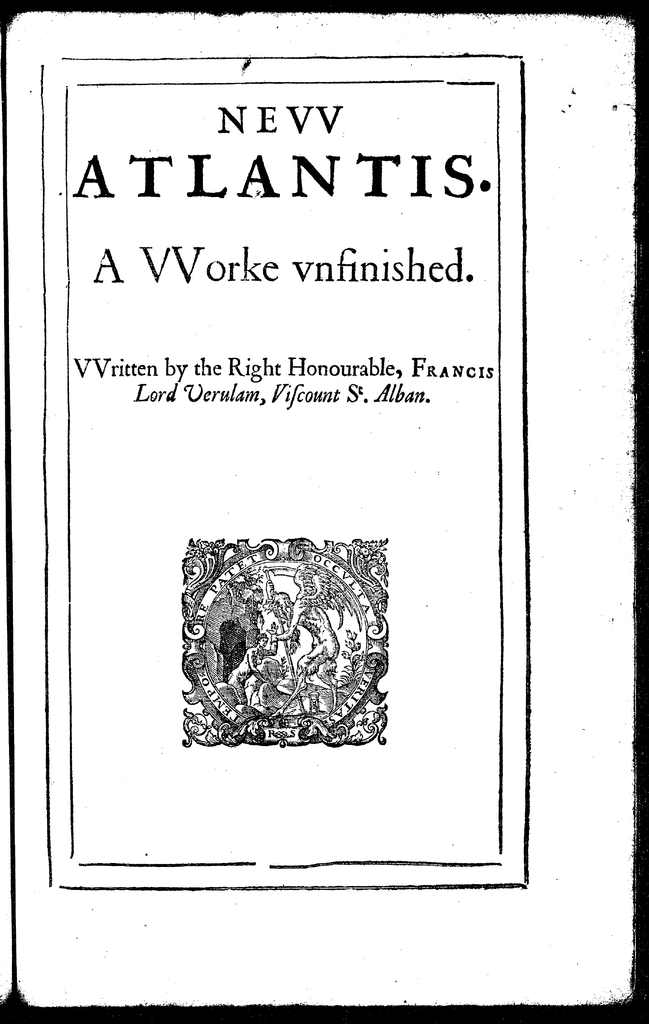
Like More’s Utopia, Bacon’s New Atlantis (1627) is set in the newly discovered world. His Atlantis is an island called Bensalem in the North Pacific, settled by Europeans.  The elite of the island are educated at a scientific academy, ‘the House of Salomon, which is described to the traveller by one of its Fathers. The purpose of the House of Salomon is succinctly explained: ‘The end of our foundation is the knowledge of causes, and secret motions of things; and the enlarging of the bounds of human empire, to the effecting of all things possible’. The discovery of causes and first principles is here linked to the technical imperative of man reinforcing his dominion over nature – ‘the enlarging of the bounds of human empire’. The description of the House of Salomon is a clear and engaging account of the conception of the new, experimental science. Much of its activity is concerned with the study of natural phenomena and their artificial reproduction: for example, meteorological effects, light and life itself are all generated by human means. The division of labour among the Fellows of the House embraces all stages of science: knowledge is gathered from travel, from books and experiment; it is then tabulated and applied. ‘Lastly, we have those that raise the former discoveries by experiments into greater observations, axioms, and aphorism. These we call Interpreters of Nature’. This is what we would call the establishment of first principles. Scientific knowledge is gathered progressively and cumulatively and leads to greater and greater technical dominance by man over his environment. In its emphasis on fabrication, on using artificial means to imitate and improve on raw nature, the New Atlantis looks back to Elizabethan aesthetics; at the same time, its pursuit of knowledge through experiment and hypothesis describes the methodology that would later be institutionalised by the Royal Society, founded in 1660.

The utopias of More and Bacon show a continuing faith in the humanist model of man: properly educated, man can exercise his reason to construct a just and reasonable world; by using his knowledge, he can control his natural environment. The vision is implicitly godless: by their own means, humans can control their own destiny, and need not look to divine salvation to be freed from their limitations. The different visions of More and Bacon are also political statements, in presenting a contrast to real English society and institutions; at the same time, the genre has a built-in scepticism: utopias present some ideal scheme, at the same time reminding us that these exist ‘nowhere’. The possibilities of a brave new world, perfectly organized, and the undermining of this vision by the recognition of human fallibility, is explored dramatically by Shakespeare in The Tempest: here it is Prospero’s magic rather than Baconian science which acts upon the external world, but its motives and results are ambiguous, and the human vices leading to conflict are not clearly reformed. The European vision of utopia is put in the mouth of the counsellor Gonzalo and made to seem both intoxicating and impossible – a theatrical version of the ironic distancing effects achieved by More:

GON:  I’ the commonwealth I would by contraries

Execute all things. For no kind of traffic

Would I admit; no name of magistrate;

Letters should not be known; riches, poverty,

And use of service, none; contract, succession,

Bourn, bound of land, tilth, vineyard, none;

No use of metal, corn, or wine, or oil;

No occupation, all men idle, all;

And women too - but innocent and pure;

No sovereignty -


SEB:    Yet he would be king on’t.


ANT: The latter end of his commonwealth forgets the beginning.


GON:  All things in common nature should produce

Without sweat or endeavour. Treason, felony,

Sword, pike, knife, gun, or need of any engine,

Would I not have; but nature should bring forth,

Of its own kind all foison, all abundance,

To feed my innocent people.


SEB:  No marrying ‘mong his subjects?

ANT:  None, man; all idle: whores and knaves. (II.i. 153-72)


The cross-currents of golden vision and worldly scepticism return us to one of the central tensions in Renaissance thought. Endowed with the faculty of reason and imagination, man can apprehend perfection; yet fallen from grace into vice, humans are ‘whores and knaves’, drawn towards dissension and destruction, their dreams of communist or technical paradises existing only in the mind.

Thursday, 29 March 2012

Renaissance Political Philosophy

Renaissance art and literature often shows a deep interest in politics, the arrangement of human society. Many of Shakespeare's plays, for example, investigate ways of managing and mismanaging states, and the consequences of decisions made at the top. This is most obviously the case with the History Plays, but it is also at the centre of the tragedies (King Lear begins with the disastrously bad idea of fragmenting a state) and even a romance like The Tempest, where the island setting works as a commentary on the ordering of a commonwealth and the duties of a ruler. The note below on political philosophies in the early modern period may, I hope, give a helpful idea of the main ideas in circulation.


The sixteenth and seventeenth centuries saw the rise of the modern state. The general model was that of authoritarian monarchies ruling over extended territories, protected by permanent armies. These armies had to be funded from taxes, which in turn necessitated a central bureaucracy. This arrangement in turn required some theoretical justification, which was provided by writings on forms of government, which we would now call political philosophy. In the Tudor period, some of these were in the medieval tradition of Advice to Princes: the deeds of great men of the past were held up as case studies, and princes were encouraged to practise the Christian virtues of  Faith, Hope, Charity, Temperance, Fortitude, Prudence and Justice. In addition were the princely virtues of liberality, magnificence, clemency, honour and the keeping of good faith. In English the Mirror for Magistrates (first published 1559), a collection initially of nineteen English poems by various hands, had this purpose: the falls of great men of the past are held up for examination (typically, these leaders are ghosts examining themselves in a mirror) so that present-day magistrates can learn from the errors of their forebears.  Plutarch’s Lives, in the 1579 translation of Sir Thomas North (1535-c.1601), similarly used biography as a way of inculcating moral awareness, especially in those of positions of power.

Narratives with a moral purpose did not, though, study the workings of the state as a whole. Interest in this subject was induced by the real changes in political organisation of the time, and by the study of ancient texts. For Italian humanists such as Leonardo Bruni (1370-1444) and Coluccio Salutati (1331-1406), the writings of the ancients provided a model of how the public realm might be organised. These writings might take the form of treatises, like Plato’s Republic and Laws, which theorised about the organisation of the realm, or histories like Livy’s, which described states in action. Underlying the ‘civic humanism’ which applied ancient writings to present political realities was a powerful belief in the capacities of human will and reason. Through these, man can improve his condition; by the right exercise of reason, humans can amend imperfections such as injustice and inequality, and strive for a perfect polity in this life. Like the medieval books of advice to princes, the humanist belief in a better future modelled on the wisdom of antiquity posited humans as perfectible creatures, designed to use reason to serve their higher needs and capable of moral improvement. Plato, Aristotle, and St Thomas all hold that the good functioning of the state depends on the virtues of governors and citizens: to be virtuous is to be honest, sincere, just and pious; and man, as a rational creature, can be educated to put the general good before his own. Such sentiments perhaps found their purest expression in the genre of the utopia. Their idealism was countered, however, by the realism of the two most important theorists of politics of the sixteenth century, Niccolò Machiavelli (1469-1527) and Jean Bodin (1530-1596).

Machiavelli’s short book The Prince (1513) had a powerful and lasting impact. It was written in exile, as the author, an experienced diplomat who had served at the courts of France and Rome, had been deposed from his post in the Chancellery of Florence in 1512. Machiavelli contemplated the birth of the modern state - the word replaces res publica in the first page of The Prince – which had left the Italian peninsula behind. Power lay with the big nation states such as France and Spain (and, increasingly, England) while Italy (which was not a nation state until the nineteenth century) was a conglomeration of fundamentally weak small states, squabbled over by the larger powers of France and the Holy Roman Empire. Although immersed in humanist culture, with a deep knowledge of Cicero, Boethius, Seneca and Livy, Machiavelli did not share the Humanist faith in the innate goodness of man, which will ensure the eventual triumph of virtue. For him, experience shows that a ruler following moral precepts, such as those espoused in books of Advice to Princes, would only achieve disaster. In The Prince, Machiavelli sets out to answer the question: what is the best way to organize a cohesive and permanent state, and thereby best ensure for its citizens some degree of liberty and security? The task of the book is to provide a practical answer to this question, not a theoretical ideal one in the tradition of Plato.

In Machiavelli’s project, experience is to be taken as the guide. A knowledge of history and attentive observation of human affairs are fundamental necessities, and reflection on them will yield reliable maxims. One such reflection is that man is not a rational creature, designed to do good and live well. Experience tells us that man is perfidious: he can be wicked and envious, and the best response to that is not to attempt to reform him by an idealist education but to manage him appropriately and form the state on the realistic basis of how humans actually are, not how we would like them to be. Machiavelli’s doctrine of the reason of state holds that all means necessary must be employed to establish a powerful state in the collective interest; since humans are essentially selfish, they will pursue their own needs rather than the general wellbeing, and so must be compelled, by whatever means, to do the right thing. In the course of pursuing the greater good building the commonweal, the Prince is justified in doing wrong, including acts of violence and terror. For Machiavelli, virtù is not an abstract list of moral principles but the excellence particular to the ruler - that is, his success in achieving the intended goal. Hence the doctrine that ‘the end justifies the means’.

The type of state that will best ensure the collective good is a secondary concern. In The Prince Machiavelli argues for a principality. In the Discourses on Livy (1513), he praises the Roman republic (a republic being a commonwealth where power is distributed and not invested in one single leader). The overriding concern is the primacy of the collective over the individual good. A good republic makes the power of the state superior to that of factions; its leader - whose individual power will be limited by the constitution - will strengthen the state, for example through laws imposing conformity on the multitude: religion can explicitly be used for this end. A republic can draw on the best elements of monarchy, aristocracy and democracy to achieve the best possible balance between nobility and the people. In both The Prince and the Discourses, Machiavelli refuses to idealize human nature. His aim is to find the best possible system of government on the basis of what we know humans to be like. His method of obtaining general precepts from observation has led to him being considered the founder of politics as an empirical science. The Prince was not published in England until 1640, but it was well known to writers before that. In several sixteenth-century writings, ‘Machiavel’ is the diabolical bogeyman ‘old Nick’: this is the figure we see in the character of Lorenzo in Kyd’s Spanish Tragedy and as the Prologue to Marlowe’s Jew of Malta.  These characterisations owe much to French anti-Florentine propaganda, and to post-Reformation hostility to Italian states in England itself. They certainly do not indicate a general refutation in England of Machiavelli’s picture of human nature, which must have been confirmed by ordinary experience. A Machiavellian concern with the real behaviour of flawed humans in distant and recent history can be seen in works like Marlowe’s The Massacre at Paris and Tamburlaine, in Shakespeare’s Henry VI plays and Jonson’s Sejanus. Bacon wrote: ‘We are much beholden to Machiavel and others, that write what men do and not what they ought to do’ (Anatomy of Learning (1605), II.xxii.9).

As we have seen, Machiavelli drew on history as the best introduction to politics, a method he continued in his history of Florence (1525). The same approach was taken by the French writer Jean Bodin (1530-1596), in his Methodus ad facilem historiarum cognitionem (Method for the Easy Understanding of History, 1566). Like Machiavelli, Bodin was concerned with real events rather than ideal concepts: in this book his interests include the effects of geography on different peoples, the way a state functions as an institution, and how international relations may be influenced by economic factors. Bodin’s interest in inflation gives him some claim to be the founder of the science of political economy. His most sustained study of statecraft is the Six Livres de la République (1576), published ten years later in an extended Latin version.  This work is an extended justification of absolutism. It was based on the observation of the bloody conflict between the Huguenots (French Protestants) and the Catholic League, which had caused appalling misery to the French people. Bodin saw the monarch as a necessary balancing figure, beyond parties and sects: absolutism was the best defence against anarchy and civil strife, and the security it brought was the precondition for tolerance, an ideal which Bodin promoted. Just as a family needs a paterfamilias, Bodin argued, a state naturally requires a supreme authority: this sovereignty, however, is a concept, not a person. It is ‘the supreme power over citizens and subjects, not limited by the law’ (I.8), since it is itself the law-maker. Sovereignty might lie with the person of the monarch, but it can equally well lie with an assembly: its chief responsibilities are to create judges, legislate and declare war; it is inalienable and indivisible, though it can delegate certain executive functions. How sovereignty is to be acquired, and whether power gained through violence itself legitimises the governing authority remain obscure points. But the main message of the work, in contrast to certain elements of Platonic philosophy and the utopian communism described by More, is that absolute power is the most natural defence of civil peace.

It will be noted that neither Machiavelli nor Bodin were arguing for anything resembling democracy. Such suffrage as existed, such as in the Republican government of Florence in the fifteenth century, was inevitably controlled by a few powerful families such as the Medici. The argument that the forceful exercise of power by the sovereign over the whole state was the best available form of government is echoed in the numerous books on government of the period. Many of these are in Latin, such as John Case’s Sphaera Civitatis (1588), a commentary on Aristotle’s Politics which recommends the perfect monarch as the ideal form of government. In English, Part I of Sir Thomas Elyot’s The Boke Named the Governour (1531) accepts that society is a hierarchical pyramid, with a single ruler at the top. Monarchy is described as the most natural and best form of government, and its divine sanction is clearly shown in the Bible. In the seventeenth century, absolutism was once again recommended by Thomas Hobbes in Leviathan (1648). The natural state of things is one of ‘war of all against all’ as individuals struggle to meet their basic needs. Life in this natural state is ‘solitary, poor, nasty, brutish, and short’ (xiii). In order to live as a community, individuals need to give authority to a sovereign authority, preferably a monarch. This is the beginnings of social contract theory: individuals resign many of their freedoms to an authority, which in turn protects them as a collective body. Social contract theory was further developed by John Locke (1632-1704) in Two Treatises on Government (1690), and, later, by Rousseau.

Political ideas are particularly liable to be diminished by summary: to reduce Machiavelli to the quote ‘the end justifies the means’ or Hobbes to ‘nature is red in tooth and claw’ is to turn a rich and organic process of thought into a single glib formulation. The books of Machiavelli, Elyot and Hobbes all reward study not as background to literature but as literary texts in themselves, making subtle and expressive use of language through the stylistic and logical devices of rhetoric and logical argument. In texts more usually studied in literature courses, the forms of government and their flaws are a frequent theme: Shakespeare’s Roman plays investigate and dramatise the use, misuse and varied distribution of power. They certainly do not advocate popular rule, whatever the vices of rulers: a classless and democratic society was unthinkable as a practical option, except in the fantastic world of utopias, and we should beware of hopefully making the values of Renaissance texts correspond to our own. It can be helpful to remember that the Renaissance was haunted by the threat of civil war: the Wars of the Roses – described in Samuel Daniel’s long poem The Civil Wars (1609), among other works - were not a distant memory in England; and the Thirty Years war and wars of religion in France of the sixteenth century were a reminder of the calamities ensuing on the absence of a central authority. Shakespeare’s Henry IV plays paint a vivid picture of the miseries of internecine struggle: ‘No more the thirsty entrance of this soil / Shall daub her lips with her own children’s blood’ (H41, I.i., 5-6). In his epic Pharsalia, on the civil war between Julius Caesar and Pompey, the Roman poet Lucan (39-65 AD) inspired numerous seventeenth-century writers, and Hobbes’s advocacy of absolutism was a response to the travails of England’s own civil wars. While Milton’s defence of regicide (The Tenure of Kings and Magistrates, 1649) seems to have had little influence beyond the Commonwealth period, a lasting strand of republican thought has been traced in England by the scholar David Norbrook.  Political ideas were in any event central to literary activity in the Renaissance; and politically intended critical enquiries, such as those pursued by cultural materialism remind us that the poetic and the political are inseparable.


Further Reading
Machiavelli, The Prince
Andrew Edward, Jean Bodin on Sovereignty, Republics of Letters
Mikael Hornqvist, 'Renaissance Political Philosophy', from The Oxford Handbook of the History of Political Philosophy (2011).

David Norbrook, Writing the English Republic (Cambridge: CUP, 1999). Quentin Skinner: The Foundations of Modern Political Thought, 2 vols. (Cambridge: CUP, 1978). Vol1, The Renaissance; Vol 2, The Age of Reformation. Machiavelli: A Very Short Introduction (Oxford UP, 1981).