Rhetoric: the art of persuasive speech. Or perhaps we might say, the art of expressive speech, in which language is shaped, 'figured', into configurations that compel our attention. Of the hundreds of figures of speech listed in reference works, only a few (metaphor, simile, alliteration) are in regular use in literary study. Here is a list of a few others: getting acquainted with them can certainly sharpen our sense of form in writing, and that perception of form can in turn - on a good day - help us to get a precise idea of the nature of the thought being expressed, and how its formal contours give it a rhythm and emotional current.
Rhetorical figures can be divided into schemes and tropes. Put simply, schemes deal with the shape of a sentence, tropes with the use of individual words. Schemes themselves can be subdivided, as follows:
Schemes of Balance
Parallelism Words, phrases or clauses with a similar structure:
Government of the people, by the people, for the people
I watched television and my wife read a book [Two clauses around and: the structure of each clause is Pronoun + transitive verb + object]
Players who abuse the opposition or maim the referee will not be selected in future. [Sentence includes two parallel phrases: abuse the opposition, maim the referee, both transitive verb + object]
Parallelism can convey the effect of being composed, in mind and speech, poised, in charge of one's material. Notice the various parallel phrases and clauses in the opening of Burke's Thoughts on the Cause of the Present Discontents:
It is an undertaking of some degree of delicacy to examine into the cause of public disorders. If a man happens not to succeed in such an enquiry, he will be thought weak and visionary; if he touches the true grievance, there is a danger that he may come near to persons of weight and consequence, who will rather be exasperated at the discovery of their errors, than thankful for the occasion of correcting them. If he should be obliged to blame the favourites of the people, he will be considered as the tool of power; if he censures those in power, he will be looked on as an instrument of faction.
One way of making clear the parts of text working in parallel is to place them in a column, to see how the elements of speech map onto each other:
If a man happens not to succeed
If he touches [If + subject + verb / verbal phrase
weak and visionary
weight and consequence [Two terms bound as a couplet, a pair of adjectives and a pair of nouns. Notice that in both pairs, a short Anglo-Saxon word is followed by a longer Latinate one]
exasperated at the discovery
thankful for the occasion [adj + preposition + noun]
And the last sentence (or period, as Burke might have considered it) consists of two balanced sentences (If clause, main clause), themselves pivoted on a semi-colon and containing parallel constructions (the tool of power / an instrument of faction)
Isocolon
When the parallelism is exact:
The louder he talked of his honour, the faster we counted our spoons.
To our right is the hard road to virtue, on our left lies the pretty path to perdition.
Antithesis
Contrasting ideas, whose relation is pointed by their position in parallel structures:
The fool thinks he is clever; the wise man knows he is ignorant.
That's one small step for a man, one giant leap for mankind.
Schemes of Unusual Word Order (Hyperbaton)
Anastrophe
Inversion of usual word order:
Slowly flows the stream
Those I fight I do not hate, those I defend I do not love.
Parenthesis
Start a sentence, then interrupt its natural flow with something else, even a complete sentence:
This crime - and I use this word deliberately - must be punished.
When he is angry - something which I am sorry to say occurs quite often - he loses all sense of proportion.
Apposition
Two things side by side, one explaining or modifying the other. (In Latin, of course, they can be some way from each other)
Ted, the village postman, has just been arrested. ['the village postman' is in apposition to 'Ted' - it saves using the relative clause ' who is the village postman']
Schemes of Omission
Ellipsis
Missing out a word or words which the reader has to 'fill in' from context.
I must to England [Obviously, 'I must go' is intended]
If you want a harder essay title, fine.
Idleness is the main vice of the young, wasted effort of the middle-aged, and despair of the old.
Asyndeton
Missing conjunctions between successive clauses.
I came, I saw, I conquered.
You were warned. You ignored this warning. You must be punished.
The teams went onto the field, the referee blew his whistle. The game had begun.
Polysyndeton
Opposite of asyndeton: lots of conjunctions.
And God said, Let there be light. And there was light. And God saw the light, that it was good.
It was cold and dark and silent and suddenly we felt very scared.
I entered the room although it was dark and atood very still but heard nothing.
Schemes of Repetition
Alliteration
Repeated initial or medial consonants. A useful sound effect:
Bruised and bloody, but not beaten.
A lovely, long, lazy summer afternoon.
Assonance
Repeated vowel sounds in stressed words, surrounded by different consonants.
An old, mad, blind, despised and dying king. [It's the 'i' sound in blind that gets repeated here]
Sing with a voice of joy.
The hard, dark path.
Anaphora
Starting successive clauses with the same word or words.
We shall fight on the beaches, we shall fight on the landing grounds, we shall fight in the fields and in the streets, we shall fight in the hills.
Epistrophe
Ending successive clauses with the same word or words.
I don't like cricket. I don't play cricket. I don't want to hear another word about cricket.
Epanalepsis
Same word at beginning and end.
Blood will have blood.
Year chases year, decay pursues decay.
Anadiplosis
End a clause with a word, and begin the next clause with the same word.
Cars have parts, parts need repairs, and repairs are expensive.
Climax
Words, phrases or clauses arranged in order of increasing importance.
I serve my employer, my family, my country and my God.
Antimetabole
An ABBA structure where words are repeated in inverse order.
Ask not what your country can do for you, but what you can do for your country.
Chiasmus
ABBA structure where grammatical structures or parts of speech are repeated inversely.
We proceeded at night, and by day we slept.
It's easy to make friends; to lose them is difficult.
Another post will give a list of tropes and reading recommendations.
Showing posts with label Style. Show all posts
Showing posts with label Style. Show all posts
Saturday, 8 September 2012
Tuesday, 31 January 2012
Guides to Good Writing
Here are a few links to guides to good writing which I can personally vouch for. They are aimed principally at anyone having to turn in a hefty piece of coursework / personal investigation / dissertation; but they contain much useful advice for all those of us who would like to express ourselves more clearly.
Student Guides
Ideal for English Literature students is this one, generously placed in the public domain,by Hazel Hutchison (Royal Holloway College, University of London), Guide to Good Writing

For a book-length guide for students, I recommend Peck and Coyle's Write it Right
Books on Style
The resources above are aimed at the student market. Other books deal with the wider question of clear style, which is applicable to various academic and professional fields.

Strunk and White's Elements of Style is a classic older book. Today it perhaps seems a little dogmatic in its precepts, and it does not go far into he mechanics of how to be clear. But it is constantly engaging, blessedly short and inspires us to get rid of some of the clutter in our prose. A few pounds very well spent. The original 1918 text by Strunk is accessible here.
 The best thing I have found on writing clearly is Style by Joseph Williams. His wonderful guide actually provides a course of exercises to help you get better (Strunk and White generally tell you get better). There are a rather confusing variety of editions of this book, which has gone through various publishers, but you won't go wrong with these two:
Style: Ten Lessons in Clarity and Grace contains the principles, with exercises
Style: The Basics of Clarity and Grace gives you the essence
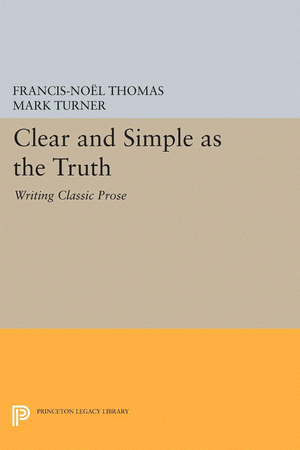
Williams is commending a certain style, which one may call 'classic', characterised by the virtues of concision, clarity and balance. This is explored rather beautifully, with plenty of examples, in a book by Francis-Noël Thomas and Mark Turner, Clear and Simple as the Truth: Writing Classic Prose

My Stuff
That's more than enough to choose from. But just to round things off, last and least, here's a little handout of my own, largely drawn from Williams, with some practical experience thrown in:
And below is a brief summary of my own commandments. Looking at it again it seems rather hectoring, telling not showing, but maybe it's of some service as a memo. Good luck to all those coursework scribes out there.
Student Guides
Ideal for English Literature students is this one, generously placed in the public domain,by Hazel Hutchison (Royal Holloway College, University of London), Guide to Good Writing
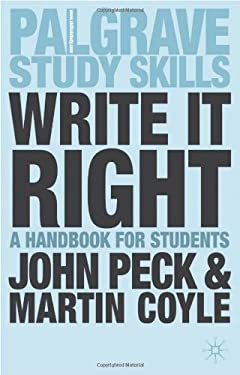
For a book-length guide for students, I recommend Peck and Coyle's Write it Right
Books on Style
The resources above are aimed at the student market. Other books deal with the wider question of clear style, which is applicable to various academic and professional fields.

Strunk and White's Elements of Style is a classic older book. Today it perhaps seems a little dogmatic in its precepts, and it does not go far into he mechanics of how to be clear. But it is constantly engaging, blessedly short and inspires us to get rid of some of the clutter in our prose. A few pounds very well spent. The original 1918 text by Strunk is accessible here.
 The best thing I have found on writing clearly is Style by Joseph Williams. His wonderful guide actually provides a course of exercises to help you get better (Strunk and White generally tell you get better). There are a rather confusing variety of editions of this book, which has gone through various publishers, but you won't go wrong with these two:
Style: Ten Lessons in Clarity and Grace contains the principles, with exercises
Style: The Basics of Clarity and Grace gives you the essence
Williams is commending a certain style, which one may call 'classic', characterised by the virtues of concision, clarity and balance. This is explored rather beautifully, with plenty of examples, in a book by Francis-Noël Thomas and Mark Turner, Clear and Simple as the Truth: Writing Classic Prose
My Stuff
That's more than enough to choose from. But just to round things off, last and least, here's a little handout of my own, largely drawn from Williams, with some practical experience thrown in:
And below is a brief summary of my own commandments. Looking at it again it seems rather hectoring, telling not showing, but maybe it's of some service as a memo. Good luck to all those coursework scribes out there.
Writing Clearly: Some Guidelines
1. Read. If you want to write well, you have to read well.
2. Find a model.
If there is an author
you find clear and compelling, try imitating his / her style.
3. Be honest.
Don’t pretend to have something to say when you don’t. Don’t try to make your
point sound bigger than it really is.
Show off by being precise, not by being fancy.
Shakespeare uses alliteration which adds to the effect and helps the
poem flow.
A completely empty sentence.
4. Choose the right subject.
Sentences should start with a precise, simple subject.
One of the aspects of Wordsworth’s poetry which we see at once in these
lines is his love of nature. Subject
is long and vague
Wordsworth’s love of nature is immediately apparent in these lines.
Subject is more accurate.
An erotic atmosphere is built up by the poet by means of imagery of
sensual pleasure.
Uncertainty over subject has led
to awkward construction
Images of sensual pleasure create an erotic atmosphere.
Clear subject leads to a cleaner
sentence.
5. Find a verb which
expresses the idea. Don’t rely on is
all the time. Write a list of verbs and put it where you can see it:
Some things that writing can do: explore, illustrate, describe, suggest, echo, allude ….
And things that people (the subject of writing) do: rejoice, mourn, ask, regret, deny …
6. End strongly.
The important point should come at the end of the sentence.
In Wordsworth’s philosophy, our emotional
responses to Nature form our moral character.
Our attitude towards the Duke varies over
the course of the play.
Over the course of the play, our attitude towards
the Duke varies.
Don’t tail off:
Our attitude to the Duke varies over the course of the play, and this
keeps us interested and involved.
7. Open paragraphs
with a topic sentence.
Although he is the villain of the play,
Edmund has some admirable traits.
Openings of
paragraphs can also work as a chain:
These early preoccupations return in the
later poetry.
Macbeth is not the only character to display
his conscience.
8. Use the main body
of the paragraph to develop the theme. For example, support it with
quotations, add a detail.
9. End paragraphs
strongly. Keep a special ‘hit’ for
the end of an essay.
10. ‘Tell the story’
from a consistent point of view.
Compare:
The girl in ‘We Are
Seven’ does not understand death. The
speaker keeps asking her why she counts the children in the family as
seven, but she does not understand what he means. The reader notices the man’s incomprehension as much as the girl’s.
Wordsworth emphasises her simplicity
by using simple language and verse forms. Innocence
and the natural wisdom of children are important ideas in the Lyrical
Ballads. The romantic movement was
particularly influenced by the ideas of Rousseau concerning children, and several later poems also deal with the
subject.
We Are Seven presents two
kinds of incomprehension: there is the girl, who does not understand death, and
the speaker, who does not understand the girl. This subject is matched by the poetic treatment: the poem’s simple language and
unsophisticated verse forms suit the ideas of innocence and the natural
wisdom of children. In this choice and handling of material, the poem is an important example of the
romantic movement’s preoccupation with childhood. It points back to the influential theories of Rousseau, and forward
to much later work on the subject.

Subscribe to:
Posts (Atom)