Showing posts with label 19th century. Show all posts

Wednesday, 23 March 2016

Watts Gallery: Marie Spartali Stillman, G F Watts, Evelyn de Morgan

The Enchanted Garden of Messer Arnaldo
On Sunday we made one of our occasional pilgrimages to the Watts Gallery, Compton - home to a permanent collection of works by the Victorian painter G F Watts, and a short walk from the remarkable Arts and Crafts Chapel designed by his wife Mary. G F and Mary Watts lived in Compton at a house called Limnerslease, which has been recently converted to a new space for exhibitions, conservation and educational events, and is now called The Studios. This superb space allows us to see examples of Mary's designs across a range of media. The whole complex is now known as The Artists' Village: a community of late nineteenth century artists used to gather there around the sage figure of GFW, and the project today is to recreate that spirit with rooms for an artist-in-residence, a conservation workshop and opportunities for hands-on making that the Wattses would surely have blessed. In the spirit of community, the wonderful Chapel was made by local people under Mary's direction.


The main temporary exhibition there at the time of writing is the female Pre-Raphaelite painter Marie Spartali Stillman (1844-1927) - the memorable name is formed by her Greek parentage (her father was the Greek Consul-General in London) and marriage to the American journalist William Stillman. Marie was by all accounts remarkably beautiful - when Swinburne met her, he wanted to "sit down and cry", which I suppose one should take as a compliment. We get a glimpse of her here in some photographs by Julia Margaret Cameron, posing as 'Memory, Mother of the Muses' and so forth, which I admit left me dry-eyed if somewhat intimidated by her lustrous and regal presence. Marie entered the art world as a model for the Pre-Raphaelites but also practised as a painter. Under the tutelage of Ford Madox Brown she worked in watercolour and gouache, creating rather dense-looking images which instantly say 'Pre-Raph': pallid beauties with waterfalls of hair stand before thick groves and rills depicted in loving detail. The subjects are generally still, contemplative scenes, often drawing on Italian sources: the Stillmans lived for some years in Florence and Rome, when William was stationed there as foreign correspondent. I particularly liked The Enchanted Garden of Messer Arnaldo, the climactic scene from Boccaccio's story of a lover performing an impossible task, analogous to Chaucer's Franklin's Tale. Here the contrast of Winter and Spring gardens has an undeniable charm and, while luxuriating in the historical costume and rich floral detail, we can also appreciate the rather skilful range of expressions, from the wondering guests to Arnaldo hiding a grin of smug satisfaction. Madonna Pietra degli Scrovigni captures Dante's stone-hearted lady holding a globe in which Love is imprisoned. Daringly alluding to the Mona Lisa, this image distils a Victorian sense of the poetic, characterised by sheer profusion of beautiful objects. A photo of the Wattses at home has the same aesthetic - every available surface seems to be ornamented, and the spaces are crammed with fine furniture and objects of every kind. It all seems quite suffocating to a modern sensibility, or mine at any rate, though at the time it must have felt like a  fortress against modern industrial ugliness.


Evelyn De Morgan, The Gilded Cage
Elsewhere in the main Museum is a selection of G F Watts landscapes, ranging from Egypt to the Surrey hills. These are different from the Pre-Raphaelite amassing of detail, building large sculptural blocks of colour. They do connect with his great symbolic and allegorical canvases in some respects: one late landscape, apparently inspired by a dream, gives us a pregnantly symbolic easy path down and steep one up amid some mountainous pass. I was taken by the paintings of Evelyn de Morgan, saluted by GFW as perhaps the greatest female artist ever: lingering memories of a sensuous Ariadne in Naxos, a lady trapped with a scholarly spouse in The Gilded Cage, and some satisfyingly weird later pieces, such as a group of benighted souls going through a transformative passage of redemption that has to be read from the bottom up.

The Chapel remains the crowning glory - a palace of brick and terracotta and an assembly of figures amid Celtic interlace in some esoteric symbolic scheme which one day I shall get around to studying.  The Artists' Village is one of the best days out in the south. It enshrines a deep Victorian faith in the positive powers of art and beauty, a mindset which seems light years away from modern cool, hip, ironic and sensationalist attitudes on offer today. In the Aesthetic / Symbolic / Arts and Crafts / Pre-Raphaelite world of late Victorianism a religious passion is turned towards art and art production. I liked the anecdote in the film shown in The Studio. A painting came back from some gallery damaged. A furious Mary told G F he shouldn't exhibit there again. Ah, he said, but we must not let our emotions get the better of us. Let us remember that all our pictures are merely meant to serve. Which might in its way be cooler than anything our century has come up with yet.
 

Monday, 22 February 2016

Delacroix and the Rise of Modern Art

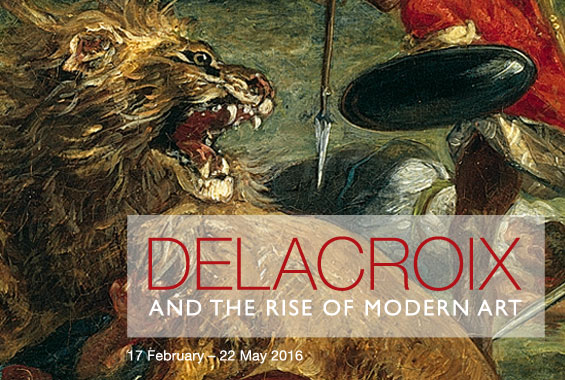
'Delacroix and the Rise of Modern Art' is, as its title implies, a show with a thesis. Delacroix, Old Master of Romanticism, was also a revolutionary artist whose stylistic verve makes him a forefather of the modern movement. At the National Gallery exhibition, we see Delacroix canvases next to works by contemporaries and later artists who picked up on some aspect of the Master's work. Colour, for instance. Delacroix immersed himself in the collours of Rubens and transported this Flemish world to France, where the dominant language was the high finish and sobre harmonies enjoined by the Academy. In this context, a work like 'The Death of Sardanapalus' (1827-8, seen here in a reduced replica made by the artist himself for his own purposes) was truly revolutionary in its energetic swirls of colour, and duly reviled when it was shown at the Salon, making Delacroix, in his own rueful words, 'the abomination of painting'. Yet to a later generation, the array of sensual tones and daring decentred composition were sources of inspiration. A genealogy can be traced from Delacroix to the Impressionists to the Post-Impressionists, at each stage colour detaching itself from realistic depiction on its way to becoming a pure expressive element, the beating heart of the image, while classical composition breaks into a million fragments. As an example of this family tree, the third room argues that Delacroix revived the genre of the floral painting, which had descended into limp decorative prettiness. From his full-blooded delight in fruit and flowers 'tis but a step to the inner world figured in van Gogh's sunflowers or the dream visions of Odilon Redon. Elsewhere we can see how van Gogh recaptured from memory the colouristic schemes of the Master in a glowing Pietà. Links are made to even later artists like Kandinsky, whose formal experiments belong to a narrative in which Delacroix's journals, concerned among many other things with the theory of optics, are a central document.

I learned a great deal from this exhibition. Delacroix looks so much like the summation of old-style grand history painting that it is refreshing to consider  him as a forerunner of later schools, his freedom from tradition underpinned by tributes from Baudelaire, Cézanne and other admirers. The paintings from Africa make a sumptuous mini-display in the second room, where whirling sufis, senatorial menfolk and the lustrous 'Women of Algiers in their Apartment' display a Moroccan experience transmuted through memory into a blazing oriental world, half real half enhanced by imagination. Here was the alternative the artist sought to biblical and ancient historical scenes. Memory, indeed, is a major theme in this exhibition: like Wordsworth, Delacroix insisted on the importance of experience re-collected, and many of the paintings from Africa were executed many years after his brief trip to Morocco in 1832.
There were art-historical detective stories to remind us of the scholarly precision end of the discipline:  A might have seen this painting by B in the private collection of C when he visited X. Such links are a reminder, too, of a now vanished world of transmission and influence. When van Gogh had only a lithograph to copy, he recaptured from memory the arrangement of complementary colours he had seen in Delacroix's other works. This kind of memory must surely be rarer in the age of mechanical reproduction.
I found the argument - Delacroix as the grandfather of modernity - pretty persuasive, although the organisers themselves say that Delacroix's journals are so complex and compendious that you can use them to prove pretty much whatever you like. Put him next to Veronese and other earlier narrative painters and you'd get another story. But both can be true, of course. The visual evidence for moderns doffing their cap to Delacroix is the most compelling, the textual is rather weaker. Despite Cézanne's flamboyant remarks about the nineteenth-century master, his work does seem to be in a very different register, although his rather dotty oil sketch of D being assumed into the heavens while contemporary artists peer up at him is saying something, however wryly, about the handover of revolutionary daring. Over the show Delacroix himself almost disappears, effaced by the storm he helped to create: there is just one painting by him in the flowers room, and in the final room a single tiny copy of a ceiling mural is overwhelmed by the cultural progeny it allegedly helped to spawn. Then there is the question of quality. The great works in the Louvre cannot be lent, and so Delacroix is not represented by many of his his masterpieces here; so the fantastic array of works by the likes of Courbet, Renoir, van Gogh, Gauguin et al. are in may cases more emphatic works than the Master's and take over our attention. The van Gogh painting of olive groves is a simply stunning piece, and doesn't gain much in interest if we consider its somewhat elusive debt to Delacroix's landscape oil sketches from England.
The exhibition is continually interesting, though I confess I didn't spend much time at the film of mural projects. My favourite picture of all was a Kandinsky, on the cusp of abstraction, where the figures and horses gradually revealed themselves after a minute or two of puzzled looking (and profitable listening to the genial audioguide). The exhibition itself also revealed its value over the two hours it took to look round. After being treated to amazing representations of Rembrandt and Goya in the Sainsbury Wing there was perhaps an initial disappointment in not seeing more Delacroix here. But that would be to miss the point of this thought-provoking and stimulating exercise in comparative looking. Baudelaire described Delacroix as a volcano concealed beneath a bouquet of flowers. In this inventive and thoughtful display, we were able to trace the range and direction of that ongoing eruption.

Wednesday, 9 April 2014

Winchester Death Masks

In the Early Life of Thomas Hardy (1928), there is a note dated 1888 about a builder and plasterer named Thomas Haviland Voss. Amongst his other labours, 'Voss used to take casts of heads of executed convicts ... Dan Pouncey held the heads while it was being done. Voss oiled the faces, and took them in halves, afterwards making casts from the masks. There was a groove where the rope went.' (This might refer to the rope of the gallows; or to the cord put under the plastercast to help extract it from the face.) The casts of executed murderers were valuable material to phrenologists, who studied the formation of the head in the belief that the shape of the skull gives valuable information on the character of its owner (a ceramic head for phrenological study is in the classroom opposite mine, and a daily object of envy).


William Palmer
Towards the end of the nineteenth century, Winchester Prison apparently gave 28 death masks to the local museum. Where their provenance was before that remains a mystery, though the donation may have been an act of civic munificence on the part of Dr Henry Giles Lyford, prison surgeon and subscriber to the Winchester Museum Fund.

Whatever their origin, a selection of these masks are now on display in the City Space area of the Winchester Discovery Centre. Not all are of murderers. The first is of one 'Eustache', former slave in St Domingo who, in the slave uprising there (1791-1803) apparently saved some 400 white people from being killed. A life of loyal service to new masters followed, ending with a period in Paris in which Eustache was observed giving regularly and generously to the poor. What would psychologists call this behaviour pattern today? Extreme empathy? Phrenologists of the time labelled it 'Benevolence' and observed that the middle forehead, where our generous instincts allegedly have their physical manifestation, was appropriately large. Next to Eustache are a series of individuals seemingly untroubled by empathy,
Add caption

including William Palmer, 'Prince of Poisoners', who made a career of killing to cover his debts. His victims included his wife, brother, mother-in-law and four of his own children. The Inscription reads 'The first cast of William Palmer. Taken by William Bally phrenologist of Manchester the 14th June 1856 Stafford'. Next to Palmer is the murderer Courvoisier and next to him James Blomfield Rush, responsible for a notorious nineteenth-century outrage, the 'Murder at Stanfield Hall'. An excerpt is given of the exhuastive documentation and analysis of his head, which must have accompanied other details of his execution. Far from his worldly triumphs, the half-mask of Napoleon Bonaparte lies in a case nearby. The exhibition is completed by two anonymous casts: one looks like an execution victim: I saw, or imagined perhaps, a groove round the neck and the expression is set in a grimace. The other is small and ungrooved; perhaps something about its shape excited the curiosity of  surgeon who had a cast taken. Or perhaps the life had been remarkable in some way that we will never know.

Phrenology is now as dead as its models, but it is impossible not to look for the mind's construction in the face, and even without the accompanying information one might surmise that William Palmer was not of a kindly avuncular persuasion. Drs Lyford and Bally and their colleagues must have gone over these items painstakingly with compasses, noting down measurements with the same solemnity as a psychologist would write up data today. The results would then be tabulated and compared. Though what practical proposals could ensue from the knowledge gained? Perhaps some kind of eugenics system was hatching in advanced minds, whereby those endowed with ominously unbenevolent heads could be quietly terminated or isolated in some way. At the practical end of things, I imagine being Mr Pouncy holding the head of a Dorchester deceased convict and feeling Mr Voss's plaster or wax fall around my hands. What did a cast cost, though, and who paid for it? Was it simply a regular part of hospital procedure (casts of hands, too, were made, we are told). Did the bereaved (or in Palmer's case, any surviving family members) have any entitlement to object to their wretched kinsfolk being given a death beyond death?  And was it Voss or Pouncy, I wonder, who closed the victim's eyes?

Sunday, 12 February 2012

Götterdämmerung (live from the Met)

The Winchester Screen’s Live from the Met series continued last night with Götterdämmerung, the fourth and last opera of the Ring cycle, in the production by the Canadian Robert Lepage. The gentleman who introduced it (‘We hope the next six hours will fly past’ was greeted with nervous laughter), told us the Met is committed to the Great Tradition while ‘propelling itself into the 21st century’ (or words to that effect) with inventive state-of-the-art production values.  Both tradition and techno propulsion were certainly on display this evening. The costumes would have been snapped up by Spinal Tap: Lord of the Rings leather tunics, long heavy dresses and big pointy spears and swords, the twenty-first century’s idea of the nineteenth century’s idea of the medieval Teutonic  badlands. The staging (of the singers, that is) was similarly conventional: most scenes were essentially proscenium arch formations, and there was a restrained approach to physical action: some more physical interaction between characters might have brought out the psychological undercurrents a little more, for example the ambiguous relationship between Gunther and Gutrune.  As for the techno side, this is a Ring that will undoubtedly be remembered for the set, Carl Fillion’s remarkable ‘Machine’ made up of 24 aluminium planks that rotate around axles into a myriad of configurations suggesting mountains, halls and the Rhine. The Machine (as it has come to be known) also serves as a screen for Lionel Arnould’s video projections, which are sometimes abstract patterns, and sometimes photographically concrete images: in one of the strongest of these, when Gunther washes Siegfried’s blood from his hands, the whole Rhine is stained red. When Hagen hears the ravens, they flit across the video among the rushing waters. Wagner’s Gesamkunstwerk is here interpreted for the digital video age.
Does the set upstage the action? Yes, to an extent: the mesmerising metamorphoses of the machine have stuck in my mind more than any of the great set-pieces of the drama.  Like a sleeping dragon, it came to life between scenes in dazzling transitions and then slumbered during them, subliminally prompting us to do the same. It was beautiful to behold but sometimes pulled attention away from the music and text rather than towards them. And any gizmo is subject to the law of diminishing returns. I was slack-jawed with wonder for the first act, but over the next five flying hours, awe started to fade.  The final effects were unfortunate:  Brünnhilde rode into Siegfried’s pyre on a mechanised Loge (rather beautifully managed until then), who clearly runs along grooves and then stops; and the destruction of Valhalla was symbolised by giant statues whose heads exploded in the heat, which is not a dignified twilight however suspended your disbelief. It was an expensive price tag for the moments which worked so well, like Siegfried stepping from the Rhine onto Gunther’s land. And with all the excitement of the marvellous mechanics, the messages about Power, Greed, Corruption, Love and Freedom - I take it that's what the work is about - could be missed.
I don't know enough to appraise the singing, or the orchestra. It all seemed suitably turbo-charged to my novice ears.  I can opine with a little mrer confidence that the acting was terrific. Live transmission lets you see the singers’ faces better than just about anyone with their four-hundred dollar tickets can, and there was much fine characterisation to enjoy. Jay Hunter Morris’s Siegfried was boyish and vulnerable (his shy little wave to the Rhinemaidens was a gem of a moment); Gunther (Iain Paterson) came over as the little man (he reminds me of the character in the movie Fargo, a nobody who hires two thugs to carry out his selfish plan); and Gutrune came over in Wendy Bryn Harmer’s performance as a lost soul, trying to make her attachment to Siegfried into something real. Deborah Voigt as Brünnhilde seemed to me to gain in strength at the end, raging against the dying of the light, and then finding the apotheosis of love in death. Hans-Peter Konig’s Hagen seemed more amoral than malevolent, arranging the extraordinary rendition of Brünnhilde with a bureaucrat’s eye for detail. In pure singing terms, the show-stealer for me was Waltraud Meier who played Waltraute (what are the chances ...): her plea to Brünnhilde to return the ring, and her account of Valhalla, was superbly emotive and dramatic, and this scene between the two women was the one in which conflicting feelings came over most strongly. The men’s chorus, left with nothing to do for great stretches of time, occupied themselves in the modern Method fashion with meaningful looks and nods. And their singing, as we expect from the Met, was gloriously full-bodied.
Live from the Met is a great idea, particularly for those of us within a short walk from a participating cinema. In many ways it beats the real thing: no trains, no hikes across town and a seat three miles from the stage. So, looking forward to Verdi’s Ernani next, more Great Tradition with whatever propelling tricks the director and computer team have in store.

Friday, 3 February 2012

Austen, Persuasion: Moral Judgements

Following the previous post on the characters of Anne and Wentworth, here are a few thoughts on the moral appraisal going on in the novel. These are some of the attitudes, it seems to me, that we get through Austen's narrator. But her narrative voice is wonderfully sly and elusive at time, so feel free to disagree! It's important to rememebr, too, that all these judgments are dramatised, woven into the rhythms and emotional arcs of the story. Reduced to critical paraphrase, they always seem dry.


Persuasion and the depiction of human vices


(Page references are to Oxford World Classics edition.)


The literary form known as the novel is, among other things, an instrument for the moral analysis of people in society. This is especially the case with the novels of Jane Austen, in which the narrating voice always comes over as that of a shrewd, reasonable observer of human affairs. Even when the narration is generally sympathetic to the heroine – as it evidently is in Persuasion – there is still some detachment. To give a cool and balanced judgment, the third-person narrator needs to be at some distance from the stage on which the events take place.


Austen is in the classical eighteenth-century tradition of the rational narrator, concerned for the cohesion of society through traditional values and customs. Persuasion shows some new tendencies in England – the new class of rich naval officers, new style of marriage illustrated by the Crofts, impulsive and romantic young people – being absorbed into the social fabric without revolutionary upheaval. Writing at a time of social and political turmoil in Europe, Austen is finally a conservative novelist, concerned to preserve traditional family and social structures by reforming, Rather than overturning, what is decadent and corrupt.


In Persuasion, Austen portrays a variety of human qualities and follies, virtues and vices. She does so with a variety of novelistic techniques. Here are some examples:


Vanity

The opening of the novel makes clear Sir Walter’s appalling vanity over his pedigree and his looks. Just in case we miss this, we are told about it explicitly:


Vanity was the beginning and the end of Sir Walter Elliot’s character; vanity of person and of situation. (10)


This trait is comically emphasised throughout, making him virtually a caricature of this vice alone.  But Sir Walter’s vanity (and Elizabeth’s) is not only there to be laughed at. Austen is also interested in the consequences of this defect. It blinds him to reality: he does not realize how far he has fallen, and he deludes himself that he is a person of great distinction in Bath. Sir Walter’s self-importance also makes him irresponsible, not living up to the conduct required by his place in society.


Here were funds of enjoyment! Could Anne wonder that her father and sister were happy? She might not wonder, but she must sigh that her father should feel no degradation in his change; should see nothing to regret in the duties and dignity of the resident land-holder; should find so much to be vain of in the littleness of a town … (112)


So ludicrous is his self-adoration that he passes judgment on the bad looks of everyone he meets, and is easily persuaded that the admiring looks of the women when he passes by with Colonel Wallis are intended for him (115). Both he and Elizabeth are easily flattered (indeed, it is often the only way to communicate with them, as Mr Shepherd discovers) and fail to see the designs of Mrs Clay. Vanity has clouded their moral judgment and prevents them from behaving rationally, in a manner useful to society.


Austen probably does not mean us to see Sir Walter as typical of his class. The novel does not lead us to think all such landholders are dreadful snobs who should be overthrown. Rather, the message seems to be that the privileges of an inherited name and estate carry with them certain duties – among them, to mange money prudently and to be a responsible landlord. As Lady Russell puts it:


We must be serious and decided – for, after all, the person who has contracted debts must pay them; and though a great deal is due to the feelings of the gentleman, and the head of a house, like your father, there is still more due to the character of an honest man. (16)


(Note that gentleman is here used to describe Sir Walter’s social position.) The message is that honesty and dignity are the true signs of nobility of character, not an entry in Burke’s Peerage. Sir Walter is an irresponsible landlord (the misery this might have caused his tenants is kept offstage) and does not behave in the manner his position in society dictates. It is not that his class as a whole is corrupt: it is that Sir Walter has betrayed the trust and failed to meet the expectations which come with membership of that class.


Duplicity

In a society where manners and customs are highly prized, there is an evident danger that some people will use a pleasing external manner to cloak their real intentions. Central to Austen’s world is the distinction between the social exterior – the ‘mask’ we put on in company – and interior thoughts and feelings. The two characters who use social manners to disguise immoral intentions to deceive and manipulate are Mrs Clay and Mr Elliot.


Mrs Clay

Anne sees through Mrs Clay very quickly:


Mrs. Clay had freckles, and a projecting tooth, and a clumsy wrist, which he [Sir Walter] was continually making severe remarks upon, in her absence; but she was young, and certainly altogether well-looking, and possessed, in an acute mind and assiduous pleasing manners, infinitely more dangerous attractions than any merely personal might have been. (33)


(Note that personal means ‘physical’ here.)


Anne fears that Mrs Clay is scheming to lure Sir Walter into a second marriage with her. This would be an indignity too far (note that Anne herself has a sense of what is proper to her class), and Sir Walter’s lack of self-knowledge leaves him vulnerable to such a plan.


Mr Elliot

There is a possible warning that Mr Elliot is not all he seems on his very first appearance at Lyme:


It was evident that the gentleman, (completely a gentleman in manner) admired her exceedingly. (87)


The parenthetical comment, with the telling phrase in manner, hints that he may not be a gentleman in character.


Anne later suspects that Mr Elliot is hiding something behind his smooth manner. Her suspicions of his nature are reported on p.130-31:


There was never any burst of feeling, any warmth of indignation or delight, at the evil or good of others. This, to Anne, was a decided imperfection. Her early impressions were incurable. She prized the frank, the open-hearted, the eager character beyond all others …


…Mr. Elliot was too generally agreeable. Various as were the tempers in her father’s house, he pleased them all. He endured too well, - stood too well with everybody. (131)


From this point Mr Elliot is no real temptation to Anne, taking a potential tension away from the novel (ie will she make the right choice, the good man or the cad?). Later, the vices of misleading others are called by their name, in the conversation with Mrs Smith:


‘Yes,’ said Anne, ‘you tell me nothing which does not accord with what I have known, or could imagine. There is always something offensive in the details of cunning. The manoeuvres of selfishness and duplicity must ever be revolting, but I have heard nothing which really surprises me. (167)


Here the sins are usefully listed: cunning, selfishness, duplicity. They contrast with the openness and straightforwardness which Anne prizes, and make Mr Elliot the opposite of the emotional Captain Wentworth.


Dullness

Sometimes praise itself can carry an undertone of criticism. In the passage describing the Musgroves (37-38), we have this description of Henrietta and Louisa


… who had brought from a school at Exeter all the usual stock of accomplishments, and were now, like thousands of other young ladies, living to be fashionable, happy, and merry. Their dress had every advantage, their faces were rather pretty, their spirits extremely good, their manners unembarrassed and pleasant; they were of consequence at home, and favourites abroad. Anne always contemplated them as some of the happiest creatures of her acquaintance …


Airheads, in other words. Anne can’t avoid the realization that her mind is superior:


But still, saved as we all are by some comfortable feeling of superiority from wishing for the possibility of exchange, she would not have given up her own more elegant and cultivated mind for all their enjoyments;


Yet she does acknowledge that they have a much better relation with each other than she does with her silly snobbish sisters:


And envied them nothing but that seemingly perfect good understanding and agreement together, that good-humoured mutual affection, of which she had known so little herself with either of her sisters.


This passage is a good example of rational judgement in action: first praise, then implied criticism, then balancing praise. This is balanced judgment, setting one thing against each other. It is reflected in the shape of the sentences: the rhythm is even and unhurried, slowing down towards the end. This evokes a calm and scrupulously attentive mind. The vocabulary is full of abstract words denoting personal qualities: fashionable, happy, merry, pretty, good (spirits), unembarrassed, pleasant, of consequence; elegant, cultivated (mind). These are the kinds of terms by which characters in Austen are analysed. Which of them perhaps have negative connotations?


Selfishness, Self-Pity

Anne’s sister Mary is an epitome of selfishness and self-pity, though this seems to be foolish rather than malicious. We get a clear account of her character failings in Chapter 5:


Though better endowed than the elder sister, Mary had not Anne’s understanding or temper. While well, and happy, and properly attended to, she had great good humour and excellent spirits; but any indisposition sunk her completely; she had no resources for solitude; and inheriting a considerable share of the Elliot self-importance, was very prone to add to every other distress that of fancying herself neglected and ill-used. (35)


Note the praise then criticism shape of the writing again. Mary’s self-pity is then shown in her first speech:


 ‘So, you are come at last! I began to think I should never see you. I am so ill I can hardly speak. I have not seen a creature the whole morning!’ (35)


Of course she gets better very rapidly (37). Mary’s pathetic lack of resourcefulness when alone, and whingeing self-pity, makes her the contrast to Mrs Smith, who has borne her troubles alone with great fortitude.


Charles is felt not to have made a very good match to Mary, who has prevented him from developing as he might have done (40). Later, there is a set-piece scene in which both she and Charles justify leaving their injured child behind so they can go to dinner at Uppercross (Chapter 7, pages 49-51). This is a marvellous example of showing, not telling. Mary’s letter to Anne (vol 2, chapter 3, pages 132-33) continues the tone.


Snobbishness

Sir Walter of course is a terrible snob, and this vice is inherited by Elizabeth and Mary, but not by Anne. Mary insists that as an Elliot she should have pride of place at the table at Uppercross (41); the rank-obsessed Musgrove girls complain about this. She also feels very superior to the Hayters (their social position is described in Chapter 9, 63-64; see also Charles’s speech about them on 65):


She looked down very decidedly upon the Hayters, and thought it would be quite a misfortune to have the existing connection between the families renewed – very sad for herself and her children. (65)


When the young people go for a walk (Chapter 10) and chance to arrive at Winthrop, the Hayters’ house, Mary does not want to visit. Her snobbery earns the contempt of Captain Wentworth, as Anne observes:


            ‘It is very unpleasant, having such connexions! But I assure you, I have never been in the house above twice in my life.’

            She received no other answer, than an artificial, assenting smile, followed by a contemptuous glance, as he turned away, which Anne perfectly knew the meaning of. (73)


Cant

Cant, in the sense of insincere feeling, earns particular scorn. One cannot help sensing Austen’s own impatience with pretension and sentimentality. This leads to a passage which can still seem quite shocking, in which Mrs Musgrove’s laments are described as ‘her large fat sighings over the destiny of a son, whom alive nobody had cared for.’ (Chapter 8, p.59). This is followed by a paragraph saying that bulky blubbers just do look ridiculous, however unfair that is:


But, fair or not fair, there are unbecoming conjunctions, which reason will patronize in vain, - which taste cannot tolerate, - which ridicule will seize.


Romantic Imagination

Anne is not exempt from Austen’s critical eye. In any case, heroes and heroines who never make mistakes are unbelievable, and those who are constantly good can be dull. However, when Anne is being held up to gentle laughter, we obviously cannot see it from her point of view, which is the main one in the novel. The moments when she is less than perfect are easy to miss.


If there is a flaw in Anne, it is that on occasions she lets her dramatic, romantic side get the better of her reason. When she is told that Wentworth finds her ‘altered beyond his knowledge’ (Chapter 7), she seems to be acting out a part of almost insane virtue. It is not very convincing:


‘So altered that he should not have known her again!’ These were words which could not but dwell with her. Yet she soon began to rejoice that she had heard them. They were of sobering tendency; they allayed agitation; they composed, and consequently must make her happier. (54)


The short sentences suggest her own violent emotions. Rejoice is wildly over the top, and the list of assertions and conclusion that the words must make her happier suggest that this is a record of her inner thoughts – that is, it does not necessarily mean she did rejoice etc., but that this is what she told herself to try to make herself think this way. Austen’s analysis of character recognises that much of the time we are internally acting out parts, and trying to persuade or console ourselves.


Towards the end of the novel, when Anne has realized she still loves Wentworth and certainly does not love Mr Elliot, we get another description of her thoughts, in which she seems to be imagining herself as a heroine in a romantic novel:


How she might have felt, had there been no Captain Wentworth in the case, was not worth enquiry; for there was a Captain Wentworth in the case: and be the conclusion of the present suspense good or bad, her affection would be his for ever. Their union, she believed, could not divide her more from other men, than their final separation. (vol 2, Chapter 9, p.155).


The subjunctive (be the conclusion) and the extravagant her affection would be his for ever here mark this as corny elevated style. The novelist / narrator comments wryly on Anne’s little private performance:


Prettier musings of high-wrought love and eternal constancy, could never have passed along the streets of Bath, than Anne was sporting with from Camden-place to Westgate-buildings. It was almost enough to spread purification and perfume all the way. (155)


            A final imaginative flurry comes in the conversation with Mrs Smith (vol 2, chapter 5), when Anne fantasises about the heroic scenes in sick rooms which nurse Rooke must be privileged to witness:


What instances must pass before them of ardent, disinterested, self-denying attachment, of heroism, fortitude, patience, resignation – of all the conflicts and all the sacrifices that ennoble us most. A sick chamber may often furnish the worth of volumes. (126)


Yes, well. We are surely meant to agree with Mrs Smith’s dry reply:


            ‘Yes,’ said Mrs. Smith more doubtingly, ‘sometimes it may, though I fear its lessons are not often in the elevated style you describe . Here and there, human nature may be great in times of trial, but generally speaking it is its weakness and not its strength that appears in a sick chamber; it is selfishness and impatience rather than generosity and fortitude, that one hears of. (127)


It is impossible to read this without remembering that Jane Austen herself knew about sick rooms and was seriously ill when she was writing this novel.  But aside from biography, this exchange reminds us that Austen is a realist in the sense of wanting to portray and examine people as they really are, and not falsify them by sentimentality or melodrama (though arguably she does this with the description of Mr Elliot as a device for tying up the plot).


Austen, Persuasion: Anne Elliot and Captain Wentworth

Following the recent post on Revision guides to Persuasion, here are some entry-level notes on Anne and Wentworth (looking only at Volume One in the case of the latter).


Anne Elliot
1.                  Anne Elliot is clearly the heroine of the novel. Persuasion is the story of a struggle in which she is the protagonist. How does she come to break with conservative family and social tradition by marrying a naval officer, without causing a complete rupture with the family circle?
2.                  As a heroine, Anne is
·         The moral centre of the novel: she is the touchstone by which we judge other characters
·         The most fully realized character, whose dilemmas and feelings we are shown
·         The dominant (but not the only) point of view in the novel.

3.                  The novel is a classic self v. society story, with Anne on one side and her immediate social world on the other.

                              Anne                           Society
                              Romance                     Prudence
                              Feeling                        Judgement
                              Individual worth         Snobbery
                              Life and vitality          Materialism
                              Personal emotion         Social pressure (persuasion)   

These polarities are illustrated in Vol 1,ch.4 where we are told about her former attachment to Wentworth and how Lady Russell persuaded her to break off the engagement. There is a basic difference in how the two evaluate Wentworth as a prospective husband.

Sometimes Anne’s romantic side is the object of gentle authorial humour, as in her conversation with Mrs Smith in Vol.2, ch.5, where the more experienced lady undercuts her heightened language.

4.                  Anne is introspective – we see a great deal of her thinking – and thus we witness her internal conflicts: a key scene in developing her character is Vol 1, ch.7, describing the meeting with Wentworth. What is the authorial perspective here?

5.                  Anne develops from a largely silent and introspective character into a more talkative and articulate one. In Bath, her speeches are longer (e.g. discussions with Mrs Smith), culminating in her conversation with Captain Harvill, in which she speaks up for women’s constancy. This increasing speech marks her growing confidence and independent judgment. It shows her becoming more resolved – symbolised in her making the first move in the Assembly Rooms (Vol 2, ch.8).

6.                  Age: Anne is an unusually old Jane Austen heroine. She represents constancy over the years. She is a character who has ‘outlived the storms’ – like the nut described by Captain Wentworth.
7.                  Despite being a romantic figure, Anne is also rational and practical: she knows what is the proper thing to do at Kellynch (though her advice is ignored) and she is cool-headed and stable in response to the two accidents – Charles Musgrove’s and Louisa Musgrove’s, in contrast to the hysterical reactions of the other ladies. Her own dignity is contrasted to the pride of her father and sisters.
8.                  Anne is also a skilful mediator between people (e.g. at Uppercross) and kind to others. She is particularly sympathetic to those who have themselves undergone emotional trauma – Captain Benwick and Mrs Smith.

Further Reading
Richard Gill and Susan Gregory, Mastering the Novels of Jane Austen (Palgrave)
Vivien Jones, How to Study a Jane Austen Novel (Palgrave), useful chapter on Persuasion

Captain Wentworth
Volume One
1.            Captain Frederick Wentworth might properly be said to be the protagonist of the novel, rather than Anne:
•             A protagonist needs to be able to do things. As a woman, Anne does not have enough opportunity of action to make important events happen. Her role is passive: she observes, considers, suffers (usually in silence), thinks. Her active roles are providing harmony between family members, and above all speaking – articulate and intelligent women can affect events through the power of persuasion. When she steps forward to Wentworth at the Assembly rooms ‘making yet a little advance’ (p.146), that is a significant action in context.
•             Wentworth, however, is active in the traditional sense of a novel’s hero. Indeed, we might consider the novel as his story:
A young, confident naval officer proposes marriage but is turned down because the woman is persuaded that his prospects are not sufficiently secure. He thinks the woman lacks courage, goes off and is successful (though neither he nor she succeed in forgetting their love). When he meets Anne again, he realizes that she has qualities which he failed to recognize before and reassesses his own judgments. He learns from all this, becomes morally better, realizes he still loves her, proposes and they get married. So the novel is about him and his moral and emotional education. The treatment of the story, however, shows it all from the woman’s point of view.
2.            As the male protagonist (in conflict with the traditional views of Lady Russel), Wentworth must have qualities to make him worthy of the virtuous Anne. These qualities develop over the course of the novel; the key events are those which educate him. We shall take these in turn.
3.            Before the action of the novel starts, at the time of the engagement. Wentworth is introduced in Vol 1 , ch. 4. In 1806 he was ‘a remarkably fine young man, with a great deal of intelligence, spirit and brilliancy’ (26) – the inner qualities which Anne prizes. However, as Lady Russel sees it, he has ‘nothing but himself to recommend him, and no hope of attaining affluence … without alliance or fortune’ (27).  How could he support Anne? What future could he give her? He is ‘confident that he would seen be rich’ and ‘full of life and ardour’ (27), but this only makes Lady r more suspicious, and Anne yields to her advice. We might see Wentworth as a ‘new man’, making his way in a new profession, impatient of traditional expectations, and perhaps unfair in expecting Anne to join him when the future is so uncertain.
4.            Wentworth takes it badly. He is ‘totally unconvinced and unbending’ and feels he is ‘ill-used by so forced a relinquishment’ (28). He leaves the country. How do we judge this reaction? Is it fair to Anne?
5.            He goes on to enjoy great success (29), making Anne’s refusal seem over-cautious in retrospect.
6.            Anne learns, in great agitation, that Wentworth is to visit Uppercross (45). He is made to seem more attractive in contrast to the pathetic story of Richard Musgrove.
7.            Louisa and Henrietta give delighted reports of Wentworth (48), a very eligible bachelor.
8.            I.7: the meeting between Anne and Wentworth after 8 years  (52-53). We see this entirely from Anne’s point of view. The language expresses her violent agitation (‘She had seen him. They had met’). She learns that he has found her altered beyond recognition (53). At last we leave Anne’s perspective and learn what Wenworth thinks: ‘He had not forgiven Anne Elliot. She had used him ill; deserted and disappointed him; and worse, she had shewn a feebleness of character in doing so, which his own decided, confident temper could not endure’ (54). Notice the return of that key word confident. Wentworth is a man of strong will and strong opinions. We learn that he is on the lookout for a wife. He has tried toconvince himself that his earler feelings for Anne are dead.  The stage is set for a psychological novel about how Anne and Wentworth come to learn more about themselves and each other.
9.            I.8 starts with a description of how they get on after the 8-year gap, from Anne’s perspective. Pages 59-61 is the scene in which Wentworth declares he would never take women on board (decided), although he has (inconsistent), and describes his exploits. He’s very reserved towards Anne: ‘His cold politeness, his ceremonious grace, were worse than anything’ (62).
10.          I.9. Key scene: Wentworth relieves Anne of the child Walter (compassionate, strong, resolute), p.68-69, with Anne’s reaction on 69.
11.          I.10 – the visit to Winthrop. Anne overhears Wentworth’s conversation behind the hedge with Louisa. (73-75). Here we learn what kind of qualities Wentworth admires (my italics): ‘Woe betide him … when it comes to things of consequence, when they are placed in circumstances, requiring fortitude and strength of mind, if she have not resolution enough to resist idle interference in such a trifle as this.’ Louisa, he says, has a character of ‘decision and firmness’. Wentworth dislikes ‘too yielding and indecisive a character’. Presumably he found Anne wanting in resolve to stand up to Lady Russel all those years ago. His speech on the nut, though, hints that he may yet come to appreciate Anne, whose beauty of character is hidden under a kernel, and who has ‘outlived all the storms of autumn’ (74).
12.          I.10 p.77. Wentworth makes sure Anne has a place in the carriage. Her interpretation of this act: ‘It was a remainder of former sentiment …’.
13.          I.12. Louisa’s accident at Lyme. This is the central episode of the whole novel, for the light it casts on the various characters. As Wentworth comes to see later, Louisa’s strength of will can just be irrational stubbornness. In contrast to her sisters, Anne is quick, practical and helpful. Anne overhears Wentworth again:’ if Anne will stay, no one so proper, so capable as Anne’ (95). This change of attitude brings Volume One to an end.

Wednesday, 1 February 2012

Austen, Persuasion: Revision and Study Guides

A short post on materials for studying and revising Jane Austen's Persuasion - activities which are, needless to say, logically secondary to reading and thinking about it independently. There seem to be plenty of materials of one sort or another out there, as a search for 'Austen study Persuasion' on Amazon revealed.

Online

Study Guide published on the Cross-Ref it site

Diana Mitchell's  Penguin Teacher's Guide suggests class activities for teachers, but is useful for individual study, keeping our eye on characters and themes with chapter-by-chapter questions.

Sparknotes

Plenty of links from this Jane Austen blog

Set of study questions

The Republic of Pemberly site is a hub for Austen, with some busy discussion boards around Persuasion.

This lecture by April Bernard covers many key aspects of the novel: Austen's background and time; the context of English class and revolutionary europe; her debt to Samuel Johnson; the use of free indirect discourse; and the elements of the novel which make it a 'fairy-tale for grown-ups'. The lecture is half an hour, followed by Q&A. Link here.

Book
Roger Gard's book on Emma and Persuasion for Penguin Masterstudies (out of print) is excellent.

Richard Gill and Susan Gregory, Mastering the Novels of Jane Austen. Substantial chapters on each of the novels.

Annotated Texts
Annotated editions are an ideal way to study a novel, especially for a writer like Austen, where we need help in picking up the references and understandings that would have been second nature at the time: Robert Morrison's sumptuous Persuasion: An Annotated Edition (Harvard) will be the edition of choice for carraige folk; David M Shaphard's Annotated Persuasion is available in printed form but much cheaper in Kindle format. From the sample pages I have seen it looks very handy. There are a lot of privately published notes and commentaries on the novel for Kindle. I haven't used them - still not quite in the Kindle community - so I can't recommend any but I'd be interested to learn of any good ones.

Monday, 30 January 2012

Austen, Persuasion: The Economic Background

Below are some notes drawn on a lecture by Sandie Byrne, ‘Pride and Prejudice in Persuasion’, given at an A Level Conference in London in 2005. I thought the lecture gave some useful suggestions on things to look out for in the novel, and follow up in further reading.

Text and Context

We should not try to read off early 19th century history from novels: they are fiction, not accurate history books.

But we should know about context – what was going on in the period. Texts cannot help being products of their times.


Regency

When Jane Austen was young, George III was on the throne. He was an obstinate moralist, and court protocol was rigidly observed: courtiers stood in his presence.

His heir the Prince ran a more relaxed household. Heirs provide a focus for dissent. Prince George, the Regent, initially allied himself with the Whigs. He was satirised as an ageing roué. We know from a letter that Austen hated the Prince Regent.

Class Structure

The upper rank of English society was the aristocracy, marked by land ownership. The ‘ton’ was the upper 10,000. To be in the ton you needed land, name and money. The higher rank was being infiltrated by arrivistes, who had land but not an ancient name.

A keyword is estate – this means both your land and property, and also your marital state.

The Estate of a man was evaluated by these questions: does he have an old name? Land (providing income from rents)? Money?

The Estate of a woman depends on her reputation. A woman’s market value depends on her marriageability.

Industrial Revolution

This brought important social changes. Rich capitalist industrialists, like mill owners and factory bosses, wanted to join higher social ranks. To bury your origins in trade, you need servants. Women servants are cheapest, so male servants are even more of a badge of gentility. Don’t be seen doing manual labour. Get some land. New lords acquired land to support their title.

Navy
The navy was a good place for a second son to rise. Unlike the army, you didn’t have to purchase your commission. You could be a midshipman at 13+. Captains could reasonably hope to become admirals. Any time you captured an enemy ship, you could make a lot of prize money [note Sir Walter's laboured joke on the word 'prize'].

An officer in a ship of the line could make a fortune. Sir Walter deplores this, since it allows the undeserving to rise to higher rank and prominence. Admiral Croft rebukes Wentworth for complaining about his first ship: Wentworth did not have much ‘interest’, i.e. family interests, patronage – he was lucky to get what he did.

So both the Industrial Revolution and the Armed forces provided some social mobility. There was old money and new money.

Gentry
Jane Austen was not in the ‘ton’. She was in the gentry (knights baronet, clergy) – people who might have some land, but were not in the oldest, ‘best’ families. Two of her brothers were naval officers.


Characters in the Novel

New Money                             Old Names                  New Poverty

Crofts                                      Sir Walter E                The Elliotts (sliding downwards)

Wentworth                              Mr E

                                                Lady Russell

                                                Mrs Dalrymple


Lady Russell may be the best of the old names – she is good and well-meaning.

By contrast, Lady Dalrymple does not fulfil the responsibilities of her position.

The Musgroves are respectable – they are of the gentry class, but with no aspirations to higher gentry. They are approved by the narrative voice, but not quite high enough for an Austen heroine.

The Musgroves and Lady Russell are static: thy represent the way things used to be.

Mr Shepherd is also (probably) static.

Mrs Clay chooses another form of social mobility.


The novel’s values

Tradition rather than revolution

Austen is not demanding social revolution: rather, the novel supports traditional values such as responsibility and duty.


Real rather than fake

Anne stands for what is real and solid.

London was associated with sham and show.

Pretence, deceit and duplicity are strongly criticised in the novel.

Country and town represent old and new: in Kellynch Anne can walk about unchaperoned. This is much harder in Bath.

Sir Walter prides himself on his appearance – this shows he has done no work in his life. This is perhaps the most ‘revolutionary’ element of the novel, since it portrays aristocrats as languid and effete.

Sexual values

On the whole, during the Regency sexual conduct was loose, though it was more restrained in the middle ranks of society. Women preserved their good name; men went to prostitutes, servants (rarely, perhaps), or married women.


Work and Money

There is less fear of social mobility in Persuasion than there is in other Austen novels such as Mansfield Park. In Persuasion, mobility is a result of one’s own endeavours, the Protestant work ethic.  The novel does not echo contemporary criticism of money from trade, for example from India, where undesirable people are making fortunes.

Austen approves of money-making. Persuasion is moving towards the Victorian utilitarian idea of climbing the ladder. But it is allied to a solid morality, without pretension and deceit. Wentworth’s new money is acceptable, since it is a result of his willpower and the service of his country.


Theme of Persuasion

Persuasion means being rhetorically convinced, but also belief, judgment, as in ‘I am persuaded that ...’. In this latter sense, Mary, for example, is persuaded that she is ill and hard done by.

Instances of the other kind of persuasion: Wentworth doesn’t persuade Anne; Lady Russell persuades Anne; Mrs Smith persuades Anne; other people try to persuade Anne to persuade Mary to be more sensible.

So the novel is both about what your persuasions are, and how you go about persuading other people.