Showing posts with label TV. Show all posts

Saturday, 21 November 2015

Mr Robot

Verily, we live in a golden age of television. My Freeview box runneth over with dramas being recorded, to be consumed from a nearby sofa unhealthily soon and close together: currently Homeland, River, The Last Kingdom, Fargo, The Returned. More to follow, I have no doubt. Meanwhile there is Amazon Prime and the brave new world of streamed series available through online retailers (I haven't dared subscribe to Netflix: probably I would give up reading altogether). Here I can report mixed results: I gave up on Hand of God after a few episodes, probably on the grounds of the sheer unpleasantness of the leading duo, the mad judge - brilliantly played by Ron Perlman, mark you - and his psycho sidekick, a pairing without the charm of Walter White and Jesse, who must have been in the mind of the production team. The Man in the High Castle scored higher on whatever undemanding barometer I was using and I look forward to the full season in November. Yesterday I tried out episode one of Black Sails, terrific stuff probably aimed at viewers less than half my age. I shall be surrendering to its frantic plot-driven charms in due course.

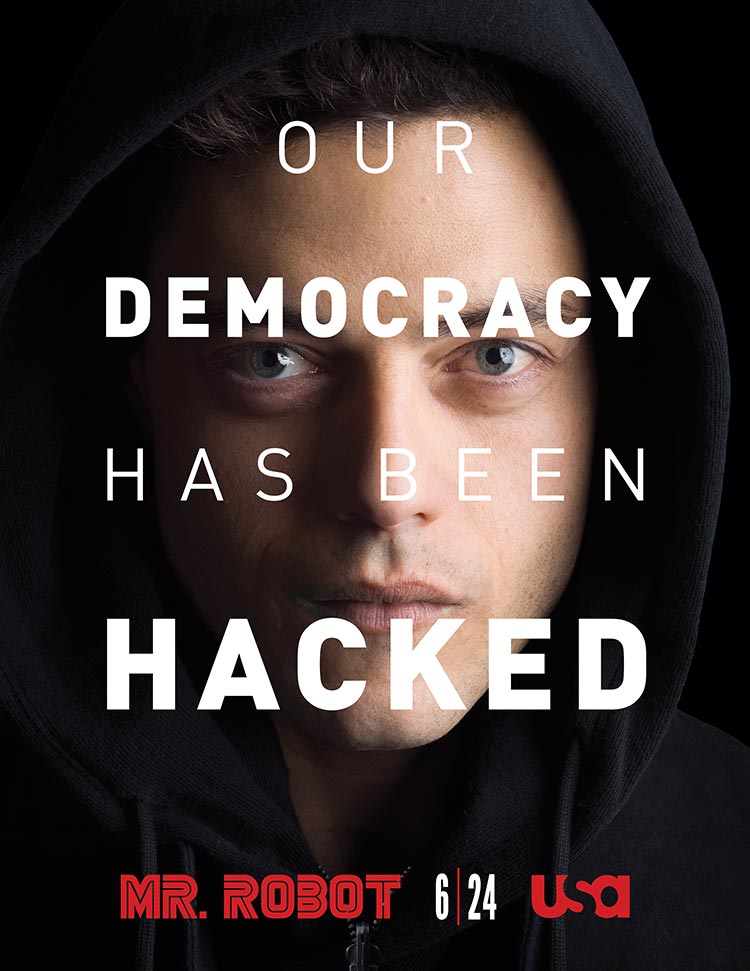
But my latest binge has been the hackers-take-on-the-corporate-beast saga Mr Robot. This took me back to one of the first TV series to grip me, The Changes, based on the trilogy of novels by Peter Dickinson. I used to come home from school avid to see this drama in which a collective lunacy leads to the smashing of machines and the pursuit of the technologically literate as witches. Years on, nervousness about our own Frankenstein creations grows: witness Humans, the Channel 4 series in which robots, or 'synths', produced as domestic helps, start to exhibit traits which makes them indistinguishable from their human masters (in other words, the only story you can ever really have in a drama about robots). In Mr Robot, post-2008, post-Snowden, post-Ashley Madison, machines are both enemy and friend. Enemy, when they take the form of massive databases storing  personal information and the world's debt; friends, when they are laptops used by brilliant hackers to bring down the beast.

Mr Robot is the story of Eliot (Elliott?), IT worker by day in a computer security company, and hacker by night, obsessively driven to hack into anything that takes his interest, but using his powers to do good, nailing the runners of a paedophile network, for example, in the illustrative opening scene. The story leads him into battle with the dragon E Corp, which actually calls itself in some kind of postmodern metafictional irony, Evil Corp. Eliot runs into a group of hackers who are bent on deleting all records of debt (think, though: your money is itself a debt that the bank owes you; your current account is from the bank's point of view a liability) and thus freeing the world from the grip of neoliberal capitalism. In another irony, this idea is itself a debt to Fight Club, a detail much noted by Amazon reviewers. In fact, Mr Robot is full of this kind of intertextual reference and in a long line of enquiry about the collapsing categories of virtual and real (Borges saw it all coming in Tlön, Uqbar, Orbis Tertius). Mr Robot himself is the architect of this ambitious scheme, and it is suggested pretty early on that he may be a product of Eliot's imagination.

About halfway through, the plot of Mr Robot loses direction and it becomes instead a trawl through Eliot's inner demons. It goes inwards just when it needs to go outward and explore the actual world a bit more. There are other annoyances: Eliot himself fits too neatly into the caricature of the brilliant IT nerd, and the team of hackers are similarly the usual gang of the variously disenchanted, airlifted in from some eighties movie by the looks of it and strangely undisturbed in their work by the attentions of the NSA. Their brandname of fsociety is distressingly juvenile. Sympathy for Eliot largely evaporated in my case when, as part of some daring break-in scheme, he has to behave in an absolutely foul manner to a blameless employee who is only being friendly. A psychotic executive is brought in to spice things up in a sub-plot that is hard to follow. The end, as we must expect in these cases, is a submission for a second season.

Still, many good things too. Excellent performances all round. One thing I notice in series these days is a much more sophisticated use of music and sound design to build atmospheres. This was part of the shocking and moving effect of a scene involving a car and a prison. for a while I thought it was all too binary, good little guys in denim pitched against the men in suits. But then I realised that the series is smart enough to see flaws in the Great Hacking Scheme, too: namely, once you have toppled the Capitalist Monster what are you going to put in its place? (In the final scenes, I wondered where all the plebs and execs partying actually got their money from). There are two brilliant passages of rapid condensed media studies discourse on the world as we experience it being essentially fake, a mind control system created by big business for its own ends. Lyotard, Chomsky ... eventually, ideas from anywhere get packaged as entertainment. And finally there is the irony of seeing an anti-corporate drama commissioned and streamed by the corporate giant Amazon (A Corp?) for our own entertainment, pushing away the real world for a while with a commercial fiction.  Illusion upon illusion. I watched this series the same week that Talktalk were humbled by a hack, first ascribed to some jihadist group but now, we are told, allegedly conducted by  game-obsessed teenagers. Perhaps Dickinson's luddites were right all along. Off to the garden shed to find a mallet. Down with machines and their sinister codes, and back to a life of honest toil in the fields of Old England.

Wednesday, 2 September 2015

Educating Cardiff / The Catch

Reporting on an evening's documentary television ...


Educating Cardiff (episode 1) took us to Willows School, recently turned around, we were told, by ebullient headteacher Joy Ballard and her team. The focus in the first episode was on Year 11, the GCSE year, although we did get a charming look at a Year 7 class being assured that the sun did indeed rise in Wales ('it's the one thing that turns night into day'), even though it didn't always feel like it; and the same class, I think, were involved in fantastic act of brinkmanship around the lunch break ('We're not finishing until this problem's solved'). The teacher in this case, and the one we saw most of, was Mr Hennessy; probably the most arresting moment of the programme was learning that Mr H himself had left school with just two GCSEs. He remembered crying in the kitchen with his mother the day results came out. He knew first-hand how things could go wrong, and went well beyond the limits of duty in trying to make sure that a group of truanting girls rocked up to their classes and took things like mock exams seriously. One of them, Leah, even got a wake-up call from Mr Hennessy each morning. We saw a lot of Leah, a bright girl who didn't see the point in school, although she was inspired by drama (the drama classes looked wonderful, by the way, and the rescue line they offered Leah was thought-provoking at a time when drama and indeed anything creative / expressive gets so little official support.) The other truant girls didn't seem to get so much attention, but that might have been editing. We also met Jessica, the oddball swat who actually wants to use classtime to study. Jessica was more comfortable with adults than her peers, diffident, introspective, not a great mixer, 'quirky' to use the word of the head ('I'm quirky too'). In a great move, Ms Ballard made Jess editor of the school newspaper, and she and her deputies promptly set about interviewing aspiring reporters, collecting comments in a suggestions box and proudly distributing the paper when it was complete. Both Leah and Jess got good news on results day. Leah could go to college and study drama, Jess got a string of As. Ms Ballard's governing style was matter-of-fact, arguing a reasoned case for turning up to school rather than bawling at her charges. I suspect anyone with Oxbridge airs and graces in this environment wouldn't last five minutes. Mr Hennessy stepped neatly into the tough-teacher-with-a-heart-of-gold persona that a series like this needs. The programme was edited from presumably hours and hours of film taken by hidden cameras. Classes looked quite bewildering exercises in crowd semi-management. There were terrific moments of wit (I loved the comment that a group of shuffling teens coming across the playground to school looked like a bad outtake from Reservoir Dogs). Some bits, like a roving reporter eavesdropping on a staff meeting (as teachers bizarrely discussed their fear of crabs and beetroot) had the feel of being staged. But beneath the charm the picture was troubling. Teachers seemed to be working with a population of children who were entirely disaffected. Where do you start with that? We saw nothing at all outside the campus, but it is only when family life is taken into account that the whole picture can emerge. I understand that Willows is in a very tough, very run-down part of Cardiff. What are the likely prospects for these children? What are their parents' expectations? As ever, the music pulled me whichever way the producers wanted my heart to go. I hope we'll meet a Welsh speaker before the series is done.


The Catch took us to a very tough place indeed, the fishing vessel Govenek as it sailed through a storm to trawl in the Atlantic, two hundred miles off the Cornish coast. I realised I knew nothing about fishing at all. For example, I didn't know that the men are not paid a regular wage. Instead they share the income from each catch, and are at the mercy not just of the tides and weather but also of constantly fluctuating prices. It was because foreign vessels had flooded the market and driven down prices that Govenek's crew had to stay out in the storm and go deep into the Atlantic (the eleventh, whatever that means), in the hope of catching enough to cover the costs of the trip. In the event, they came across a school of turbot and netted (hey, is that where that metaphor comes from?) £50,000 worth. (The selling is done at auction to supermarket buyers, with Govenek represented by an agent. There is a mark-up of over 50%  by the time it arrives in the shops.) While crews are usually different for each voyage, skipper Phil has a loyal team who sail with him regularly, trusting his judgment and putting up with his occasional irate visitations to the deck, hurling crates around and stomping off in a blizzard of expletives. The crew also had under their wing novice seaman Loui, from Essex, an interesting young man with a background in home schooling, no qualifications, an adoring mum and an obvious desire to put on a good show and be accepted as one of the boys. He made a good enough job of it to be allowed the honour of casting a grappling hook (or something) and getting invited back for a second trip. The Catch made it clear that this trade is serious, dangerous business. 'What's the worst injury you've seen?' 'Death. Death over the side, by drowning.' Phil remembered a man going overboard. He reached him in the water but didn't have the strength to get him back on board. 'He's still out there somewhere.' Great television. Humbling. Willows and the Govenek. Which would find me more of a useless burden, I wonder? And who would jump in to save me? (Why, Phil or Mr Hennessy, of course, two of Britain's last real men.)

Tuesday, 1 September 2015

School Swap: The Class Divide

School Swap was a two-episode documentary in which small contingents from a private and state school swap places for a week, to see how the other half lives (or, in the case of the privately educated, how the other 93% lives). In episode 1, the Headmaster of (private) Warminster School travelled with three of his pupils to (comprehensive) Bemrose School in Derby. And in episode 2 Derby visited Warminster. There were shots of the children in class, at the homes of their host families in Derby or the small dormitory at Warminster, and we got at least a glimpse of the workings of the two institutions.
Of course a series like this is primarily entertainment, not research. You never know how spontaneous scenes are, how much was shot again, what scenes were selected out for not following the gameplan, and so forth. Nonetheless, I found School Swap more enjoyable and illuminating than many documentaries, and less obviously manipulative. There were several thought-provoking moments. One of the private schoolboys, entered as a lower tier candidate for maths at Warminster (meaning he could not get higher than a C) was regarded as a potential A 'at least' at Bemrose. Was his school too anxious to stream, one wondered? Brett from Derby seemed positively euphoric in his dorm at Warminster, dressing for a formal dinner with evident pride and being motivated by some simple remarks on his potential and the need for hard work. Had no adult said this to him before? Both heads came over as warm individuals; Jo (Derby) made some insightful comments on how privately educated children take up a disproportionate number of top university places and jobs in the professions. Self-confidence, built through relentless positive messaging, seemed to be the answer. I liked her comment on the Warminster children already adopting the nonchalant Oxford walk. She was sharp, but not chippy, and completely devoted to the children of her community. Full credit to Warminster Head for giving a history lesson at Bemrose, too. Speaking of which, the teaching seemed to be much the same in both schools, though the extra discipline at Warminster (made possible by smaller class sizes) was remarked on with admiration by Brett.
School Swap had its weaknesses, of course. Most obviously, it was an experiment that decided its conclusion in advance: private schooling is better because the days are longer and crammed with goodies. Filming techniques underlined this message. Warminster was forever bathed in golden light and surrounded by ethereal music as the camera soared celestially upwards as we contemplated the transcendent beauty of the campus. It is, we were told, 'exclusive', a word delivered with no apprent sense of irony. Bemrose was shot much more from ground level. No ethereal music accompanied the punishment room, or the session on nutritional eating, though to be fair the street-fest we saw looked a lot more fun than hymn practice at a Warminster assembly. Parents on both sides were remarkably absent, though they are surely the most important figures of all.  Warminster Head's comment that 'we have two education sectors in this country: private and state' is technically true but disguises - as he would know - a mass of complications. State education differs widely according to distribution of wealth; state schools in affluent areas are de facto largely private, serving those who can afford to live in the catchment area. And whatever school they use, families will still be differentiated by wealth: parents with money can afford after-school music lessons and drama clubs and the like, and those without can't. Did Warminster have to go all the way to Derby because the local comps weren't grim enough? I welcome the project to have joint clubs for both schools, on equal terms, but it's hard to see how that could work across such a great distance. Still, collaboration and some measure of integration across sectors is surely, both morally and practically, the way forwards. There was no time to examine how well children at either school were served by the national curriculum, but perhaps that is the subject for another documentary. And while Bemrose was shown working brilliantly to address the socioeconomic problems of its intake - the breakfast club for disaffected boys and the pastoral mediation session were inspirational - Warminster seemed to have no problems whatsoever to deal with besides the Head not having room for his dessert at dinner. That can't be true, surely? No one is perfect. Was there no case of homesickness, obsessive helicopter parenting, individuals not fitting into the vision? You believe the good things more when you hear about the not-so-goo things.
All the same, School Swap was a good two hours of television, and while at the project stage it might have expected shock and confrontation, it delivered instead a heartening mood of curiosity and genuine burgeoning friendship. When the ethereal music was over, one could only reflect that there are losses on all sides when the young from different backgrounds are separated during their schooldays, which is exactly when they should be getting to know each other. I don't think it's a question of private establishments having a superior approach to the business of educating, much as they love to philosophise about their art: of course Bemrose would have lectures and clubs and dinners if it could afford them. It really does seem to come down to money. Class divide, indeed.

Wednesday, 16 July 2014

2013-14 Selected TV

Looking back over the last few months, I note I have watched heroic amounts of TV. I am, in fact, addicted to television drama, which has many advantages over the live version: free (well, factor in the license and the LoveFilm sub, and it's still nearly free), often brilliantly acted, sometimes brilliantly written and you can watch it at a time of your choosing with pause facility and no one there to annoy you. Yes yes I know you don't get the chemistry, but then there's a special chemistry too between me and Jack Bauer two feet away on the laptop, soundtrack of pulsing music and CTU's myriad of gadgets pounding into my ears. As well as an accessible alternative to theatre, TV drama is just as absorbing and stimulating as many novels.

So, yes, all of 24 Season 7 and now halfway through 8 and realizing with joy that I have completely forgotten the disposable plotlines of all the others so can watch them again. Seem to remember the first was actually a taut thriller about protecting a presidential candidate with no nuclear bombs or imminent threats to a whole seaboard in sight. I love the intense talk of protocols and schematics, the data analyst as hero, the guilty feeling of being absorbed in right-wing apologetics (not so bad when a corporate nutcase steps forward as top baddy), the glorious predictability (it's not one plot but a series of them: as soon as baddie no.1 is dealt with, we learn there's someone EVEN BIGGER behind them, in a kind of reverse Russian doll sequence), the way an English actor (in 6, I think) has to breathe life into lines like 'I'm not going anywhere without you'.

But 24, and indeed most things in this dull sublunary sphere, wilt and fade before the majesty of Breaking Bad. Walter White, the teacher I should have been (never good enough at Chemistry, alas; and it's hard to break bad armed only with the skills of close reading of poetry and a smattering of Stanislavski). My thoughts on this are not yet beyond the visceral exclamatory stage. Gus Fring! Tuco! Hank! The season where every episode starts with shots of the pool (copied from, or by, House? I haven't checked the dates)! There are episodes (Grilled, Phoenix, Fly, Dead Freight, Ozymandias) that stand on their own as amazing dramas, taking you to emotional areas that linger in the mind long afterwards. There is a sense throughout that this is modern capitalism, scrabbling and killing for medical insurance money, right on the edge of civilisation; the parched desert becomes the image of the contemporary, atrophying soul. But for close  reading of this, best to go to the careful reviews on Den of Geek (oddly banned from our filter as a gaming site). From the desert to the snowscapes of Minnesota, and Fargo was a recent pleasure. There are no rules, as great villain Lorn Malvo patiently explained to Martin Freeman. Though didn't he turn from something extra-human into a normal mortal at the end? True Detective was brilliant at the start, turning into something more regulation buddy-cop thriller at the end, but as with BB and Fargo making a whole landscape - in this case the swamplands of Louisiana - the main character. J and I ended our long-term project of watching all eight seasons of House, enjoyable right to the end despite the diminishing circles solely because of the central character, brilliantly portrayed by Hugh Laurie, though Wilson provided a fine comic foil. And going back almost a year, time to mention the enjoyable, atmospheric oddity of Jane Campion's Top of the Lakes, the ultra-miserablisim of Southcliffe (comparable to David Greig's The Events as a response to inexplicable mass killing) and the historical portraits of life in The Village and The Mill.

For other British TV, much enjoyed watching The White Queen and having it explained to me by nJ who was studying The Wars of the Roses at the time. I gave up on the first In the Line of Duty (bolt-cutters are my limit) but watched the second series through, held by one genuine shock moment and the compelling Keeley Hawes, right up until the messy ending, where tying ends together just created a big knot. Serial killer series The Falls (our answer to The Killing and The Bridge) was, added to those, too many young women being tormented and killed for our televisual entertainment. My diet of Euro TV, aside from Scandinoir, has included Braquo - like Spiral, a French equivalent to The Shield only the subtitles make you feel clever - and (just started) Isabel from Spain.

So - good to get away from the grimness with some comedy, and have loved the Office-style psuedo-docu of Parks and Recreation and W1A (following 2012 - but why are British comedies so pathetically short compared to US ones, by the way?), the crazy fun of Brooklyn Nine Nine, the love and pain of Rev (the Easter episode incredibly moving). Coogan and Brydon's The Trip to Italy became steadily less interesting: I wanted to hear more about the food and less of their admittedly accomplished impressions.

Wednesday, 11 January 2012

Dickens on Film

Interesting Arena documentary yesterday evening on film adaptations of Dickens. These have been pouring out from the earliest days of the cinematograph, and the production line is as busy as ever. The phenomenon is hardly surprising. Dickens considered himself a man of the theatre, and initially wanted to be an actor - a talent he was able to exercise in his stage readings. The novels themselves are composed of theatrical scenes and characters: somehow Dickens makes popular melodrama into high art. The programme was ingeniously made, cutting unexpectedly from one vintage clip to another, sometimes using voiced commentary, sometimes words on screen. In a clip from a lecture, novelist Angus Wilson explained that Dickens was a 'simple New Testament christian' whose novels distinguish clearly between good and evil, but also juxtapose these forces continuously. The ugly and beautiful, the demonic and angelic, constantly cohabit in the same sentences and paragraphs: Fagin and Oliver, Squeers and Smike, Quilp and Little Nell.  Film can recreate the half-real half-phantasmal world that Dickens's stories move in, and film and TV adaptations can rebuild something like the world which Dickens's readers knew but which has long gone now. For Our Mutual Friend, the Thames and its drab docklands had to be rebuilt in Cardiff. We were taken through silent treatments, early talkies, paused to admire the greats (David Lean), and thence were taken into the world of TV. This medium opened up the larger sprawling novels, which had been resistant to the compact sapce of a movie. Apparently Dickens at 5 on a Sunday afternoon was once a national institution (is there any reason why tapes of these can't be put online?). I didn't know that the Russian director Sergei Eisenstein on 'Dickens, Griffith and the Film Today' (in Film Form), praising Dickens's prescient use of montage and cutting between narrative threads to heighten mood. It's one thing to say a writer is cinematic, it's another to have it said by a genius of the cinema.

Saturday, 7 January 2012

Public Enemies

It's a disconcerting thought, but most of my knowledge of social issues at the tougher end of things probably comes from the telly. From juvenile offenders (Out of Control), to rehabilitation (Boy A), drugs culture on council estates (Top Boy), immigrant labour ( Ken Loach's brilliant It's a Free World), railways (The Navigators, Loach again) and social services (the somewhat sui generis Appropriate Adult), the picture in my head of these matters is largely created by TV drama. And there have been many others, not on this off-the-top-of-my-head list (Peter Kosminsky's work, for example, swims belatedly into mind). Last night saw the conclusion of the BBC's first (I think) serious social issue TV drama of 2012, Tony Marchant's Public Enemies, which looked at the Probation Service. The story focussed on the relationship between a probation officer (Anna Friel) and a released offender (Daniel Mays). The plot can be easily found elsewhere, so I'll just note down some first impressions. Spoiler alert, by the way, if you haven't seen it yet.

The first thing is the genre, the social issue drama. These get so little release in mainstream cinema we must be grateful for the medium of television to keep them going. In terms of content, social issue dramas pull in two directions. First, they have to give realistic information on the topic, and I gather Public Enemies took expert advice to make sure that what it portrayed was accurate. Like all the films / series in the list above, it left me far more informed than I was before about the matter in hand. Today I actually know a little bit about things like release conditions, hostels and curfews, exclusion zones, probation disciplinary hearings, paralegals etc. But at the same time these series have to be dramas, with character arcs, suspense, recognition, resolution and the general Aristotelian kitbag. And in real life - whatever the social setting - character arcs and uplifitng resolutions don't happen all that often. So the social bit and the drama bit can be in a kind fo tension. This is a standard challenge for any realistic narrative, of course, cf Gaskell, Gissing and co.

Public Enemies started with heavy realism, taking us through the problems faced by offenders on their release, as they try to re-integrate into a hostile society, which is whipped up by a vicious media. As well as this, there was also an interesting line on the Probation Service falling into the culture of minimising risk rather than reforming its clients. But then the drama started to take over, and we got standard tropes of a Proving-his-Innocence story plus Romance plus a Twist. The central characters were very well played, but depended on several walk-on parts (like the ubiquitous resentful / baffled partner who watches helplessly as the protagonist get more and more involved, it no doubt happens, but had enough of that in The Killing, thanks). As a story Public Enemies worked, but as it developed the drama seemed to be shying away from the main problem it had set up. To ensure our empathy, the assumption seemed to be, it had to change the main character from guilty to innocent. So the whole issue of what's involved with a guilty ex-con being released, and how people - how we -  react to this, was not really explored. Making us sympathetic to a guilty person would have been much more of a challenge, and I was sorry that Public Enemies didn't go down this road. Also, the girl in the Garden Centre had to quietly disappear so Friel could take over as the love interest, which seemed a little callous.  But certainly a worthy piece of public education, with great performances all round.

Saturday, 31 December 2011

Great Expectations (BBC)

The BBC got started on the Dickens bicentenary just before 2012 with a three-part adaptation of Great Expectations (and also excerpts from Tomalin's recent biography nicely read by Mrs Crawley, sorry, Penelope Wilton). This treatment has drawn some critical ire for its rather free approach to the business of adaptation, and it was certainly surprising to see the plot actually being rewritten in the closing stages. All humour was bleached out (no Aged Parent, for example), and the verbal tags (Joe's 'What larks', Jaggers' 'Put the case') were largely excised.  Miss Havisham, played by Gillian Anderson, was much younger than usual, and moped around like the doped out survivor of a grunge rock band.  Biggest mistake was to make Pip (played by Daniel Booth) into a willowy fragrance model, with lean pale cheek and quivering upper lip - this might be the modern metromale in the Age of Beckham, but the idea that a blacksmith's apprentice would look anything like this after seven years in the forge reallis just absurd. Nor could we believe that this rather self-assured young man was inhibited by Estella, who in fact came over as the needier of the two. But from all these changes some of the emotional darkness and strangeness of the work surfaced. Joe, Jaggers, and Magwitch all took their turn as surrogate father in Pip's journey, and what was lost in humour was made up for with the sense of being hopelessly lost, stranded in a pretend self between the marshes and the murky London streets. There was also a real evil about Orlick, Drummles and Compesson which larks and merry evenings at the Wemmicks can obscure. In general the production reminded me of The Crimson Petal and the White, another exercise in new-look Victoriana, much possessed by questions of hysteria and identity. Great performances by Ray Winstone (Magwitch), David Suchet (Jaggers) among others. And plenty of BBC Dickensiana to look forward to.

Thursday, 22 December 2011

Black Mirror, 3: The Entire History of You


The final episode of the Black Mirror trilogy wasn’t written by Charlie Brooker but by Jesse Armstrong, whose CV includes Peep Show and Fresh Meat. Here the topic was memory. In The Entire History of You, we entered a world where our memories are captured by an implant called a ‘grain’ (not unrelated to a pod). We can then scroll through these (how they are sorted into files is left to the viewer to imagine) and select memories to replay: install recall at a click. It is a neat way of taking the world we already have, where we are already familiar with vast internet memory caches, tablets  and memory sticks, and looking a little further down the road.
The Entire History of You touched in passing on various possibilities created by this technology: memories scanned and checked when we travel; the chilling prospect of ‘retrospective litigation’, where parents are prosecuted for their children’s lack of earnings; and the idea of memories being stolen, manipulated, sold. In the end, the story explored the idea that instant access to memory stores could (already does?) lead to obsessive behaviour, as a young husband pursues his suspicions of his wife’s infidelity until their relationship is destroyed, and memory itself has become toxic. Most of the action in fact lay in the relationships of the key figures in this triangle, the technology being worked into a familiar jealousy story. As the story unfolded, it was clear that the perfect availability of the past was eroding the value of the present: this was suggested in the sleek, soulless houses and the oddly empty green spaces between them. There were a few quirks, perhaps: wouldn’t the wife know her husband was the jealous type? Is it plausible that his behaviour could be suddenly triggered at a moment he feels vulnerable about his career? And why does he drive such an old car? Are those who voluntarily don’t have a grain -  it doesn’t seem to be a compulsory ID marker, yet - not able to travel? The main character of Borges’s greart story ‘Funes el Memorioso’ remembers everything but as a result he cannot really think, because thinking involves constantly abstracting from particulars. In The Entire History of You the protagonist drowns in a sea of particulars, until he comes to realize that living must involve forgetting. In a world where we recreate ourselves on Facebook, blogs, and in digital info of all kinds this is worth, well, remembering. A strong end to this interesting series.

Wednesday, 21 December 2011

Black Mirror, 2: 15 Million Merits

A much better effort, I thought, than the first programme in this trilogy. Without an against-the-clock storyline we were able to enter more fully into the world depicted and muse upon its verities. So here we are, in a world where humanoids (or at any rate the young good-looking ones) are locked away underground, pedalling on gymn bikes to build up credits / merits (the creatrors seem to take a dim view of gymns), and fed a Matrix-like world of videogames and streamed TV junk (porn being in heavy supply). There do not seem to be  books, or any other source of real culture, and language has decayed to the point where conversation is denuded into almost nothing.  Individuals are locked away for some time in individual cells made of screens where video is beamed from all sides and watching appears to be compulsory. The only way out of this inferno seems to be to spend 15 million merits to have a chance to appear on the talent show 'Hot Shots', an amphitheatre of cruelty and all things synthetic, there to perform to the boos and yelps of an artificially generated audience. Before you go on stage, you have to drink 'Compliance'. Thus a promising singer can be recruited to a porn channel (it's either that or back to the bikes). In the story her champion manages to appear himself on the show and speak out angrily against the tat, the packaging, the fakery ... but the system, as total systems do,  immediately co-opts all opposition, and the would-be rebel is rewarded for his 'passion' with a penthouse, a more attractive artificial reality to look at, and regular slots as a show protestor on another 'stream'. (A neat acknowledgement by husband-wife writers Brooker-Huq here that their attack on TV is also TV entertainment).

Regular dystopian tropes, then, but beautifully observed. The 'Hot Shot' judges (led by a brilliant Rupert Everett) were amusing but also sinister, and touches like the bored-out-of-their heads staff and the awful Scouse contestant ('singing is my destiny') gave it all a credible air. Most memorable of all was the picture of human nature itself melting into something else, as endless junk, grey uniforms, and the vanquishing of the past by media tat did their work. We sensed that tender relationshiops like the one between the two protagonists did not have long to go. Not Orwell's totalitarianism, but late post-humanist capitalism triumphing over the human spirit. This one really did hang together, and will linger in the mind.

Monday, 19 December 2011

TV: Charlie Brooker, Black Mirror 1: National Anthem


After getting my weekly fix of Southland on 4od I watched the first episode of Charlie Brooker’s satire Black Mirror, a none-too-subtle title for a series clearly meant to hold up a mirror to the darkest aspects of our collective self. This episode was called National Anthem,  in which a contemporary artist (the shocking antics of contemporary  art , tick) kidnaps a 'princess' (celebrity culture, tick)  and demands on a YouTube video (viral media, tick) that the prime minister (politicians, tick) performs a bestial act live on TV (degrading effects of (a) opinion polls and (b) modern media, tick tick), all of which is covered gleefully by TV stations (the hysteria of 24-hour sensationalism, tick) and  - initially - cheered on by a demented population (brain-sapped plebs, tick).

I did watch to the end, but I didn’t find it a particularly effective satire. It ticked all the boxes (see laborious parentheses above) too knowingly, but didn’t seem to be coming from any engaged position. It didn’t seem that we were really being warned about the lobotomising powers of media culture. Instead we were invited to admire the cleverness of the creators as they referenced Facebook, Twitter etc.  As we noticed actors who had been in The Thick of It etc. we found ourselves in the self-congratulatory world of TV shows alluding archly to each other. In other words, the programme was itself a case of the kind of media-obsessed world it was supposedly satirising, and as so often it was more than half in love with the technology (cf a Spooks-style raid) it was holding up to the, well, mirror. It just seemed lacking in insight and fresh angles: Nothing was said here about art / politics / YouTube etc. that we didn’t know already. The plot in particular seemed to be begging for notoriety, but was let down by massive implausibility (eyes, not a DNA test, would normally be enough to distinguish a male from a female finger.  A contemporary artist who is an IT genius + mad + depressed + capable of kidnapping a Kate Middleton-figure from security guards? Please.) It was unsure of its tone: was the scene with the ‘performer’ standing in for the PM meant to be funny? If not, what was it meant to be? Most of the charcterisation was thin. The PM and his wife needed more screentime together for us to get interested in their relationship. There was very little sign of characters with any moral conflict, which might have given the isuues human depth.

So, it was all a bit of a disappointment, especially since Brooker is one of our best observers of pop culture: his Screenwipes and Newswipes are an absolute must. He has also written extremely well: Nathan Barley and Dead Set are strong satiric works.  National Anthem had its moments: there were some comic touches (the idea of a police team surrounding a house in … Truro); the change of mood as crowds watched the PM’s humiliation did go beyond the simplified crowd portrait we had seen up until then; and the very end contained some sharp points about the dynamics of public and private life. But there weren’t enough of them. Having said that, as a Brooker fan I shall certainly give the next episode a go.