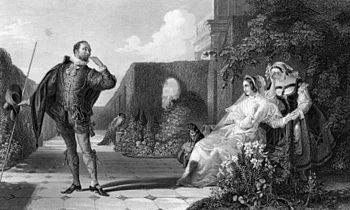
 At the time of writing, there are various productions of Twelfth Night going on: The National, Salisbury, Globe ... and the Winchester players are taking it to the Minack in Cornwall this summer. And of course thousands of school students have the joy of being examined on it. So, here is my guide to the play, scene-by-scene, published as a downloadable, photocopiable resource by zigzag. Hope someone, somewhere, finds it useful.
Showing posts with label Shakespeare. Show all posts
Showing posts with label Shakespeare. Show all posts
Sunday, 4 June 2017
Twelfth Night: Comprehensive Guide
At the time of writing, there are various productions of Twelfth Night going on: The National, Salisbury, Globe ... and the Winchester players are taking it to the Minack in Cornwall this summer. And of course thousands of school students have the joy of being examined on it. So, here is my guide to the play, scene-by-scene, published as a downloadable, photocopiable resource by zigzag. Hope someone, somewhere, finds it useful.Friday, 8 July 2016
Romeo and Juliet
 Before the live streaming of the Kenneth Branagh production of Romeo and Juliet there were some brief video interviews with teenagers. The interviewees were asked what was best and worst about being a teen, and - moving into the Shakesperean zone - whether they believed in love at first sight. They weren't asked whether they thought it would ever be a cool idea to fake death through drugs in order to meet their exiled beloved in a tomb, though. And the question of arranged / forced marriage was not brought up, either. Anyway, this warm-up was a refreshing change from the somewhat gushing interviews we sometimes get at the start of live theatre screenings.
The production itself was strikingly broadcast in black and white. It can't have been much different in the theatre: the whole white-grey-black chromatic design was inspired by the films like La Dolce Vita, with sharp suits and slick or laid back movement styles to match. In the Capulet ball there seemed to be a nod to the amazing protracted party sequence of The Great Beauty, with its short electro score and angular choreography. There was the architecture of Fellini, too. A simple set of stone walls and columns was used to suggest a flow of scenes from piazza to café to sepulchre, in dramatic mediterranean light. Some jazzy numbers were added, with well-chosen moments of ambient soundtrack at key moments. Lily James and Richard Madden shone as the lovers, finding a seductive playfulness in the verse. This is the first production I can remember where comedy was discovered in the balcony scene, and it made their joyous discovery of love all the more affecting. Given the poster, the erotic aspect was played down here. Senior actor Derek Jacobi was cast as Mercutio, which seemed a peculiar choice as this part is normally seen as a hot-blooded, even manic, natural stand-up and hell-raiser; but it all made sense when in the preamble Branagh explained his inspiration in reading of the ravaged Oscar Wilde haunting cafés in Paris: and so we got Mercutio the faded playboy, hanging out with the young bloods, not manic but mellow, dreaming of past conquests. His brief song was charming, and the death that followed soon after was very touching, making a lot of the idea of a 'scratch', of the pointless contingent nature of it all. Overall the production did what it should do, allowing the emotional realities behind the narrative to unfold, so we could see that the play is also the tragedy of the Nurse, of Paris, of the now childless Capulets, of a culture in the chiaroscuro of love and death.
Of course there is always the oddity of the Friar. What the hell does he think he is doing? Would it have been possible - or prudent, anyway - for a priest simply to marry off the children of seriously powerful families in the city just like that, without, you know, checking it was OK? And you don't need to be obsessed with risk assessments to see that the whole precision-timed escape through drugs business is a non-starter. It did look in this production that the herb-dealing Friar wasn't going to be allowed to scamper back to his breaking bad lab any time soon, at any rate. But, hey, Shakespeare is allowed creaky plots. The production was powerful, balancing quick passages of movement with stillness. Star of the evening was Lily James, who balanced passion with clarity, conveying a girl at once in command and hopelessly out of her depth. The 50s look worked to good effect (though the Prince looked more like a traffic warden than an absolute ruler), and for me it was a night at Okehampton Carlton well spent, even if I did have to move grumpily away from a row of people who felt the need to chomp on crisps through the whole thing. Seeing a London show on the edge of Dartmoor, many a mile from London, brought home the value of live streaming. With one cavil, though. A superb touring company in Winchester not so long ago had undeservedly small houses. If there's any evidence that streaming shows with big names is impacting on live theatre in this way then I hope something could be done - some share of profits recycled back through the relevant funding body, perhaps? It was something to ponder, on a memorable drive back in the dark and rain through winding, deer-haunted country roads.
Saturday, 27 February 2016
As You Like It, National Theatre
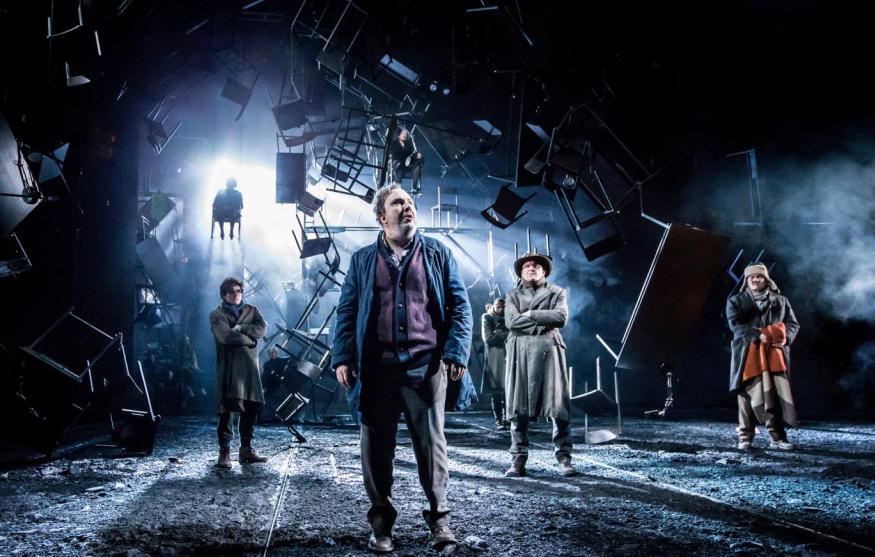 The National Theatre's new production (the first in over 30 years, forsooth) of As You Like It opens in a modern office space, where Orlando is employed in the lowly capacity of plant-sprayer. During the day, the office fills with workers doing things at PCs and having choreographed snacks and, as is common in office life these days, enjoying breaks for wrestling matches featuring the Duke's Champion, staged with all the bling and zing of the WWF. When the scene moves to Arden the chairs and desks are hauled up in an ingenious whoosh and dangle mid-air, forming an expressionist forest, like a gigantic installation sculpture - visually suggesting, perhaps, that Arden is the world of court / office turned inside out and topsy-turvy. Backlight is splintered through this remarkable creation, shadows flicker, and there is an accompanying sculpture of sounds from animal noises to (beautiful, in Orlando Gough's score) a capella humming. As couples couple and the wafer-thin 'plot' resolves we are released from dimness into primary colours, dancing and happiness.
I start with Lizzie Clachan's set because this is what really lodges in the memory. The Olivier certainly invites such huge design-led productions, and the NT economics presumably make it possible. Perhaps West End expectations make it necessary. Every play I have seen in this space recently has had a staging hugely in excess of what the text actually requires. You start to wonder how the price of a ticket is divided: how much of a £40 seat goes to superfluous non-speaking actors who, in this case, sit first at a desk, then among the trees or pad around as sheep? (Or how about the policemen in Man and Superman who appeared for 1 minute of a 3-hour play?) How much then goes to the machinery which makes such a colossal mechanism work? Or to the creative team of 13 (what does an 'Artistic Collaborator' do?)? We are getting close to the point where the directors outnumber the speaking actors, like the physios and psychs on a test cricket tour.
Well, all this extravagance could have overwhelmed the play itself, but the acting was thankfully strong enough to distract us from the set and its population of extras. Actually, this was a particularly clearly delivered production: every sentence was doing some work and made sense of. Joe Bannister was a likeable Orlando, Rosalie Craig a feisty Rosalind. The complicated stage business around the wrestling smothered their initial meeting, and this Rosalind was always more in control than she was giddy with Cupid's dart. Orlando's 'I can no longer live by thinking' rang out with a pathos I had not felt in it before. Celia (Patsy Ferran) and Oliver (Phillip Arditti) were miraculously convincing in their love-at-first-sight moment and generally a delight to behold. Touchstone (Mark Benton) wasn't funny, but I defy anyone to find this character funny, whoever plays him. Sixteenth-century logic-chopping wit is as dead as a Monty Python parrot. But I'm glad this rather unpleasant fool got a clonk on the nose from William at the end of that horrid little scene. Jaques (Paul Chahidi) was done interestingly, with the seven ages speech delivered as a kind of improvisation upon an idea, bringing refreshing spontaneity to this tired set piece. Much facial expression suggested some kind of condition explaining the character's melancholy. The production ended by working its charms, with no attempt to disguise the preposterous ending, and a full-scale all-singing-all-dancing finale in gorgeous costumes.
Briefly mentioned among the padding with which NT surrounds its live screenings was the fact that this was a 1599 play - that astonishing year which saw this, Julius Caesar and most likely the beginning of work on Hamlet, as Shak and Co. moved across the river and into the Globe. A feature on the history of performance in the NT was really nothing more than a few reminiscences of how awesome it is to play that space by whoever they could round up. More on 1599 would have been instructive. Mighty things were on hand at this point in Will Shak's life - meta-theatre (we need to see a production where boys are playing girls playing boys seducing men to see what got Puritans hot under the collar), fluidity of character - you are who you decide to be in the given moment - and forays across and around the frontiers of serious and comic. As for stunning sets, if we have clever people to make them and the London crowd are happy to pay pretty prices to be wowed by them, then I suppose they will continue. You can always go the Globe or Sam Wanamaker for something barer. As you like it, indeed. But I remember warmly a recent workshop at the National itself on 'simple, effective' design and I would like to see something there soon in the Olivier or Lyttleton using a couple of tables and a chair or two. Go on, NT creatives, I dare you.
Saturday, 24 October 2015
Hamlet (Cumberbatch)
 We went to see Hamlet in what is rapidly becoming my favourite way of seeing London productions - streamed from the theatre onto a cinema screen, cutting out the expense and fatigue of travel and bringing you up close to the acting. It was particularly appropriate to this record-breaking-sold-out-within-minutes production directed by Lyndsey Turner and starring Benedict Cumberbatch. For this show had so many cinematic effects, it felt like watching a film turned into a stage play and then turned back into a film again. Lyndsey Turner was working with Designer Es Devlin; their last collaboration, which I saw in the NT Lyttleton, was Caryl Churchill's A Light Shining in Buckinghamshire. Both productions in their joint vision have featured a large and well-stocked banqueting table and large amounts of earth (in neither case required by the texts, both of which can be performed on a nearly empty stage). The Turner-Devlin Hamlet was set a vast palace interior and used Richteresque ambient music to underscore the emotions of the scenes. There were chases under strobe, freeze frames and a stunning dust-storm at the end of the long first half, leaving the palace a half-sunk ruin for the second, symbolising the moral decay of Claudius and Denmark no doubt. Heaven knows how many lighting cues there were; the whole thing was certainly visually exciting to watch, with a wardrobe ranging from evening dress to modern military and a delightful large toy fort.
I start with the look of the thing because that did, over time, become a distraction. Shakespeare's verse is deeply visual because it was written for a less furnished stage than a lavish London show would dare to put before us. A clever design can accentuate the feelings of a work, but it mustn't work against the words themselves. Here it did. when Claudius is giving his first speech on the death of the old Hamlet and his marriage to Gertrude, we shouldn't be gawping at ornate evening dress and weird table props. There were moments when what we saw and what we heard took us in different directions. For example, we saw in mime Hamlet put on an Indian head-dress in what appeared to be an affectionate, playful scene with Ophelia. But then we saw Ophelia reporting Hamlet's appearance (2.1), 'My lord, as I was sewing in my closet'. But what she was describing was not what we had just been seeing at all. What were we to make of this? Was the idea that she was making it up? But why would she do that? Then there is design and stage business when none is really needed. Consider the brief scene about the fight for a scrap of land in Poland, setting us up for 'How all occasions do inform against me' (4.4). It's an odd afterthought of a scene in any case, and hardly needs a whole military camp with soldiers in tents blowing on their fingers to bring it alive. This is theatre adapted to the hyper-visual world of the modern audience, I suppose. But it must first and foremost adapt itself to the text. The Players scene (shortened to lose the dumb show) didn't work simply because in order to see the lovely mini-stage on the stage we couldn't see Claudius, and everything is meant to be about his reaction (the camera helped us cinemagoers a bit).
All this can be justified by theatre's constant need to recreate itself, and the changing expectations of a younger audience (it was great to see some youngsters at Vue Cinema when we saw it, apparently there of their own volition and not part of a school trip; if Cumberbatch brought them and cool visuals held them then that's an undiluted good). But that brings me to a further grumble. If you're going to bring Shakespeare to the people, then it really should be Shakespeare, untampered with. In this showing, the opening battlement scene was lost and sort of transposed into Hamlet's meeting with Horatio; but that first scene, amongst other things, establishes Horatio's character as the studious sceptic, a foil for Hamlet's more intuitive cast of mind. Polonius was heavily cut. His first speech amounted to 'He hath. my lord. I do beseech you, give him leave to go.' In the text you'd get in a bookshop, we get: 'He hath, my lord, wrung from me my slow leave / By laboursome petition ...' and so on in leisured rhetorical fashion. Notice how this speech characterises Polonius as a windbag, a trait developed in his advice to Laertes (also edited), his spying on Laertes (cut entirely), and his meeting with Hamlet (reduced). In this production, Polonius was in fact turned into a model of concision, making the Queen's exasperated 'More matter, with less art' quite meaningless. Shakespeare's character of Polonius had been turned into a fairly nondescript elderly courtier. But of course, we must concede, Shakespeare's company cut, and we must regard the texts we have as flexible things, at best approximations to what the first audience heard. Still, I don't think flexibility should reach to simplifying and modernising the words themselves. Instead of 'Good Hamlet, cast thy nighted colour off', we got 'nightly colour'. Why? Is 'nighted' really too brain-achingly tough to figure out, especially when he's wearing black? Accents shifted. Claudius gave 'comméndable' in the modern stress, against the metre of the line, but the correct 'perséver' a couple of lines later. We heard, or I think I heard heard, 'Things rank in nature possess it merely', and I contend that the missing 'do' matters. In Gertrude's description of Ophelia's death the 'hoar' leaves were kindly translated for us into 'pale'. Unless I am mistaken, every mention of a Polack was nervously corrected to 'Polish'. Everything was delivered in the modern naturalistic style: Gertrude's 'I thought thy bride-bed to have decked, sweet maid' had at least two heavy pauses breaking up the line, just to take one example among many. Well, this is Shakespeare today and it can bring lines alive in unexpected ways. I don't think I'd ever really registered 'The sun no sooner shall the mounains touch' (4.1) but something about its delivery on this occasion put the image vividly in my mind. This is why one goes to Shakespeare repeatedly. I wonder if there will be a swing towards a more verse-oriented delivery of Shakespeare in coming years. Perhaps I should forget these reservations and get into the flow. Perhaps. But orchestras don't change Mozart's notes, and art galleries don't alter their masterpieces to make them easier to a modern sensibility. There is something indicative of a deep lack of confidence in altering the thing you are bringing to the public, however slightly. Wedges continue to have thin ends.
All that being said, I did enjoy this Hamlet and was glad I went. There were some excellent performances. Ciaran Hinds was a menacing Claudius, and Karl Johnson was brilliant, doubling as Ghost and Gravedigger and getting both parts across vividly. Sian Brooke was an affecting Ophelia, making her frankly tedious mad scenes into something touching, especially when she went to the piano, and Matthew Steer was an amusing Rosencrantz. Benedict Cumberbatch himself was full of vocal and physical energy, bringing across Hamlet's relish of exercise both mental and physical just as he is saying he has had enough of it all. In fact his action-packed performance perhaps diverted us from the point that the play revolves around his hesitation, his in-action when it comes to the moment of vengeance. But this is just hard to get. How many in a modern audience are worried that they might go to Judgement unconfessed? Yet the failure to kill Claudius while he is a-praying revolves around this. Cumberbatch made sense of the soliloquies and his Hamlet overall was humorous, genial and engaging. I did find the music, the antics, the imaginative staging, the cool visuals exciting. And there were moments which came across effectively and poignantly - 'there's providence in the fall of a sparrow' struck me as a particularly well-tuned moment. But after the immediate excitement had faded I felt the production tried a little too hard to be like a movie and lost the intimate verbal drama of Shakespeare's creation. Somewhere at the back of my mind was a speech by Steven Berkoff reported in the paper that same day, on how young actors these days don't know or care about the history and traditions of their craft. I don't know whether that is true, but practitioners can always benefit from opening themselves to older styles. Also in my mind, a letter to the paper a while back wondering why it is that while musicians work hard to fathom what Beethoven meant by a phrase or passage and try to bring it out in performance, productions of plays and operas often push the author to one side and 'interpret' their material into some bizarre places, and sometimes out of recognition. There must be an answer to that, but I can't think what it is. Perhaps it's to do with markets, directors and designers needing to have a brand. We mustn't overstate the role of the 'creative team' as it's unfailingly called these days. I love directing plays, but I can't see it as a creative act comparable to writing one. Shakespeare is the Creator we should be left thinking about. All unresolved issues pattering round the brain. Hamlet, more than any other work, at least gets you thinking.
Wednesday, 16 July 2014
As You Like It (SATF)
 Here's how to do it. Shakespeare at the Tobacco Factory's As You Like It is stylish, clear, beautifully paced, engaging throughout. The stage is a largely empty space with just a few pieces of furniture here and there and a striking backdrop whose abstract swirl hints at forests real and metaphorical. And from the opening moments it's clear that we're going to get an intelligent and unfussy account of this exploration of hatred, love, disguise and reconciliation, focussed on bringing out the characters and situations without any intruding directorial concept. If Orlando's defeat of Oliver at wrestling was slightly hard to credit (but then it always is), the resulting love / infatuation was instantly believable and charming, thanks to the acting talents of Jack Wharrier and the fabulous Dorothea Myer-Bennett. Clear and unfussy is all very well, but everything depends on the text feeling like a release of intellectual and emotional energy. Some relationshiops have to work impossible fast, and Celia (Daisy May) and Oliver (Matthew Thomas) managed the impossible. Vic Llewellyn made us believe we understood the Elizabethan wit and charmed us through the ghastly scene (one of the bits of Shakespeare I hate most) when he chases off the luckless William. Great attention to detail: Audrey lifting her skirts, the comic brushstrokes of Le Beau and Martext (Vincenzo Pellegrino); Paul Currier as Jacques finding humour in the melancholy humour (and reminiscent of Mycroft?). Anyway, love what Tobacco Factory are doing. They even produce a programme worth paying for, vanishingly rare these days.
Sunday, 18 May 2014
Henry IV Part 1
 Henry IV, Part 1 (not Shakespeare's title, or, possibly, even his intention) was conveniently screened at Winchester Everyman just days before older inmates were due to go under the examiner's lash on it. And as with RII, Doran delivered a beautifully clear and well-paced account. Attention drawn by Alex Hassall, who gave us a likeable warm-hearted Hal (though as a result the strategic coldness of 'But herein will I imitate the sun' was lost; and my all-time-favourite Shakespeare line 'I do, I will' didn't have the heart-stopping impact I expect, nay demand, dammit). Jasper Britton was a pinched and bitter Henry, a boxer who's played dirty but comes out of the corner fighting.
 The big decisions were to make Hotspur a kind of Midlands psycho - I think there's more humour in the Glendower scene than we got here - and of course star name Anthony Sher as Falstaff. Now here was something different. It's been good to see two parts normally given to bass-baritones - Lear and Falstaff - played by different voices recently (Simon Russell Beale and Sher). Sher gave us a wheedling decayed knight, who loves playing to the tavern; his grin during the exchanges with Hal was lovely, and we got real affection from the various insults directed at Hal for not being fat. I liked the way he didn't hurry the speeches but felt for the balance of each sentence. He got a well-earned laugh just for the way he called out some names: 'Poooiins ..' As for staging, same set-up as for RII, only without any ex machina gallery. Good use of the enormous depth of this set-up. Watching these plays in a modern production makes one realize how they were written for smaller companies. Seeing, for example, the lovely Jennifer Kirby in her one scene - the domestic with Hotspur - and as a crowd member in the tavern and that's it is a bit odd, like a football player being brought off the bench for five minutes then called back in. In the whole of Richard II, Jane Lapotaire has one scene, and can read a book for the rest of the evening. What's that like? Nice work if you can get it, or frustrating? Shakespeare's company would have done much more role-sharing, and that idea is in various ways woven into the plays themselves.
Digressions. A production that relaxed into and relished the multifarious language of the play that has everything, including first tremors of the tragedy to come. Good attention paid to individuating the secondary characters, Worcester and Northumberland nicely distinct. The complex narrative of the conspiracy has never been clearer to me, and with one stroke of business the parallels between court and rebels were brilliantly brought out. Loved the bed gag, but must wait a decent time before stealing it.
Titus Andronicus
 Lucy Bailey's production of Titus Andronicus has been revived and is currently on at The Globe. What a spectacular experience, a 16th-century play sending into shock an audience brought up on Saw and Tarantino. The staging effects initially seemed straightforward, nothing remotely scary: a semi-awning over the pit, braziers, weird sounds of hammering and sawing; yet over the evening these grew into something dark and strange. William Houston was electrifying as Titus, suffering from some kind of mental pain at the outset (the soundworld of Django Bates brings this out brilliantly), drawing us into his private hell scene by scene. Superbly judged use of comedy: the use of Aemilius / Bacchus was terrific. The big lesson I got was to juxtapose comedy and savagery, which I suppose is obvious and pure Tarantino come to think of it. Indira Varma chilling as Tamora, Obi Abili charismatic as Aaron. Flora Spencer-Longhurst well-nigh unwatchably affecting as the mutilated Lavinia.
Moving some actors around on scaffolds brought out the political nature of the piece, though at the cost of slowing the thing down: watching extras trundle platforms along is not very exciting. The mob chants and sudden violence around it were properly alarming, though. Effects brutally er, effective, and the vengeful slaughter of the brothers made me think nervously, I trust they've had medical advice on this ... Plenty of press stories of people fainting. I'm sorry to say I didn't see anyone keel over, though I did see a few leave, including one young lady with a hand over her mouth, and the lady next to me (thanks for sharing the blanket, by the way) was moved to shout out on the lines of 'No! What? Why?' on several occasions. Aaron's murder of the midwife is probably the most horrible thing I've seen on a stage. Great stuff. Verse well spoken (for my dodgy ear, Aaron a little soft in one spot), the whole thing stagewise a tremendous lesson in how big things can be made out of simple ideas. Fantastically convincing delivery of this piece. Would have loved to join in the elaborate curtain call more, but had to run for train. Such are the travails of the provincial pedagogue. Managed Creed, Matisse and this all in one day, though. Still in therapy.
RSC Richard II
First in the RSC production of the tetralogy. Here are some notes, more memos to self than any kind of review:
- Totally loved the floor! Because (a) the thrust / traverse approach just seems to be perfect for staging this kind of work, which craves a public forum space, and (b) the digital design was beautifully effective, creating wonderful transitions and establishing atmosphere without taking over. Really want to learn how to do this!
- RII and other plays of the period (MND, R&J) are particularly challenging as they have a relish for verse form that a modern audience doesn't share (sorry, everyone, you're all ignorant pigs), and the verse has a regularity that the modern actor bred into naturalistic bend, compression and stretch needs to accommodate. Here the actors found their way into it convincingly (pedant Hebron noted only one missed antithesis), Tennant especially good, and took us on an enthralling psychological journey. One huge homoerotic pause was worked in really well.
- Close harmony singing and small ensemble playing the perfect music here and in 1H4
- Lesson: if something's dotty, don't conceal the dottiness. York begging for his son to be executed and the gauntlet-throwing scenes were given their proper comic value (perhaps they are meant to be comic relief?); conversely, thank goodness no funny business was added to the gardener scene which is pure renaissance allegory. In general the comic strain was played well (it was Mark Rylance at the Globe who made this aspect of the play clear to me).
- Another lesson. One challenge of plays like this is what are the non-speaking characters meant to be doing during the endless speeches (eg York listening to Duchess of Gloucester)? Here the handling of gesture / pose / movement / expression seemed just the right foil for the voice.
- Execution of the caterpillars oddly tame (perhaps I'm contrasting it to the shudder-inducing treatment of this scene in The Hollow Crown), but then it is pretty clearly meant to happen offstage.
- Absolutely lovely to see Jane Lapotaire on stage, and her remarks in the interval interview about working in theatre being nurturing and supportive were so moving and so right. At school - or anywhere - a play should never be an opportunity for a teacher-director to boss young people around. So say I, bossily.
- And touching to see Michael Pennington just after seeing him in younger years in a re-watching of John Barton's awesome Playing Shakespeare
- Thank you director Greg Doran for telling the story without overlaying it with unnecessary directorial interpretation and for focussing on the emotional narrative.
- I would very happily listen to Oliver Ford Davies read the phone directory.

King Lear (NT)
 Live screening of theatre - the poor man's option (that's me, £50 + travel + food, come orfit!) or is it in some ways actually better than being in the building? Yes, you miss all the chemistry of being under the same roof while the actors are doing it then and there for you. But then if you're at the back of the dress circle wishing you'd brought your binoculars and praying that someone two rows down would stop texting then maybe you're missing out too. Especially when so much of the action is in the eyes ... SRB's staring face in the division scene suggesting he's already a few biscuits short of a full picnic hamper, or Anne Maxwell Martin's orgasmic crumple in the unwatchable bit, to name but two ocular pleasurings.
For me, a production of hits and misses. I liked the approach of showing Lear as bloody impossible and clearly dangerous from the off, the rapid barkthrough of the first big scene, the deep permeating coldness of Edgar and Cornwall. Some sense was made of the loopy Edgar plot and the blank of Albany's character was filled in convincingly. The Stalinesque sculpture of Lear was a good touch and the general sense of a bleak tyranny setting (thanks, Edward Bond by the way) held together. Above all the mad scenes were the clearest I have ever heard, and showed SRB's naturalist clarity at its best. I've never listened so hard to the 'who would scape whipping' scene with Gloucester. The recognition of Kent at the end was oddly more moving than the death of Cordelia. There were some nice Mendes touches ('Tis a good block', 'She cannot deny it').
Misses: I wasn't wowed by the Fool, and the notorious addition to the script to explain his sudden disappearance didn't add much (in any case, there's not much mystery to explain: Cordelia and the Fool were probably played by the same boy, making 'And my poor fool is hang'd' one of the most extraordinary lines in the canon, taking us inside and outside the play world in the same moment; one day I'm going to see a production which gets this, or I'll just have to do it myself). Having rows of non-speaking soldiers is just a rather obvious way of trying to fill in the Olivier stage (what are they actually for in a closed council scene, anyway?). Similarly the storm scene looked like they needed to give the rotating drum an MOT, since - on screen anyway - it served no real theatrical purpose. Stuff like waterboarding is just a theatrical cliché these days. The end was a bit of a mess: Shakespeare gets Edmund and the ugly sisters offstage for a reason, lads! We need that space clear for the ending! Cordelia looked none too convincing with a gun, which anyway worked against her image as the spiritual opposite of her sisters.
And then, I thought, hold on, aren't there things wrong with the play? Would any script editor accept King Lear in its present state? Except as a folk story, on another plane from the warp and woof of real human psychology, the opening scenes make no sense. Lear and Gloucester are in some kind of competition for The Most Stupid Old Man in Britain award, a trait inherited by their beloved: Cordelia's ostentatious sincerity is tiresome, and Edgar bolting off to the heath without even speaking to dad is incredible (as is the jumping off the cliff bit - why not just say who he is? 'Why I do trifle thus with his despair / Is done to cure it' - and how's that going?). And - a question mark which becomes bolder in a production like this with warplanes whizzing around - who's actually in charge of the English army? Cornwall's dead, Albany's in a dither, this lot wouldn't even manage to charter a taxi to the Dover ferry terminal let alone meet an invading an army (and why no re-appearance of France, Mr Shakespeare? Ah, I think I get it. The actor's busy playing Albany!) And Sam Johnson was surely right to find it flawed. It's not the trite reason that it's too tragic, it's that any aesthetic of checks and balances is offended by the fact that Cordelia's death has no payoff whatsoever: the closing speeches do not add up to any kind of hard-won wisdom and bear no relation to what we have seen (you might think that 'speak what we feel, not what we ought to say' is exactly the wrong moral to draw: that's how all the trouble started, for gawd's sake!). Platitudes anyway (a problem with slavering schoolmaster bardolatry is that people who read nothing but Shakespeare don't realize how many of the ideas are renaissance commonplaces). Anyway, the play is absurdly over-produced and companies should be doing more Massinger, Middleton and Co. and giving Mr Lear a rest for a bit. The blog has spoken!
Henry IV Part One, study links
For those sweating to death and larding the lean earth for a Henry IV(1) exam, here's a gathering of links. Though I'm sure it's all in hand ...
The whole darned thing (Globe production) is available on digitaltheatre.com, and the good news is our ancient foundation subscribes, so you can watch it anywhere on the network:
https://www.digitaltheatreplus.com
Radio production with the brilliant Leo McKern as Falstaff:
https://www.youtube.com/watch?v=HL2lPfomaKU
Andrew Moore's commentary is really good:
http://www.universalteacher.org.uk/shakespeare/henry4part1.htm
Schmoop. Lively breezy commentary:
http://www.shmoop.com/henry-iv-part-1/
Useful stuff on Shakespeare online
http://www.shakespeare-online.com/playanalysis/1henryIVcommentary.html
For the analysis of a passage, this RSC publication is a really good guide to the fundamentals:
http://www.teachingshakespeare.ac.uk/downloads/ts_shakespeares_language.pdf
The whole darned thing (Globe production) is available on digitaltheatre.com, and the good news is our ancient foundation subscribes, so you can watch it anywhere on the network:
https://www.digitaltheatreplus.com
Radio production with the brilliant Leo McKern as Falstaff:
https://www.youtube.com/watch?v=HL2lPfomaKU
Andrew Moore's commentary is really good:
http://www.universalteacher.org.uk/shakespeare/henry4part1.htm
Schmoop. Lively breezy commentary:
http://www.shmoop.com/henry-iv-part-1/
Useful stuff on Shakespeare online
http://www.shakespeare-online.com/playanalysis/1henryIVcommentary.html
For the analysis of a passage, this RSC publication is a really good guide to the fundamentals:
http://www.teachingshakespeare.ac.uk/downloads/ts_shakespeares_language.pdf
Wednesday, 19 February 2014
Coriolanus
 Before seeing the live screening of Coriolanus today I took in an episode of House. It brought out the issue central to both works, namely the problem of the Great Man: how do society and the special individual, endowed with extraordinary talent, accommodate each other? The answer is not very well at all. House, brilliant diagnostician, behaves with total and amused contempt for societal and institutional norms, and his genius, while saving paitents, moves like a giant wrecking ball through the lives of those around him. Coriolanus, great warrior and orator, is similarly aloof from the world of dingy democracy. It's a preoccupation where Shakespeare does seem to be in tune with the modern mind. In play after play, we see a Great Man (and, arguably two Great Women, Lady M and Cleopatra) floundering and unable to function in the political world: Macbeth, Antony, Hamlet, Lear, Brutus. Fast forward to now and we have our own succession of genius figures outside the net of normality: the genius must be Asperger-y (Sherlock, and SH is the obvious inspiration for House, himself inspired by a doctor), or latent badass (Walter White) or, commonest of all, maverick cop held back by the (often corrupted) rules, from Dirty Harry onwards. We pay for society by either reining in the great ones - and our own capacity for greatness - by the banality of politics, or leave them to roam the badlands of our imagination.
But back to Coriolanus, in the Donmar Warehouse production starring Tom Hiddleston and directed by Josie Rourke. What a luxury to see these sell-out productions from the comfort of a cinema seat without the hassle and costs of travel. Recent visits to screeings of Macbeth, The Queen and Billy Budd remain as vivid as any 'real' theatrical experience. There was much to enjoy here. Hiddleston's central performance was magnetic. Mark Gatiss was in great form as Menenius, in which he simply and effectively slipped the equally patrician establishment Mycroft into blank verse. Peter de Jersey (Cominius) gave an admirable exposition of fluent verse-speaking, and Deborah Findlay found a human angle on the original tiger mum Volumnia (though how this palpably and irritatingly bonkers mum manages to persuade her son at the end continues to mystify me). The lovely Birgitte Hjort Sorenson was imported from Borgen in order to look sexy and upset as Virgilia, which must be one of the worst-written parts in the canon (the character is simply obliterated by Volumnia or Coriolanus in every scene). Hadley Fraser was a bluff and believable Aufidius, who delivered the ultra-weird homoerotic bondage speech convincingly and had a good line in dental stops. A small company, so there was no crowd for the Tribunes to appeal to (coluldn't some of them have thrown on a cloak of some kind?) leaving the supposed clamour of the hungry masses in the hands of a couple of graffiti artists: still, what you lose in large scale you make up in small, and the chamber quality of most of the piece came over strongly here.
I found myself admiring the staging a good deal. Donmar Warehouse, as it happens, is about the same size as my own school theatre and there was a good deal to learn about simple and clear effects: I liked seeing the company around the stage in the first part (does this Brechtian device ever not work?), the painted areas on the stage, the strong use of top and backlighting, unfussy costumes, blink-and-you-miss them scene changes with minimal props, moderate use of digital projection and effective blocking in the round. No condescending efforts were made to remind us all of the contemporary relevance: the waving of order papers was a nice touch. And the final coup de théatre ended the production on a strong visual note. On a day where Michael Grandage's comments that theatre audiences should be trusted to rise to the demands of art, this was a clear demonstration of that philosophy in action.

Sunday, 29 April 2012
Renaissance Utopias
Writers on politics like
Machiavelli and Bodin treated the study of government as a science, based on
the study of human behaviour in history. Next to this empirical approach,
another way of thinking about the organisation of states was offered by the
genre of the utopia – the idealised perfect society. The Utopia, as a sustained
exercise in thought, is a product of the Renaissance, though some important
roots can be traced: first, the monastic tradition encouraged Christians to
think of human individuals and communities as perfectible, capable of living in
harmony and pursuing the common good. Secondly, the writings of antiquity,
particularly The Republic of Plato,
inspired humanists to consider society in ideal terms. This idealised society
is also portrayed in the various versions of the Golden Age in Renaissance
literature, though while these emphasise the perfect society as existing in the
past, the utopia is generically distinct in describing a society notionally
existing in the present or the future.
A third inducement to contemplation
of the utopian society was the explorations and discoveries of the early modern period, which
revealed that forms of society and modes of living were not universal but
contingent on location and history. There was, it seemed, nothing inevitable
about the social and political arrangements of the West, and humans were
evidently capable of organising themselves in societies in many different ways. These various influences are visible in the
most famous work in the genre, the Utopia
of Thomas More. About a century later, the
New World is once more the setting for the New Atlantis of Francis Bacon, which is
further informed by technological advances and the new scientific method. As
well as being interesting texts in their own right, these two books illustrate
important strands of thought in Renaissance thinking which are reflected in
many different kinds of writing.
 |
| Illustration to More, Utopia, 1516. Image:Wikipedia |
Thomas More (1478-1535) wrote his
Utopia in Latin, for an educated audience: its original title is De optimo reipublicae statu, deque nova
insula Utopia (On the best form of Republic, and the new island Utopia,
published 1516). In the kind of Latin wordplay relished by More, Erasmus and
their fellow humanists, More gave as the etymology of ‘utopia’ the Greek ou-topos, meaning ‘no place’, suggesting
such a state of affairs was impossible; but the title may also be a pun on eu-topos, or ‘happy place’. More started
by writing Book II, a description of the imaginary island of Utopia
Such is Utopia the ‘happy place’.
But it is also an impossible ‘no-place’, and More underlines this point by
adding a prefatory first book. Here he recounts how on a diplomatic trip (which
really took place) he was introduced to the traveller Ralph Hythloday, who had
visited Utopia and describes it to him (the recent voyages of Amerigo Vespucci
to America, made famous in Vespucci’s account published in 1507, are
mentioned). Hythloday’s name is another pun, constructed from Greek words
meaning ‘a skilled conveyor of nonsense’. By putting the description of Utopia
into the mouth of Hythloday, More achieves an ironical distancing effect,
dialogically voicing praise of the ideal commonwealth and scepticism of its
viability in the same work. (The choice of Latin creates another kind of
distance, keeping the work in the safe hands of readers who enjoy Greek puns
and are unlikely to be stirred to revolt by any of its sentiments.) In the
persona of Hythloday, More is also able in the Conclusion of the work to make
explicit criticisms of European society, and especially England
... But my chief
objection was to the basis of their whole system, that is, their communal living
and their moneyless economy. This one thing alone takes away all the nobility,
magnificence, splendour and majesty which (in the popular view) are the true
ornaments and glory of any commonwealth.
How is our interpretation of this
affected by the parenthetical ‘in the popular view’? This seems to imply that,
from the point of view of the learned narrator and his audience, admiration of
‘splendour’ is a vulgar concern. And what are we to make of the fact that More
was himself for many years tempted to forego public life and pursue the
‘communal living and ... moneyless economy’ of a monastic vocation? The ending
finely balances scepticism and admiration, idealism and realism:
Meanwhile, while
I can hardly agree with everything he said (though he is a man of
unquestionable learning and enormous experience of human affairs), yet I freely
confess that in the Utopian commonwealth there are many features that in our
own societies I would like rather than expect to see.
 Like More’s Utopia, Bacon’s New Atlantis (1627) is set in the newly
discovered world. His Atlantis is an island called Bensalem in the North
Pacific, settled by Europeans. The elite
of the island are educated at a scientific academy, ‘the House of Salomon,
which is described to the traveller by one of its Fathers. The purpose of the
House of Salomon is succinctly explained: ‘The end of our foundation is the
knowledge of causes, and secret motions of things; and the enlarging of the
bounds of human empire, to the effecting of all things possible’. The discovery
of causes and first principles is here linked to the technical imperative of
man reinforcing his dominion over nature – ‘the enlarging of the bounds of
human empire’. The description of the House of Salomon is a clear and engaging
account of the conception of the new, experimental science. Much of its
activity is concerned with the study of natural phenomena and their artificial
reproduction: for example, meteorological effects, light and life itself are
all generated by human means. The division of labour among the Fellows of the
House embraces all stages of science: knowledge is gathered from travel, from
books and experiment; it is then tabulated and applied. ‘Lastly, we have those
that raise the former discoveries by experiments into greater observations,
axioms, and aphorism. These we call Interpreters of Nature’. This is what we
would call the establishment of first principles. Scientific knowledge is
gathered progressively and cumulatively and leads to greater and greater
technical dominance by man over his environment. In its emphasis on
fabrication, on using artificial means to imitate and improve on raw nature,
the New Atlantis looks back to Elizabethan aesthetics; at the same time, its pursuit
of knowledge through experiment and hypothesis describes the methodology that
would later be institutionalised by the Royal Society, founded in 1660.
Like More’s Utopia, Bacon’s New Atlantis (1627) is set in the newly
discovered world. His Atlantis is an island called Bensalem in the North
Pacific, settled by Europeans. The elite
of the island are educated at a scientific academy, ‘the House of Salomon,
which is described to the traveller by one of its Fathers. The purpose of the
House of Salomon is succinctly explained: ‘The end of our foundation is the
knowledge of causes, and secret motions of things; and the enlarging of the
bounds of human empire, to the effecting of all things possible’. The discovery
of causes and first principles is here linked to the technical imperative of
man reinforcing his dominion over nature – ‘the enlarging of the bounds of
human empire’. The description of the House of Salomon is a clear and engaging
account of the conception of the new, experimental science. Much of its
activity is concerned with the study of natural phenomena and their artificial
reproduction: for example, meteorological effects, light and life itself are
all generated by human means. The division of labour among the Fellows of the
House embraces all stages of science: knowledge is gathered from travel, from
books and experiment; it is then tabulated and applied. ‘Lastly, we have those
that raise the former discoveries by experiments into greater observations,
axioms, and aphorism. These we call Interpreters of Nature’. This is what we
would call the establishment of first principles. Scientific knowledge is
gathered progressively and cumulatively and leads to greater and greater
technical dominance by man over his environment. In its emphasis on
fabrication, on using artificial means to imitate and improve on raw nature,
the New Atlantis looks back to Elizabethan aesthetics; at the same time, its pursuit
of knowledge through experiment and hypothesis describes the methodology that
would later be institutionalised by the Royal Society, founded in 1660.
The utopias of More and Bacon show
a continuing faith in the humanist model of man: properly educated, man can
exercise his reason to construct a just and reasonable world; by using his
knowledge, he can control his natural environment. The vision is implicitly
godless: by their own means, humans can control their own destiny, and need not
look to divine salvation to be freed from their limitations. The different
visions of More and Bacon are also political statements, in presenting a
contrast to real English society and institutions; at the same time, the genre
has a built-in scepticism: utopias present some ideal scheme, at the same time
reminding us that these exist ‘nowhere’. The possibilities of a brave new
world, perfectly organized, and the undermining of this vision by the
recognition of human fallibility, is explored dramatically by Shakespeare in The Tempest: here it is Prospero’s magic
rather than Baconian science which acts upon the external world, but its
motives and results are ambiguous, and the human vices leading to conflict are
not clearly reformed. The European vision of utopia is put in the mouth of the
counsellor Gonzalo and made to seem both intoxicating and impossible – a
theatrical version of the ironic distancing effects achieved by More:
GON: I’ the commonwealth I would by contraries
Execute all things. For no kind of
traffic
Would I admit; no name of
magistrate;
Letters should not be known;
riches, poverty,
And use of service, none; contract,
succession,
Bourn, bound of land, tilth,
vineyard, none;
No use of metal, corn, or wine, or
oil;
No occupation, all men idle, all;
And women too - but innocent and
pure;
No sovereignty -
SEB: Yet he would be king on’t.
ANT: The latter end of his
commonwealth forgets the beginning.
GON: All things in common nature should produce
Without sweat or endeavour. Treason,
felony,
Sword, pike, knife, gun, or need of
any engine,
Would I not have; but nature should
bring forth,
Of its own kind all foison, all
abundance,
To feed my innocent people.
SEB: No marrying ‘mong his subjects?
ANT: None, man; all idle: whores and knaves. (II.i. 153-72)
The cross-currents of golden vision
and worldly scepticism return us to one of the central tensions in Renaissance
thought. Endowed with the faculty of reason and imagination, man can apprehend
perfection; yet fallen from grace into vice, humans are ‘whores and knaves’,
drawn towards dissension and destruction, their dreams of communist or
technical paradises existing only in the mind.
Tuesday, 3 April 2012
Shakespeare, The Tempest and Revision Guides
A few suggestions for anyone needing to face the examiners on Shakespeare's The Tempest. Of course, the notes to any decent study edition (Oxford, Cambridge, Arden) will take you a long way, but when it comes to tying it all together a few short guides can be very helpful.
Books
With any set text, it's always worth checking to see if there is a guide on Penguin's excellent, now-sadly-out-of-print Critical Studies series. And indeed there is. Sandra Clark's short book on The Tempest covers background, themes, context etc very clearly and thoroughly.
Rex Gibson's guide to the play in the (in print) Cambridge Student Guides series place a lot of emphasis on context and different modern critical approaches.
Greenwich Exchange encourage authors to go their own way, and Matt Simpson's Student Guide to The Tempest has a nicely personal feel.
Neither of these has a huge amount on commentary on a passage, so if you may need to write in detail on a chunk of text, Peck and Coyle's How to Study a Shakespeare Play has lots of tips. The title is unexciting, but accurate (textbooks have a pleasing modesty and directness).
Online
Revision Guides
The main points are outlined on the Cummings Guide page
Thorough study guide by Andrew Moore on universal teacher
Cliffs Notes
Audio
Podcasts of lectures by Dr Emma Smith of Hertford College, Oxford. Link from her home page (or go direct to iTunes U). Her lecture on The Tempest addresses the question, 'Is Prospero Shakespeare?'.
Talk by Penny Gay on 'Cannibals and Colonization in The Tempest'
Video
One-hour lecture by Professor William Carroll (University of Boston), Shakespeare's 'The Tempest' and Early America (starts after four minutes of preliminaries) - lots on context and later versions / interpretations.
Professor Marjorie Garber (Harvard), Lecture on The Tempest - main points discussed in a seminar
Books
With any set text, it's always worth checking to see if there is a guide on Penguin's excellent, now-sadly-out-of-print Critical Studies series. And indeed there is. Sandra Clark's short book on The Tempest covers background, themes, context etc very clearly and thoroughly.
Rex Gibson's guide to the play in the (in print) Cambridge Student Guides series place a lot of emphasis on context and different modern critical approaches.
Greenwich Exchange encourage authors to go their own way, and Matt Simpson's Student Guide to The Tempest has a nicely personal feel.
Neither of these has a huge amount on commentary on a passage, so if you may need to write in detail on a chunk of text, Peck and Coyle's How to Study a Shakespeare Play has lots of tips. The title is unexciting, but accurate (textbooks have a pleasing modesty and directness).
Online
Revision Guides
The main points are outlined on the Cummings Guide page
Thorough study guide by Andrew Moore on universal teacher
Cliffs Notes
Audio
Podcasts of lectures by Dr Emma Smith of Hertford College, Oxford. Link from her home page (or go direct to iTunes U). Her lecture on The Tempest addresses the question, 'Is Prospero Shakespeare?'.
Talk by Penny Gay on 'Cannibals and Colonization in The Tempest'
Video
One-hour lecture by Professor William Carroll (University of Boston), Shakespeare's 'The Tempest' and Early America (starts after four minutes of preliminaries) - lots on context and later versions / interpretations.
Professor Marjorie Garber (Harvard), Lecture on The Tempest - main points discussed in a seminar
Saturday, 31 March 2012
Renaissance Religious Drama
English drama in the Renaissance
turned from the sacred to the secular. Over the sixteenth century, medieval
religious plays gave way to the worldly subject matter of the Elizabethan and
Jacobean stage. This shift is marked by continuity as much as departure,
however, and Renaissance drama frequently adopts ideas from late medieval theatre.
Under pressures which made the production of religious plays all but
impossible, Renaissance dramatists transformed some of the traditional
character types and situations of native drama into new secular versions, and
thus appealed to an audience whose imagination had been formed by the old
mysteries, saint plays and moralities.
Mystery Plays
Before the Reformation, practically
all plays in England Chester , York ,
Wakefield , and Coventry
These forces were primarily
political. When in 1533 Henry VIII broke with Rome
and had himself proclaimed supreme governor of the Church in England Rome Rome Chester
cycle ended in 1574 (interestingly, the Mayor was summoned before the Privy
Council in 1575 to explain why an illegal performance had been permitted, and
pleaded that the citizens had demanded it), York
and Wakefield in 1576 and Coventry
Besides these changes in the
political and religious climate, certain cultural shifts may also have made the
mystery plays anomalous. Originally, performances of these dramatisations of
the scriptures may well have been more formal and stylised, recognisably linked
to the solemn enactment of the liturgy in church. With the rise of humanism and
naturalism, however, this formalism and sanctity was eroded by more robust and
irreverent characterisation of wicked or minor characters: hence Noah’s wife,
the three shepherds before they behold Christ, Cain and Herod all arise as
naturally expressive, human types. Such characterisation was incompatible with
the more abstract presentation of holiness, and so God and Christ ceased to
appear in the dramas, which were perhaps becoming an occasion for popular mirth
and festivity rather than a pious contemplation of the great mysteries. This
worldliness was echoed in staging which responded to public desire for a
gorgeous pageant: individual plays were usually financed by particular guilds,
who no doubt competed with each other to put on the most colourful show. Ironically,
it is these elements of the mysteries, arguably at odds with their original
purpose, which were the most influential on later drama: Shakespeare’s Shylock
is recognisably based on the lively devils of earlier mysteries; the provision
of an enjoyable spectacle was taken up by the London
Morality Plays
Like the mysteries, morality plays
instructed their mainly illiterate audience through theatrical entertainment.
But while mystery and miracle plays dramatize stories from the Bible and the
lives of the saints, morality plays deal with the struggle between vices and
virtues for the soul of man – a drama of internal spiritual struggle known as psychomachia. In this way conceptual
issues could be made concrete and memorable. Moralities are essentially
dramatized sermons, and their characters are personified abstractions
representing such things as Charity, Pride, Wealth, Death, Humility and so
forth. Their stories are not related to any specific days in the Church
calendar, and could thus be performed at
any time. As in the mystery and miracle dramas, performers were often amateurs
from the guilds, playing to popular audiences in yards, guildhalls and other
extempore settings.
About thirty morality plays
survive. From the fifteenth century among the best known are The Castle of Perseverance (c.1415), in
which the soul is a castle besieged by the forces of the devil, Mankind and Everyman (c.1495). The genre continued into the sixteenth century,
often taking on clear political resonances. In Skelton’s Magnifycence (c.1515) ‘a prince of great might’ (Magnificence)
dismisses Measure and is led astray by Vices (including Counterfeit Countenance
and Cloaked Collusion), before being rescued and returned to greatness by
Charity, Good Hope and Perseverance. The play is a clear satirical attack on
Cardinal Wolsey and his lavish spending habits. John Bale’s King Johan (1539) took the morality form
even further by having named characters: his protagonist is the historical King
John, who struggles to save Widow England
In the court of Henry VIII the
morality play effectively merges with the Interlude. Examples of ‘moral interludes’
include the anonymous Hickscorner
(c.1513) and Wever’s Lusty Juventus
(c.1510). Moral interludes include individuals as well as allegorical types
among the characters, and depict the Vices in increasingly comic terms: Pride,
Gluttony and Self-Love are characterised as clowns and buffoons. The rise of
the Vice to star performer is attested in other ways: while morality plays
usually involve a lot of doubling of parts, the Vice was played by only one
actor, who would be the most accomplished player. The actor playing the Vice
also collected money from spectators at halls and innyards: it was his performance
that drew in the crowds and the money. Unsurprisingly, it is the figure of the
Vice whonis most readily recognisable in later Renaissance drama: examples are
the servant Miles, who rides on the devil’s back in Robert Greene’s Friar Bacon and Friar Bungay (1594), the
main character the Jew Barabas in Marlowe’s The
Jew of Malta (c.1589) and Wagenr in Dr
Faustus (c.1588). The latter play also shows the influence of the old
moralities in the debates of the Good and Bad Angels and the presentation of
the seven deadly sins. Various Shakespearean characters can also be traced back
to the anarchic morality Vice: Hal refers to Falstaff as ‘that reverend Vice,
that grey Iniquity’ (1 Henry IV,
2.5.413); Richard III declares ‘Thus, like the formal vice Iniquity, / I
moralize two meanings in one word’ (3.1.82); and Hamlet refers to his uncle
Claudius as ‘a vice of kings’ (3.4.88). In Shakespeare echoes of the morality
vice range from the childlike Puck in A
Midsummer Night’s Dream to Othello’s tormentor, the villainous Iago and to
the scheming and vengeful Edmund in King
Lear. In such characters Shakespeare picks up on and develops possibilities
latent in the simple morality dramas: the contending feelings of attraction and
repulsion that the Vice induces in us, the mixture villains can present of
attractive qualities (cleverness, observation, humour, realism) with depraved
moral intentions, and the spectrum of human wrongdoing, from playful
mischief to utter malevolence.
Besides the figure of the Vice,
combining laughter with literally devilish action, morality plays influenced
later Renaissance drama in other ways. They
establish the idea of psychomachia as
the central action. From Marlowe’s
Faustus to Shakespeare’s Macbeth and Hamlet, it is this dramatic conflict
within the main character that is the focus of the drama. Morality plays and
interludes also incorporate topical material concerning government and social
order as subjects for drama. Hamlet’s description of players as ‘the abstract
[summing-up] and brief chronicles of the time’ (2.2.481) could be used of
earlier plays such as Skelton’s that used the morality form as a device to
comment on contemporary matters. The earlier dramas also employed stage
conventions that lived on in the scenes and gestures of later works. Powerful
scenarios such as that of Edgar, disguised as the beggar Poor Tom, leading his
blinded father Gloucester
Protestant Drama
Some writers in the earlier part of
our period used the form of medieval religious dramas as a vehicle for
Protestant propaganda. John Bale (1495-1563), an ex-Carmelite monk turned
zealous Protestant, wrote several plays (all c.1538-40) violently attacking
Catholicism. God’s Promises is a
Protestant mystery cycle, comprising seven scenes in which biblical figures
obtain a renewal of the covenant from God. The flavour of Three Laws is suggested by stage directions stipulating that Sodomy
should appear dressed as a monk, Ambition as a bishop, and Hypocrisy as a
Greyfriar. King Johan energetically
cheers on Henry VIII’s battle with the papacy. These works found little
official favour, however, and on the fall of his patron Thomas Cromwell, Bale
was forced to flee the country. Religious polemic on stage was perceived as
dangerous: it threatened to undermine the control of religious thought by the
authorities, and could moreover lead to public affray. Such presumably were the
motives behind the 1543 Act banning ‘interpretations of Scripture ... contrary
to the doctrine set forth, or to be set forth, by the King’s Majesty.’ In the
reign of Edward VI (1547-1553) the state turned more decisively to Calvinist
Protestantism and the influence of this theology can be found in some plays. Jacob and Esau (c.1557), possibly by
Nicholas Udall, clearly presents the Calvinist doctrine of predestination. In the
Prologue we are told that ‘Jacob was chosen and Esau reprobate’ and Isaac says
in prayer to God: ‘Of thy iustice, whom it pleaseth thee, thou doest reiect, /
Of thy mercy, whom [it] pleaseth thee, thou doest electe’ (ll.1473-4). Scholars
have debated how closely the theology of the play conforms to Calvinism, but
the general presence of the central idea is clear, as it is in A new enterlude ... of the life and
repentaunce of Marie Magdalene (printed 1566) by Lewis Wager. In this Protestant
adaptation of the Catholic saint play, Mary Magdalene is saved despite her
depraved past because she is elect. The utter despair of discovering that the
route to salvation is closed is dramatized in The Conflict of Conscience (c.1580) by Nathaniel Woodes, in which
the hero Philologus realizes that he is not elect. Theological differences over
the doctrine of predestination can be found in the texts of Marlowe’s Doctor Faustus (both of these appeared
after his death, and incorporate material clearly added later, so neither is a
secure guide to the first performance): in the A Text (1604) the Good Angel
says ‘Never too late, if Faustus can repent’. In Calvinist terms, the
reprobate, or unelected, is unable to repent because God witholds the grace needed
for this – Claudius’s inability to repent although he wishes to (Hamlet, 3.3.36-72) may similarly
indicate his predestined damnation. The B Text of Faustus (1616) changes ‘can
repent’ to ‘will repent’, with the implication that repentance lies in the will of Faustus:
his faith rests with him and is not predetermined.
Doctor
Faustus (c.1588) was the last overtly religious play to appear on the
Renaissance stage. Acting companies and their managers must have felt that
treatment of doctrine was simply too dangerous for the public stage. The Old
Testament, in particular the Apocrypha, provided safely uncontroversial
material for some plays (Thomas Garter, Godly
Susannah (1568); George Peele, The
Love of King David and Fair Bathsheba (1594)), and the histories of
Josephus furnished the source for Lady Elizabeth Carew’s Mariana, the Fair Queen of Jewry (1613). But religious drama
effectively disappeared from the stage. Milton
Wednesday, 28 March 2012
Corruption in Renaissance Literature
 It is no doubt naive to refer to a unitary 'Renaissance world view' of human nature. (Though when I was researching Renaissance ideas the sheer energy some academics devoted to attacking Tillyard for his useful handbook came as a surprise.) The emphasis today is on studying the diversity of beliefs in the period - beliefs which were themselves shifting and not static, moving within and across different communities. In exploring anything along the lines of an 'Elizabethan World Picture' there is also the danger of identifying the official, authorised view with the inwardly felt convictions of a diverse people. Nonetheless, one notion that we find permeating much medieval and early modern culture, while varying in tone and pitch, is the fallen state of man. This more or less coherent belief - diversely construed and variously expressed - is the subject of the brief note below. It is at the very least a useful contrast to some of the sunnier pictures of Christian humanism in circulation.
Renaissance writings frequently refer to moral corruption. Often,
this is viewed as the defining characteristic of all human beings: to err is
human; to be mortal is to be fallible and degenerate. The villains of tragedy
are there not to reassure us that evil resides in only a few special cases, but
to remind us that we are all naturally biased towards evil. Our essential moral
character is flawed, and self-discipline is needed to resist the temptation to
sin. In the medieval and Renaissance scheme of things, the barrel of mankind contains
nothing but bad apples. The moral life is founded on an admission of our
corrupt nature, and directed towards the search for improvement and redemption.
We are not born good and then descend into wickedness. Rather we are inherently
wicked, and only achieve good through conscious effort. Through this effort,
man may realise some of his potential for nobility and dignity: God endowed
humans with these qualities, but mankind generally smothers them with sin and
error. The Faerie Queene, in which
knights fight to uphold virtues, is one example of this philosophy in literary
action.
Culturally, this conception of human nature is rooted in Christian
doctrine. Catholics and Protestants did not disagree over man’s sinfulness, but
over the instruments of salvation. In the Christian account, Adam - who stands
for all mankind - was made in the image of God and enjoyed the highest state of
human nobility, including the right use of reason and will. But when he ate the
fruit of the tree of knowledge in the Garden of Eden, he fell from grace with
God, and brought the human state into moral darkness. This story gives
narrative sense to the notion that weakness and disobedience are intrinsic to
man’s nature. We do not need to do
anything to become bad, for we are bad already: this is the fact of original
sin. The fault lies solely in man: God designed us perfectly, but we have
spoiled the design. Man wrongly exercises his reason, which is divine in
origin, and thus he mistakes the nature of things. We apply our will to the
wrong ends.
Thus a chasm separates God, who is absolutely good, from
man, who is depraved. The spiritual life is an attempt to cross this chasm, and
in literary writings we frequently find an opposition drawn between mortal
corruption and heavenly perfection. This division between mortal and immortal,
depraved and perfect, also occurs within man himself, who is divine in origin
and potential, but frequently bestial in his actions and desires. The soul
looks to heaven, while the flesh drags us to the earth and earthly corruption.
In Hamlet’s words, man crawls between earth and heaven. Medieval and Renaissance
writings typically express the desire to go back to the prelapsarian state (before
the Fall) to recover man’s original pristine condition. Recognition of error is built into Christian discipline, in
the form of confession and penitence. It is also integrated into the Church
year, particularly in the season of Lent when all Christians were (and are)
required to reflect contritely on their sins.
Though he is biased towards what is bad, man can still recognise
goodness through the soul, which is divine in origin. But the soul is
imprisoned in the body, and confronted by the three enemies of man: the world, the flesh and the devil. These
temptations are not merely abstract notions. The devil is actively at work
among men, thwarting their struggle to lead a good life. To take another
example from Hamlet, when Hamlet
addresses his father’s ghost, ‘Be thou a spirit of hell or goblin damned’, he
appeals to a general belief that such diabolical agents were real beings,
intent on taking the understanding prisoner and leading the will astray. The
dark hours before daylight in which this encounter takes place suggest the
darkness and confusion of the human state.
Beyond explicitly Christian doctrines, we find the assumption
that man is innately corrupt expressed in other aspects of Renaissance culture.
The geocentric universe might in one view give the earth an exaggerated
importance as the centre of all things. Yet it also means that the earth is at
the lowest point of the universe. It is the dregs at the bottom of the bottle,
a sedimentary layer where all the muck of the cosmos has gathered. From it, we can only look out on the heavens,
from which we are excluded. In the sublunary space below the moon, the air is
corrupted by vapours: spirits from hell can work here, but not angels, whose
element is the ether above. Just as man is separated from God, so is the
sublunary part of the universe divided from the harmony of the spheres. Weighed
down by his sensual life, man is deaf to their music:
Sit,
Jessica. Look how the floor of heaven
Is thick
inlaid with patines of bright gold:
There’s not
the smallest orb, which thou behold’st,
But in his
motion like an angel sings,
Still
quiring to the young-eyed cherubims, -
Such
harmony is in immortal souls;
But whilst
this muddy vesture of decay
Doth
grossly close it in, we cannot hear it.
(The Merchant of Venice
The human soul, though immortal, is stifled by the ‘muddy
vesture’ of the body. It is further imprisoned by the earthly world which man
has rendered corrupt by the wrong use of his will. And so the soul’s tendency
is to gaze longingly at the perfection from which it has been expelled. In the
Renaissance period, this idea also had a close parallel in the philosophy of
Plato, which depicts man living in a state of ignorance and illusion, but
motivated by his better instincts to search for the Good and the Beautiful.
Since Renaissance writing works so much through analogy, we
see the notion of corruption extend well beyond individual human agents. To
continue with our main textual illustration, Hamlet depicts original sin (the murder of a brother, a figure of
Cain murdering Abel in Genesis)
spreading like a virus within the enclosed body of the court: madness, incest,
mistrust, spying, lying, betrayal, despair and further murder are all results
of this corruption progressively destroying the human community. The court and
the state are organisms like the body: ‘There’s something rotten in the state
of Denmark
Go, tell
the Court – it glows
And shines like rotten wood;
Go, tell
the Church – it shows
What’s good, and doth no good.
The poetic language of the period is correspondingly full of
terms like those we have seen in our examples: rotten, gross, muddy, rank, foul, pestilential, sick, decayed, wasting, stale. Images of physical and bodily decay are outward signs of spiritual
corruption. Hamlet complains of his morally sullied ‘solid flesh’, and declares
that ‘The world’s an unweeded garden that grows to seed. / Things rank and
gross in sense possess it merely’ (merely
here means ‘completely’). This
vocabulary is answered by an equally rich set of images describing heavenly
beauty, harmony and perfection.
The Medieval and Renaissance concern with general corruption
can pose a challenge to the modern reader. We may find it all depressing and
pessimistic. Indeed, some Renaissance works themselves explore this idea: those
who develop a morbid obsession with sin, like Timon of Athens, do little good
in the world, and spiral downward into melancholy and madness. There is a
frequently stated suspicion about the advisability of the purely contemplative
life. Yet the assumption that humans are fallible is in itself not viewed as a morbid
fancy, but as self-evident truth, which must be accepted as a prelude to good
action.
We may still find empathising with this view difficult, since
we have been exposed to different doctrines. The eighteenth-century
enlightenment promoted the opposite idea that man is naturally good. This
belief is still powerful today, and helps explain why in popular parlance
violent criminals are referred to as monsters and animals: to be human is to be
essentially good, and so those who do evil cannot be fully human. Films about
serial killers advance the idea that evil is something only a few de-humanised
beings do, reassuring the rest of us that wickedness is something out there,
not in here. Subsequently, the Romantic movement redefined the inner life as a
process of fulfilment through the realisation of creative energy, rather than a
process of spiritual struggle.
The older view of corruption is not, then, necessarily
pessimistic, any more than it is pessimistic for us to accept we have some
physical illness. An awareness of moral illness, of natural fallibility, is
also an encouragement to improve. (Whereas, we might say, the premise that we
are essentially good provides little incentive to attain goodness: we cannot
aspire to what we already have.) From the bottom of the ladder, we naturally
look up. Sidney
Sith our erected wit, maketh us
know what perfection is, and yet our infected will, keepeth us from reaching
unto it.
Wit and will are in a psychomachia
(a struggle between different parts of the mind) similar to that between Reason
and Passion. Wit lifts us towards higher truth, ‘infected will’ pulls us back
down again. This internal conflict is something we can find in numerous texts:
Macbeth’s will draws him towards terrible acts in the mistaken quest for power;
while at the same time with his wit, or imaginative faculty, he can see with
intense clarity that he is damned. As part divine, part animal, man has a dual
nature. As a son of Adam, he is corrupt, but as God’s creation, he can use his
free will to strive for perfection. Many theological disputes centred around
the extent of man’s corruption, and texts of the time explore it in numerous
ways. In writing like Sidney
An older book with interesting things to say on such matters is C S Lewis, The
Discarded Image (Cambridge UP, 1964), in particular ‘The Human Soul’, 152-169.
Saturday, 11 February 2012
Romeo and Juliet (Headlong Theatre)
 Romeo and Juliet is irresistibly relevant (the ultimate accolade de nos jours): warring families, rebellion, youthful energy expressing itself in violence and passion, bewilderment between the generations, and, like a flower in the desert, the possibility of true love and redemption. All of this is common ground shared by the sixteenth century and our world today. Some aspects of the play even seem shockingly modern: what is Mercutio but a contemporary hyper ADHD kid? Isn't Tybalt a streetwise, feral psychopath ruling the Estate? Arranged marriages and honour killings are still going on, and lovers on the rebound still gatecrash parties and meet someone else the same evening. No wonder that from West Side Story to Romeo + Juliet to the present touring production by Headlong Theatre the play has been presented in contemporary terms.
There are, of course, elements of the play that are remote to us, and which we need to accommodate imaginatively if we are to enjoy a modernising production: not many of us live in a city state under the absolute power of a prince; few teenage lovers would rush off to the Friar, or marry in his cell; not many teenage girls have nurses, and family wars don't, as far as I know, generally lead to the construction of kitsch golden monuments to their victims. And so the play comes close to us, and then, in an instant, backs off and reminds us it's from somewhere else altogether.
Headlong Theatre's production, directed by Robert Icke, brings out the perennial relevance of the play without trying to hide the strictly Renaissance aspects under a blanket of gimmicks and concepts. We started without the sonnet prologue (a mistake, I think, traditionalist that I am), and went straight into the action with a ticking digital clock. The story was played out with a stress on the compressed action, a narrative energy we recognise from shows like 24 and The Killing. One brilliant idea was to have double takes (Sliding Doors, Run Lola Run and a staple of video games) of some scenes as alternative scenarios were played out: tiny alterations to events mean the two lovers don't meet at the party, or the Nurse never gets to deliver Juliet's message, or Romeo in Mantua learns of Juliet's plan in time. It brought home the hugely contingent nature of the tragedy, which depends on so many near hits and near misses. A dull brick wall closing off a space on which about the only furniture was the bed (sliding on and off) was enough to suggest the oppressive enclosure in which the young generation are struggling to make something of their lives. The besuited Prince behind a microphone was enough to place it in the modern world of rolling news.
There was a great deal more inventive theatre to admire, some of it refreshingly simple. It was good to see the fights, which are massive choreographed events in the films by Zeffirelli and Luhrmann, played out as tawdry scuffles (and an opening double take suggested that it was one tiny accident that set the whole train of events in motion). Mercutio (played by Tom Mothersdale) was convincingly brilliant and troubled, the ace student who's still expelled from a new school every year. In the last fifteen minutes or so before the interval acting and directorial ideas came together to create a huge emotional impact: scenes between the Friar and Romeo and the Nurse and Juliet were intercut, played out at the same time on the same space, while a traumatised Benvolio (Danny Kirrane) described the deaths of first Mercutio and then Tybalt from a screen-shaped balcony area. This really brought over the sense of everything happening at once, and the musical accompaniment of Tori Amos singing 'I Don't Like Mondays' expressed the sense of melancholy and alienation beneath the action. It was a triumphant feat of stagecraft, taking us right into the emotional vortex of the play. I also loved the hallucinatory sequence using film as Juliet's potion goes through her system (though I was sorry to lose my favourite line, Capulet's 'Death lies on her ...'). And there was wonderfully simple idea for staging Romeo buying his poison from an apothecary (musical background, and the weirdly blank look of the dealer were typical of the sense of detail in the production).
So there were lots of clever theatrical ideas, but it wasn't over-directed. There was room for the acting to engage us. The star-crossed lovers, played by Daniel Boyd and Catrin Stewart, were gauche teenagers, hardly comprehending or even believing the emotions going through them. I liked Romeo's nervy, trying-to-keep-his-cool body language. Juliet took us through her emotional journey, largely imprisoned on the bed which was her own private theatre of love and death (and full marks to her and to Brigid Zengari's Nurse for perfect diction; some other moments in the evening were a notch too quiet, given the competition of some noisy lighting fans). The production was at its strongest in bringing out the Capulet family drama: I'd never really noticed before the significance of Juliet being the only surviving child, on whom the dreams of the dynasty are pinned. That helped to explain Capulet's furious treatment of her when she goes against his wishes. The idea of Lady Capulet and Tybalt having a fling at the party had a fantastic pay-off later, as we saw Lady C after Tybalt's death crumbling away as she contemplated the expiry of her own chances of happiness. The Capulet parents (Keith Bartlett and Caroline Faber) had a great depth and presence, and the mother-daughter scenes were touchingly played, close yet awkward. Because of this focus on Juliet's family drama the Montague-Capulet feuding had less weight. When Montague appeared at the end, I realised I'd almost forgotten there was an inter-family feud. And the Prince was left with his lines but not integrated into the story in other ways (eg by appearing on the streets, but that is a problem in the script). So private ensemble tragedy came over more powerfully than the public and political. But now that large-scale movies have stressed the political side (LA gangs, immigrants etc) it is surely right for stage productions to remind us that the play is predominantly a small-scale chamber drama.
The production engaged us constantly with inventiveness and detail, while allowing Shakespeare's verse to breathe. Imaginative staging helped to bring out the inner drama of the characters' feelings. But what feelings are they, exactly? Language and love constantly evade each other, as sincerity collapses into cliché. In whatever guise it is presented, Shakespeare's great tragic love story (though he did not make up the story) casts a shadow. For there is, inescapably, the possibility that this love is just another infatuation of Romeo's, Juliet conveniently taking the place of Rosaline as the latest dreamgirl. A double suicide caused by an infatuation and a series of accidents? That tragedy would be too dark altogether. So we hold onto the notion of mutual adoration that the lyrical poetry offers us, believing that, to be the cause of so much suffering, the passion of the couple must also be real. And perhaps it is believing it that makes it true.
To end with the production, though. Headlong were in association with Nottingham Playhouse and Hull Truck. They are an exciting company, and the young trio of Daniel Boyd / Catrin Stewart and Robert Icke are names to watch. Great to see such a good Romeo and Juliet just down the road in Southampton's Nuffield Theatre. There's a nice review of it by Lyn Gardner in The Guardian, too. Strongly recommended.
Subscribe to:
Posts (Atom)