Showing posts with label Sculpture. Show all posts

Saturday, 24 October 2015

Last Judgment Tympanum, Autun


The Last Judgement of Autun, completed about  1145, speaks to us across the centuries. We may not see this great sculptural composition today with the same wonder as medieval pilgrims, many of whom were lepers come to venerate the relics of their patron saint Lazare and pray for a miraculous cure. But we can still feel a great impact from this mighty subject – Christ in judgement, the dead rising from their coffins and being gathered into Heaven or Hell according to their merits. And we can give ourselves time to experience the emotional power, or affect, of what we see. Partly, this is carried by individual episodes, like the horror-movie scenes of the damned being seized by giant hands, lifted bodily and thrust into strange containers by sneering demons; or the almost comical sight of the saved in the New Jerusalem opposite, looking contentedly out at the view below. But the expressive force of the Judgement is also a matter of its formal means: the power of Christ is communicated by his massive scale, his hands magisterially outstretched and his gaze concentrated ahead, as if it is we who are being appraised for eternity. The bold symmetry of the figure of Christ equates him with cosmic harmony, the order of the whole universe as represented by the sun and moon beside him. As we look, we feel Christ’s Majesty in the strain of the supporting angels, and we sense the subservience of the Apostles to his right in their strange, elongated bodies. Throughout, we get a sense, so frequent  in Romanesque art, of teeming tumultuous action – look, for example, at the balletic bodies of the angels with their great summoning horns, loud enough to awaken the dead, as twisted and coiled with energy as any jazz trumpeter. Indeed, having mentioned jazz, we might also pick up a curiously modern visual drama: the stretched figures remind us of Giacommetti, the crouching, huddled, leaning and clinging bodies are what we’d see in a Pina Bausch dance work. After the five hundred year hiatus of perspectival naturalism, modern art gazes into the unconscious and picks up where medieval culture left off.

We could spend much longer taking in the formal qualities of the work. Indeed one approach to this art is to concentrate on our immediate response to line, curve, relationships of mass, formal patterns, the play of light. This is what an artist like Antoni Tàpies chiefly took away from this art, and used in his own work; Meyer Schapiro’s description of the Moissac tympanum is an example of patient, slow looking over every visual detail, relating part to whole and savouring its formal, plastic properties.  What can we say of the style of Gislebertus (to take that for the moment as the name of the artist)? First, that he clearly let his imagination work on the subject he was given. Notice the differentiation in the risen, whom we see process along the lintel. The blocks of stone they stand on are their tombs, yanked open as God’s Second Coming pulls them back into the fierce, blinding light of Judgement. The divine mandorla in which He appears, presiding over the whole Cosmos, is an explosion of energy like a second Big Bang. Among the saved we notice a group of small figures – children! – gathered ecstatically around an angel, two bishops with croziers, a monk, and two pilgrims with bags bearing the symbols of the cross and the scallop, to show they have journeyed from Jerusalem and Santiago de Compostela respectively.  On the other side, the scene of the angel rejecting one of the damned evokes a strong compassion. It reminds me of Masaccio’s Expulsion in the Brancacci chapel. Some accounts of the history of art have it that Masaccio and his fellow Florentines rediscovered complex human emotion in art after centuries of rigid medieval poses and faces; but a good look at Autun makes clear that this neat narrative is, to say the least, simplified. The Autun Last Judgement is full of recognisable human psychology: the apostles crowd towards God like sports fans hoping for an autograph (are they pleading on behalf of the judged? ); the gracious, leaning figure of Mary on God’s right signifies her infinite grace; the demon and St Michael are intent on their battle for a soul, and the terrified figures cling to St Michael’s feet as they cower from the three-headed serpent. All these incidents are bursting with character and energy. Even the figures in the outer archivolt, which illustrates the times of the year with the zodiac, have a realistic feel to them. They seem intent on, and happy in, their work.

Symbols have a history. Scholarship has related many of the iconographic details of this Last Judgement to eastern influence; the arrival of Byzantine motifs, such as the appearance of Mary in a Judgement scene – this is the first example in the West – reminds us of the fruitful interaction of national styles that marks the Romanesque period. The whole scene, too, is a wonderful example of how medieval art takes Christian ideas so literally: weighing souls is not a metaphor, but a real weigh-up on a scale; and it seems from this sculpture that there is no way of getting into heaven except by being physically pulled up, or pushed and dragged in through a convenient window. The tymapanum takes our gaze to the hidden mysteries of heaven and hell; but it also brings those places vividly down to earth.

As well as its artistic qualities, The Autun Last Judgement is also a remarkable artistic feat. The central scene of Christ and the angels is carved onto 13 separate blocks of stone, and the upper and lower registers around them take up 16 more. To support this huge weight, the lintel is made from two parts and supported by central column. It seems likely that the main figures were carved at ground level and further work was done in situ, when the stones were in position, to make possible exact continuity across limbs and drapery, concealing the joins beneath. The point of the whole exercise was not to create a work of art to be admired, but to instruct and scare the populace. The various inscriptions make this clear: above the damned, for example. The Latin means ‘May terror cover those who are in bondage on account of earthly error and the horror of this scene shows them their lot’.  And above Christ: ‘I alone dispose of all things and crown merit. Those who are led astray by crime will be judged and chastised by me’. In its time, then, this work had a powerful ideological function: for all its brilliance, we may say, it was a tool of control by the Church over the minds and imaginations of the faithful. It was there to scare, but also to comfort, as the poor and humble could imagine the bliss of being with God in paradise, wearing fine linen and living in a palace in the company of angels.

In later centuries, amazingly, this sculpture came to be seen as crude, and the church canons plastered over the whole tympanum in 1766, erasing the Virgin’s face and breaking off Christ’s nose to make an even surface. This act at any rate saved it from the attentions of post-revolutionary anti-clerical destruction (of which Cluny was a victim) and the work was discovered (literally, dis-covered) in 1837. It should be seen as a part of a greater whole, for the rest of Autun Church contains more superb stonework, among them a stunning capital carving of the hanging of Judas. Gislebertus, who ‘signs’ the work ‘Gislebertus hoc  fecit’,  is usually credited as the sculptor, though Linda Seidl argues that he was in fact a member of the ducal family responsible for the acquisition of the saint’s relics. Whoever he was, we may feel he occupied a very different world from us. Yet we too have our devils – think of the Joker in Batman, for example – and social media is energetically used every day to shame those who have strayed from the path of correct behaviour. Perhaps we are not so distant from our medieval forebears as we may think.

Don Denny, ‘The Last Judgement Tympanum at Autun: Its Sources and Meaning’, Speculum, 67:3 (July, 1982), 532-547.

Denis Grivot, Twelfth Century Sculpture in the Cathedral of Autun (Colmar-Ungersheim, 1980)

Meyer Schapiro, Romanesque Architectural Sculpture (University of Chicago Press, 2006)

Linda Seidel, Legends in Limestone: Lazarus, Gislebertus and the Cathedral of Autun (University of Chicago Press, 1999)


Monday, 17 August 2015

Tate Britain: Barbara Hepworth

When does art become over-familiar, so ingrained that a surprise response becomes impossible? Hepworth's smooth, primal forms, Moore's landscapes morphed into human form; walking around Tate Britain, where I spent many hours many years ago, I found myself nostalgic for the time when the modern pressed itself into my consciousness, when it wasn't familiar or embalmed in reverence.

Tate Britain's Hepworth show was a fruitful re-introduction to this stern yet serene creator, giving us a clear account of stages in Hepworth's artistic career. Room One introduced us to direct carving: while the classical way was for a sculptor to model in clay and then leave it to assistants to cast the work in bronze, in the 1920s a number of sculptors (Jacob Epstein, Henri Gaudier-Brzeska among them) carved directly into stone. This method was not, it seems, all that revolutionary, and was in fact taught in art schools; but it was associated with decorative rather than fine art. This is always a tricky distinction;. Is John Skeaping's charming Fish (1929-30) a mantelpiece item, while his (attributed) torsos, because they are sort of Grecian, 'fine'? Whose values are at work here?  But perhaps, albeit sceptically, one can detect a kind of higher seriousness in the austere figures which look back to archaic and classical forms next to the charming animal sculptures by contemporaries like Alan Durst, Ursula Edgecumbe, Elsie Henderson. Who were they?  We wonder how fame's trail was blazed, exactly. How many artists, like Leon Underwood, were just not that interested in the networking and self-promotion that lead to a place in the galaxy? How meritocratic is the art history we tell ourselves?

Anyway, I found myself fascinated as much by the kinds of stone as by the works themselves: anhydrite, polyphant, white alabaster, Hoptonwood, Bath, Corsehill - each one suggesting something to the artist's mind by its heft, grain and texture. There is always the magic of working against the stony matter, too: hard, cool Parisian marble becomes the warm soft bodies of Hepworth's Doves (1927). There is a strong sense of contiuity with other epochs, in the seated, inwardly asorbed female figures with their ancient geometrical hair (Contempative Figure, 1928). While the block of stone is suited to bust and seated figure, its grain and curve following sometimes a twist in the body, wood tends towards the vertical. But it, too, steps out of its time: Standing Figure (1929-30), with its stylized face and blank eyes recall the kouroi of Egypt. This was a time, we remember, when artists were finding in the so-called 'primitive' a path away from the oppressive canons of academic tradition and the vacuity of modern life.

Room Two, 'Studio',  is about the partnership, artistic and personal, of Barbara Hepworth and Ben Nicholson. A work of art makes us wonder about the process of its making, and one of the best ways of tracing that process is to become, imaginatively, the artist herself. And so, in front of Head (1930-31), I feel the Cumberland alabaster in my hand, my body latched on to its vast geological history and the landscape it comes from, my skin answering to its smoothness, my mind's eye picking up the face pushing outwards from within the stone. Carving is unearthing, dis-covering. Everything leads to a kind of simplicity which resonates, which has presence. Modernity makes its mark room: in the Cubist abstraction of Two Heads (1932), in the formal experiments of the Mother and Child series (1934), or the Freudian moment in the phallic imagery of Two Forms (1933) and Standing Figure (1934). Yet at the essential, mystical level, the view is always in the direction of the primal, the prehistoric, the work which bypasses the rational historic mind and speaks to our instincts, as a cliff-face or a cloud may speak to us.
Room 3, International Modernism, puts Hepworth in the context of abstract artists of the period: Alexander Calder, Sophie Taeuber-Arp, Piet Mondrian, Auguste Herbin. There are pages from the magazines through which their work became visible.  And here are the kinds of pieces I auto-associate with the name 'Hepworth': smooth, polished, elemental forms (simply called 'Forms'); smooth and gleaming, like distended eggs, tapering standing figures like megaliths; distillations of sand-dunes, the undulations of landscape, forms in a rock pool. The base becomes part of the work. There is something theatrical going on, a feeling that that stones have a mysterious life and speak to each other across quiet spaces. Serenity, purity of a ritual kind takes over from the roughness and mess of ordinary life. Here, and in the next room, we find the family of wooden carvings, hollowed out, painted, strung like Aeolian harps - expressions of the feelings of a landscape, dream versions of caves, tunnels and subterranean streams.
We move into a room of larger wooden sculptures, from the hard tropical wood guarea. These are inspired by a visit to Greece, soon after the tragic death of the artist's son Paul, aged 23. We are invited to perceive a funereal quality to the sculptures, and perhaps there is one, or is that simply a case of reading what we know into what we see? Before we leave, there is a reconstruction of a pavilion for a 1965 exhibition in the Netherlands, with the bronze works exhibited there - looping and folding concentric bands, petrified ripples.
I didn't mind seeing Hepworth indoors. Of course these works take on another dimension in a landscape setting, but sculpture shouldn't depend on a particular environment, and I thought they kept their charge in the soft-toned spaces of the Tate's downstairs galleries. The main weakness of the exhibition was the rather anxious promotion of Hepworth as an international modernist - which she was, but there isn't enough here about Cornwall and the St Ive's community, as if that would make her seem parochial to London gallery-goers; and the more her modernity was stressed, the more I saw the prehistoric and the turning away from modern life. But that is a paradox within Modernism itself. More importantly, the exhibition let the sculptures do their work, speak to the spirit, and quicken our response to the earth, the land, the undulations of that wave, that hillside.

Monday, 7 April 2014

Kim Lim

Outing to Roche Court today, the New Art Centre sculpture park which is always beautifully atmospheric, whatever the weather (in today's case, grey and rainy). Craig Martin's colourful teapot looked strikingly cheerful in the drizzle, Gormley figures surprised you from behind a hedge, and Richard Long's path of flint and David Nash's burnt wood pieces looked satisfyingly at one with the Wiltshire landscape. In the gallery is the work of Kim Lim (1936-1997), a new name to me. I found the pieces instantly engaging: most of the work on show is sculpture in different types of stone (marble, Portland and granite) dressed and incised with simple flowing lines, creating a harmony of mutually respondent curves and receding planes. The exhibition was evocative of deep time, mass answered by space, the beautiful surface of stone given a rhythm by fissures and simple shapes. The work carries suggestions of Eastern philosophy, though apparently this artist was inspired at least as much by Cycladic sculpture, and Indian and South East Asian art as well as ancient Chinese vases: the common quality is a deep response to simple form, primal matter and simple but exquisitely judged decoration. Lim was Chinese-born but studied in St Martin's, settled in Britain and was married to William Turnbull. Her work could be placed in a minimalist context, suggesting through taut economical means elemental qualities of air and sea; it has the strange quality of the best minimal art and music of being cool and mathematical yet at the same time emotionally affecting. Equally the work could be set alongside Moore and Hepworth and an engagement through material with the flow of air, sea and earth. Above all it invites a meditative relationship, taking us to an experience of shapes and sensations in which contextual matters drift away. Nice to have the company and expert commentary of Kimvi Nguyen, who was especially taken by the 'Twelve Grey Colour Chart Paintings' (2013) by David Batchelor in the Artist's House. There is always exciting work to discover at Roche Court, and the idyllic setting between Stockbridge and Salisbury creates a viewing experience beguilingly different from that offered by the busy and trendy London galleries.

Thursday, 20 September 2012

Moissac Tympanum


Image: Web Gallery of Art
The tympanum at Moissac, c.1115-1135, depicts Christ in majesty surrounded by the tetramorph, the symbols of the four evangelists. Beyond the tetramorph are accompanying angels. The other figures are the twenty-four elders beholding Christ, as described in St John's Revelations. The posts below show elongated figures of Peter (left) and Isaiah (right), while the central trumeau combines the figures of st Paul, Jeremiah and various fabulous beasts. Below are some links which should aid further exploration of this Romanesque masterpiece.

Superb images and brief text on paradoxplace

Andrew Tallon of Vassar College has produced some outstanding photographic resources, enabling the viewer to zoom in on details. See the bottom of his homepage.

A video of the Moissac portal led me to this wonderful blog on the Romanesque sculpture and architecture of the route to Santiago, The Joining of Heaven and Earth

Moissac is included in a useful chapter on Romanesque in the online World History of Art

Meyer Schapiro wrote a detailed study of the Moissac sculptures for his 1935 doctoral thesis. This work is available in two articles on JSTOR: 'The Romanesque sculpture of Moissac, Part I (1)' deals with the programme of capital sculptures in the cloister. The tympanum is described in detail in the second article, 'The Romanesque Sculpture of Moissac, Part 1 (II)'.  Both can be conveniently read in book form in Meyer Schapiro and David Finn (photos), The Romanesque Sculpture of Moissac (1985). Schapiro's Charles Eliot Norton lectures on various sites are published as Meyer Schapiro, Romanesque architectural sculpture (2006).

Wednesday, 23 May 2012

Reading the Romanesque

In answer to a request, here are some suggestions for reading on Romanesque Art, conventionally dated to c.1000 to c.1200 with all sorts of blurring and overlapping at either end of course. Here are some one-stop-shop books which cover all the arts of the period. Specific books on architecture etc. can be left for other posts.

Anne Shaver-Crandell, Cambridge Introduction to Art: The Middle Ages is an excellent starting-point. Clear and helpful chapter on Romanesque.

Andreas Petzold, Romanesque Art is attractive, authoritative, readable. The emphasis here is on how the art worked within the society, so there are chapters on patronage, women, the Church, other cultures (Classical, Jewish, Islamic). Not much extended object-specific analysis, but an excellent primer on looking for the significance of works you do encounter.


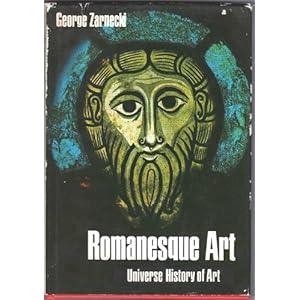
George Zarnecki, Romanesque, has chapters on the different media: Architecture, Sculpture, Metalwork, Ivories, Stained Glass, Wall Painting, Book Illumination. The author takes us through the key features of each of these, and wears his enormous learning lightly. As with many older art books, this one challenges the reader by having illustrations on a different page from the text, so there is a good deal of flicking around which interrupts the reading. Well, we just have to get over it. The points Zarnecki makes in capsules about individual images (capital sculptures, for example) are outstanding.
Henri Focillon, The Art of the West 1: The Romanesque is a classic of art history. First published in 1938, it shows the author's appetite for dealing with whole cultures, whole centuries, looking for deep principles which help us to understand the individual object. Focillon writes wonderfully, in a style quite different to most approved art history. Of Romanesque imagery - bestiaries, strange distorted sculptures - he says: 'It seems, not the created world, but the dream of God on the eve of the Creation, a terrible first-draft of his plan'. Thoughts like that put a smile on your face and transform the act of seeing. Plenty to be learned here - as far as I can tell, it's not overly dated - and inspirational too.

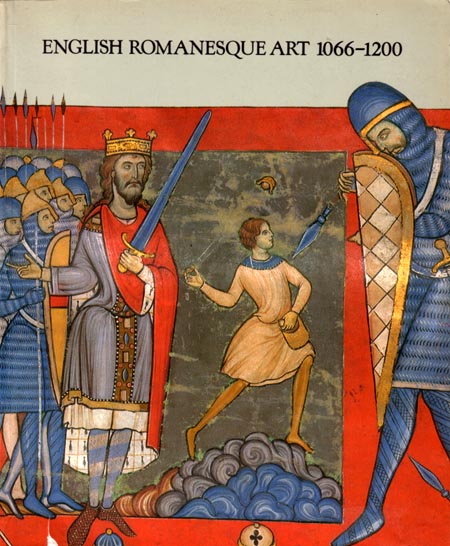
Zarnecki and other scholars produced English Romanesque Art 1066-1200, the catalogue which accompanied a major exhibition of Romanesque art from England, at the Hayward way back in 1984. All the arts are covered, and detailed descriptions of the exhibits make it a good source for getting to know particular works. Lots of information, perhaps best for occasional detailed reading.
A quick mention for two books which cover a wider period than those above:  John Beckwith, Early Medieval Art and C R Dodwell, The Pictorial Art of the West, 800-1200. Best read in that order. That's a long enough list for now.

Wednesday, 25 April 2012

Ste-Madeleine de Vézelay, Narthex Tympanum Sculpture

Narthex tympanum, Ste-Madeleine de Vézelay. Image from Sacred Destinations.

The great portal sculpture at Vézelay has received a great deal of attention from art historians, who have offered different interpretations of the scene depicted. The general narrative is clear enough: Christ in the centre is, through his blessing, animating the apostles, whose ecstatic reception is expressed through dramatical torsion in posture and expressive gestures. The surrounding scenes seem to represent the world in which the apostles do their work. But is the exact scene the Pentecost (in which the gift of tongues was bestowed ont he apostles, so that they could be understood by speakers of different languages); or is it the slightly different 'Mission to the Apostles' (when Christ tells them to go out into the world)? and is the scene itself a representation of the work of the Church in the world, or a preaching of the crusade in stone? Could some of these ideas be conflated? Below are some useful links for those who would like to follow up these issues.

Main images with brief French commentary on Vézelay website. Invaluable guide to the sculptures (from Cornell Uni wsebsite), and another useful chart with links to detailed interpretation of the figures.

Basic information is well presented on Sacred Destinations site, which has several further links.

Andrew Tallon (Vassar College) has produced some outstanding photographic resources. See the bottom of his page.

Christian Ann Zeringue, Evaluation of the Central Narthex Portal atr Sainte-Madeleine de Vézelay. Dissertation presented for MA at Louisiana State University (2005):  clear summary and appraisal of scholarship, with useful historical context.

Some of the specific articles drawn on by Zeringue are accessible through JSTOR. These are overwhelmingly to do with theological interpretation:

Adolf Katzenellenbogen, 'The Central Tympanum at Vézelay: Its Encyclopedic Meaning and its Relation to the First Crusade', Art Bulletin, 26 (1944), 141-51.  Argues that sculpture represents the 'Mission to the Apostles'.

Michael D Taylor, 'The Pentecost at Vézelay', Gesta 19:1 (1980), 9-15. As the title suggests, argues that it is indeed the Pentecost.

Peter Low, 'You who were once far off: Enlivening scripture in the main portal at Vézelay' Art Bulletin, 85 (2003), 469-90.

Véronique Frandon, ‘Du multiple à l’Un. Approche isonographique du calendrier et des saisons du portail de l’église abbatiale de Vézelay’, Gesta, 37:1 (1998), 74-87. Analysis of the calendar images on the outer rim of the archivolt.

For the printed word, see:

M F Hearn, Romanesque Sculpture (1981). Final chapter on Vézelay and other theophanies in tympanum sculpture.

Peter Strafford, The Romanesque Churches of France (2005). This review by Eric Griffiths is a nice short piece on the Romanesque style.


Friday, 10 February 2012

Donatello (1386-1466): Selected Works

This post offers an overview of the life and works of the great fifteenth-century Florentine sculptor Donatello. It covers only a selection of Donatello's works. Most of what follows below consists of notes on a film written by the art historian Charles Avery: Donatello: The First Modern Sculptor (1986). I've added a few  links, mainly to specialised articles on JSTOR. Avery's excellent book Florentine Renaissance Sculpture is a wonderful guide to Donatello, Ghiberti, Lucca della Robbia et al. It is listed as out of print, but there always seem to be copies in the V&A bookshop, if you happen to be in that direction.

Introduction
  • Donatello was a hugely versatile artist, who mastered a variety of techniques
  • His theme was ‘human life itself’
  • His expressive art inspired later sculptors including Michelangelo, Raphael, and Rodin
  • Donatello’s art gives form to the Renaissance interest in human character and the individual
  • It also realises the expressive value of ancient forms, preserved in Greek and Roman statues. [On Donatello and the antique, see Osvald Sirén, The Importance of the Antique to Donatello,  American Journal of Archaeology, Vol. 18, No. 4 (Oct. - Dec., 1914), pp. 438-461]
Early Life
Sources: Anecdotes in Vasari’s life; legal documents in archives. No first-hand sources, such as diaries or letters.
Background: rough, working-class. Father a wool-carder, involved in Ciompi revolt, exiled for murder.
No record of Donatello marrying: did he devote himself as a celibate to art (as some humanists did)? Or was he more interested in boys? In either case, his art can be understood as a pursuit of the Platonic ideal of self-governance, in which spiritual harmony is attained by harnessing the forces of Reason and Passion.
As a teenager, Donatello was apprenticed to a guild. Guilds shared responsibility for maintaining religious buildings: for example, the Wool Merchants looked after the Cathedral and Campanile, while the Cloth Finishers were responsible for the Baptistery.  This prompted fierce competition between the guilds.

Works

1401    Baptistery Doors competition. Donatello is said to have submitted a design. He was then one of Ghiberti’s assistants for 3 years, during which he absorbed G’s largely gothic vision, adapted to classical proportions.

Can D’s hand be traced in the vigorous modelling of Adam and Eve and other figures in some hexagonal panels?

1406    D now working on Cathedral commissions. He had a hand in these marble prophets on the Porta della Mandorla, with Nanni di Banco:


1409    St. John the Evangelist (below left) for Cathedral façade. This commanding figure shows great advance in technique and vision. (Images from Web Gallery of Art (wga)):


One issue in this work is the viewing angle: sculptures designed to be placed high up on buildings had to be seen from ground level at an acute angle, and the proportions of the body were consequently altered. [See: Roger Tarr,  Brunelleschi and Donatello: Placement and Meaning in Sculpture, Artibus et Historiae, Vol. 16, No. 32 (1995), pp. 101-140]

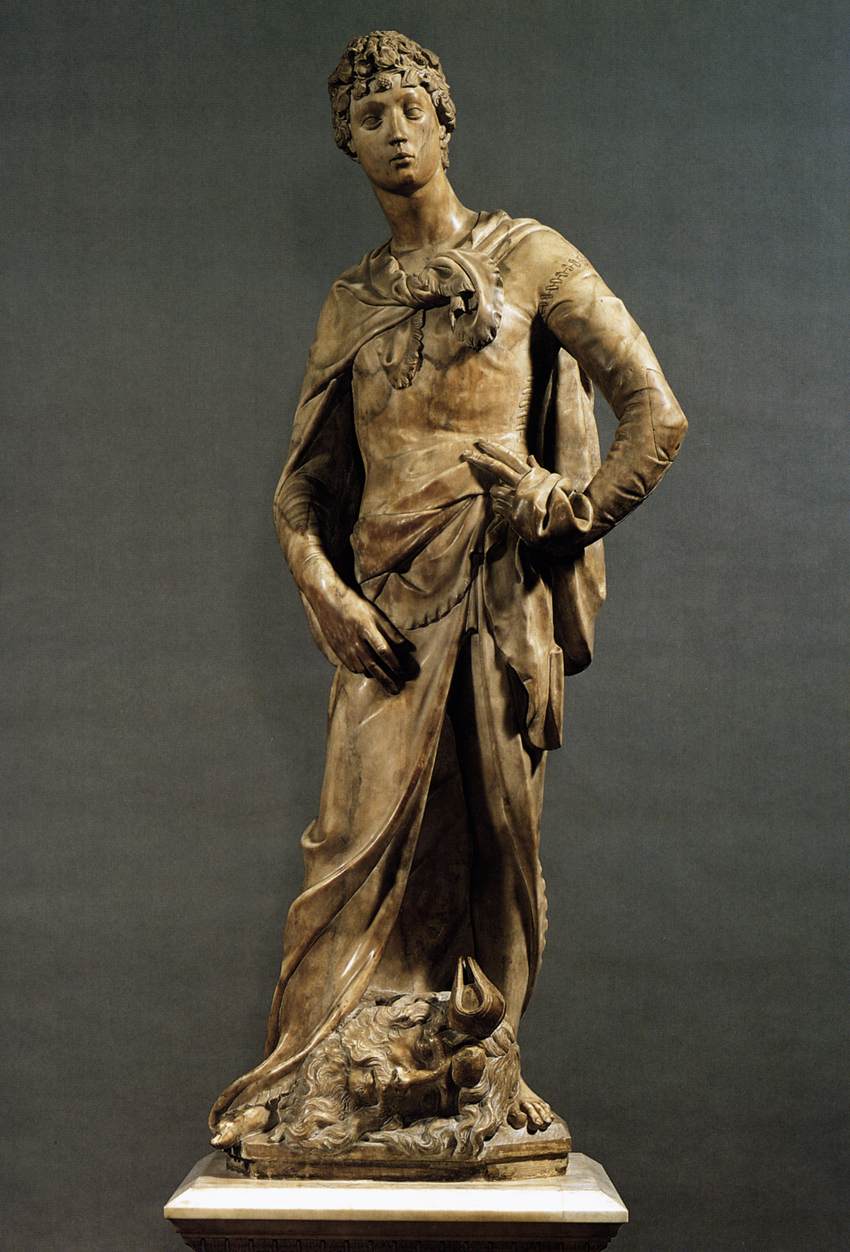
1409 David in marble (above right) commissioned for the Palazzo de Priori (town hall). Originally it was painted. Its “swaying elegance and sinuous gothic line” echoes Ghiberti. David, with his “graceful, nonchalant pose”, is not in a conventional heroic stance. The influence of ancient art is visible in Goliath’s head, which looks like that of an ancient Roman god.
 

c.1413 St Louis of Toulouse, commissioned by Guelph party. This is a gilded cast bronze. It had to be refired after casting. The drapery was built up in separate sections, and is used for expressive effect.

c. 1416 St George, commissioned by the Guild of Armourers for Orsanmichele. The “calm purpose” and “concentrated simplicity” express youthful devotion, idealism and courage. This piece shows the revelation of ancient sculpture – the sense of life in the stone. The sculpted body becomes the figure in action, convincing and dramatic. It is a style of sculpture which mirrors life itself. See also St Mark (c.1411) also for the Orsanmichele. [See discussion of St Mark on SmartHistory.]


Underneath St George we find the St George relief (1416-17). This is the first dated Renaissance example of figures being placed in a realistic setting of landscape and architecture. It anticipates the use of perspective by Brunelleschi and Masaccio. The technique of shallow carving was also an innovation. (The St George stature and relief are now in the Bargello Museum, Florence).


The later 1420s saw Donatello working on the statues for the Campanile, the great belltower next tot he Cathedral. For this he made lifesize statues of Old Testament prophets. These works show a revolutionary realism. Habbakuk (1427-36) took an obsessive eight years to carve, and Vasari records an anecdote of Donatello telling it to speak.

c.1427 Relief of The Assumption of the Virgin. This work continues the innovation we have already seen int he St George relief, where a sense of space is created through light carving, so-called shallow relief. Usually a sculptor cuts down through the marble. But Donatello reduced his implements to three tools, using the corner of a flat chisel to draw in the marble, with a point chisel to create background. There is a free, flexible level of depth. This is the technique known as schiacciato (which literally means 'squashed').


1427-29           Donatello made several works for the nearby town of Siena. This is his gilded bronze relief, Feast of Herod, for the Siena font. Notice how the perspective is used to evoke the drama, drawing us to the head of Herod. Donatello conveys the brutality of the act, and the shock of outrage of the onlookers. Salome is a sinister figure. She looks rather like a classical bacchante. This relief also compartmentalises different scenes. Possibly this was inspired by Trajan’s column. Donatello was studying and collecting ancient sculpture at this time. Avery compares this work favourably with another treatment by Donatello of the same subject: the marble Herod’s Feast (c.1439), once in the collection of Lorenzo the Magnificent (now in the Musée des Beaux Arts, Lille). Here the space overwhelms the figures, making the actors “subservient to their setting”.
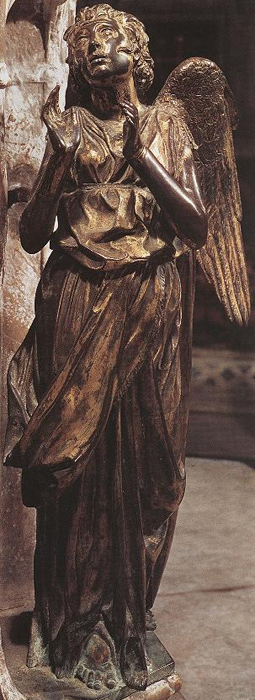
1427-29 Donatello also made for the Siena font, two bronze figures of  the virtues Faith and Hope. These  present "sculptural rhythms in drapery". The lyrical style contrasts with the dramatic treatment of the Herod panel:

1434 saw Cosimo de Medici's return from exile to Florence. Cosimo offered Donatello lodgings, a workshop and sumptuous clothing (in which the artist had very little interest, it would seem).
1428-43 Roundels for the Old Sacristy, San Lorenzo, Florence (building by Brunelleschi), showing scenes from the life of John the Baptist. Note the deft handling of perspective, the depiction of architecture and the sense of the theatrical in the depiction of the characters. There are also four roundels of the Evangelists. Are these pieces in harmony with their setting? Donatello’s highly coloured decorations contrast and perhaps conflict with Brunelleschi’s light grey and white architecture.
The roundels were made straight from the scaffolding. The plaster was applied in layers and immediately worked. Donatello drives across the composition with diagonal lines, and crops figures to suggest a depth beyond the frame. Relief is a very difficult technique. Figures must look as if they are in the round, in perspective, not flattened. Donatello’s backgrounds are lightly modelled, but still convey an effect of deep space. This relief shows St John on Patmos:


1439    Cantoria   In 1431, Luca della Robbia had been commissioned to produce a Cantoria (singers’ gallery) for the Florence Duomo. Possibly his design was influenced by the outdoor pulpit at Prato which Donatello and Michelozzo had made, in fits and starts, between 1428 and 1438. Donatello’s Cantoria (pictured) depicts a wild, bacchic dance, in a continuous scene behind the columns, with a studded mosaic background. There is a comparison of the two cantorie on this art travel site.


1430s Atys. The putti of the Cantoria are similar in spirit to the sculpture of a boy known as the Atys. It has a pagan feel, but no one knows who or what the boy symbolises.


c.1435 Annunciation, in gilded grey Tuscan sandstone (pietra serena), for the Cavalcanti Chapel, Sta Croce, Florence. Lifesize figures. The scene is like a stage. Figures are in three-quarter relief in a shallow space. The Virgin looks startled and shy. While the gestures and movements are human, the faces are idealised, like the classical Three Graces. This is different from many other Donatello works already discussed.


1443    Donatello has to abandon his studio, as Cosimo is acquiring and demolishing properties to make way for his palazzo. Donatello goes to Padua, at this time an important place of learning, and governed by Venice. For the next ten years, he works for the basilica of St Anthony.
Padua
1445-53           Gattamelata,  ‘spotted cat’. This was modelled on the bronze horses of St Mark’s, Venice. One problem which equestrian statues have to address is that a lot of weight is placed on the horse’s relatively thin legs. [See: Mary Bergstein, Donatello's"Gattamelata" and Its Humanist Audience, Renaissance Quarterly, Vol. 55, No. 3 (Autumn, 2002), pp. 833-868]


1449    Crucifix. Notice the strikingly realistic anatomy. With this work, Donatello brings the Renaissance to northern Italy.


1446                Commissioned to create sculptures for the high altar, the Altare del Santo: 6 saints, a central Virgin and Child. Donatello supervised all 29 pieces in four years. 16 were entirely by him. Note the frantic grief of the three Maries in the Entombment.
1450                The sculptures were installed. The original high altar was later demolished. It is not known for certain whether the present, reconstructed order of the statues is accurate. The Virgin and Child sculpture uses a device from Byzantine art, in which Christ is represented as if in the womb of the Virgin. 1448, Madonna and Child between St Francis and St Anthony, bronze:
 

The Heart of the Miser (1446-1450). In a number of bronze reliefs, Donatello depicts scenes from the life of St Anthony. The spaces in these are very varied, and the detailed and dramatic action, with skillful stage management of groups, suggests the influence of mystery plays. Notice the fantastic architecture in the Miracle of the Miser’s Heart. In the film, Henry Moore praises Donatello’s “inventive literary mind”. These reliefs would have started as preparatory drawings (only one survives), followed by a sketch modelling in wax and a cast in terracotta. There are a few surviving examples of these in Padua. (Image from Victoria and Albert Museum).
The Miracle of the miser's heart
After his work in Padua, Donatello returned to Florence. His works – or those of his workshop - on return include the Roundels in the Medici Palace, for example the Triumph of Eros.
Two other works located in the Palace were the earlier bronze David (c.1430), and Judith and Holofernes (1455-60). [For a detailed study of their political significance, see Sarah Blake McHam,  Donatello's Bronze "David" and "Judith" as Metaphors of Medici Rule in Florence, The Art Bulletin, Vol. 83, No. 1 (Mar., 2001), pp. 32-47] 


We should remember that David is a poetic allegory: Goliath represents the death of what is base at the hands of what is beautiful. This work is the first freestanding nude since antiquity (apart from Donatello’s own Crucifix in Padua). The work relates to the symbols of Platonic perfection – Love, Beauty and Virtue. [See Laurie Schneider, Donatello's Bronze David, The Art Bulletin, Vol. 55, No. 2 (Jun., 1973), pp. 213-216; and a discussion on SmartHistory site.] . Judith and Holofernes (1455-60) was originally for the palace garden. Like David, it presents the triumph of beauty over vice. The original inscription helps the viewer to understand this: ‘Behold the neck of pride severed by the hand of humility’. The cushion is in the shape of a wineskin, an emblem of oriental luxury and drunkenness. The putti on the pedestal are also drunk. This is a powerful, monumental work, in part at least because it is a powerful idea: god must triumph over wrong.
The Chellini Madonna (before 1456) is a bronze roundel of the Virgin and Child mentioned as a gift by Donatello’s doctor (Giovanni Chellini Samminiati). This is hollowed on the reverse side, for casting molten glass. (Image from V&A, and see their extensive page, linked above).
c.1457             St Mary Magdalen  This shocking image has a “stark, terrible reality”. Donatello carved into a tree trunk, then added pliable materials to model the surface. Note blue eyes, golden hair, and a bone structure recalling former beauty. But it is not a despairing image: the soul has become ennobled, triumphing over the flesh. [See:  Martha Levine Dunkelman, Donatello's Mary Magdalen: A Model of Courage and Survival, Woman's Art Journal, Vol. 26, No. 2 (Autumn, 2005 - Winter, 2006), pp. 10-13]


1457    St John the Baptist, Siena Cathedral. The right forearm was added later. This continues the realist style of Judith and Mary. 


The Lamentation for the Dead Christ (c.1456), for the Siena bronze doors scheme shows a hard-hitting realism. Could it be a critique of the sweeter style of Ghiberti?
 

1460s   Bronze pulpits for San Lorenzo. It is thought that these works could be designs for the reliefs for the abortive Siena Cathedral doors scheme. They show that even in old age Donatello was unorthodox, passionate and personal. Notice the relentless diagonal in the Martyrdom of San Lorenzo (below), the feeling for deep space. However, the buttresses at the corner of one relief are clumsy (the work of an assistant?). The composition of the panels may not be as originally intended. [See: Irving Lavin, The Sources of Donatello's Pulpits in San Lorenzo: Revival and Freedom of Choice in the Early Renaissance, The Art Bulletin, Vol. 41, No. 1 (Mar., 1959), pp. 19-38]


1466 Donatello dies, and is honoured with burial at San Lorenzo, near the tomb of Cosimo, who had died in 1464.  
For more online tours of Donatello, see:

Monday, 2 January 2012

Josep Llimona, El Desconsol

In the middle of the lake outside the old Arsenal (now parliament building) in the Ciutadella park we see the sculpture of a forlorn nude woman, classical in design, romantic in her collapsed expressive posture. This is El Desconsol (Grief, 1907) by Josep Llimona (or at any rate a copy: the original is in MNAC - click on the image to get their description). There's also a handy description here (other languages available). Here's my picture (the strategic leaf is a genuine accident of nature!):


Josep Llimona is perhaps the most celebrated of the Modernista scuptors. He was a profoundly pious Catholic, and with his brother Joan he founded the Cercle de Sant Lluc, devoted to moral regeneration in art and the nation (the world, the universe ...). Gaudí was the most famous member of this fun-loving club. Llimona's sculptures unsurprisingly tend to have a clear morally persuasive force. Other examples of his work can be seen across Barcelona: among them the frieze on the front of the Arc de Triomf, the Dr Robert monument, the statue of St Jordi on Montjuic, and a memorial to victims of Napoleon (which I once had to explain to a Frenchman: 'triste souvenir' was his rather beautiful response). For a useful list of Llimona's works, see the gaudiallgaudi page.

For the flavour of this interesting artist, here is a powerpoint of some of Llimona's works, on display in MNAC and the excellent, recently opened Museu del Modernisme Català. All in marble apart from the one bronze:


Other sculptors to look out for in a similar style are Enrich Clarasó, Eusebi Arnau, Josep Clarà, and Josep Reynés. A very good book on the period is Barcelona and Modernity, the catalogue for a major exhibition which took place in America in 2006-7.

Thursday, 22 December 2011

Sculpture: The Figure in the Landscape


There’s a gem of an exhibition at the Winchester Discovery Centre, called The Figure in the Landscape. It brings together works by sculptors who are all responding to the landscape, and shaping their responses through different materials methods. One striking feature of the show is how individually each artist responds to the land and its elements. For Barbara Hepworth, ideas of community are essential: the dolmens of Cornwall evoke individuals, linking culture across time; and the landscape itself is a palimpsest of human communities, a place where land, mind and spirit are integrated. Henry Moore, represented here by a small reclining figure, turns figures into landscapes: we seem to catch the human form as it is shifting through some metamorphic process into the contours of mountains and hills. Some artists are drawn to the pure forms and geometric patterns of the land: Tim Harrisson captures concentric ripples in marble in Double Vision, while Peter Randall-Page’s Entomology II arranges ceramic shapes in a symmetrical leafy pattern, like a picture of the fractal series underlying natural phenomena. Charlotte Mayer and Lotte Glob respond to seismic forces and the rough textures of the earth in their work, which somehow imbues inert matter with a feeling of potent force and the character carved into it over great passages of time.  

Sculptures are not only finished products, They also tell a story of a process which, when we know about it, becomes part of our apprehension of the work. Keith Rand’s abstract constructions are the end result of walking, absorbing and exploring the downlands of Salisbuy plain, while Chris Drury – represented here by a video of an iceberg – is another walker, whose work offers traces of journeys, captured in different media. Simple images can have multiple resonances: Roger Stephens’s Shore, made up of three marble forms, irresistibly suggests a group – a family – looking expectantly … where? Out to sea, or from sea to land? Or from past to present? From one work to another we become conscious of the quality of the different materials – marble, chalk, bronze – and  their suggestive, expressive qualities. In the synthetic world of the modern city, it is refreshing to have an exhibition like this to bring us, so to speak, back to earth. The Figure in the Landscape is curated by Rachel Bebb of The Garden Gallery, Broughton.

Wednesday, 14 December 2011

Barcelona: Columbus Monument


The Columbus Monument which looks out over Barcelona's harbour is a striking landmark. Although the first stone was laid on 26th September 1882, it was not inaugurated until 1st of June 1888, the year of the Universal Exhibition (which opened on 20th May). Consequently it is closely associated with that event and its great themes: the celebration of modern industry and industrial materials; Barcelona's pride in its own economic and industrial growth, as it puts itself alongside Paris and London; and  Catalonia's assertion of its rightful place in centre stage in Spain. The monument's neoclassical, heroic figures (the work of several Barcelona sculptors) clearly articulate a confidence in - or nostalgia for? - imperial power, just ten years before Spain was to lose the last of its colonies in the disastrous war of 1898.  Like other works of the late nineteenth century the Columbus Monument makes a statement about the present through its representation of the past. The various elements make up a complex symbolic whole, and the entire piece needs to be read as a narrative to make sense.

Here is an introductory video by World Site Guides, with the calming background music that seems to be deemed essential for such productions:


Detailed information, with excellent illustrations, is given in Peter van der Krogt's remarkable website on Columbus monuments around the world.

As with all Barcelona monuments, the essential local source is the Art Públic site, which also appears with suitably calming music. Remembering the date (1888), the entries on the monument can be found in a few clicks.

as for the great question, was Columbus in fact Catalan? The case is summarised here, and discussed in exhausting detail on the Catalan Wikipedia entry.