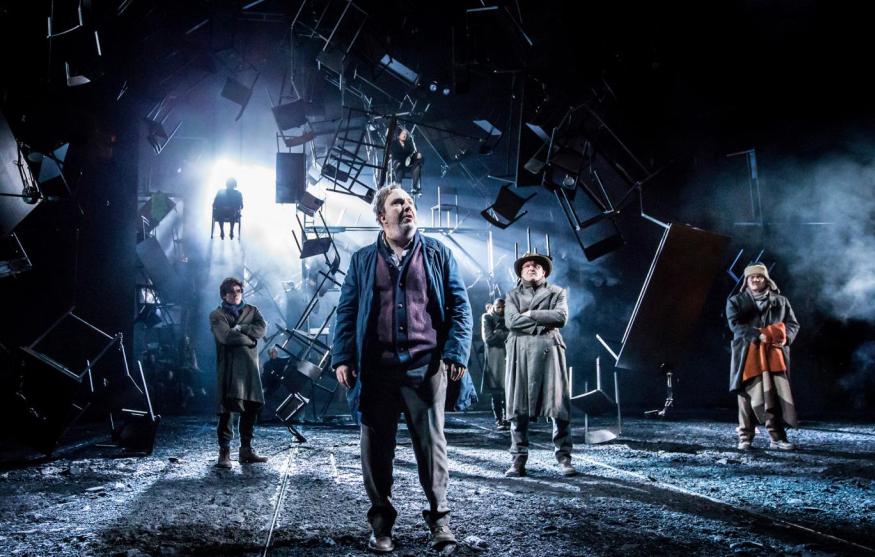
Fix was the third of my three-shows-in-three-nights experience and, rather appropriately, about addiction: already I was feeling the neurotransmitters charging up at the ritual of picking up a ticket, taking a seat, watching another world in front of me. It's devised and performed by Worklight Theatre, and on an overnight trip to Exeter I took the chance to see it at the Bike Shed Theatre - my first visit to this atmospheric, cavern-like space in Fore Street. I'd already been to a couple of shows at the pop-up Boat Shed Theatre at the quay, and was glad to get acquainted with the permanent version.
Anyway, Fix is based on two years of research into addiction, which was distilled here into a three-hander, switching rapidly between scenes with musical interludes. Rianna Dearden played a counsellor (researching for a PhD), and we followed, in glimpses, the story of two addictions: a gambling addict named Zach (played by Finley Cormack), who is distracted from looking after his infant daughter by a gambling app; and Maggie (Fiona Whitelaw), wife of a porn addict. The stories are interleaved with information about the biochemistry of addiction, delivered at terrific pace and with terrific energy (so terrific I struggled to keep up at times). The music was delivered on two guitars with all three of the cast singing, and the songs recast the language of addiction study in a beguiling way. The opening number celebrated the powers of dopamine. One turned phrases from a porn site into a kind of rap, and another told us about the number of licensed betting shops in the UK ('There are 8700 casinos ...' it started, but I'm afraid an internal switch turned on Katie Melua, 'There are Nine Million Bicycles in Beijing'). The company made great use of the small space, sitting on small wooden crates also used for percussion, and presented a fast-moving hour of emotional rollercoaster from hilarity to despair. It seemed just the right kind of space for this sort of punchy info-drama. I'll look forward to more from Worklight and more visits to the Bike Shed. What a pleasure, too, to meet Mumbai theatre practitioner Sapan Saran, who is embarking on a tour of small theatre spaces in the West Country - an inspirational project, indeed, and I trust an enjoyable one.
Showing posts with label Theatre Review. Show all posts
Monday, 18 September 2017
Betrayal
'Jerry is a literary agent; Emma runs an art gallery; Robert is a publisher. Emma and Robert are married and Jerry is Robert's best friend, but Emma and Jerry have a seven-year affair and Robert has secrets of his own.'
Thus the flyer for Pinter's Betrayal, at Salisbury Playhouse, and it's all too easy to imagine a terrible play based on it, a middle-class soap opera involving arty people in Hampstead getting in and out of bed with each other. But it's a fascinatingly involving piece, not least for its technique of telling the story backwards, at each regressive step throwing everything into further doubt. What is this love story we are being shown? By the end we see it starts as a drunken declaration and fizzles out in boredom. Was there love along the way? Maybe, yet we are increasingly aware that behind every statement there is an evasion, or a deception. There was certainly desire, with Emma escaping from something and Jerry perhaps avoiding a disconnect in his own marriage he does not want to address (or perhaps just arrogant enough to think he can have everything). Passion is surrounded by puzzle. Who knew what when? What further deceptions are taking place behind the scenes? Is Emma really just having drinks with Casey? Is Jerry's wife really just friends with her doctor colleague?In whose kitchen was a child thrown and caught? Pinter's trademark silences and pauses are filled with the sound of people searching for a foothold in an emotional landscape of ice and fog.
A capable cast found the drama of the words, and the gaps between them. Emma (played by Kirsty Besterman - lovely to see her again here after Separate Tables) found a convincing spectrum from cool and controlling to utterly disconsolate. There was a real hint at something nasty not quite being shown in her marriage to Robert (Robert Hands), who seems to accept her affair with icy insouciance and yet exudes real menace. A brooding violence is internalised and expressed in insinuating verbal attack. His speech about squash had the effect of a brutal attack, while the Venice hotel scene projected a palpable tension. Jerry (Robert Mountford) played the lover, pinging like a squash ball between the other two. The Salisbury Playhouse has a very wide stage, and the production made full use of it: this might be thought to work against the intimate nature of the drama, but I thought it actually worked well, the spaces between the actors bringing out the emotional distances between them, enhanced by ambient sound effects.
Betrayal is based on Pinter's own affair with Joan Bakewell. Rather knowingly, it has jokes about authors writing novels based on their own domestic lives. It has a slight period feel to it now, taking us to a time when we used traveller's cheques, and actually wrote letters to each other. And do literary agents earn so much that they can afford to buy, or rent, a flat in Kilburn purely for the occasional adulterous afternoon? Perhaps easier then than now. Yet it remains fresh, as it is not really about a particular affair, or even romantic affairs at all, but the nature of our dealings with each other, where our knowledge of our lives is only ever partial and every ordinary word casts a long and troubling shadow.
Golem
A couple of years ago, I attended a seminar by 1927 theatre company at the National Theatre. They create what might be called mixed media theatre: live acting and music against a background of hand-painted animation and claymation. Interaction between performers and projected animation - for example, an actor waters a plant which then, in projection, blossoms - requires precise spacing and timing. A curious mixture of hi-tech and play, creating a sense of wonder. I was intrigued by the workshop and so was delighted when I had a chance to see the 1927 show Golem on tour at the Nuffield, Southampton.
A Golem, in Jewish folklore, is a being created entirely from inanimate matter - claymation on a mythical level. The show uses the idea to create a fable about our relationship with helpful artificial gadgets, which soon come to dominate us: another variation on the Frankenstein story. Tied into this was a theatrical exploration of the corrupting effects of materialism and the culture's injunction to be forever buying into the latest brand: 'Keep up with the times, or you'll be left behind' repeated Golem's mellifluous voice (oddly, it's the exact same voice that tells me all my Tesco points add up). Human relations are sacrificed in the continued urge to look after number one. Human beings are simply marks for the corporations who use the Golem to market their products.
All of which makes it sound preachy. But Golem is a captivating experience, far too lively to become solemn, and often humorous. The animation, inflected by a Weimar Expressionist aesthetic, took us to a distant place which provided a distorted reflection of our own world. The acting style drew on silent cinema's language of gestures and heavy expressions, with striking wardrobe design to match: in his golem-induced quest to look good, the main character, Robbie, initially a shy nerd, ends up looking like a spaceman. But his ascent of fashion is at the cost of rejecting a woman, and the feelings that went with that relationship. Cartoon-style voices, often following exactly marked rhythms, further heighten the effect.
As the show progresses, Golem goes through rebrands, shaping human needs to corporate ends, until there is nothing left of us. The show felt like a dream, mixing the grotesque (the sleazy dance club) and the satirical with wildly inventive imagery (I loved the sequence of the Golem factory), leading us to a terrifying concluding vision of a posthuman world, where man and golem seem to have merged. The servant becomes the master, the inanimate clay has now sucked the soul out of all of us. A technologically masterful show about the dangers of technology.
Sunday, 2 October 2016
The Threepenny Opera
I was up at the National Theatre at the weekend for the New Views teachers' course, and a trip to The Threepenny Opera was thrown in. Never one to turn down an evening with Brecht and Weill featuring gangsters, beggars and prostitutes, I happily grabbed the ticket, realizing I'd only ever heard, but never seen, this Weimar masterpiece. Once, when the earth was in an earlier stage of its development, I wrote an A Level thesis, unpretentiously entitled 'Art in the Weimar Republic: Development and Dissemination'. Memories flooded in of the Bauhaus, of the Expressionists, and of those merry souls Beckmann, Grosz and Dix. The designers had clearly been looking at the same images: the look of Celia Peachum here, for example, was clearly modelled on Dix's portrait of Anita Berber, and Peachum's hairpiece was the exact same style as sported by Dix's wife Martha. Although the piece had been transposed in the script to London (not, perhaps, such a leap from the festering rancour of 20s Berlin to modern hard-Brexiting Britain), it was a German twenties visual we saw, and all the stronger for it. As for the work itself, it's hard to get a grip on. Taking off from Gay's A Beggar's Opera, which parodied the operatic conventions of the day with a story featuring a highwayman as hero and a medley of popular songs, The Threepenny Opera is a satire based on satire. It's very very knowing and self-conscious about what it's doing. Over its own genesis the work turned from being mainly a musical to a play with musical numbers, the main credit shifting from Weill to Brecht. What is it now? An anti-musical, perhaps one might call it, a feel-bad show (as MacHeath reminded us, verfremdungheitingly out of character, when we dutifully came back for the second half). It promises at the outset that no moral ending is envisaged, and throughout laughs knowingly at its own operatic formulae. Choruses, duos, arias are all poured out in a thick tar of cabaret songs, delivered with a snarl, and rendered naughtily delightful by an exhilarating set of obscene lyrics provided by translator / adapter Simon Stephens. And at the end, a deus ex machina and a parting moral are provided, the first for a laugh and the second for, perhaps, real. Brechtian alienation is a more dynamic thing than we are sometimes told, I think: instead of keeping us at a kind of arm's length from emotional engagement, it draws us in and then pushes us away again. Passages of bleak realism are undercut with a caustic joke or piece of knowing stage action; a storyline involves us then calls attention to its unreality.
The production itself made full use of the Olivier space, building up from a backstage look of platforms and flats to some clever designs, which quickly assemble and equally quickly collapse. Rory Kinnear was a suitably seductive MacHeath, who we can't hate as much as we know we should (I hear what he did at Kandahar and I still want him to escape - what's wrong with me? Aha! thus is the Brechtian mirror held up to my self-contradicting little mind). That's partly because those after him are if anything even worse, and because the world of sewers can, logically, only produce the sewer-dwelling rodent. There is a problem, though, in hammering on at length about how squalid and corrupt the world is and I must admit, by the end of the very long first half the songs were starting to sound pretty much the same as each other and to say the same things over and over again. Powerfully delivered, though. Nice - by which I mean not nice - movement work, neat differentiation of characters among MacHeath's gang, some fine choreography in, for example, the arrest of our vile yet strangely dashing hero. Still, that first half did feel long. The second was tighter, the story coiling around us. There was no escaping the sense of the play's bold, blustery bigness by the end. Great programme essay, too, by Dan Rebellato, on why we need Brecht today. His first reason is that Brecht is fun - it's the fun of kicking over a sandcastle and making, say, a sand abattoir instead. That sort of fun. But what was left after the fun, that evening? A sense of self-satisfaction at having seen a European classic at the National? Is the socially probing mischief lost among the well-heeled theatregoers of today's London theatre? Has the anti-classic simply joined the dinner party as another member of the canon? Well, Brecht would want me to be leaving with that kind of question, I suppose, hastening down the tunnel past Imax to catch the 10.35, developing and disseminating as I go.
Labels:
Drama,
Literature,
Music,
Plays,
Theatre,
Theatre Review
Dedication
The Essex Rebellion, which Southampton was drawn into, is certainly historical fact, as is the curious detail that one of Essex's followers persuaded Shakespeare's company, The Lord Chamberlain's Men, to take the mothballed Richard II play and put it on, presumably because it showed an ineffective monarch being usurped. (It's not absolutely certain this was the Shakespeare play.) The company was questioned over this, but Shakespeare was not interrogated by Star Chamber, as he is at the start of Dedication. This is, of course, the play playing with notions of history and reality. As a dramatic opening device, the interrogation of the bard provides a neat entry point into the substance of the play, which shows various parallel scenarios for how WS and HW may have known each other: these range from Shakespeare being hired to help HW brand himself as a cultivated aristocrat among his circle (for my money, the least sexy and most likely option), across a spectrum of intimacy to the two men being passionate lovers (not impossible). The alternative scenarios reminded me of Nick Payne's Constellations, which I also saw at the Nuffield, and Kurosawa's film Rashomon, where the same event is narrated differently by those involved in it. This approach to playmaking is certainly licensed by Shakespeare's own use of invention in his historical dramas, and his assertion, as a character in Dedication, that history is largely a matter of imagination anyway. And we have an instinct to fill in the gaps which, in this instance, are many. Memory, as WS says at one point in the piece, dies with us. If you don't record what happened, it's gone forever.
I found Dedication an intriguing play. It presents Shakespeare as rather a low-key figure, in his lack of dazzle not unlike the portrait given in Edward Bond's Bingo. It is as if the exuberant wordsmith has been left on the pages of his writings, leaving behind an enigmatic cipher, who could be anyone and anything. HW is of course a spoiled Riot Club sort of brat, at his most compelling when he recounts the horrors of the Irish expedition, which, in real history, he undertook under Essex. The production is directed in the round by Sam Hodges, on a simple rotating set with a central platform (which goes up and down). With no furniture and minimal props, this simple space turned from court to chamber to a street in Shoreditch to a prison cell - a nod to Shakespeare's own theatrical world. Music was provided by four cowled singers (recalling the recent RSC Richard II), but to speak over these the actors were amplified, which shouldn't really have been necessary in a small space. I'd have liked to see a real actor as the Star Chamber judge, whose voice was recorded. Perhaps it was felt this would blur the focus on the duologue. The two actors, Tom McKay (WS) and Tom Rhys-Harries (HW) covered with great skill the script's emotional range, from light-hearted banter to the intensities of love and anger (there is even a swordfight!). A strong work by Nick Dear, and another evening well spent in the Nuffield leaving one with a memorable theatrical meditation on history, memory and art. Looking among the blank spaces of historical record, we ask, what do we know, after all, even of ourselves and one another?
Friday, 8 July 2016
Romeo and Juliet
Before the live streaming of the Kenneth Branagh production of Romeo and Juliet there were some brief video interviews with teenagers. The interviewees were asked what was best and worst about being a teen, and - moving into the Shakesperean zone - whether they believed in love at first sight. They weren't asked whether they thought it would ever be a cool idea to fake death through drugs in order to meet their exiled beloved in a tomb, though. And the question of arranged / forced marriage was not brought up, either. Anyway, this warm-up was a refreshing change from the somewhat gushing interviews we sometimes get at the start of live theatre screenings.
The production itself was strikingly broadcast in black and white. It can't have been much different in the theatre: the whole white-grey-black chromatic design was inspired by the films like La Dolce Vita, with sharp suits and slick or laid back movement styles to match. In the Capulet ball there seemed to be a nod to the amazing protracted party sequence of The Great Beauty, with its short electro score and angular choreography. There was the architecture of Fellini, too. A simple set of stone walls and columns was used to suggest a flow of scenes from piazza to café to sepulchre, in dramatic mediterranean light. Some jazzy numbers were added, with well-chosen moments of ambient soundtrack at key moments. Lily James and Richard Madden shone as the lovers, finding a seductive playfulness in the verse. This is the first production I can remember where comedy was discovered in the balcony scene, and it made their joyous discovery of love all the more affecting. Given the poster, the erotic aspect was played down here. Senior actor Derek Jacobi was cast as Mercutio, which seemed a peculiar choice as this part is normally seen as a hot-blooded, even manic, natural stand-up and hell-raiser; but it all made sense when in the preamble Branagh explained his inspiration in reading of the ravaged Oscar Wilde haunting cafés in Paris: and so we got Mercutio the faded playboy, hanging out with the young bloods, not manic but mellow, dreaming of past conquests. His brief song was charming, and the death that followed soon after was very touching, making a lot of the idea of a 'scratch', of the pointless contingent nature of it all. Overall the production did what it should do, allowing the emotional realities behind the narrative to unfold, so we could see that the play is also the tragedy of the Nurse, of Paris, of the now childless Capulets, of a culture in the chiaroscuro of love and death.
Of course there is always the oddity of the Friar. What the hell does he think he is doing? Would it have been possible - or prudent, anyway - for a priest simply to marry off the children of seriously powerful families in the city just like that, without, you know, checking it was OK? And you don't need to be obsessed with risk assessments to see that the whole precision-timed escape through drugs business is a non-starter. It did look in this production that the herb-dealing Friar wasn't going to be allowed to scamper back to his breaking bad lab any time soon, at any rate. But, hey, Shakespeare is allowed creaky plots. The production was powerful, balancing quick passages of movement with stillness. Star of the evening was Lily James, who balanced passion with clarity, conveying a girl at once in command and hopelessly out of her depth. The 50s look worked to good effect (though the Prince looked more like a traffic warden than an absolute ruler), and for me it was a night at Okehampton Carlton well spent, even if I did have to move grumpily away from a row of people who felt the need to chomp on crisps through the whole thing. Seeing a London show on the edge of Dartmoor, many a mile from London, brought home the value of live streaming. With one cavil, though. A superb touring company in Winchester not so long ago had undeservedly small houses. If there's any evidence that streaming shows with big names is impacting on live theatre in this way then I hope something could be done - some share of profits recycled back through the relevant funding body, perhaps? It was something to ponder, on a memorable drive back in the dark and rain through winding, deer-haunted country roads.
Sunday, 17 April 2016
Les Blancs
The script is the final text adapted by Robert Nemiroff, Hansberry's husband. From the script alone, it must be said it is in several passages thuddingly didactic, with scenes that would be handy in a textbook of colonial history and international politics. Characters fall neatly into types that illuminate positions in the conflict: the bad English Major, the good doctor at the Mission who nonetheless sees that in the wider scheme of things he is part-healer, part agent of a genocide brought about by making Africans live a particular kind of life. Other characters have the same typological recognisability: the wise Cassandra-like English woman, the African dealing with his own identity crisis, the onlooking journalist trying to understand it all on behalf of the audience. Their various attitudes are delivered with the subtlety of a megaphone. This is quite different from, say, Friel's Translations, another play about history, colonialism and independence (or, say, Elizabeth Bowen's novel The Last September). One feels this Brechtian epic would be an improving read, and indeed I feel I should read it as I don't imagine I took in on a single viewing all of the ideas being energetically exchanged. At least the arguments do not go all one way, and there is a genuine sense of difficulty, as we are reminded of the suffering of innocents on all sides. The points one can immediately think of for and against taking up arms are all stated by some character or other, though I think it is significant that while we see before us the murderous conduct of the Major we only hear about the slaughters committed by rebels. Weirdly, the wise old white woman appears to give permission for Tshembe to join his brothers in their fight for liberation, one which begins with fratricide. So if you wanted to find colonial arguments that the natives are not up to the job of self-government, you wouldn't have to look very hard here. Hansberry did not have a chance to visit Africa, and there is a feeling of intellectualising distance in the character typology here. Playwrights 'on the ground' like Athol Fugard and Wole Soyinka can take us closer - I am imagining, of course - to the idiom and domestic circumstances of African life. Having said all that, the cast, led by Danny Sapani as Tshembe, work wonders in bringing emotional colour and nuance to a text that could easily come across as clunky and predictable.
The production, directed by Yael Farber, makes the most of the Olivier stage to bring out the epic sweep of the play. The Mission compound is surrounded by great dark spaces which suggest the vast territory of the state and continent beyond. A Ngqoko Cultural Group act as a Chorus, providing African language and music between and during scenes; and there is much excitingly choreographed movement to balance the wordy script, with the speechless emaciated female figure representing the spirit of Africa providing a visual anchor to the whole production. As is common these days, there is a constant ambient score and soundscape. Live theatre moves inexorably in the direction of film. The revolving stage is kept very busy and seemed to me to be over-used. It can be very effective at suggesting the passage of time or breaking up the scenes, but I don't see why it has to keep going during scenes themselves. One passage of dialogue between the journalist and the older lady Madame Neilsen turned into a kind of game of hide and seek as they clambered around the mission building as it span around. Why? That doesn't help me follow what is being said, instead it distracts my attention from it. Towards the end it looked like the stage would whack into a character's legs, but of course he moved at the right time. (Apparently on the first preview the revolve stopped working altogether and some of the audience begged to see the rest of the play without it. Request denied.) The production team of 28 (that's twenty-eight) created a gallery of effects - especially spectacular at the conclusion - that lengthened the play to three hours, which I imagine is longer than the author had in mind
Towards the end there is a rousing speech by a rebel leader urging his people to 'Kill them all'. This conveys a sense of the Greek-like ineluctability of tragedy when a people feel driven to extreme measures (it has been carefully spelled out to us that all peaceful intents at negotiation have been rebuffed; I wonder if real historical cases are quite so clear). It was disquieting to see this a day after the bombing of Brussels airport by a group with presumably the same mindset. Curious, too, to see a play with so much dialogue that in the end despairs of dialogue altogether, either between cultures or within families. I got the feeling that this is a work which was still finding its final form at the author's death, and the 'final text' can only be an approximation to something more subtle and poised that might have resulted. Or not. Subtlety and poise might be responses altogether too comfortable for the issues under scrutiny here. It is not a bad thing to be returned to a Brechtian idea that drama can teach and provoke.
Sunday, 13 March 2016
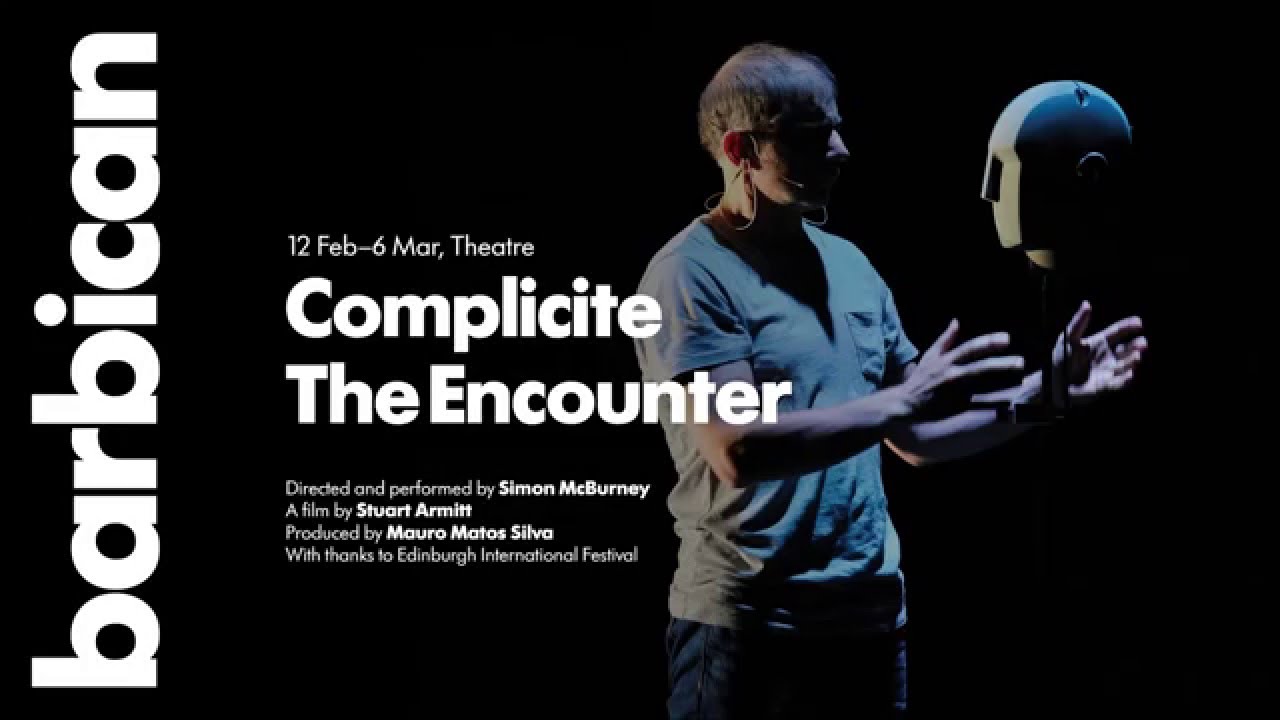
The Encounter
Years ago I listened, mesmerised, to a radio drama called Mnemonic, about the frozen body of Otzi the Iceman, who died some 5,000 years ago. Scientists speculated, other voices added a poetic commentary, and the story was spliced with a parallel love story from the director / narrator's experience. The theme was memory, and how imagination works with and recreates memory in our excavations from the near and distant past. Excavating this listening experience, I can't remember if then I would have recognised the voice of actor Simon McBurney (as I certainly would now), or how much if anything I knew of his company Théâtre de Complicité, makers of works which weave stories from found materials - what is now called devised drama - and bringing in techniques from the latest stage technology to traditional mime to make the stories ring. I'm pretty sure I had no idea that what I was listening to was a stage work, as it seemed to speak so directly through sound.The latest Complicité production is The Encounter, a one-man show performed by McBurney. It's based on a book about the experiences of photojournalist Loren McIntyre in the Amazon in 1969. An experienced traveller, McIntyre didn't mark a path back to his plane and ended up as a kind of prisoner-guest of the Mayoruba tribe, deep in the jungle. In his time with them, he finds the tribe on a journey, erasing their settlements and destroying their belongings, as they follow the river in an attempt to go back to the beginning, to remove themselves from time. Only out of time will they be safe from the invasions of the white man and modernity. Even more remarkably, McIntyre finds he can communicate with the headman, whom he calls Barnacle, without speaking. This telepathic channel is referred to by one Indian (the only one he can communicate with verbally, through the mutual language of Portuguese) as 'the old language'. McIntyre called it 'Amazon beaming', the title of a book by his friend Petru Popescu which is the main source for the production. He never experienced it again, and never made a big deal out of it. In fact, it only came to light in a discussion, years later, about the problems of communicating with Indians when there is no mutual tongue. Nothing in the recounting suggests it was a boast or an exaggeration or a fabrication. McIntyre was a highly successful and by all accounts rather retiring explorer and had no need to embellish his real-life experiences.
The Encounter stages this story with no pretence at realism. McBurney plays himself, McIntyre and other parts including the likeable Portuguese-speaking Cambio and uses simple mime techniques: a long pole becomes an aeroplane, an arrow, a thorn bush, and plastic water bottles are enough to evoke the tools and accessories of a whole tribe. Less simple is the remarkable 'binaural' sound technology which sends different sound channels into each ear: the audience is required to wear headphones throughout the performance. There is a mixture between live, recorded and looped sound, often overlaid with music. Walking through a mound of tape is recorded to represent the sound of walking or dancing in the jungle, simple vocal sounds are relayed and superimposed to create an aural tapestry of the Amazon at night. Sidelight throws deep shadow which is enough to suggest the depths of the jungle, and there are some vivid light effects on the giant canvas at the back. But the techniques and technology are not sitting up to be admired in this show. They serve themes of communication, rapacious modernity against the primeval world of the Indians, and take in the voices of anthropologists, mathematicians and the actor's invisible daughter who can't get to sleep.
I couldn't get to see it in London, but thankfully caught it on the final day of the live stream. I watched it in the late afternoon and then almost immediately in the evening (using up all the data allowance of my phone). It was simply a spell-binding experience, stimulating, moving, thought-provoking. It seemed to me that whether I 'believed' the mythology of the tribe, or the strange phenomenon of beaming, was beside the point. What matters is what is being said through the material about connections across individuals and cultures, about time, and the need to get lost and find home again, and find it changed. McBurney's performance is a wonder. The Chieftain's's words outlived the broadcast. They are holding us still in time... Some of us are friends ...
Sunday, 28 February 2016
A Raisin in the Sun
Over the evening, I felt a growing awareness of the nature of the Youngers' condition. Beneatha's boyfriends represent - perhaps a little obviously - the avenues available to her: return to Africa and the adoption of a clear ancestral identity; or assimilation into modern American life. Her intellectual questioning attitude leads her into trouble with her mother and her men. The dangers of free-thinking youth is not a race-restricted problem, needless to say. Meanwhile Walter is driven to distraction by his condition of servitude but lacks the savviness and education needed to make a go of business. His lack of preparation and tendency to fantasise make him dangerously vulnerable to exploitation. When Lena spends a portion of the insurance money on a down payment for a house, it looks as though a door has been opened for the Youngers. But the house is in a white neighbourhood, and the purchase leads to a visit from a representative of the 'Clayborne Park' community attempting to buy them out. 'Racial prejudice doesn't come into it,' of course.
It was a delight to see a traditional well-made play, introducing the characters then setting the spinning wheel going and leading us through their purgatory to a fateful decision, which takes them into a future full of risk - including, it is broadly hinted, actual physical risk. Hansberry wrote Raisin at the young age of 28 and it was, apparently, the first play by a black writer on Broadway, where it was produced in 1959. At that point, the question of what would happen to the Youngers after the final curtain was a question to the audience. Not that it has gone away, of course. Eclipse Theatre Company, who are taking their fine production on tour, is committed to drama and theatre-based projects which raise awareness of inequality and other race-related issues. Uneasily, I recalled I had been at a rather grand establishment dinner the evening before and I don't remember seeing a single black face there. And then there is the furore over this year's Oscars... So the work of Eclipse Company and other similar outfits is as necessary as ever.
This production was satisfyingly true to the work's origins: a drab single-room set, simple lighting plot, clear characterisation and full-blooded attack on the climactic speeches which may seem a little melodramatic now, but were part of the dramatic rhetoric of the time. It was entirely respectful to the aesthetics of the work, as conceived by the author. No production razzmatazz or modernising was needed to help us understand or feel the ideas and passions of the play. I must say it came as a refreshing relief after the National's ostentatiously lavish As You Like It to be reminded what can be done with a standard fourth wall set-up without a battery of special effects. The play itself is a tremendous work of social theatre: Walter Younger should be as well-known to English audiences as Willy Loman. Indeed they are similar in several ways: dreamers, victims of society but with enough flaws to make us edgy and stop the flow of easy sentiment. The whole ensemble worked beautifully together to create a gripping and moving evening of theatre. Fine work from the smaller parts along with the leads. This was another great night at the Nuffield, Southampton. We feel so lucky to be within easy distance of this venue, showing some of the best work currently being done on the British stage. It brought back memories of Jacobs-Jenkins Neighbors, another remarkable play about the black experience in America, which I also saw at the Nuffield. If you happen to come on this post and are considering getting a ticket to A Raisin in the Sun, don't hesitate!
Saturday, 27 February 2016
As You Like It, National Theatre
I start with Lizzie Clachan's set because this is what really lodges in the memory. The Olivier certainly invites such huge design-led productions, and the NT economics presumably make it possible. Perhaps West End expectations make it necessary. Every play I have seen in this space recently has had a staging hugely in excess of what the text actually requires. You start to wonder how the price of a ticket is divided: how much of a £40 seat goes to superfluous non-speaking actors who, in this case, sit first at a desk, then among the trees or pad around as sheep? (Or how about the policemen in Man and Superman who appeared for 1 minute of a 3-hour play?) How much then goes to the machinery which makes such a colossal mechanism work? Or to the creative team of 13 (what does an 'Artistic Collaborator' do?)? We are getting close to the point where the directors outnumber the speaking actors, like the physios and psychs on a test cricket tour.
Well, all this extravagance could have overwhelmed the play itself, but the acting was thankfully strong enough to distract us from the set and its population of extras. Actually, this was a particularly clearly delivered production: every sentence was doing some work and made sense of. Joe Bannister was a likeable Orlando, Rosalie Craig a feisty Rosalind. The complicated stage business around the wrestling smothered their initial meeting, and this Rosalind was always more in control than she was giddy with Cupid's dart. Orlando's 'I can no longer live by thinking' rang out with a pathos I had not felt in it before. Celia (Patsy Ferran) and Oliver (Phillip Arditti) were miraculously convincing in their love-at-first-sight moment and generally a delight to behold. Touchstone (Mark Benton) wasn't funny, but I defy anyone to find this character funny, whoever plays him. Sixteenth-century logic-chopping wit is as dead as a Monty Python parrot. But I'm glad this rather unpleasant fool got a clonk on the nose from William at the end of that horrid little scene. Jaques (Paul Chahidi) was done interestingly, with the seven ages speech delivered as a kind of improvisation upon an idea, bringing refreshing spontaneity to this tired set piece. Much facial expression suggested some kind of condition explaining the character's melancholy. The production ended by working its charms, with no attempt to disguise the preposterous ending, and a full-scale all-singing-all-dancing finale in gorgeous costumes.
Briefly mentioned among the padding with which NT surrounds its live screenings was the fact that this was a 1599 play - that astonishing year which saw this, Julius Caesar and most likely the beginning of work on Hamlet, as Shak and Co. moved across the river and into the Globe. A feature on the history of performance in the NT was really nothing more than a few reminiscences of how awesome it is to play that space by whoever they could round up. More on 1599 would have been instructive. Mighty things were on hand at this point in Will Shak's life - meta-theatre (we need to see a production where boys are playing girls playing boys seducing men to see what got Puritans hot under the collar), fluidity of character - you are who you decide to be in the given moment - and forays across and around the frontiers of serious and comic. As for stunning sets, if we have clever people to make them and the London crowd are happy to pay pretty prices to be wowed by them, then I suppose they will continue. You can always go the Globe or Sam Wanamaker for something barer. As you like it, indeed. But I remember warmly a recent workshop at the National itself on 'simple, effective' design and I would like to see something there soon in the Olivier or Lyttleton using a couple of tables and a chair or two. Go on, NT creatives, I dare you.
Wednesday, 24 February 2016
Sarah Kane, Cleansed
'Either love me or kill me, Graham' is one of the longer sentences in Cleansed, echoing Roland Barthes' assertion that 'being in love is like being in Auschwitz', the somewhat tasteless variation on the Petrarchan agonised lover that is said to have inspired playwright Sarah Kane. Cleansed recreates Auschwitz in the form of some kind of hospital-turned-detention camp, in which the commandant figure Tinker and his goons deal with homosexuals and drug addicts by torturing and eventually killing them - presumably cleansing a society of its deviants, though there is no picture of any wider political or social context. Into this arena comes Grace (the name is a hint) in search of her twin brother Graham, who is killed at the start of the play. Their ghostly sibling affection survives, sort of, though it is apparently all a hallucination; and so in a way does the love of two gays and a romantic attachment which another prisoner forms for Grace herself. Tinker has a stripper in a box onto whom he projects the feelings he has repressed and which Grace arouses. The stripper professes to love Tinker near the end, though that comes over as some kind of hysteria or conditioning. Indeed the whole play is an enactment of various aspects of hysterical psychology. The moments of love, if that is what they are, are rather crudely symbolised by flowers prodding up through the floor. At the end, the flowers, shafts of light and the descent of rain seem to promise a new beginning, humanity having momentarily crawled out from under the Orwellian boot stamping on its face forever.Like Grace, the play too seems to want to be either loved or killed. It amounts essentially to almost non-stop torture for 105 minutes. Within a couple of minutes Graham's eyeball is injected, and this is followed by acts including a tongue being cut out, limbs chewed up in a torture machine, regular beating up of prisoners, rape, suicide, throat-cutting and shooting. There is also an endless scene involving a box of chocolates. Physical violence is complemented by other items from the vocabulary of shock such as onstage sex, masturbation, book burning and a graft of male genitalia onto our understandably traumatised protagonist. Those who love Cleansed and Kane's work in general admire the lack of compromise, the deconstruction of existing theatrical form, the challenge to theatre's own limits in terms of believable spectacle and the link it gave British theatre to middle European designer-led dramatic aesthetics. Kane handily takes elements of Buchner, Bond, Beckett (the Beckett of What Where, for example, although that places all violence, Greek-style, offstage), Howard Barker, and Pinter, and follows them to a point of extreme visceral violence that could not really be surpassed. Having seem a minor walkout by Hampshire gentry from our own mild production of The Revenger's Tragedy I think I can see the motive for such an enterprise. Sock it to the ghastly comfortable middle classes! Kane must have been following a vision of some kind. There was no guarantee anyone would hail this work, or even go to see it, when it was first put on. It can't just be a matter of épater la bourgeoisie. A nineties play, Cleansed undoubtedly picks up in its imagery on the atrocities of the Bosnian war and refuses even the consolation of intellectual examination of what it is showing, for authorial commentary is nowhere in the stabbing dialogue or periods of wordless cruelty. Perhaps we do need reminding - where we least expect it, in the plush comfort of the stalls - of our darker nature. There is nothing here that is worse than Bartolomé de las Casas on the Europeans' treatment of the unfortunate natives of Hispaniola in 1492, for example, or Goya's Disasters of War. There is an interesting essay by Dan Rebellato in the programme praising Kane's unyielding vision, and I read a warm appreciation of her talents by Mark Ravenhill later.
While such supporters love her, others will kill Cleansed and its creator for much the same reasons: the destruction of form means the removal of character development and plot, with their associated arcs, and leaves us with unchanging tone, exhaustion of compassion and ultimately disinterest in the barely formed characters, repetitive rhythms and a spectacle that continually doubles back and plays variations on its own motifs rather than taking us anywhere. Like punk, it represents an energising nihilism, another kind of cleansing; yet nihilistic language cannot of itself say anything especially interesting or involving. There is no suspense, no shift of perspective, no interesting dialogue, only the thudding predictability of something disgusting about to happen as a piece of apparatus or a chair or gurney are wheeled out yet again. Is there anything transcendent or enriching in such a vision? Goya and de las Casas believed in a concept of humanity that this work appears to dismiss. Maybe we could place Cleansed in a genealogy stretching from Oedipus through, well, The Revenger's Tragedy to Artaud and absurdism, theatre as a quasi-religious expiatory ritual. But another lineage is the gladiators, bear-baiting and snuff movies, an indulgence of the instinct that makes people slow down at car crashes. In renouncing the legacy of humanism and enlightenment, revolutionary art can end up becoming an emblem of the sensation-seeking postmodern consumerism that is busy replacing that intellectual heritage with various kinds of exploitative commodification. In the history of theatre, Cleansed is radical in its formal adventure and piercing pitch. But in the context of the wider entertainment culture, it is worrying close to horror porn.
Beyond such adulation and deprecation, there is another, and sadder, way of regarding Cleansed, which is as the product of a desperately troubled mind. Sarah Kane suffered from severe depression and took her own life at the hideously young age of 28. Of course it is dangerously reductive to read an output of five plays merely in terms of the author's tragic death. Yet while conceding that important point, I admit I find it impossible not to see such work as the expression of a mind working through its own nightmares - cleansing itself, perhaps - by giving them palpable form. The same association of life and art suggests itself in the lyrics and performance of Joy Division singer Ian Curtis (much admired by Kane), however much one tries to dissociate the person who suffers and the mind that creates, or whatever it was exactly Eliot said. If this play had been witten by someone I knew, I would certainly be seriously concerned for their health. (I had a similar sensation when pondering Agnes Martin's grids at Tate Modern.)
I didn't love Cleansed, nor do I want, criticially, to kill it. The actors working with director Katie Mitchell certainly pulled off a committed and intense production. Drab design and relentless electro underscoring heightened the Bosch-like visionary feel of the work. It is certainly a young person's creation, bold in ambition, grindingly unsubtle in technique (those flowers!), an unsubtlety matched by the various clangs and beeps and buzzers of the production soundscape. The play is part of the creative career of a particular writer, and if the universe were just it would be seen as an early work. It wasn't her last play. I saw the later Crave a couple of years ago, which is strikingly different, simply four voices speaking across each other (and owing a good deal to Beckett's Play). It is clear that Kane was setting herself interesting challenges and finding different shapes for the expressionist aesthetic. What could it have led to? Telly, is a likely guess. It's odd how some of this material now seems absorbed into the mainstream in grand guignol series like Luther and Whitechapel. Aficionados of brutality turn to film and television now: Lars von Trier's Nymphomania, Dennis Kelly's Utopia. Kane's theatre, inyerface, brutalist, whatever you want to call it, had to happen, perhaps, just as black canvases and 4'33" had to happen, following lines of enquiry to their natural terminus. But it seems quite a period piece now. It's the art of the dead end, and the problem of dead ends is that they don't go anywhere. There are no doubt special websites for those who like this sort of thing.
Friday, 29 January 2016
Les Liaisons Dangereuses
Saturday, 21 November 2015
Strange Arrangements, Drifters
Drifters is quite
a feast for the senses, with atmospheric use of lighting and ambient sound. It
speaks, too, of the essence of theatre, where a paper bag can become a living
thing, and the debris of the sea can transform itself, with a little
imagination, into a forest, a cavern, a ship, a home. Drifters was a good lesson in how theatre does not need to imitate the realism of film and television. On stage, you can achieve more by going in
the other direction, using the crafts of mime, puppetry and evocative movement to create with the audience's participation an alternative world.
It was a fine masterclass in these arts. I would, though, have liked some kind
of plot. I felt I was seeing a sequence of well-though-out routines created,
presumably, through improvisation in the studio. But without some kind of
narrative arc, bringing its own drama of twists and turns, it was difficult for
the show to gather momentum or make us care greatly for the characters. Story really is a wonderful and important thing, and putting it to one side creates a challenge for performers and audience alike. As a celebration of
the imagination through theatrical means, though, Drifters undoubtedly succeeds; and I shall certainly be
looking out for the next production by Winchester-based company Strange
Arrangements.
Monday, 2 November 2015
The Glass Menagerie
There was a strong design element to the production, credited to someone evidently so eminent that he is known simply as Ultz. The stage, framed by moving boards, resembled a film screen, picking up on Tom's escapist obsession with going to the movies. Tom himself spent most of the time either in front of the stage or in the audience, leading us through his 'memory play' as it played before us. Subdued colours and dim lighting produced a monochrome effect suggesting memory haze and early film. There were captions, slides and live streaming of Tom himself, and a set of metal steps for the fire escape from the family's apartment, also representing the escape route for Tom and a kind of bridge between past and present. Lighting and sound were used to tremendous atmospheric effect, and there were some ravishingly beautiful moments with candles, windblown curtains and the glowing glass unicorn.
There's always a danger that such directorial and designer cleverness overwhelms the play, or suggests a lack of confidence in it - as I think happened in Lyndsey Turner's Hamlet - but here the ideas were thought through and brought out Williams's poetic vision without distracting from it. Acting throughout was terrific. Dannie Lee Wynter played Tom with a caustic confidence, gradually revealing his character's insecurities and tragic inadequacy as family provider. Belinda Lang portrayed his mother Amanda with great understanding, showing a character who is at the same time insufferable yet understandable in her anxieties. The scene between Laura (Pearl Chanda) and her gentleman caller Mr O'Connor (Wilf Scolding) was totally compelling, touching and finally devastating. All in all, a remarkable piece of ensemble acting and a bold, committed production. The Nuffield moves towards Christmas fare now, but I'm very glad we caught this, and thankful I listened to two people who recommended it. Why some people in Winchester think you have to go to London to see good theatre is a mystery which passes understanding.
Tuesday, 27 October 2015
Flare Path
This production by the Original Theatre Company brought out the play's strengths to great effect. Rattigan had a genius for exploring the depths of emotion swirling away beneath English reserve, and an apparent belief in the victory of traditional decency over personal gratification. He had a sympathy for those who cannot live up to ideals their culture sets for them which still touches the heartstrings today. He was also a great craftsman, and Flare Path moves irresistibly through exposition and development to two climactic moments. One of these is based on reading a letter. Rattigan liked the dramatic power of documents. One thinks of Crocker-Harris reading the inscription to his book in The Browning Version, the newspaper report that crowns The Winslow Boy, and the rather different one in Separate Tables. Less conducive to modern tastes is the sentimentality. The final scenes just seem too soft, but to a wartime audience who of course did not know how things would end, there must have been fairly strict boundaries to what was palatable: Rattigan had difficulties even getting the play put on because theatre managers felt the public did not want a piece about war. Then there is the patronising habit of making working class characters figures of fun (and shrewish Maudie, with her endless prattle about bus timetables, is hardly even fun today). No point being too stern about this: after all Shakespeare had his rustic clowns to give us a break from the verse of the nobles. The idea that only the educated few have complex interior lives has a long ancestry. Back to the show, there was terrific ensemble acting throughout, and no point really in picking out individual names.
The performance was compelling and finally very moving, partly because it turned one's mind to the historical realities. I'm sure my Battle of Britain veteran grandfather would have approved, and I'm glad his grandson knows a bit more now about the life that crews and officers endured. Although in many ways a period piece, Flare Path - when given a production as strong as this one - still does a vital job of bringing its fast-receding period to life. Presumably theatres in 1942 would not have had the sound and lighting effects that we enjoyed at Theatre Royal Winchester. But then they would not have needed much help in imagining them. The play ends with a wartime song, 'I don't want to join the airforce'. I suppose in its original London run, the audience, stirred but not shaken, would have joined in.
Subscribe to:
Posts (Atom)