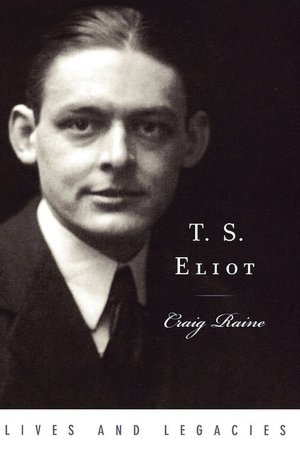
With a writer as densely allusive and suggestive as T S Eliot, we can sink happily into the details of each particular poem, without ever feeling we have quite touched the seabed. This is an intensely rewarding activity, of course, but it also calls out for a complementary panoramic view of the work, in which we view poems next to each other and get a sense of the poet's general preoccupations. I offer here some thoughts on the first section of the Selected Poems (Faber),
Prufrock and Other Observations (1917). This is a remarkable first collection, in which the poet speaks with a fully achieved voice, in a formally innovative style, and assays the great themes that we will see worked on again across the
oeuvre.
Prufrock and Other Observations (1917). Observations? It gives the poet a distant air: he is not the Romantic poet expressing his emotional life, but a detached, clinical observer of his times. This is Eliot's impersonal poet, reserved and elusive, using the masks of personae rather than speaking in his own voice: there are many such masks in the
Selected Poems: Prufrock, Gerontion, the voices of 'The Waste Land', Simeon ... Eliot is writing dramatic monologues in the tradition of Browning, but with a modern twist. His speakers are ghostly, phantasmal, barely characters at all perhaps beyond the poem they are in. After the psychotic swagger of Browning's Duke in 'My Last Duchess' we get the traumatised voice of Prufrock, vehicle for the doubts and hesitations of modern man, consumed by early twentieth-century angst. For a curious thing about some of the great modernists - Eliot, Pound, Lawrence - is that they
hated the modern world. They were really anti-modernists, seeking in the past the order and vitality and sense which they felt had been drained out of the Western world. The contemporary scene they regarded with horror: it was, literally, a waste land, a spiritual desert life is savaged, mechanised, brutalised, rendered meaningless by the loss of a shared cultural tradition. One of the preoccupations we meet in the first volume is this sense of
disenchantment: other ages might have known the grace and loveliness of the mermaids, but they are silent now. The later religious poems can be read as a search for a way out of this disenchantment, back to grace, beauty and meaning.
The air of coldness of the title of
Prufrock and Other Observations clashes with the warmth of the dedication, to Eliot's friend Jean Verdenal, who died in the First World War. It is characteristic that Eliot should express his warmth of feeling for Verdenal through a quotation from Dante, a poet Eliot revered and turned to throughout his life. It is the first of the many, many allusions and quotations we will meet in the book. And it stirs questions. Why express yourself through the words of another poet, from another time, in another language? For some, it is simple elitism: an epigraph in Latin or Italian is like a sign saying 'Don't bother with this unless you're part of the club of the hyper-educated', a way of ring-fencing culture off from the common man. Another suggestion has been that it is a deliberate strategy of invoking (literally, calling in) the great tradition in the contemporary: through allusion and quotation, Eliot's poems seek to be inclusive, to involve the formative texts of Western civilisation. Quotation is a kind of genuflection to the great lights of culture. Or, perhaps, it is a form of reticence. A rather shy way of uttering affection, we may feel. Eliot cannot salute his dead friend directly, in his own words, but does through in a sideways fashion, through the words of Dante. Cleverness deflects the grief. Deep feeling is in this way managed and ordered through the apparatus of erudition. Or a mixture of these motives. Or none of the above.
Even before the first poem, we are in Dante's underworld, where he is guided by Virgil among the souls in Inferno and Purgatory: 'trattando l'ombre come cosa scalda', treating the shadows [the dead] like the solid thing. Shadows and reality, the dead and the living - this is one of the great Eliot themes. He is fascinated by the meeting between the living and the dead: on a literary plane, this is the meeting of past and present writers, the relationship between modernity and tradition. In Eliot's scheme of things, Dante is a modern poet, a voice expressing the present. And Prufrock, Gerontion, the inhabitants of 'The Waste Land', the Hollow Men - they are all in some shadowland, the twilight kingdom, between life and death. The living can seem more dead than the dead, an idea still being worked through in the Ariel poems, where we find the Magi between the old (dead) dispensation and the new world, or Marina's father between life and death in the ephemeral smoke (an echo of the fog of Prufrock). And overshadowing the work is the the tragedy of the First World War. Against that Inferno, everything can collapse into unreality. In Eliot, we barely leave Dante's underworld, where the living poet descends, with the help of Virgil, to meet the spirits of the dead, and where the spirits, through poetry, give voice to their vexations.
The first persona we meet is Prufrock, speaker of the first poem. He is himself an 'observation'. A strong influence here is the French poet Jules Laforgue (1860-87), who cultivated an air of sceptical, cynical detachment from vulgar modern life. Prufrock - whose tidy respectable name deflates the romantic expectations of 'Love Song' - is in the Inferno of modernity, and the 'you and I' suggests Dante and Virgil, touring this latest manifestation of spiritual death. (Another key influence is Baudelaire, whose speakers take refuge in the imagination from the sordid urban world: 'La rue assourdissante autour de moi hurlait', the deafening street howled around me, he wrote). Prufrock is captive in the lonely, fog-bound city, and his particular circle of hell is the world of society, the drawing rooms, cultured conversations and teatime rituals which form the timetable of his existence. It is a poem of existential crisis: Prufrock is existing but not living. He
cannot live. He looks out at the world around him and vertically down into himself. His world has 'formulated' him, and he is acutely aware of its judgements and expectations. Confined by this self-consciousness, he cannot find in himself any will to act, to take on an independent life: even to speak about it would be a presumption, a disturbance of the settled world. Though he walks and talks, Prufrock is, spiritually speaking, dead - a soul in agony, in hell. His condition is that of paralysis, a morbid lassitude born of the sense of the pointlessness of life, which leads to an inability to do anything apart from retreat into guilt-ridden introspection. This
ennui is a major theme in Baudelaire; and we find another treatment in James Joyce's
Dubliners, whose characters are unable to move or act beyond the narrow circumscribed world defined for them by place, tradition, religion. In this condition, life itself - meaningful, fulfilled life - is deferred, indefinitely postponed. Yet another reference here is Matthew Arnold's
'The Buried Life', which describes the sense of our real lives and selves being hidden from us:
But often, in the world's most crowded streets,
But often, in the din of strife,
There rises an unspeakable desire
After the knowledge of our buried life.
The buried life, the life not fully lived is another great Eliot theme, or really the same theme as the meeting of living and dead, for it is about the life which never happens, which turns into a mental death. Prufrock cannot act; Gerontion ends up in a waste land at the end of an empty life; The Hollow Men take this spiritual inactivity to an extreme; and even Simeon, having been granted the revelation, resigns himself to an otherwise uneventful life.
After Prufrock's love song, which describes not being able to love, and not having a song, we meet the similarly tortured speaker of 'Portrait of a Lady'. The title alludes to a Henry James novel, and the poem is a Jamesian 'moment', consciousness investigated to breaking point. The lady believes her companion is an understanding friend (lines 19-23), but he knows he isn't: he stands back from the scene he is in, treats it as material for art, reflects on his incapacity for true friendship (the musical images form an analogue of this guilt pulsing through him), and takes refuge in social rituals - admiring the monuments and so forth. It is another version of Arnold's buried life, the unspoken world where conversation falters, the subterranean anxieties which lie beneath social ritual. (This acute awareness of hidden, vertiginous depths beneath the surface of events is a great modernist trope: it is the basic premise of Joyce's Ulysses and Woolf's Mrs Dalloway - both, incidentally, published in 1922, the same year as 'The Waste Land'.) Feeling unequal to the emotional demands made of him, the speaker of 'Portrait' takes refuge in the persona of the refined
flaneur, the ironic observer of urban life. Music throughout is the unconscious force that jerks him into recognising his inadequacy. When she dies - she is nearing her journey's end, she says - how will he respond to that? Will she have the better of him by pointing out in her death his total inability to find the right feeling in himself? Intellect, culture, irony .. all here have led to a dead end, a failure of sympathy and communication. Eliot the tremendously educated (Harvard, Paris, Oxford) intellectual poet is contemplating the emotional atrophy which follows from over-cultivation of the intellect. As in Prufrock, the form expresses the emotional narrative of the piece, giving us an x-ray of the synaptic currents as the speaker feels his nerves grow, then calms himself, then starts again ... And we are getting an uneasy sense now of Eliot's representation of
women - terrifying presences in Prufrock, and a source of neurotic anxiety here.
In 'Preludes', we return to the modern city, as explored by Baudelaire (Eliot seems here to be remembering his home town of St Louis, Missouri - in exile in London, the memory grows keener). We can see the waste land forming - the streets are shabby, life is made up of pointless 'masquerades', the poet watches and cultivates his observational powers. The Preludes look back to Baudelaire and more recently to
Imagism, the school of poetry formed by Pound and others in opposition to the (as they saw it) vacuous rhetoric of Georgian poetry. Imagism is devoted to clear, sharp delineations in a language which is born of common speech but exact. From the image the reader 'gets' the emotional state behind it. Compare the images in these poems to Pound's famous 'In a Station of the Metro':
This apparation of these faces in the crowd;
Petals on a wet, black bough.
From these deft observations and metaphors an emotional world is built up in the reader's mind. Alongside the clarity and economy of the writing, we also note the detached poet stance uttering some rather unpleasant observations about the sordid contents of some unnamed, ordinary person's mind. Thanks! And how does he know, anyway? The ironic detachment here becomes an aggressive snobbery, as in the dead crowd on London Bridge in The Waste Land. We could read this as the speaker projecting his own disenchantment and self-loathing onto what he sees: Preludes and Rhapsody, after all, explore the process of perception, dramatise the way inner state colours observations of the external world. But nonetheless, elitist detachment from ordinary life is for many one of the less agreeable aspects of the Eliot poetic.
Then we come to 'Rhpasody on a Windy Night', a poem freighted with intimidating learning, if we consult Southam and other guides. One influence is the French writer Henri Bergson, and his theories of memory (like Eliot, Bergson was interested in the
coexistence of past and present); perhaps we see a trace of F H Bradley, the Oxford philosopher on whom Eliot wrote his doctoral dissertation (the war prevented Eliot from attending his viva voce exam, and hence he never became Dr Eliot). Bradley's subject was the philosophy of mind: is there any reality beyond the reality of my consciousness? Are there minds other than mine? How could I know if there were? and so forth. (Perhaps the most clearly Bradleyan lines occur in 'The Waste Land': 'each in his prison / thinking of the key'). But 'Rhapsody' is not a philosophical poem. It does not argue a thesis, and source-hunting is likely to lead us away from its emotional depths onto the dry (very dry) land of abstract reflection, where some readers may prefer to be. For 'Rhapsody', like the other poems in the collection, is quite terrifying. It is about suffering, and depicts a mind in an extreme state. Again we find a speaker trapped in a circle of hell, which takes the form of an urban nocturne. Memory is troubling, leading us into madness (11-12). We meet another menacing female (16-22). A prostitute, at that time? Perhaps. Or a projection of the mind? Another paralysed spirit, certainly, unable to communicate. Failure to communicate is perhaps the keynote. Even the children are oblivious, and the nearest the speaker gets to any kind of interaction with anything is playing tug-of-war with a crab. we never quite know if the images int his poem are nightmare phantoms, or things in the real streets around which, restlessly, he walks. Alongside these themes we notice another Eliot motif, which is eyes: the woman's eye is twisted, and the child's eye is a blank. We remember the piercing eyes in Prufrock. Turn from here to 'The Hollow Men' and you'll see eyes all over the place, eyes unable to see, unable to meet. If the eyes are the windows to the soul, as the saying has it, then we find ourselves here in a soulless place, the place where the soul dies. 'Rhapsody' follows the meandering route of the speaker as he walks through this desolate inferno - waste land - city - unconscious - memory liminal space where thoughts that should be dead and buried come to life. He finally reaches his sparse-sounding lodging, with the single toothbrush hanging pathetically on the wall. The lamp tells him to get ready for the business of living (which is what Prufrock spends his life doing). Life? what life? The irony is savage, hence the last line, locked in place by rhyme (rhyme endings in Eliot are rarely comforting chimes, more often beats of mounting nervous tension).
To sum up the themes announced in Prufrock: failure of communication, the buried life, the life not lived, the mingling of living and dead, past and present, women as a source of fear and self-doubt, elitism (perhaps), despair, suffering. A depressing list, so what stops the experience of reading from being purely depressing? First, the simple fact that is being said: the unspeakable is being articulated, the depths hauled to the surface (cf the image of memory throwing things up on a beach in Rhapsody). There is the creative energy which we find in the exact use of language and the formal techniques: quotation and allusion, the handling of 'free' verse so that the lines form an exact map of the mental journey they describe, the employment of personae, the sharp characterisation, imagery that has not been done to death, and still makes a surprising impact today. And we sense that this is the real thing, not someone writing what they think poetry ought to sound like, but using poetry as an instrument to transcribe experience, whatever dark places that may lead us into. The creative process of art, then, is a way of dealing with pain. The next set of poems, 'Ara vos Prec' (Poems, 1920) will ask, among other things, whether art and intellect are sufficient for dealing with the tribulations of modern (modernist) life.
For more overview material (online) see:
One-page summary from
Books and Writers
Ronald Bush,
T S Eliot's Life and Career
General Account on
The Poetry Foundation
Also:
Earlier post on this blog on
Prufrock
Keith Sagar,
'Prufrock Supine and Sweeney Erect'
Analysis of
Rhapsody
Another account of Rhapsody on
Wondering Minstrels blog
 Surely the first thing that strikes anyone on looking at the selection from Poems, 1920 is that they are extraordinarily difficult. In 'Gerontion' and the quatrain poems, Eliot uses dislocation: we seem to slide suddenly from one scene, or voice, or topic, or image to another, and the link is not at all clear. Then there is the obstacle course of quotations and allusions - in 'Burbank' a whole heap of them - which defy us to recognise and make sense of them. On top of this are difficulties in language, such as the tortuous syntax of 'Gerontion', and the abstruse vocabulary ('Polypohiloprogenitive' etc.). As if that were not enough, we have strange names to makes sense of (Princess Volupine, the 'characters' in 'Gerontion'), references to classical myth ('Sweeney among the Nightingales') and obscure theology ('Mr Eliot's Sunday Morning Service'), and a lack of clear subject matter. And the voice with which the poems are delivered seems frequently to change in tone - from ironic and sardonic to philosophical to, occasionally, lyrical (the description of the painting in 'Mr Eliot's Sunday Morning Service'). It is comforting to discover that the best-read critics and scholars have found these poems