 I'm delighted to be involved in this short guide to reading poetry. It was quite a collaborative effort. I was able to draw on excellent work by Andrew Hodgson, the thoughts of Caroline Moore, and the editorial work of Jon Connell. The result is intended to be accessible for readers from 13 upwards. It's published simultaneously with the snappy, sensible guide How to Write Well by journalist Tim de Lisle. Connell Guides aim to help those facing exams, but to go well beyond exam mentality. If this helps readers young or old find or refresh their confidence and pleasure in poetry, then it will have done its job.
Showing posts with label Criticism. Show all posts
Showing posts with label Criticism. Show all posts
Sunday, 4 June 2017
How to Read a Poem
I'm delighted to be involved in this short guide to reading poetry. It was quite a collaborative effort. I was able to draw on excellent work by Andrew Hodgson, the thoughts of Caroline Moore, and the editorial work of Jon Connell. The result is intended to be accessible for readers from 13 upwards. It's published simultaneously with the snappy, sensible guide How to Write Well by journalist Tim de Lisle. Connell Guides aim to help those facing exams, but to go well beyond exam mentality. If this helps readers young or old find or refresh their confidence and pleasure in poetry, then it will have done its job.Sunday, 22 January 2012
Amos Oz
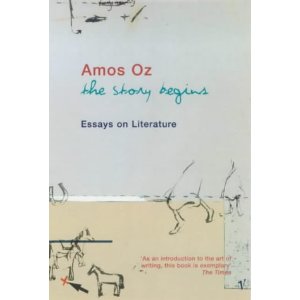 Amos Oz is a distinguished Israeli writer, whose work includes novels, poetry, political commentary and memoir. The Story Begins is his masterclass in close reading of fiction. There are ten short chapters, each dealing with the style of a story or novel, and the way that the beginning takes us into the work. Authors examined include Fontane, Gogol, Chekhov, Kafka, Márquez and Carver. There are also critiques of Hebrew writers who some of us may not be so familiar with: Shmuel Agnon, S Yizhar, Yaakov Shabtai. But for the purposes of enjoying The Story Begins it isn't necessary to have read any of the works Oz considers, since his main concern is with how the fictions get going (and plot developments are summarised when necessary).
 Oz is interested with the 'contract' any fiction implies at the outset between reader and writer. The brilliant first essay takes the opening of Fontane's Effi Briest, which seems to a modern reader a standard bit of descriptive scene-setting, the kind we have little patience with these days. Then he shows how every detail in the scene contributes through symbol and atmosphere to the development of the story. He shows us how to read Gogol by picking up the mad bureaucratic style, and explains how Márquez (in The Autumn of the Patriarch) dissolves the sense of time on which novels usually depend. A Carver story requires us to look for the emotional life of the characters beneath the surface, in the interstices of the writing. Oz picks up words, phrases and sentence shapes and relates them to the larger life of the story or novel under scrutiny. Each writer requires us to 'tune in', to pick up a series of codes and understandings that makes the reading experience work.
In a postscript, Oz expresses his frustration at dry academic criticism, which takes the pith out of literary texts. He emphasises the fundamental importance of getting lost in a book and picking up the particular pleasures it gives us. (Words like 'examined' and 'scrutiny' above suggest this dessicated world of joyless analysis, and don't do justice to his irresistibly enthusiastic approach: the chapters are based on lectures at high school and university and we hear the ebullient teacher's voice here.) Reading for pleasure doesn't mean being unthinking or unobservant, or falling into belle-lettristic complacency; but it does mean reading slowly and finding our way around in the new and strange world any good fiction writer takes us to. The Story Begins is top notch lit crit, and a writer's introduction tothe art of slow reading. Five stars.

Thursday, 19 January 2012
James Wood, How Fiction Works
 James Wood is one of the liveliest critics around. His essays always give a sense that the whole business of reading closely really matters, as part of our experience of life, not simply as an academic exercise. Most of his writing takes the form of essays (several are collected in The Irresponsible Self and The Broken Estate). How Fiction Works is a book-length study of the techniques we find in writers from Fielding to David Foster Wallace. It really is about how good novels and stories work, what makes them go, what makes them work their magic on us. We strat with a lesson on narrative, and in particular the uses of the free indirect style, where we often float between the minds of the narrator and the characters (Consider: 'Sir Richard listened patiently to the scruffy clerk's explanation' - here we are looking at Sir Richard from the outside, shown the action by the third-person narrator, yet at the same time we are also inside Sir Richard's mind, as he congratulates himself on his patience and finds the clerk scruffy' - it's a simple trick, yet marvellous effects come from it). There are chapters on other aspects of the fiction-writer's trade such as characterization, imagery, dialogue. It is all refreshingly undidactic and reads like an enthusiastic reader sharing his findings. Woods is averse to dogmas like show-don't-tell and 'characters should be rounded' and well equipped to point out how great writers regularly break these notional 'rules'. In conclusion he considers the claim that the realist novel is outmoded in the modern age, and feels this is mistaken, or pedantically over-insistent. In any case, he argues, serious writing is not about the construction of reality but about the search for truth. How Fiction Works is constructed in short, fragmentary sections - each one an observation, usually based on a particular passage. (And the passages are nicely complete in themselves: there is no need to have read all the novels he cites to follow the discussion.) How Fiction Works has a personal style and taste, which makes it very readable. It is unblemished by jargon, opinionated, lively, not stifled by reverence and altogether highly recommended to anyone studying literature, or simply anyone who likes reading literary novels and wants to read them better (let us assume that anyone in the first of these categories also belongs to the second).
Monday, 19 December 2011
Book: Craig Raine, T S Eliot
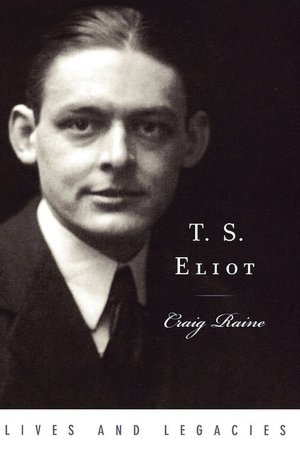 Raine’s study of T S Eliot is a curious book. It clearly assumes
familiarity with the major works, and with the broad shape of the biography, so
is not for first-timers. Yet some of the summary passages, such as the account
of Eliot’s view of the person who suffers and the mind which creates, will not
give anything new to experienced readers. So who is it for? It offers excellent
close readings of some less noticed poems (‘Lune de Miel’ and ‘Dans le
Restaurant’) while skipping important works like ‘Preludes’ and ‘Rhapsody
on a Windy Night’, and it gives only a general impressionistic account of ‘The
Waste Land’. The reading of ‘The Four Quartets’ is too fragmentary to be satisfactory,
while as usual making neat local poits about word choice along the way. The
main thesis of the book is that Eliot’s work is animated by the Arnoldian
Buried Life, the sense of life unlived, emotions unfulfilled. This is just
about made to cohere with the secondary thesis that Eliot is a classicist in
the sense of being sceptical of romantic emotional effusion, and more interested
in the detached depiction of less usual, fugitive emotions. The difficulty here
is that, as Eliot recognised, the terms ‘Romantic’ and ‘Classical’, when
applied as anything other than period terms – and perhaps even then - are too vague to do any useful work.
Raine’s study of T S Eliot is a curious book. It clearly assumes
familiarity with the major works, and with the broad shape of the biography, so
is not for first-timers. Yet some of the summary passages, such as the account
of Eliot’s view of the person who suffers and the mind which creates, will not
give anything new to experienced readers. So who is it for? It offers excellent
close readings of some less noticed poems (‘Lune de Miel’ and ‘Dans le
Restaurant’) while skipping important works like ‘Preludes’ and ‘Rhapsody
on a Windy Night’, and it gives only a general impressionistic account of ‘The
Waste Land’. The reading of ‘The Four Quartets’ is too fragmentary to be satisfactory,
while as usual making neat local poits about word choice along the way. The
main thesis of the book is that Eliot’s work is animated by the Arnoldian
Buried Life, the sense of life unlived, emotions unfulfilled. This is just
about made to cohere with the secondary thesis that Eliot is a classicist in
the sense of being sceptical of romantic emotional effusion, and more interested
in the detached depiction of less usual, fugitive emotions. The difficulty here
is that, as Eliot recognised, the terms ‘Romantic’ and ‘Classical’, when
applied as anything other than period terms – and perhaps even then - are too vague to do any useful work.
The main difficulty of Raine’s book is that the theme of the buried life is strained to breaking
point, as it is used to apply to so many things: Prufrock’s stifling of impulse, the buried
voices in ‘The Waste Land’, the idea of a positive renunciation in ‘Ash
Wednesday’, the dramatization of repressed conscience in the plays and the
spiritual experience in ‘The Four Quartets’. This makes us feel that a whole oeuvre
is being blurred over and made to fit a single idea, a reductive strategy false to the variety of Eliot's writing. Along the way, there
are some scrupulous readings of lines, interspersed with weird tabloidese
one-sentence paragraphs, surprising choices of adjective for a critical work (a
Walcott poem, left largely unquoted, is ‘botched’; an interpretation by George
Steiner is ‘stupid’). The chapter on the Criticism is entertaining for its
comments on inconsistencies and vagueness in Eliot’s work, but Eliot’s
criticism really needs to be traced chronologically and systematically, and
there is too much hopping about from one essay to another. The chapter
defending Eliot against accusations of anti-Semitism is a much-needed
counterbalance to what has become critical orthodoxy; it might be stronger if
Raine had not earlier been vigorously defending TSE from any and all other accusations
(mistreatment of his first wife etc.), making him look like a defence lawyer rather than an impartial
critic (an effect contributed to by the dedication to Valerie Eliot). Some of the readings, such as the contention that Burbank is a dramatic
monologue, which we would see if we knew our Joyce better, seem to me
over-ingenious. Some are brilliantly precise. The book is certainly not a general introduction to a major
writer, but a vigorously argued pursuit of a big idea, the Buried Life that is alleged
figure in the carpet of the whole work from beginning to end. Raine's TSE is certainly
worth reading, and one would generally prefer criticism with a personal touch
like this to a toneless Introductio. But for a general overview of Eliot’s art we need
to look elsewhere.
Subscribe to:
Posts (Atom)