Showing posts with label Philosophy. Show all posts

Tuesday, 3 April 2012

The Renaissance: History of an Idea

'The Renaissance' is one of the most frequently used terms in cultural history, but the idea itself has been subject to much examination and discussion. Here is a summary of some of the key points in the debate.


The Idea of Renaissance

Claims that the fourteenth century witnessed some kind of cultural rebirth in Europe go back to the period itself. The Italian poet Petrarch (1307-74) saw the rinascimento as the revival of the values of the classical world, after the barbarian invasion of Rome and the ensuing chaos of the Dark Ages. Petrarch lived in what has been called ‘the calamitous fourteenth century’ - calamities which included, among other things, the Hundred Years War, the ‘Babylonian captivity’ of the papacy in Avignon, and the horrors of the Black Death. Contrasting the glories of ancient Rome with this miserable present, Petrarch divided history into two periods, historiae antiquae, which ended with the ending of the Roman Republic, and historiae novae, from the Roman Imperial period onwards. This was an unorthodox view, as it placed pagans in the period of light and Christians in the darkness. Petrarch yearned for a return to the spirit and letters of ancient Rome. Addressing his own poem Africa (composed 1338) he says:

For you, if you should long outlive me, as my soul hopes and wishes, there is perhaps a better age in store; this slumber of forgetfulness will not last forever. After the darkness has been dispelled, our grandsons will be able to walk back into the pure radiance of the past. (Africa, IX, 453-7)

The achievement of the Florentines in restoring the light was saluted by the (Florentine) humanist Marsilio Ficino (1433-99):

If we are to call any age golden, it is beyond doubt that age which brings forth golden talents in different places. That such is true of this our age [one] will hardly doubt. For this century, like a golden age, has restored to light the liberal arts, which were almost extinct: grammar, poetry, rhetoric, painting, sculpture, architecture, music ...

In his Lives of the Artists (1550), the artist and writer Vasari presented the history of northern Italian art as an upward journey, leading away from the stylized forms of the Middle Ages to the magnificent realistic art of Michelangelo. This journey was led by a series of heroic artists of genius. Through them, as Vasari tells the story, the glories of the ancient world had been reborn.  Such comments are not attempts at objective history. They appear in writings such as letters or manifestos, where poets promote their activities and seek patrons. Vasari’s Lives is also a work of propaganda: it was dedicated to the Grand Duke of Tuscany and thus naturally extols the greatness of that region.

Effusions of enthusiasm such as these are not the same as claims that the age as a whole can be characterised as a rebirth, or re-naissance of ancient thought. The use of the word ‘Renaissance’ as a serious historical term really starts in the nineteenth century. The French historian Michelet famously called the Renaissance a time of ‘the discovery of the world and the discovery of man’. In this period, Michelet points out, man looked outwards at the world around him: he explored in ships, investigated with science, and celebrated natural objects in art. At the same time, people looked inwards at themselves: in the plays of Shakespeare, or the essays of Montaigne, we see an unprecedented representation and examination of individual human consciousness. This thesis was further developed by the Swiss historian Burckhardt in his massively influential The Civilization of the Renaissance in Italy (1860). For Burckhardt, the Renaissance was the birth of the modern age: medieval certainties about man, the world and God faded away, and the modern individual emerged – equipped to enquire and reason, to trade and to express himself through his behaviour and creative work.

            How convincing are these various claims? They have certainly been influential. Petrarch’s picture of a noble classical age, lost in the ‘Middle Ages’ and revived in the rinascimento has ingrained itself in the Western sense of history. Yet there is much to be said against it. Above all, it discounts the cultural achievements of the so-called ‘Middle Ages’. Latin culture could hardly be reborn in Petrarch’s time, since it had never died: Europe is built on the ruins of Rome, and throughout the Middle Ages we see Roman influence: in language, education, customs and the law. At certain points, such as the ‘Carolingian Renaissance’ of the ninth century and the ‘twelfth century Renaissance’ involving scholars like John of Salisbury, classical writings had been intensively studied: indeed, the manuscripts that Petrarch and others were ‘discovering’ were earlier medieval copies, largely owing to scribal activity under Charlemagne. The image of a brilliant rebirth, so persuasively painted by Petrarch and his followers, may be more self-advertisement than historical fact.

            The theses of Michelet and Burckhardt have also been disputed by later writers. Was the Renaissance really the birth of modernity? Medieval practices and beliefs did not disappear but continued throughout the Renaissance period. As for the examination and celebration of the natural world, we can see these clearly in the work of a medieval scholar like Roger Bacon and the poetry of St Francis. Seen in this light, the Renaissance could be seen as a development of the medieval world rather than a departure from it. Perhaps the single greatest invention of the Renaissance - printing - came from the medieval guild system. Equally, Renaissance characteristics can be found in cultural achievements of the eighteenth century and even into the present. At both ends, the chronology is highly problematic.

            In short, while Michelet and Burckhardt draw our attention to important phenomena of the period, they also select out a great deal. Moreover, their books are based on a theory of history that is also controversial: this is the idea - inspired by the German philosopher Hegel - that an age has a Zeitgeist (Spirit of the Age) - an underlying essence or character which unifies its various parts. Moreover, in the Hegelian view, history is teleological: that is to say, it is moving in a certain meaningful direction. This assumption underlies the nineteenth-century historians’ emphasis on the Renaissance as a progression from past to present. This notion, too, which links with the outlook of Vasari and others, is contentious.


For these reasons, some historians and critics have avoided the term ‘Renaissance’, and preferred to employ the label ‘Early Modern’ for broadly the same period. A book like this one could also be called ‘English Reformation Literature’, since the ideas of Reformation theology had at least as much impact on the English in these centuries as the models of classical culture - and possibly more. Nevertheless, the Renaissance is a convenient term for denoting a certain period, and we can use it without committing ourselves to the thesis elaborated by Burckhardt and other historians. A period term may be used for practical convenience; indeed without them, study becomes next to impossible.

            The foregoing discussion is not intended to imply that the writers discussed may be in any way dismissed. Vasari’s Lives is one of the great books of the West. Burckhardt’s book, the result of five tears’ exhaustive travel, reading and note-taking, is still indispensable for the serious student of the Renaissance, precisely because of the discussion it has provoked. And while it has been seriously revised in the light of later scholarship, it has not been comprehensively demolished. Some contemporary writers on the Renaissance still, with various important qualifications, see the period as representing a profoundly significant shift in Western man’s modes of thinking and living. The debate on what we mean by ‘The Renaissance’ is still ongoing.


Further Reading

A classic defence of the label ‘Renaissance’ as applied to Italian art is: Erwin Panofsky, Renaissance and Renascences in Western Art (London: Paladin, 1970), ch. 1 ‘Renaissance – Self-Definition or Self-Deception?’, 1-35.

See also the first two essays in A G Dickens and others, Background to the English Renaissance. Introductory Lectures (London: Gray-Mills, 1974): E H Gombrich, ‘The Renaissance – Period or Movement?’, 9-30; J R Hale, ‘The Renaissance Label’, 31-42.

A modern summary of the debate is given by Margaret L King, The Renaissance in Europe (London: Laurence King, 2003), ‘Introduction: The Idea of the Renaissance’, viii-xv.

'The Renaissance' on In Our Time: excellent discussion by Francis Ames-Lewis, Peter Burke and Evelyn Welch.

Sunday, 29 January 2012

Eighteenth-Century Taste


In Jane Austen's Persuasion (1818) we are told that the heroine, Anne Elliott, is "an extremely pretty girl, with gentleness, modesty, taste and feeling". It is one of those lists of epithets in Austen that seems at first comfortingly familiar, and then elusive. What does it mean in this world to have 'feeling'? What kinds of behaviour make up 'gentleness'? And what would the first readers have understood by 'taste'? Any one of these words can start us on an archaeological dig into the various concepts at work int he novel: we need to investigate them, because it is against these values that we make sense of the action. On the subject of taste, I found a programme in the In Our time archive very helpful, and I offer some notes on it here. But better still, listen to the programme directly: there's a link at the end of this post. 

In the early eighteenth century Britain was commercially successful, surpassing its nearest rival Holland. There was new wealth pouring in, and much of it was spent by the newly wealthy on luxuries. Over the centuries, these consumables ranged in style from classical and gothic to Venetian, Indian and, of course, chinoiserie. All this money and luxury led to some concerns, not only the perennial anxiety over arrivistes enjoying a status previously reserved for those of noble blood (returning to Persuasion, we might think of Sir Walter's dislike of naval officers for just this reason a century later). It was also feared in some quarters that the enjoyment of luxuries would lead to a moral decline: Britain was the greatest empire since Rome, and a parliamentary democracy, superior to the effete court of absolutist France. Would this identity be threatened by cultural borrowings? Would the manly Brits go soft, stroking their new lace fabrics instead of staffing the empire?

With so much new stuff (literally and figuratively) coming in, and merchants climbing up the class ladder, some principle of discrimination seemed desirable. How do you know what is really good, how do you separate quality from tat? The ability to do this is taste, French 'le gout', "a capacity for discriminating beauty". There was more openness for debate about such matters in Britain: in France the court basically set the rules, while in Britain since the Glorious Revolution of 1688 the court was much weaker and there was room for other authorities to emerge.

Writers were one such source of authority. As they became interested in the question of taste, they gave the notion an intellectual basis. One of the most important intellectuals was the gentleman philosopher, the Third Earl of Shaftesbury (1671-1713; in the first half of the 18th century the nobility had an important role as the arbiters of taste). He brought aesthetics (the study of beauty) to the centre of philosophy. Shaftesbury made a link between beauty and religion: he believed that we commune with God by looking at beauty, which is characterised by order, harmony, and proportion. These ordering design elements are in turn analogous to the internal ordering needed for the virtuous life. Hence discriminating perception works together with ethical judgement. Virtue is our sense of moral order and perfection, analogous to our intuitive approval of the rightness of a building's facade. The enjoyment of beauty, the moral life, and the understanding of the divine are all linked.

From this analogy drawn between moral and aesthetic judgement, it followed that it was desirable to develop one's powers of perception and discrimination, to become cultivated. For Addison (1692-1719), in his essays in The Spectator, this quality was fundamental to a civilised person. Acquiring a sense of the elegant, polite and refined arts was higher than the mere pursuit of pleasure: it was the distinguishing mark of the modern, polished citizen.

In any period, ideas develop in opposition to other ideas. This was the case with taste in the eighteenth century, which was conceived partly in opposition to religious enthusiasm, as practised by non-conformists such as the Methodists. On the one hand there is balance, order, design, perspective, reason, stability; on the other there is the baroque, the unlicensed, wild, effusive. For the proponents of taste, the first set is identified with Englishness, making the second alien and a little suspicious. Taste thus provides a vocabulary for both the inner and outer life: it indicates an ordered religiosity within, and governs the way you comport yourself in society. And it identifies you as a loyal Englishman.

Unlike the political arts, which could only be practised in public, by men, the art of acquiring taste could be pursued and expressed in the home, the territory of women. It was possible for women to demonstrate taste through their choice of decoration, their manners, how they walked. The objects and rituals of the home - teatime served in Wedgewood China, Chippendale furniture - all betokened taste. It was not the privileged domain of the aristocracy, or even the gentry: in Richardson's novel Pamela (1741), the eponymous heroine shows a higher standard of discrimination than those of higher social standing. You can advertise your taste simply by behaving in accordance with certain rules, and rules are not expensive. Culture was more available: this was the age of the first public libraries, household pianos, printed sheet music, the novel, public pleasure gardens. Nature itself was perceived through eyes educated by taste in paintings: so under William Gilpin's instruction, travellers learned to search for 'picturesque' landscapes, nature which looked like a picture; while landholders could have their parks remodelled by 'Capability' Brown (so-called because he assessed lands for their 'capability', that is potential for landscape treatment) to suit the idea of what the countryside would look like if it was tastefully designed.

Cultivation was no longer the hobby of the wealthy elite. Fanny Burney's Evelina (1778) depicts a London where cultural pleasures are readily available. Indeed, vulgar aristocrats were mocked: Pope's Epistle to Burlington satirises a vulgar country estate (and in so doing implicitly praises Burlington's refined neoclassical sensibilities, as exemplified by his Palladian house at Chiswick). The nouveaux riches and their fancy houses at Twickenham and Clapham all came in for a bit of bashing too. (We could add that Gilpin was himself satirised in Thomas Rowlandson's Doctor Syntax drawings.) Beneath it all was an unresolved question: could culture simply be acquired by anyone with sufficient income? Or did you have to be born into it?  Which middle class groups have got it right? Who are the tasteful and who are the vulgarians? The new form of the novel was itself hard to pin down: Richardson teaches the proprieties, yet as a mere tradesman - he was a printer of humble background - he was regarded as an impertinent upstart by aristocrats like Lady Mary Wortley Montagu (1689-1762). In the early nineteenth century, judgements of taste course through the novels of Jane Austen.

The British Empire was a source of this diversity and confusion. The British colonies allowed for self-creation, unstifled by hierarchy. At home, a more mobile society allowed for self-invention too. The basic story of the eighteenth century novel is someone become a lady or gentleman, displaying the taste and attitudes necessary for that status. the But there was always a need for an authorised code of what was tasteful and decorous. And once that code is known it can be deployed to exclude others. In the nineteenth century, the obsession with taste fades.

An interesting discussion, though as one contributor mentions, it somewhat collapses chronology in teasing out the big themes. It  leaves us with the question of where we are today, taste-wise. Can 'good taste' be taught? Is 'tasteful' - as Amanda Vickery says right at the end - today's ultimate put-down? The word itself, like all evaluative terms in England, is inevitably involved with class and money, and is often avoided for that reason. But it seems to me that, whatever term we employ, taste is still operative, though in discrete areas, not as a universal code. The communities around rap music, opera, handbags and National Trust houses will all have their ideas of what's proper, what's cool or naff, and individuals will absorb this code more or less consciously. We still define ourselves by what we like: do you find Downton Abbey a Sunday evening pleasure, or ghastly soft heritage, for example? Do you pronounce your refinement through not going to Guy Ritchie's Sherlock Holmes films, or is that the attitude of a self-important snob? We'd like to think we at least have our own answers to such questions, but I suspect we look around us for the 'right answer' just as much as our eighteenth-century forbears did. Our identity is to a large extent constructed by society, or the bit of it we find ourselves in, and many of our opinions are consequently the received opinions of that group. Perhaps it is a romantic fallacy to think things could be otherwise.

The reading list on the In Our Time page makes me feel very ignorant, but one book I have read, and would recommend is John Brewer, The Pleasures of the Imagination. Not in the reading list is Shaftesbury's Characteristics of Men, Manners, Opinions, Times (1711).

Monday, 16 January 2012

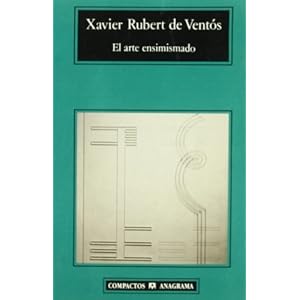
El arte ensimismado

En El arte ensimismado (1963) Xavier Rubert de Ventós nos ofrece una introducción al arte moderno, o, más precisamente, a ese estilo de arte moderno del siglo XX que aún puede causar un cierto temor hasta en el público de alta preparación cultural: los cuadros de la más pura y austera abstracción, la música serializada y electrónica, la poesía experimental que parece un juego privado y sin sentido. El argumento del libro es que este arte hermético fue motivado por un instinto de auto-preservación en un mundo lleno de representaciones de todo tipo. Buscando un papel distinto, al arte arriba al extremo de un formalismo sin deseo de comunicar nada. La abstracción representa un determinado esfuerzo de crear un arte que no sea ni representativo, ni evocativo de emociones reconocibles, ni reducible a cualquier interpretación metafísica, ni parte de un esquema decorativo.
¿Y el resultado de este intento? El arte por el arte, una obra que no representa un objeto, porque es en sí el objeto (unas obras de Tàpies, por ejemplo), una composición sin enlaces  al mundo exterior o al mundo interior del espectador. Esta búsqueda de pura forma explica el serialismo en la música como una manera no de crear una nueva expresividad, sino de evitar expresión del todo. El ‘nouveau roman’ de Robbe-Grillet, la película experimental de Resnais, el bebop en jazz, el puro funcionalismo en la arquitectura – todo responde a este deseo de autonomía de la obra, casi diríamos hoy, una condición autística a nivel creativo.
El autor así nos da una perspectiva muy clara desde donde podemos contemplar  de nuevo unas obras de arte más intransigentes a la interpretación, y describe la situación artística de medianos del siglo veinte en el contexto de la filosofía existencial. Rubert de Ventós  - que escribió éste, su primer libro, a los 22 años - ayuda al lector a apreciar el arte moderna con una cierta simpatía por los motivos y preocupaciones que lo inspiró. Pero no pierde la distancia crítica, e investiga también los problemas con la posición que describe. Como producto, y objeto,  de la mente,  es el destino de la obra de arte padecer  ‘alienación’ (empleo el término del autor, en el sentido de percepción intencional) del espectador, y el formalismo puro parece una quimera. Con el tiempo todo se hace académico, habitual y viático de emoción y significado. Admiro la claridad del estilo, la comparación de las artes diferentes y el argumento muy enfocado y matizado. Anda qué debut!