Showing posts with label English Literature. Show all posts

Monday, 18 September 2017

Betrayal

'Jerry is a literary agent; Emma runs an art gallery; Robert is a publisher. Emma and Robert are married and Jerry is Robert's best friend, but Emma and Jerry have a seven-year affair and Robert has secrets of his own.'

Thus the flyer for Pinter's Betrayal, at Salisbury Playhouse, and it's all too easy to imagine a terrible play based on it, a middle-class soap opera involving arty people in Hampstead getting in and out of bed with each other. But it's a fascinatingly involving piece, not least for its technique of telling the story backwards, at each regressive step throwing everything into further doubt. What is this love story we are being shown? By the end we see it starts as a drunken declaration and fizzles out in boredom. Was there love along the way? Maybe, yet we are increasingly aware that behind every statement there is an evasion, or a deception. There was certainly desire, with Emma escaping from something and Jerry perhaps avoiding a disconnect  in his own marriage he does not want to address (or perhaps just arrogant enough to think he can have everything). Passion is surrounded by puzzle. Who knew what when? What further deceptions are taking place behind the scenes? Is Emma really just having drinks with Casey? Is Jerry's wife really just friends with her doctor colleague?In whose kitchen was a child thrown and caught? Pinter's trademark silences and pauses are filled with the sound of people searching for a foothold in an emotional landscape of ice and fog.

A capable cast found the drama of the words,  and the gaps between them. Emma (played by Kirsty Besterman - lovely to see her again here after Separate Tables) found a convincing spectrum from cool and controlling to utterly disconsolate. There was a real hint at something nasty not quite being shown in her marriage to Robert (Robert Hands), who seems to accept her affair with icy insouciance and yet exudes real menace. A brooding violence is internalised and expressed in insinuating verbal attack. His speech about squash had the effect of a brutal attack, while the Venice hotel scene projected a palpable tension. Jerry (Robert Mountford) played the lover, pinging like a squash ball between the other two. The Salisbury Playhouse has a very wide stage, and the production made full use of it: this might be thought to work against the intimate nature of the drama, but I thought it actually worked well, the spaces between the actors  bringing out the emotional distances between them, enhanced by ambient sound effects.

Betrayal is based on Pinter's own affair with Joan Bakewell. Rather knowingly, it has jokes about authors writing novels based on their own domestic lives. It has a slight period feel to it now, taking us to a time when we used traveller's cheques, and actually wrote letters to each other. And do literary agents earn so much that they can afford to buy, or rent, a flat in Kilburn purely for the occasional adulterous afternoon? Perhaps easier then than now. Yet it remains fresh, as it is not really about a particular affair, or even romantic affairs at all, but the nature of our dealings with each other, where our knowledge of our lives is only ever partial and every ordinary word casts a long and troubling shadow.


Sunday, 4 June 2017

Twelfth Night: Comprehensive Guide

At the time of writing, there are various productions of Twelfth Night going on: The National, Salisbury, Globe ...  and the Winchester players are taking it to the Minack in Cornwall this summer. And of course thousands of school students have the joy of being examined on it. So, here is my guide to the play, scene-by-scene, published as a downloadable, photocopiable resource by zigzag. Hope someone, somewhere, finds it useful.

How to Read a Poem

I'm delighted to be involved in this short guide to reading poetry. It was quite a collaborative effort. I was able to draw on excellent work by Andrew Hodgson, the thoughts of Caroline Moore, and the editorial work of Jon Connell. The result is intended to be accessible for readers from 13 upwards. It's published simultaneously with the snappy, sensible guide How to Write Well by journalist Tim de Lisle. Connell Guides aim to help those facing exams, but to go well beyond exam mentality. If this helps readers young or old find or refresh their confidence and pleasure in poetry, then it will have done its job.


Sunday, 2 October 2016

Dedication

Southampton's Nuffield Theatre is staging the premiere of Nick Dear's new play, Dedication.  This work gives us a speculative exploration of the possible relationship(s) between Shakespeare and his patron Henry Wriothesley (pronounced 'Rizzley'), the Third Earl of Southampton. The play is constructed on a slender basis of known facts. It's historically likely that when the theatres closed for plague in 1592-3, Shakespeare turned to writing narrative poetry, Venus and Adonis (by far and away his most popular work during his lifetime), then the more austere The Rape of Lucrece. These poems are dedicated in fulsome flattering terms to Southampton, but nothing can really be read into that language, since gushing dedications were the convention of the time, like long acknowledgements pages in academic books today. Beyond the dedications nothing is known of the nature of the relationship between these two men. There is a theory that the sonnets may have been commissioned by Wriothesley's family to encourage him to marry, and the play includes an enjoyable joke for the cognoscenti about the first seventeen sonnets all being basically the same. Henry Wriothesley (HW) has even been proposed as a candidate for the mysterious Mr WH, to whom the sonnets are dedicated by the printer.


The Essex Rebellion, which Southampton was drawn into, is certainly historical fact, as is the curious detail that one of Essex's followers persuaded Shakespeare's company, The Lord Chamberlain's Men, to take the mothballed Richard II play and put it on, presumably because it showed an ineffective monarch being usurped. (It's not absolutely certain this was the Shakespeare play.) The company was questioned over this, but Shakespeare was not interrogated by Star Chamber, as he is at the start of Dedication. This is, of course, the play playing with notions of history and reality. As a dramatic opening device, the interrogation of the bard provides a neat entry point into the substance of the play, which shows various parallel scenarios for how WS and HW may have known each other: these range from Shakespeare being hired to help HW brand himself as a cultivated aristocrat among his circle (for my money, the least sexy and most likely option), across a spectrum of intimacy to the two men being passionate lovers (not impossible). The alternative scenarios reminded me of Nick Payne's Constellations, which I also saw at the Nuffield, and Kurosawa's film Rashomon, where the same event is narrated differently by those involved in it. This approach to playmaking is certainly licensed by Shakespeare's own use of  invention in his historical dramas, and his assertion, as a character in Dedication, that history is largely a matter of imagination anyway. And we have an instinct to fill in the gaps which, in this instance, are many. Memory, as WS says at one point in the piece, dies with us. If you don't record what happened, it's gone forever.


I found Dedication an intriguing play. It presents Shakespeare as rather a low-key figure, in his lack of dazzle not unlike the portrait given in Edward Bond's Bingo. It is as if the exuberant wordsmith has been left on the pages of his writings, leaving behind an enigmatic cipher, who could be anyone and anything. HW is of course a spoiled Riot Club sort of brat, at his most compelling when he recounts the horrors of the Irish expedition, which, in real history, he undertook under Essex. The production is directed in the round by Sam Hodges, on a simple rotating set with a central platform (which goes up and down). With no furniture and minimal props, this simple space turned from court to chamber to a street in Shoreditch to a prison cell - a nod to Shakespeare's own theatrical world. Music was provided by four cowled singers (recalling the recent RSC Richard II), but to speak over these the actors were amplified, which shouldn't really have been necessary in a small space. I'd have liked to see a real actor as the Star Chamber judge, whose voice was recorded. Perhaps it was felt this would blur the focus on the duologue. The two actors, Tom McKay (WS) and Tom Rhys-Harries (HW) covered with great skill the script's emotional range, from light-hearted banter to the intensities of love and anger (there is even a swordfight!). A strong work by Nick Dear, and another evening well spent in the Nuffield leaving one with a memorable theatrical meditation on history, memory and art. Looking among the blank spaces of historical record, we ask, what do we know, after all, even of ourselves and one another?

Saturday, 27 February 2016

As You Like It, National Theatre

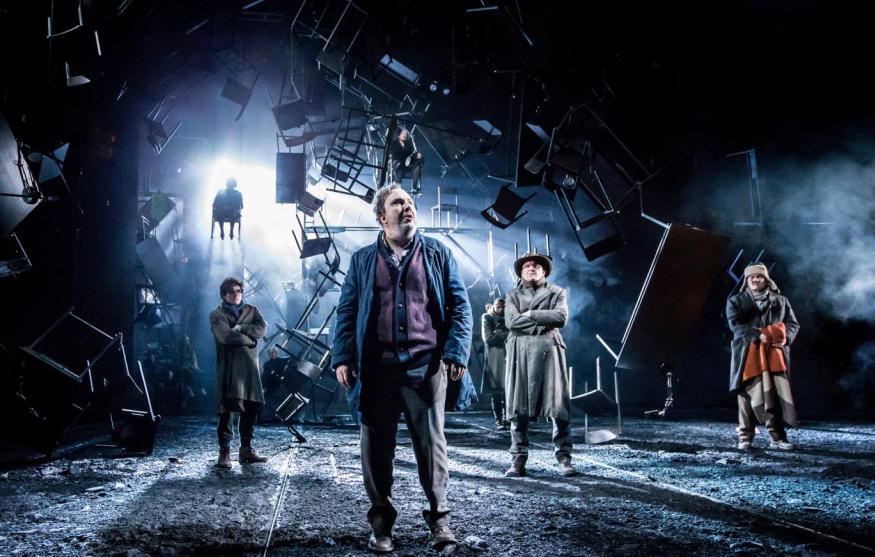
The National Theatre's new production (the first in over 30 years, forsooth) of As You Like It opens in a modern office space, where Orlando is employed in the lowly capacity of plant-sprayer. During the day, the office fills with workers doing things at PCs and having choreographed snacks and, as is common in office life these days, enjoying breaks for wrestling matches featuring the Duke's Champion, staged with all the bling and zing of the WWF. When the scene moves to Arden the chairs and desks are hauled up in an ingenious whoosh and dangle mid-air, forming an expressionist forest, like a gigantic installation sculpture - visually suggesting, perhaps, that Arden is the world of court / office turned inside out and topsy-turvy.  Backlight is splintered through this remarkable creation, shadows flicker, and there is an accompanying sculpture of sounds from animal noises to (beautiful, in Orlando Gough's score) a capella humming. As couples couple and the wafer-thin 'plot' resolves we are released from dimness into primary colours, dancing and happiness.


I start with Lizzie Clachan's set because this is what really lodges in the memory. The Olivier certainly invites such huge design-led productions, and the NT economics presumably make it possible. Perhaps West End expectations make it necessary. Every play I have seen in this space recently has had a staging hugely in excess of what the text actually requires. You start to wonder how the price of a ticket is divided: how much of a £40 seat goes to superfluous non-speaking actors who, in this case, sit first at a desk, then among the trees or pad around as sheep? (Or how about the policemen in Man and Superman who appeared for 1 minute of a 3-hour play?) How much then goes to the machinery which makes such a colossal mechanism work? Or to the creative team of 13 (what does an 'Artistic Collaborator' do?)?  We are getting close to the point where the directors outnumber the speaking actors, like the physios and psychs on a test cricket tour.


Well, all this extravagance could have overwhelmed the play itself, but the acting was thankfully strong enough to distract us from the set and its population of extras. Actually, this was a particularly clearly delivered production: every sentence was doing some work and made sense of. Joe Bannister was a likeable Orlando, Rosalie Craig a feisty Rosalind. The complicated stage business around the wrestling smothered their initial meeting, and this Rosalind was always more in control than she was giddy with Cupid's dart. Orlando's 'I can no longer live by thinking' rang out with a pathos I had not felt in it before. Celia (Patsy Ferran) and Oliver (Phillip Arditti) were miraculously convincing in their love-at-first-sight moment and generally a delight to behold. Touchstone (Mark Benton) wasn't funny, but I defy anyone to find this character funny, whoever plays him. Sixteenth-century logic-chopping wit is as dead as a Monty Python parrot. But I'm glad this rather unpleasant fool got a clonk on the nose from William at the end of that horrid little scene. Jaques (Paul Chahidi) was done interestingly, with the seven ages speech delivered as a kind of improvisation upon an idea, bringing refreshing spontaneity to this tired set piece. Much facial expression suggested some kind of condition explaining the character's melancholy. The production ended by working its charms, with no attempt to disguise the preposterous ending, and a full-scale all-singing-all-dancing finale in gorgeous costumes.


Briefly mentioned among the padding with which NT surrounds its live screenings was the fact that this was a 1599 play - that astonishing year which saw this, Julius Caesar and most likely the beginning of work on Hamlet, as Shak and Co. moved across the river and into the Globe. A feature on the history of performance in the NT was really nothing more than a few reminiscences of how awesome it is to play that space by whoever they could round up. More on 1599 would have been instructive. Mighty things were on hand at this point in Will Shak's life - meta-theatre (we need to see a production where boys are playing girls playing boys seducing men to see what got Puritans hot under the collar), fluidity of character - you are who you decide to be in the given moment - and forays across and around the frontiers of serious and comic. As for stunning sets, if we have clever people to make them and the London crowd are happy to pay pretty prices to be wowed by them, then I suppose they will continue. You can always go the Globe or Sam Wanamaker for something barer.  As you like it, indeed. But I remember warmly a recent workshop at the National itself on 'simple, effective' design and I would like to see something there soon in the Olivier or Lyttleton using a couple of tables and a chair or two. Go on, NT creatives, I dare you.

Wednesday, 24 February 2016

Sarah Kane, Cleansed

'Either love me or kill me, Graham' is one of the longer sentences in Cleansed, echoing Roland Barthes' assertion that 'being in love is like being in Auschwitz', the somewhat tasteless variation on the Petrarchan agonised lover that is said to have inspired playwright Sarah Kane. Cleansed recreates Auschwitz in the form of some kind of hospital-turned-detention camp, in which the commandant figure Tinker and his goons deal with homosexuals and drug addicts by torturing and eventually killing them - presumably cleansing a  society of its deviants, though there is no picture of any wider political or social context. Into this arena comes Grace (the name is a hint) in search of her twin brother Graham, who is killed at the start of the play. Their ghostly sibling affection survives, sort of, though it is apparently all a hallucination; and so in a way does the love of two gays and a romantic attachment which another prisoner forms for Grace herself. Tinker has a stripper in a box onto whom he projects the feelings he has repressed and which Grace arouses. The stripper professes to love Tinker near the end, though that comes over as some kind of hysteria or conditioning. Indeed the whole play is an enactment of various aspects of hysterical psychology. The moments of love, if that is what they are, are rather crudely symbolised by flowers prodding up through the floor. At the end, the flowers, shafts of light and the descent of rain seem to promise a new beginning, humanity having momentarily crawled out from under the Orwellian boot stamping on its face forever.

Like Grace, the play too seems to want to be either loved or killed. It amounts essentially to almost non-stop torture for 105 minutes. Within a couple of minutes Graham's eyeball is injected, and this is followed by acts including a tongue being cut out, limbs chewed up in a torture machine, regular beating up of prisoners, rape, suicide, throat-cutting and shooting. There is also an endless scene involving a box of chocolates. Physical violence is complemented by other items from the vocabulary of shock such as onstage sex, masturbation, book burning and a graft of male genitalia onto our understandably traumatised protagonist. Those who love Cleansed and Kane's work in general admire the lack of compromise, the deconstruction of existing theatrical form, the challenge to theatre's own limits in terms of believable spectacle and the link it gave British theatre to middle European designer-led dramatic aesthetics. Kane handily takes elements of Buchner, Bond, Beckett (the Beckett of What Where, for example, although that places all violence, Greek-style, offstage), Howard Barker, and Pinter, and follows them to a point of extreme visceral violence that could not really be surpassed. Having seem a minor walkout by Hampshire gentry from our own mild production of The Revenger's Tragedy I think I can see the motive for such an enterprise. Sock it to the ghastly comfortable middle classes! Kane must have been following a vision of some kind. There was no guarantee anyone would hail this work, or even go to see it, when it was first put on. It can't just be a matter of épater la bourgeoisie. A nineties play, Cleansed undoubtedly picks up in its imagery on the atrocities of the Bosnian war and refuses even the consolation of intellectual examination of what it is showing, for authorial commentary is nowhere in the stabbing dialogue or periods of wordless cruelty. Perhaps we do need reminding - where we least expect it, in the plush comfort of the stalls - of our darker nature. There is nothing here that is worse than Bartolomé de las Casas on the Europeans' treatment of the unfortunate natives of Hispaniola in 1492, for example, or Goya's Disasters of War. There is an interesting essay by Dan Rebellato in the programme praising Kane's unyielding vision, and I read a warm appreciation of her talents by Mark Ravenhill later.

While such supporters love her, others will kill Cleansed and its creator for much the same reasons: the destruction of form means the removal of character development and plot, with their associated arcs, and leaves us with unchanging tone, exhaustion of compassion and ultimately disinterest in the barely formed characters, repetitive rhythms and a spectacle that continually doubles back and plays variations on its own motifs rather than taking us anywhere. Like punk, it represents an energising nihilism, another kind of cleansing; yet nihilistic language cannot of itself say anything especially interesting or involving. There is no suspense, no shift of perspective, no interesting dialogue, only the thudding predictability of something disgusting about to happen as a piece of apparatus or a chair or gurney are wheeled out yet again. Is there anything transcendent or enriching in such a vision? Goya and de las Casas believed in a concept of humanity that this work appears to dismiss. Maybe we could place Cleansed in a genealogy stretching from Oedipus through, well, The Revenger's Tragedy to Artaud and absurdism, theatre as a quasi-religious expiatory ritual. But another lineage is the gladiators, bear-baiting and snuff movies, an indulgence of the instinct that makes people slow down at car crashes. In renouncing the legacy of humanism and enlightenment, revolutionary art can end up becoming an emblem of the sensation-seeking postmodern consumerism that is busy replacing that intellectual heritage with various kinds of exploitative commodification. In the history of theatre, Cleansed is radical in its formal adventure and piercing pitch. But in the context of the wider entertainment culture, it is worrying close to horror porn.

Beyond such adulation and deprecation, there is another, and sadder, way of regarding Cleansed, which is as the product of a desperately troubled mind. Sarah Kane suffered from severe depression and took her own life at the hideously young age of 28. Of course it is dangerously reductive to read an output of five plays merely in terms of the author's tragic death. Yet while conceding that important point, I admit I find it impossible not to see such work as the expression of a mind working through its own nightmares - cleansing itself, perhaps - by giving them palpable form. The same association of life and art suggests itself in the lyrics and performance of Joy Division singer Ian Curtis (much admired by Kane), however much one tries to dissociate the person who suffers and the mind that creates, or whatever it was exactly Eliot said. If this play had been witten by someone I knew, I would certainly be seriously concerned for their health. (I had a similar sensation when pondering Agnes Martin's grids at Tate Modern.)

I didn't love Cleansed, nor do I want, criticially, to kill it. The actors working with director Katie Mitchell certainly pulled off a committed and intense production. Drab design and relentless electro underscoring heightened the Bosch-like visionary feel of the work. It is certainly a young person's creation, bold in ambition, grindingly unsubtle in technique (those flowers!), an unsubtlety matched by the various clangs and beeps and buzzers of the production soundscape. The play is part of the creative career of a particular writer, and if the universe were just it would be seen as an early work. It wasn't her last play. I saw the later Crave a couple of years ago, which is strikingly different, simply four voices speaking across each other (and owing a good deal to Beckett's Play).  It is clear that Kane was setting herself interesting challenges and finding different shapes for the expressionist aesthetic. What could it have led to? Telly, is a likely guess. It's odd how some of this material now seems absorbed into the mainstream in grand guignol series like Luther and Whitechapel. Aficionados of brutality turn to film and television now: Lars von Trier's Nymphomania, Dennis Kelly's Utopia. Kane's theatre, inyerface, brutalist, whatever you want to call it, had to happen, perhaps, just as black canvases and 4'33" had to happen, following lines of enquiry to their natural terminus. But it seems quite a period piece now. It's the art of the dead end, and the problem of dead ends is that they don't go anywhere. There are no doubt special websites for those who like this sort of thing.

Monday, 2 November 2015

The Glass Menagerie

We greatly enjoyed The Glass Menagerie at the Nuffield, the first show to be directed by Sam Hodges since he took over as Director there in 2013. Tennessee Williams's 1944 play is strongly autobiographical: would-be writer Tom Wingfield (TW, note) longs to escape from a home in which everyone is in flight from reality: his mother, a suffocating, domineering southerner abandoned by her husband and taking resort in fantasy and nostalgia; his sister Laura, who has dropped out of school and business college and occupies herself going for walks, playing phonograph records and looking after her collection of glass animals, her 'glass menagerie'; and Tom himself, precariously employed in a shoe warehouse where he is known as 'Shakespeare' for his dreamy hobby of writing. The summit of this heartbreak household's ambitions is a 'gentleman caller' who will fall for Laura and spirit her away. The play leads up to this great event and its repercussions for the family. Does it end happily ever after? Remember, this is Tennessee Williams we are talking about here.


There was a strong design element to the production, credited to someone evidently so eminent that he is known simply as Ultz. The stage, framed by moving boards, resembled a film screen, picking up on Tom's escapist obsession with going to the movies. Tom himself spent most of the time either in front of the stage or in the audience, leading us through his 'memory play' as it played before us. Subdued colours and dim lighting produced a monochrome effect suggesting memory haze and early film. There were captions, slides and live streaming of Tom himself, and a set of metal steps for the fire escape from the family's apartment, also representing the escape route for Tom and a kind of bridge between past and present. Lighting and sound were used to tremendous atmospheric effect, and there were some ravishingly beautiful moments with candles, windblown curtains and the glowing glass unicorn.


There's always a danger that such directorial and designer cleverness overwhelms the play, or suggests a lack of confidence in it - as I think happened in Lyndsey Turner's Hamlet - but here the ideas were thought through and brought out Williams's poetic vision without distracting from it. Acting throughout was terrific. Dannie Lee Wynter played Tom with a caustic confidence, gradually revealing his character's insecurities and tragic inadequacy as family provider. Belinda Lang portrayed his mother Amanda with great understanding, showing a character who is at the same time insufferable yet understandable in her anxieties. The scene between Laura (Pearl Chanda) and her gentleman caller Mr O'Connor (Wilf Scolding) was totally compelling, touching and finally devastating. All in all, a remarkable piece of ensemble acting and a bold, committed production. The Nuffield moves towards Christmas fare now, but I'm very glad we caught this, and thankful I listened to two people who recommended it. Why some people in Winchester think you have to go to London to see good theatre is a mystery which passes understanding.

Tuesday, 27 October 2015

Flare Path

ImageA flare path (as I learned while watching the play) was the line of lights that illuminated a runway to enable WWII Bomber Command pilots to take off and land - dark before and after, and perilously visible to enemy night fighters as well. Terence Rattigan knew a thing or two about flare paths: he was a tail gunner in RAF Coastal Command, and wrote the play during service (and put a tail gunner in it). Indeed, the manuscript was nearly lost when his aircraft was damaged in combat. In Flare Path the play, we see RAF officers and their crews staying with their wives in a hotel in Lincolnshire, close to their airbase. For all the  jovial banter and stiff upper lip, they know they could be called out at any moment without notice, to be sent on missions from which they may not return. Dramatic action comes from a love triangle involving actress Patricia, her old flame fading film star Peter Kyle and her husband Teddy, whom she married recently without passion, apparently despairing of making a proper go of it with married Kyle and seeking respectability. Teddy does not know about her previous relationship, and telling him is simply unthinkable.  (Teddy later confesses he suffers, as any sane person would one might think, from 'funk' while flying a plane and being shot at). Patricia is torn between her loyalty to pilot husband and her romantic attraction to Kyle, a dilemma resolved in perhaps a rather predictable way, given that the play was performed in 1942 (the fact that Kyle is a naturalised American and thus a non-combatant is a sort of lingering hint). Other plots weave across this one, including a marriage between a barmaid and a Polish count, who insists on her being addressed as 'Countess'. Count Skriczevinsky speaks hardly any English, source of much good-natured mirth. Does he love Doris as a wartime pleasure, or for ever? Doris isn't sure. Before, during, and after the men are called on a night mission, a goodly amount of pink gin is consumed. Comedy leavens the deadly serious central subject.


This production by the Original Theatre Company brought out the play's strengths to great effect. Rattigan had a genius for exploring the depths of emotion swirling away beneath English reserve, and an apparent belief in the victory of traditional decency over personal gratification. He had a sympathy for those who cannot live up to ideals their culture sets for them which still touches the heartstrings today. He was also a great craftsman, and Flare Path moves irresistibly through exposition and development to two climactic moments. One of these is based on reading a letter. Rattigan liked the dramatic power of documents. One thinks of Crocker-Harris reading the inscription to his book in The Browning Version, the newspaper report that crowns The Winslow Boy, and the rather different one in Separate Tables. Less conducive to modern tastes is the sentimentality. The final scenes just seem too soft, but to a wartime audience who of course did not know how things would end, there must have been fairly strict boundaries to what was palatable: Rattigan had difficulties even getting the play put on because theatre managers felt the public did not want a piece about war. Then there is the  patronising habit of making working class characters figures of fun (and shrewish Maudie, with her endless prattle about bus timetables, is hardly even fun today). No point being too stern about this: after all Shakespeare had his rustic clowns to give us a break from the verse of the nobles. The idea that only the educated few have complex interior lives has a long ancestry. Back to the show, there was terrific ensemble acting throughout, and no point really in picking out individual names.


The performance was compelling and finally very moving, partly because it turned one's mind to the historical realities. I'm sure my Battle of Britain veteran grandfather would have approved, and I'm glad his grandson knows a bit more now about the life that crews and officers endured. Although in many ways a period piece, Flare Path - when given a production as strong as this one - still does a vital job of bringing its fast-receding period to life. Presumably theatres in 1942 would not have had the sound and lighting effects that we enjoyed at Theatre Royal Winchester. But then they would not have needed much help in imagining them. The play ends with a wartime song, 'I don't want to join the airforce'. I suppose in its original London run, the audience, stirred but not shaken, would have joined in.

Saturday, 24 October 2015

Roger Scruton, Culture Counts

In Culture Counts, Roger Scruton mounts a defence of the heritage of high culture of the West against what he perceives as its enemies: fanatical Islam (only glancingly referred to), the operations of the market (briefly discussed near the end) and, above all, the attitude of 'repudiation' advanced by multiculturalists in the universities. He argues that the literature, music and art handed down to us - or at any rate the best of it - contains a body of emotional and moral knowledge that is intrinsically valuable and provides the imagination with a purer and better air to breathe in than the popular confections of the moment. The purpose of education in the humanities should not be to benefit the student with a set of instrumental skills, but rather to look after the culture itself by training a fresh set of guardians to look after it. The criticism we teach and practise should be to do with elucidating the aesthetic value and moral lessons of works. Despite the depredations he sees wrought by the multiculturalists, Scruton sees hope in the efflorescence of traditional practice in neoclassical architecture, music that returns to pre-Modernist tonality and writing that is similarly embedded in the conversation of canonical works.

One strength of Scruton is always the writing. He frames his arguments clearly and gracefully in a rhythmical prose that is a pleasure to read and a standing lesson for the tone-deaf scribes of the journals. His style is precise but also conveys deep feeling. Consider the phrasing and cadences of this sentence from his description of the decline of architectural teaching: 'Students of architecture were no longer to learn about the properties of natural materials, about the grammar of mouldings and ornaments, about the discipline of the orders, or the nature of light and shade'. Whatever one's views on building design, that is a beautiful summation of the essence of the classical view. The author is particularly strong at explicating philosophical points. I came away from his discussion of the different kinds of knowledge, for example, with that pleasant sensation of having had my mind tidied and cleared. And similarly with the passage on the thin crust of normality, with barbarous instincts beneath and the serene air of art and spiritual empathy above, and in many other instances. Some points are made in a single striking sentence: the few pages on Foucault, for example, ask us to consider whether that thinker can help us at all in elucidating the truth-value of any part of a governing discourse. He can be very funny, as in the attack on Le Corbusier. And I warmed to Scruton's sense of battling against the powers-that-be in academia. Though I am out of touch with the academic world now, I sense that his kind of traditionalism still has little purchase in the modern seminar and lecture hall. The book is an interesting contrast to John Carey's What Good are the Arts, which had the peculiar quality of an author sounding cross at the very idea of a higher culture, even though he was clearly on the winning side. One has to look hard for Carey's enemies - presumably Scruton and a few senior members of Oxford college common rooms - but Scruton's are at any rate easy enough to discern. I wonder if both authors overstate the influence of university courses generally.

Some parts of the book left me with reservations. Perhaps the weakest part is his chapter on teaching, with its wildly romantic vision of children rote-learning and acquiring a love of medieval Latin and the classic texts. There is no sensible suggestion here how such a programme could possibly be implemented, and I don't even see what he imagines happening in a lesson. Most of what he posits, concerning the slow acquisition of moral truths, would happen on a subliminal level anyway rather than by direct instruction. The chief enemy of promise in schools is not an academic culture of scepticism, but the dominant discipline of accountancy, which demands that any piece of work should be judged against a hyper-rational scheme which breaks down skills and 'objectives' into specific categories, each carrying percentage points. It is an insane approach to the business of learning (for a business is what it has become in all sectors of education), and has nothing whatever to do with the way the mind works or how culture lives. But unfortunately it is the system which dictates the practices of every single school and teacher in Britain today. Next to this one can gaze at Scruton's vision and sigh a little. But he must know that his kind of education has no chance whatever of taking effect, and so the chapter really reads as the indulgence of a fantasy.

Nor am I sure what our author would like to happen at university level, except for a mass removal of feminists, Marxists and the like. He castigates universities for adopting a programme based on various kinds of scepticism; but perhaps it is the job of a university to be sceptical. There are some well-aimed shots about some kinds of study which simply deaden the mind because the only tolerable answers are those known in advance; and the point that the so-called liberalism of some kinds of theoretical inquiry is simply a way of excluding anything off-message seems hard to counter, at least at an abstract level. It does seem to be the case that the same dismal left-wing dogma is preached across many university courses. What alternative is being offered, though? Elevating selected cultural artefacts to the 'high' category carries its own dangers. It misses the internal tensions which the great works and their creators leave us with. Is it repudiation to point out that in our greatest literature we also find anti-Semitic caricature? What are we to make of the fact the The Faerie Queene carries in its sumptuous verse the notion that the Irish are savages and should be exterminated by some kind of murderous robot? Is this a denial of our heritage? The issues seem to me rather to be things worth discussing. His reading of texts as embodiments of moral lessons seems painfully reductive (the single example of what we are meant to take from King Lear is most unconvincing. Nor do I see that one has to choose between Scruton's kind of reverence for art as embalming the best that has been thought and said on the one hand, and the hard-edged world of modern criticism on the other. I can be moved by King Lear one day and read a cultural materialist discussion of it the next, without the second experience damaging the first. This is, to be sure, a cognitive challenge, but the human mind is well equipped to perform distinct and even opposite operations at the same time.

Scruton's view continues a tradition from Arnold, Eliot and Leavis, and it is important that this tradition persists. In this book at any rate it seems to be deeply informed by a sense of some lost world of collective values, located chiefly in the shared beliefs of religion. Around Scruton's writing there hovers the yearning for community, for a way of thinking that confers membership in a society resting on firm foundations, at peace with itself. I simply have no idea where in history that world is to be found. I gained a great deal from this book, and would recommend it as a stimulating read; but I do not find myself sufficiently enchanted by the lament for an imagined golden age to seek membership of this particular club.

Hamlet (Cumberbatch)

We went to see Hamlet in what is rapidly becoming my favourite way of seeing London productions - streamed from the theatre onto a cinema screen, cutting out the expense and fatigue of travel and bringing you up close to the acting. It was particularly appropriate to this record-breaking-sold-out-within-minutes production directed by Lyndsey Turner and starring Benedict Cumberbatch. For this show had so many cinematic effects, it felt like watching a film turned into a stage play and then turned back into a film again. Lyndsey Turner was working with Designer Es Devlin; their last collaboration, which I saw in the NT Lyttleton, was Caryl Churchill's A Light Shining in Buckinghamshire. Both productions in their joint vision have featured a large and well-stocked banqueting table and large amounts of earth (in neither case required by the texts, both of which can be performed on a nearly empty stage). The Turner-Devlin Hamlet was set a vast palace interior and used Richteresque ambient music to underscore the emotions of the scenes. There were chases under strobe, freeze frames and a stunning dust-storm at the end of the long first half, leaving the palace a half-sunk ruin for the second, symbolising the moral decay of Claudius and Denmark no doubt. Heaven knows how many lighting cues there were; the whole thing was certainly visually exciting to watch, with a wardrobe ranging from evening dress to modern military and a delightful large toy fort.


I start with the look of the thing because that did, over time, become a distraction. Shakespeare's verse is deeply visual because it was written for a less furnished stage than a lavish London show would dare to put before us. A clever design can accentuate the feelings of a work, but it mustn't work against the words themselves. Here it did. when Claudius is giving his first speech on the death of the old Hamlet and his marriage to Gertrude, we shouldn't be gawping at ornate evening dress and weird table props. There were moments when what we saw and what we heard took us in different directions. For example, we saw in mime Hamlet put on an Indian head-dress in what appeared to be an affectionate, playful scene with Ophelia. But then we saw Ophelia reporting Hamlet's appearance (2.1), 'My lord, as I was sewing in my closet'. But what she was describing was not what we had just been seeing at all. What were we to make of this? Was the idea that she was making it up? But why would she do that? Then there is design and stage business when none is really needed. Consider the brief scene about the fight for a scrap of land in Poland, setting us up for 'How all occasions do inform against me' (4.4). It's an odd afterthought of a scene in any case, and hardly needs a whole military camp with soldiers in tents blowing on their fingers to bring it alive. This is theatre adapted to the hyper-visual world of the modern audience, I suppose. But it must first and foremost adapt itself to the text. The Players scene (shortened to lose the dumb show) didn't work simply because in order to see the lovely mini-stage on the stage we couldn't see Claudius, and everything is meant to be about his reaction (the camera helped us cinemagoers a bit).


All this can be justified by theatre's constant need to recreate itself, and the changing expectations of a younger audience (it was great to see some youngsters at Vue Cinema when we saw it, apparently there of their own volition and not part of a school trip; if Cumberbatch brought them and cool visuals held them then that's an undiluted good). But that brings me to a further grumble. If you're going to bring Shakespeare to the people, then it really should be Shakespeare, untampered with. In this showing, the opening battlement scene was lost and sort of transposed into Hamlet's meeting with Horatio; but that first scene, amongst other things, establishes Horatio's character as the studious sceptic, a foil for Hamlet's more intuitive cast of mind. Polonius was heavily cut. His first speech amounted to 'He hath. my lord. I do beseech you, give him leave to go.' In the text you'd get in a bookshop, we get: 'He hath, my lord, wrung from me my slow leave / By laboursome petition ...' and so on in leisured rhetorical fashion. Notice how this speech characterises Polonius as a windbag, a trait developed in his advice to Laertes (also edited), his spying on Laertes (cut entirely), and his meeting with Hamlet (reduced). In this production, Polonius was in fact turned into a model of concision, making the Queen's exasperated 'More matter, with less art' quite meaningless. Shakespeare's character of Polonius had been turned into a fairly nondescript elderly courtier. But of course, we must concede, Shakespeare's company cut, and we must regard the texts we have as flexible things, at best approximations to what the first audience heard. Still, I don't think flexibility should reach to simplifying and modernising the words themselves. Instead of 'Good Hamlet, cast thy nighted colour off', we got 'nightly colour'. Why? Is 'nighted' really too brain-achingly tough to figure out, especially when he's wearing black? Accents shifted. Claudius gave 'comméndable' in the modern stress, against the metre of the line, but the correct 'perséver' a couple of lines later. We heard, or I think I heard heard, 'Things rank in nature possess it merely', and I contend that the missing 'do' matters. In Gertrude's description of Ophelia's death the 'hoar' leaves were kindly translated for us into 'pale'. Unless I am mistaken, every mention of a Polack was nervously corrected to 'Polish'. Everything was delivered in the modern naturalistic style: Gertrude's 'I thought thy bride-bed to have decked, sweet maid' had at least two heavy pauses breaking up the line, just to take one example among many. Well, this is Shakespeare today and it can bring lines alive in unexpected ways. I don't think I'd ever really registered 'The sun no sooner shall the mounains touch' (4.1) but something about its delivery on this occasion put the image vividly in my mind. This is why one goes to Shakespeare repeatedly. I wonder if there will be a swing towards a more verse-oriented delivery of Shakespeare in coming years. Perhaps I should forget these reservations and get into the flow. Perhaps. But orchestras don't change Mozart's notes, and art galleries don't alter their masterpieces to make them easier to a modern sensibility. There is something indicative of a deep lack of confidence in altering the thing you are bringing to the public, however slightly. Wedges continue to have thin ends.


All that being said, I did enjoy this Hamlet and was glad I went. There were some excellent performances. Ciaran Hinds was a menacing Claudius, and Karl Johnson was brilliant, doubling as Ghost and Gravedigger and getting both parts across vividly. Sian Brooke was an affecting Ophelia, making her frankly tedious mad scenes into something touching, especially when she went to the piano, and Matthew Steer was an amusing Rosencrantz. Benedict Cumberbatch himself was full of vocal and physical energy, bringing across Hamlet's relish of exercise both mental and physical just as he is saying he has had enough of it all. In fact his action-packed performance perhaps diverted us from the point that the play revolves around his hesitation, his in-action when it comes to the moment of vengeance. But this is just hard to get. How many in a modern audience are worried that they might go to Judgement unconfessed? Yet the failure to kill Claudius while he is a-praying revolves around this. Cumberbatch made sense of the soliloquies and his Hamlet overall was humorous, genial and engaging.  I did find the music, the antics, the imaginative staging, the cool visuals exciting. And there were moments which came across effectively and poignantly - 'there's providence in the fall of a sparrow' struck me as a particularly well-tuned moment. But after the immediate excitement had faded I felt the production tried a little too hard to be like a movie and lost the intimate verbal drama of Shakespeare's creation. Somewhere at the back of my mind was a speech by Steven Berkoff reported in the paper that same day, on how young actors these days don't know or care about the history and traditions of their craft. I don't know whether that is true, but practitioners can always benefit from opening themselves to older styles. Also in my mind, a letter to the paper a while back wondering why it is that while musicians work hard to fathom what Beethoven meant by a phrase or passage and try to bring it out in performance, productions of plays and operas often push the author to one side and 'interpret' their material into some bizarre places, and sometimes out of recognition. There must be an answer to that, but I can't think what it is. Perhaps it's to do with markets, directors and designers needing to have a brand. We mustn't overstate the role of the 'creative team' as it's unfailingly called these days. I love directing plays, but I can't see it as a creative act comparable to writing one. Shakespeare is the Creator we should be left thinking about. All unresolved issues pattering round the brain. Hamlet, more than any other work, at least gets you thinking.


Wednesday, 12 August 2015

John Finnemore, Teddy Lester

John Finnemore, author of Teddy Lester Captain of Cricket (London: Chambers, 1916), you have given me a joyous lifelong memory. I discovered this book as a boy in my uncle's house. Its orange boards and thick flaky paper intoxicate me still. Now I have rebound Captain of Cricket, I have one other  title in the series, and I search for more whenever I'm in a second-hand bookshop. Teddy, easily the best cricketer in Slapton School, takes the reputation of the house seriously and comes down hard on bullying. He is firm but fair and does what is right. Frank Sandys, brilliant new boy, bowls with a queer shuffling run. His stock ball is a googly (odd, since that is meant to be a surprise delivery), occasionally mixed up with a straight fast one. Ito the Bat is Japanese and bowls with a bizarre action, hence his soubriquet. Teddy and his chums play cricket, in a strange form of the game where bowlers 'find a spot' and become unplayable. They stroll around Slapton school and save the country. Their teachers barely exist.

Penny for your thoughts, Ito, old man.

Who were you, John Finnemore? Wikipedia says there is nothing left now but census returns, and reconstructs your (childless) life with Emma, teaching in Welsh schools, and eventually making real money from writing. I imagine you in your elementary classroom, speaking Welsh, dreaming up Boy's Own plotlines. Is there really nothing out there? No school archives In Aberystwyth, no letters, no manuscripts? Why did you buy a house with fifteen bedrooms?

John Finnemore, you died aged 52. Your books are rare finds today. You are not listed on goodreads, but you are a good read. When I pass by an empty cricket ground, sometimes, at dusk, I stand quite still. The whole of Slapton watches with hushed breath. Everything depends on this last wicket stand, and Frank Sandys is shuffling in to bowl.

Wednesday, 28 May 2014

'Tis Pity She's a Whore

Third time to the Nuffield in a week, second viewing of this production in a week, second Jacobean tragedy in a day (what is ... happening ... to me?) - on Tuesday I went down the M3 yet again to see 'Tis Pity She's a Whore by John Ford, production by Cheek by Jowl (who are probably better known in the modern theatre world than Ford). C by J founder Declan Donnellan's The Actor and the Target is a bible for modern actors, and it is always instructive to see a production which follows such a carefully-thought-through attention to a text, with acting technique rather than directorial concept the centre of gravity.

This version of 'Tis Pity updates to modern dress, with Anabella a contemporary teenage girl and her bedroom the single setting for the action - not so very different from the bare Jacobean stage where time and space equally collapse into a single platform and the audience are similarly required to 'see' the different settings of the action. Second time around, I noticed the attention to detail in the room: red cd player, red lampshade, red book cover .. Exciting opening choreography, creating a sense of a girl both empowered and controlled by the surrounding male culture. It's easy to get this sort of thing wrong and start with clever staging, but this production had clearly started with deep thought about the language and characters and worked outwards from there.

Every detail of staging had a reason for being there, and though some speeches were given a modern twist (Hippolita's offer of herself in marriage to Vasques becomes a full-on seduction scene, Soranzo's already horrible beating becomes something unspeakable) it was never twisted out of credibility and the business brought out the nastiness that seeps from between the lines of Ford's writing. Easy, too, for frantically inventive staging to become a distraction from the core action and speech, but only once - Hippolita at the party  - did the interpretation take over from the text for me (it took the second viewing to figure out how all the things going on fitted together), suggesting a certain lack of interest in the niceties of remitting breach of betrothal in the seventeenth-century and a desire to give us something busy to look at instead.

Notes. Plenty of circular movement, inevitable when a bed is plonked in the middle of the stage, and devastating deployment of the bathroom offstage. Effective use of onstage singing, an object lesson in juxtaposition (eg something atrocious happening against soft music offstage). Speech hard to discern over the music at times, Friar and Cardinal looked out of place as the Catholic context of the original doesn't belong in the secular hedonistic world of this interpretation (how many students these day go around with a tutor Friar in tow?). There should be some kind of quota on how many tops can be ripped off enthusiastically in the space of two hours, as there was a diminishing return in the constant revelation of torsos. Will Alexander a terrifying Vasques, honey-voiced and brutal; Orlando James and Eve Ponsonby convincing throughout as the doomed brother and sister. Overall impression one of excitement at the spectacle, a creeping sense that, yes, these people are really psychopathically sick, and an overpowering atmosphere of corruption - all in the Jacobean spirit. Or part of it: this production of a not-frequently-performed play omitted entirely the comic subplot and made other cuts, most oddly to the ending - so we were listening to a symphony with sections of the orchestra missing. But what it set out to do it achieved wonderfully well: it yanked this piece out of its cosy heritage habitat and made the material visceral, shocking and affecting to a contemporary audience using the full resources of its company. Hit the target, one might say.

The Duchess of Malfi

A Jacobean day, starting with the very welcome BBC4 screening of John Webster, The Duchess of Malfi, the inaugural production at the new Sam Wanamaker Playhouse. The theatre is a close replica of Blackfriars, built following drawings in Worcester College, Oxford. It certainly looks sumptuous, a beautiful wooden stage against an elegant three-doored screen with balcony, enclosed by decked seating. And the candles (£400 a day, hmmmm) were gorgeous, even on the telly. The period costumes gleamed and shimmered, as did the make-up. Still don't think I'd want to train it up there and pay London prices (up to £60) to sit on a hard wooden bench at a 70 degree angle to the stage with columns and candelabra in the way, though. Also not sure how well the voice would travel upwards with a balcony of (over-used) musicians tootling away above it, but would have to go to find out. The authentic has a certain allure but engineering has moved on a bit.

Watching it on TV had plenty of advantages: you could see the expressions close up, the sound quality was excellent and the thrilling bareness of the satge had even more impact on a screen, usually so crowded with detail. The production was preceded by a documentary by Steven Shapiro, full of enthusiasm, who offered some unilluminating interviews with star actors and presented the thesis that the author of The White Devil and The Duchess of Malfi might have been someone of a not altogether sunny disposition. Two pages of an Arden / Mermaid introduction would give you more information. The TV introduction by Andrew Marr seemed to be vaguely inspired by the Proms and added nothing at all apart from plot spoilers and a stupefyingly condescending warning not to alter our TV sets when the stage goes dark. Thanks, W1A!

The verse was well delivered throughout: I haven't seen the Duchess for 12 years (Salisbury, 2002 to be precise - excellent show), but the strange similes and distinctive seventeenth-century treatment of the verse line brought it all back: compass, tennis balls, medlar trees, pyramids... what a unique consciousness is here. Throughout I kept realizing what Eliot got from the period, not that he made any secret of it. A world-weary Bosola, going through the motions of seeking preferment and sinking further into self-disgust. Ferdinand was really compelling: that moment when the strange repeated laughs signal he's flipping will stay with me. Gemma Arterton was excellent as the Duchess, upright alabaster among the ruins, far better than the reviews I'd seen had led me to expect (I wonder, by the by, if £60 seats have the effect of turning viewers and reviewers into bogus connoisseurs of how Jacobean drama ought to be interpreted, which is something we know very little about indeed). Shafts of comedy (the doctor) piercing but also drawing attention to the darkness. Only thing I didn't like was the music: it was beautiful and beautifully played, but a distraction from the action - the opening was ludicrously over-extended - and far too sweet to bring out the moods of the piece. But I'm delighted that the BBC are now doing this, sparing us the cost of an NT Live showing, and quiver with anticipation for more.

By the way, have just come across Peter Kirwan's impressive early modern drama in performance blog, Bardathon.

Monday, 26 May 2014

The Curious Incident of the Dog in the Night-Time

Latest NTLive experience was Curious Incident, whose in-the-round staging made it particularly amenable to camera coverage: we did indeed 'breathe the same air' as Christopher, which was the director's intention, the grid-like patterns and enclosed rectangular space simulataneously suggesting his consciousness was both sadly cut off (difficulty with processing emotional reactions and metaphor) and curiously infinite: his hilarious dialogue with the vicar showed how a completely literal interpretation of things can lead to its own exhilarating imaginative posibilities - "they'd have to fire dead bodies into space on rockets ..."

Coming to it from a 'what could we do here?' perspective, there was much to pick up. Simple furniture, expressive use of staging and the immensely powerful deployment of features like the train set and chalk drawing. Loved the physical side, with Frantic Assembly providing some moves that were effective because not over-used. Well-judged music, again economically employed. And of course, the acting was pitch-perfect throughout, Luke Treadaway, although clearly somewhat more than fifteen, making a deeply sympathetic Christopher (his and has been going round in my head all day). The play gave a convincing account of the world from Christopher's point of view and from outside as well. Effective doubling by a small company. All of this is theatre that any school should aim at. But the programmed light systems and the underground scene would take some replicating, I imagine.

It was lovely to to be reminded of the novel's story. There were some deeply moving moments, like the mother's monologue near the end of Act One and the ending, and serious and comic played off each other beautifully throughout. In the novel, the digressions on maths conundrums like Conway's Soldiers and the Monty Hall problem were part of the fascination, but these couldn't really be staged; something like it was left until the problem explanations at the end, but we had to leave before we heard them. How many plots are there in literature? Twenty? Seven? Essentially there's just one, which is always to do with someone trying to overcome obstacles to achieve something - the story of human life - and this novel and play give us an elemental version of this tale. I have no idea how clinically accurate it is. Mark Haddon says he wasn't writing about autisim, but difference. Would seasoned police officers and transport workers really be so nonplussed by a character like Christopher, though? Surely they see all types over a week? Perhaps they're better prepared now than when Curious Incident appeared, and both book and play have something to do with that. No explanation on stage of the title; perhaps it is assumed that a modern audience knows its Holmes stories well enough not to need any.

Saturday, 24 May 2014

Tonight at 8.30 (Trio 1)

Happy to catch the first Trio of Tonight at 8.30, having caught 2 and 3 on the opening day(authoritatively reviewed somewhere below). Instead of being a light frothy entrée as I'd imagined, this trio included the heaviest piece of the lot, The Astonished Heart, a shriekingly intense study of tragic obsession  (and an early version of the idea of the psychiatrist being the most messed up of the lot, a topos later to yield Cracker, Frasier and Hannibal Lecter). The core ideas came over clearly and the dénoument(s - one onstage, one off, Coward seems to have a thing with double endings) had real power. Before that, We were Dancing, on quickly evaporating affairs in an ennui-soaked world where substantial relationships are impossible; and to round off the Trio, Red Peppers, in which we see  the eponymous comic duo grinding through their act at a variety palace, then look behind the curtains at bickering among theatrefolk. Across the three pieces music, shifting rhythms, shafts of wit and through it all a palpable strain of misery. Tonight at 8.30 plays with genres, but the keynote is tragic.
     
Taking these pieces together, one catches Coward at the tailend of a classical tradition in which tragedy is reserved for the privileged and the working man is a clown; and while he is not Ibsen he does subvert this in interesting ways: the Red Peppers acquire a kind of grandeur in  their valiant attempt to 'keep it fresh, keep it fragrant' and the acidic portrait of decadence among the (precariously) privileged makes one think of Ivy Compton-Burnett or Henry Green's Party Going.  Again I was struck by correspondences to later writers: We Were Dancing gave a foretaste of Pinter's The Lover, the minute verbal analysis of emotional currents in An Astonished Heart has something in common with, say, Albee's A Delicate Balance; while Red Peppers could be an early sketch for Osborne's The Entertainer (both were astute critics of a world they were nostalgic for). Coming back to the show after a week, I could better appreciate the mixture of period and modern in the performance: imitating Coward's clipped diction and the postures captured in the programme photos would have drenched it in sepia; while observing Coward's rhythms with the contemporary voice certainly brought out the rawness and immediacy of the emotional situations. Staging was clear and unfussy, the acting wondrously versatile. Hugely enjoyed Tonight at 8.30, delighted it started at The Nuffield, and hope it has a really succesful tour. More good stuff to come at The Nuffield - looking forward to Rich Hall tomorrow, Cheek by Jowl (saw them a few days ago in Oxford) on Tuesday and Catch-22 in a couple of weeks.

Sunday, 18 May 2014

Henry IV Part 1

Henry IV, Part 1 (not Shakespeare's title, or, possibly, even his intention) was conveniently screened at Winchester Everyman just days before older inmates were due to go under the examiner's lash on it. And as with RII, Doran delivered a beautifully clear and well-paced account. Attention drawn by Alex Hassall, who gave us a likeable warm-hearted Hal (though as a result the strategic coldness of  'But herein will I imitate the sun' was lost; and my all-time-favourite Shakespeare line 'I do, I will' didn't have the heart-stopping impact I expect, nay demand, dammit). Jasper Britton was a pinched and bitter Henry, a boxer who's played dirty but comes out of the corner fighting.

The big decisions were to make Hotspur a kind of Midlands psycho - I think there's more humour in the Glendower scene than we got here - and of course star name Anthony Sher as Falstaff. Now here was something different. It's been good to see two parts normally given to bass-baritones - Lear and Falstaff - played by different voices recently (Simon Russell Beale and Sher). Sher gave us a wheedling decayed knight, who loves playing to the tavern; his grin during the exchanges with Hal was lovely, and we got real affection from the various insults directed at Hal for not being fat. I liked the way he didn't hurry the speeches but felt for the balance of each sentence. He got a well-earned laugh just for the way he called out some names: 'Poooiins ..' As for staging, same set-up as for RII, only without any ex machina gallery. Good use of the enormous depth of this set-up. Watching these plays in a modern production makes one realize how they were written for smaller companies. Seeing, for example, the lovely Jennifer Kirby in her one scene - the domestic with Hotspur - and as a crowd member in the tavern and that's it is a bit odd, like a football player being brought off the bench for five minutes then called back in. In the whole of Richard II, Jane Lapotaire has one scene, and can read a book for the rest of the evening. What's that like? Nice work if you can get it, or frustrating? Shakespeare's company would have done much more role-sharing, and that idea is in various ways woven into the plays themselves.

Digressions. A production that relaxed into and relished the multifarious language of the play that has everything, including first tremors of the tragedy to come. Good attention paid to individuating the secondary characters, Worcester and Northumberland nicely distinct. The complex narrative of the conspiracy has never been clearer to me, and with one stroke of business the parallels between court and rebels were brilliantly brought out. Loved the bed gag, but must wait a decent time before stealing it.

Tonight at 8.30

ETT (English Touring Theatre) is coming to have the same illustrious acronymic aura in my world as RSC, NT and ROH. Recently I have seen great productions of Translations and The Misanthrope put together by this production company. Now they have come up with the outrageously bold scheme of putting on all of Noel Coward's Tonight at 8.30, a series of one-act plays comparable to a set of piano preludes, each exploring a different key and atmosphere. We went on the press day / night, enjoying the Nuffield's fantastic 2-for-1 offer, and managed to see two of the three trios, so between 3.30 and 10.00 enjoyed six plays (and a good supper at The Crown Inn in between).

Noel Coward had been vaguely catalogued in my mind as a period writer, author of bittersweet witty drawing room dramas. No longer! There's clearly much more going on than that. Was he kicked aside by kitchen sink drama? No, Osborne is clearly anticipated in the distinctly dodgy Fumed Oak, in which a stifled husband lets go at his womenfolk in a bilious outpouring of grievance and resentment. Was Coward's flow of verbal elegance answered by the still waters of modern drama? No, listen to the silences in Still Life, first outing of the material that became Brief Encounter. Full of evocative space and shadow. Family Album, in which a Victorian grieving family are gloriously deconstructed, still feels fresh in its experiment and sudden launches into song; while the dreamworld of Shadow Play had a bleak raking over of an ashen relationship that made me think of Pinter's Betrayal. Speaking of Brief Encounter, it was odd to hear all the plays in largely modern accents: I suppose it would all have been in Celia Johnson cut-glass speech patterns at the time; but reviving that would simply seem affected today. The limits of so-called authenticity.

Coming back to it... not that Coward needs to be validated by later work. He has his own universe, one of quiet desperation under a genteel exterior, a feeling for dis-connect that can be tragic or comic (the magnificent Hands Across the Ocean), and a capacity for the exalting power of wit that puts him in the tradition of Goldsmith, Wilde and Shaw. What happened to brilliant wit, by the way? Stoppard carries the torch, I suppose, but it's the Americans who are the real champions of the one-liner: see any Sorkin-scripted episode of The West Wing.

Wonderful actors, supported in bringing out the jazz-like rhythms and emotional score by director Blanche McIntyre. The players sparked and sparkled throughout the dazzling day. It's all about ensemble, so wrong to pick out names, but I must grant myself the pleasure of typing out the name of Kirsty Besterman, who moved across roles with immensely charming aplomb, and in Hands Across corpsed and got out of it. Rupert Young took a succession of second-tier parts with great charisma. And simply seeing actors change roles with each piece was a pleasure that theatre-going doesn't normally provide. Ominous that all plays had to be cancelled yesterday owing to an actor's illness, which is the flipside of such an enterprise. Hope it's nothing serious: longing to see Trio 1 next weekend!

RSC Richard II

First in the RSC production of the tetralogy. Here are some notes, more memos to self than any kind of review:
  • Totally loved the floor! Because (a) the thrust / traverse approach just seems to be perfect for staging this kind of work, which craves a public forum space, and (b) the digital design was beautifully effective, creating wonderful transitions and establishing atmosphere without taking over. Really want to learn how to do this!
  • RII and other plays of the period (MND, R&J) are particularly challenging as they have a relish for verse form that a modern audience doesn't share (sorry, everyone, you're all ignorant pigs), and the verse has a regularity that the modern actor bred into naturalistic bend, compression and stretch needs to accommodate. Here the actors found their way into it convincingly (pedant Hebron noted only one missed antithesis), Tennant especially good, and took us on an enthralling psychological journey. One huge homoerotic pause was worked in really well.
  • Close harmony singing and small ensemble playing the perfect music here and in 1H4
  • Lesson: if something's dotty, don't conceal the dottiness. York begging for his son to be executed and the gauntlet-throwing scenes were given their proper comic value (perhaps they are meant to be comic relief?); conversely, thank goodness no funny business was added to the gardener scene which is pure renaissance allegory. In general the comic strain was played well (it was Mark Rylance at the Globe who made this aspect of the play clear to me).
  • Another lesson. One challenge of plays like this is what are the non-speaking characters meant to be doing during the endless speeches (eg York listening to Duchess of Gloucester)? Here the handling of gesture / pose / movement / expression seemed just the right foil for the voice.
  • Execution of the caterpillars oddly tame (perhaps I'm contrasting it to the shudder-inducing treatment of this scene in The Hollow Crown), but then it is pretty clearly meant to happen offstage.
  • Absolutely lovely to see Jane Lapotaire on stage, and her remarks in the interval interview about working in theatre being nurturing and supportive were so moving and so right. At school - or anywhere - a play should never be an opportunity for a teacher-director to boss young people around. So say I, bossily.
  • And touching to see Michael Pennington just after seeing him in younger years in a re-watching of John Barton's awesome Playing Shakespeare
  • Thank you director Greg Doran for telling the story without overlaying it with unnecessary directorial interpretation and for focussing on the emotional narrative.
  • I would very happily listen to Oliver Ford Davies read the phone directory.

King Lear (NT)

Live screening of theatre - the poor man's option (that's me, £50 + travel + food, come orfit!) or is it in some ways actually better than being in the building? Yes, you miss all the chemistry of being under the same roof while the actors are doing it then and there for you. But then if you're at the back of the dress circle wishing you'd brought your binoculars and praying that someone two rows down would stop texting then maybe you're missing out too. Especially when so much of the action is in the eyes ... SRB's staring face in the division scene suggesting he's already a few biscuits short of a full picnic hamper, or Anne Maxwell Martin's orgasmic crumple in the unwatchable bit, to name but two ocular pleasurings.

For me, a production of hits and misses. I liked the approach of showing Lear as bloody impossible and clearly dangerous from the off, the rapid barkthrough of the first big scene, the deep permeating coldness of Edgar and Cornwall. Some sense was made of the loopy Edgar plot and the blank of Albany's character was filled in convincingly. The Stalinesque sculpture of Lear was a good touch and the general sense of a bleak tyranny setting (thanks, Edward Bond by the way) held together. Above all the mad scenes were the clearest I have ever heard, and showed SRB's naturalist clarity at its best. I've never listened so hard to the 'who would scape whipping' scene with Gloucester. The recognition of Kent at the end was oddly more moving than the death of Cordelia. There were some nice Mendes touches ('Tis a good block', 'She cannot deny it').

Misses: I wasn't wowed by the Fool, and the notorious addition to the script to explain his sudden disappearance didn't add much (in any case, there's not much mystery to explain: Cordelia and the Fool were probably played by the same boy, making 'And my poor fool is hang'd' one of the most extraordinary lines in the canon, taking us inside and outside the play world in the same moment; one day I'm going to see a production which gets this, or I'll just have to do it myself). Having rows of non-speaking soldiers is just a rather obvious way of trying to fill in the Olivier stage (what are they actually for in a closed council scene, anyway?). Similarly the storm scene looked like they needed to give the rotating drum an MOT, since - on screen anyway - it served no real theatrical purpose. Stuff like waterboarding is just a theatrical cliché these days. The end was a bit of a mess: Shakespeare gets Edmund and the ugly sisters offstage for a reason, lads! We need that space clear for the ending! Cordelia looked none too convincing with a gun, which anyway worked against her image as the spiritual opposite of her sisters.

And then, I thought, hold on, aren't there things wrong with the play? Would any script editor accept King Lear in its present state? Except as a folk story, on another plane from the warp and woof of real human psychology, the opening scenes make no sense. Lear and Gloucester are in some kind of competition for The Most Stupid Old Man in Britain award, a trait inherited by their beloved: Cordelia's ostentatious sincerity is tiresome, and Edgar bolting off to the heath without even speaking to dad is incredible (as is the jumping off the cliff bit - why not just say who he is? 'Why I do trifle thus with his despair / Is done to cure it' - and how's that going?). And - a question mark which becomes bolder in a production like this with warplanes whizzing around - who's actually in charge of the English army? Cornwall's dead, Albany's in a dither, this lot wouldn't even manage to charter a taxi to the Dover ferry terminal let alone meet an invading an army (and why no re-appearance of France, Mr Shakespeare? Ah, I think I get it. The actor's busy playing Albany!) And Sam Johnson was surely right to find it  flawed. It's not the trite reason that it's too tragic, it's that any aesthetic of checks and balances is offended by the fact that Cordelia's death has no payoff whatsoever: the closing speeches do not add up to any kind of hard-won wisdom and bear no relation to what we have seen (you might think that 'speak what we feel, not what we ought to say' is exactly the wrong moral to draw: that's how all the trouble started, for gawd's sake!). Platitudes anyway (a problem with slavering schoolmaster bardolatry is that people who read nothing but Shakespeare don't realize how many of the ideas are renaissance commonplaces). Anyway, the play is absurdly over-produced and companies should be doing more Massinger, Middleton and Co. and giving Mr Lear a rest for a bit. The blog has spoken!

Sunday, 13 April 2014

Ayckbourn, Relatively Speaking

Relatively Speaking (1965) was Ayckbourn's first big hit in the West End, played by big names (Richard Briers, Michael Hordern, Celia Johnson) and earning a congratulation from Noel Coward. Radio 4 Extra broadcast a production yesterday in celebration of the playwright's 75th birthday. It's evocative of its time - the speech habits somehow conjured up the seventies programmes of my youth - and perhaps a valuable period piece in its insight into the shifting value systems of the swinging sixties. Yet for all its patina of age it comes over freshly today, thanks to the brilliant writing and deft characterisation. Ayckbourn had said he set out consciously to write a well-made play, and Relatively Speaking has the precise farcical clockwork of Wilde, and behind him Sheridan and Goldsmith. It's a delight to find oneself caught up in the elaborate machinery of this tight four-hander. The humour comes from a ludicrous series of mistaken identities, delivered quickly enough to be convincing and yielding wonderful sustained passages of dialogue which can be taken two ways. The bite comes from the hints of dark duplicity at the core of things, and the end leaves us doubting whether any enduring relationship is possible in the world the play creates. Beneath the gentility lies something deadly: Pinter's image for his plays, 'the weasel in the cocktail cabinet', applies equally to Ayckbourn. A brilliant theatrical moment in the 'father's' plan for a business trip, then topped by the lining of a pair of slippers. Only the innocent young man at the centre of it all comes over as an improbably naïve drip in the harder cooler 21st century. A joy to listen to after Sunday lunch while more intrepid souls are pounding the London Marathon, and a reminder in the days of experiment and shock drama of the enduring richness of craftsmanship and a good ear for the follies of man, ay and woman too.