Showing posts with label 15th Century. Show all posts

Monday, 22 February 2016

Botticelli, Dante's Inferno

The Courtauld is presently exhibiting thirty of Dante's drawings illustrating scenes from Dante's Divine Comedy. Dante wrote his vision of hell, purgatory and heaven when in exile from Florence, between (approximately) 1308 and 1320. Botticelli's drawings are dated to c.1480-1495, by which time the poem was a national Florentine treasure. It is thought that Botticelli's drawings were made for Lorenzo di Pierfrancesco, who is also thought to have received, variously by gift or direct commission, the same artist's Pallas Athene Training a Centaur, Primavera and Birth of Venus. Fortunate fellow, though as a Medici I suppose you felt entitled to such reminders of your magnificence. In time, the Dante drawings wound up in the collection of the 12th Duke of Hamilton, who was obliged by financial distress to sell them - along with other manuscripts - to a national collection in Berlin in 1882. The Courtauld exhibition brings together drawings and manuscripts, including the sumptuous 'Hamilton Bible', in a show entitled 'Botticelli and Treasures from the Hamilton Collection'.

It is believed that Botticelli originally planned to colour the Dante illustrations, but that at an early stage in the project this scheme was abandoned. Certainly one does not regret the absence of colour in these designs, where the formal qualities of line and composition convey an overwhelmingly vivid impression of Dante's visionary experience and its moral lessons. Often multiple events crowd the same page, as in Inferno 8 (5th Circle of Hell), where Phlegyas rows souls to the underworld, Dante berates one forlorn figure clinging onto the boat, and is subsequently embraced by Virgil, who congratulates him for his virtuous outrage. Around the poet and his guide contorted souls writhe, howl and moan. In the bottom corner, the pair arrive at the city of Dis (Abandon Hope ...), to be met by a group of grinning, winged and horned devils. There is a splendid Disney-like demon smiling straight out at us from another tower. It's hard not to smile back, and to a modern eye the whole infernal scenario has a certain amusing charm. Everywhere, hands and gestures sketch emotional states like members of  the Pina Bausch dance troupe. The Inferno drawings are so crowded with detail that one can only list some of the most memorable figures: the monster Geryon, with a man's head, dragon's body and scorpion's tale; or the terrific drawing of the simonists (Inferno 19) disappearing headfirst into holes in the ground, giving us the bizarre sight of Dante lecturing the splayed legs of Pope Nicholas III. Dante does quite a lot of berating and altogether comes over as quite a bruiser, not the gentle poetic soul of romantic representations. Presiding over this theatre of cruelty - and the Inferno is an intensely mean and cruel book - is the full-page Lucifer, whose three heads crunch up the bodies of Judas and, startlingly for those who come to the story via Shakespeare, Caesar's assassins Brutus and Cassius. These conspirators annoyed Dante and other medievals for getting in the way of a stable empire under a strong ruler.


In the Purgatory drawings, souls take on more individual characteristics. The devils drift away and there is generally more space on the page. We see the proud weighed down by stones (thus they can't stand proud, another attraction of the drawings is that with a bit of help from the label they are easy to read), and the envious with their eyes sewn shut, among whom Dante receives the metaphysical light of revelation from an angel. Punishments are mirror opposites of the sins committed: thus, the slothful in life become whirling, frenzied mobs stampeding around (Purgatory 18), and gluttons are reborn as emaciated figures resisting the temptations of water and the fruit of an upside-down tree. The Divine Comedy reads as a  legal compendium, covering all possible cases: even in heaven, we meet those who broke their vows, though through no fault of their own, a strange little lawyerly subclause one feels. As Dante enters Paradise, he is accompanied by Beatrice, and the more realized worlds of Inferno and Purgatorio fade out to leave abstract designs of cosmic spheres through which the happy couple glide. There's a lovely fade-out as we leave them, tiny couples on a cloud, disappearing from mortal view.


It's funny how things overlap. I caught this exhibition in a break from the excellent National Theatre Drama Teachers Conference over the river. On the same evening, we were given tickets to Sarah Kane's Cleansed - an updated Inferno, though here the torments and cruelty are unexplained, not drawn into any comprehensible modern scheme; nor was there anything really to recreate the tension between the delicacy of the drawing and the roughness of the content that we find in Botticelli. From faith in art and God to the modern loss of these, je suppose. And the next day, I was fortunate enough to attend a presentation by 1927 theatre company. Their work seemed in the tradition of the drawings, too: 1927 combine music, actors and animation in productions which look back to silent film and early cartoons. The expressive, opened out bodies, the eyes, and the interaction between animated and real figures of their works (Golem, for example) are pure Botticelli, pure Dante. A replacement bus service from Basingstoke made the journey through various underworlds complete.

Tuesday, 3 April 2012

The Renaissance: History of an Idea

'The Renaissance' is one of the most frequently used terms in cultural history, but the idea itself has been subject to much examination and discussion. Here is a summary of some of the key points in the debate.


The Idea of Renaissance

Claims that the fourteenth century witnessed some kind of cultural rebirth in Europe go back to the period itself. The Italian poet Petrarch (1307-74) saw the rinascimento as the revival of the values of the classical world, after the barbarian invasion of Rome and the ensuing chaos of the Dark Ages. Petrarch lived in what has been called ‘the calamitous fourteenth century’ - calamities which included, among other things, the Hundred Years War, the ‘Babylonian captivity’ of the papacy in Avignon, and the horrors of the Black Death. Contrasting the glories of ancient Rome with this miserable present, Petrarch divided history into two periods, historiae antiquae, which ended with the ending of the Roman Republic, and historiae novae, from the Roman Imperial period onwards. This was an unorthodox view, as it placed pagans in the period of light and Christians in the darkness. Petrarch yearned for a return to the spirit and letters of ancient Rome. Addressing his own poem Africa (composed 1338) he says:

For you, if you should long outlive me, as my soul hopes and wishes, there is perhaps a better age in store; this slumber of forgetfulness will not last forever. After the darkness has been dispelled, our grandsons will be able to walk back into the pure radiance of the past. (Africa, IX, 453-7)

The achievement of the Florentines in restoring the light was saluted by the (Florentine) humanist Marsilio Ficino (1433-99):

If we are to call any age golden, it is beyond doubt that age which brings forth golden talents in different places. That such is true of this our age [one] will hardly doubt. For this century, like a golden age, has restored to light the liberal arts, which were almost extinct: grammar, poetry, rhetoric, painting, sculpture, architecture, music ...

In his Lives of the Artists (1550), the artist and writer Vasari presented the history of northern Italian art as an upward journey, leading away from the stylized forms of the Middle Ages to the magnificent realistic art of Michelangelo. This journey was led by a series of heroic artists of genius. Through them, as Vasari tells the story, the glories of the ancient world had been reborn.  Such comments are not attempts at objective history. They appear in writings such as letters or manifestos, where poets promote their activities and seek patrons. Vasari’s Lives is also a work of propaganda: it was dedicated to the Grand Duke of Tuscany and thus naturally extols the greatness of that region.

Effusions of enthusiasm such as these are not the same as claims that the age as a whole can be characterised as a rebirth, or re-naissance of ancient thought. The use of the word ‘Renaissance’ as a serious historical term really starts in the nineteenth century. The French historian Michelet famously called the Renaissance a time of ‘the discovery of the world and the discovery of man’. In this period, Michelet points out, man looked outwards at the world around him: he explored in ships, investigated with science, and celebrated natural objects in art. At the same time, people looked inwards at themselves: in the plays of Shakespeare, or the essays of Montaigne, we see an unprecedented representation and examination of individual human consciousness. This thesis was further developed by the Swiss historian Burckhardt in his massively influential The Civilization of the Renaissance in Italy (1860). For Burckhardt, the Renaissance was the birth of the modern age: medieval certainties about man, the world and God faded away, and the modern individual emerged – equipped to enquire and reason, to trade and to express himself through his behaviour and creative work.

            How convincing are these various claims? They have certainly been influential. Petrarch’s picture of a noble classical age, lost in the ‘Middle Ages’ and revived in the rinascimento has ingrained itself in the Western sense of history. Yet there is much to be said against it. Above all, it discounts the cultural achievements of the so-called ‘Middle Ages’. Latin culture could hardly be reborn in Petrarch’s time, since it had never died: Europe is built on the ruins of Rome, and throughout the Middle Ages we see Roman influence: in language, education, customs and the law. At certain points, such as the ‘Carolingian Renaissance’ of the ninth century and the ‘twelfth century Renaissance’ involving scholars like John of Salisbury, classical writings had been intensively studied: indeed, the manuscripts that Petrarch and others were ‘discovering’ were earlier medieval copies, largely owing to scribal activity under Charlemagne. The image of a brilliant rebirth, so persuasively painted by Petrarch and his followers, may be more self-advertisement than historical fact.

            The theses of Michelet and Burckhardt have also been disputed by later writers. Was the Renaissance really the birth of modernity? Medieval practices and beliefs did not disappear but continued throughout the Renaissance period. As for the examination and celebration of the natural world, we can see these clearly in the work of a medieval scholar like Roger Bacon and the poetry of St Francis. Seen in this light, the Renaissance could be seen as a development of the medieval world rather than a departure from it. Perhaps the single greatest invention of the Renaissance - printing - came from the medieval guild system. Equally, Renaissance characteristics can be found in cultural achievements of the eighteenth century and even into the present. At both ends, the chronology is highly problematic.

            In short, while Michelet and Burckhardt draw our attention to important phenomena of the period, they also select out a great deal. Moreover, their books are based on a theory of history that is also controversial: this is the idea - inspired by the German philosopher Hegel - that an age has a Zeitgeist (Spirit of the Age) - an underlying essence or character which unifies its various parts. Moreover, in the Hegelian view, history is teleological: that is to say, it is moving in a certain meaningful direction. This assumption underlies the nineteenth-century historians’ emphasis on the Renaissance as a progression from past to present. This notion, too, which links with the outlook of Vasari and others, is contentious.


For these reasons, some historians and critics have avoided the term ‘Renaissance’, and preferred to employ the label ‘Early Modern’ for broadly the same period. A book like this one could also be called ‘English Reformation Literature’, since the ideas of Reformation theology had at least as much impact on the English in these centuries as the models of classical culture - and possibly more. Nevertheless, the Renaissance is a convenient term for denoting a certain period, and we can use it without committing ourselves to the thesis elaborated by Burckhardt and other historians. A period term may be used for practical convenience; indeed without them, study becomes next to impossible.

            The foregoing discussion is not intended to imply that the writers discussed may be in any way dismissed. Vasari’s Lives is one of the great books of the West. Burckhardt’s book, the result of five tears’ exhaustive travel, reading and note-taking, is still indispensable for the serious student of the Renaissance, precisely because of the discussion it has provoked. And while it has been seriously revised in the light of later scholarship, it has not been comprehensively demolished. Some contemporary writers on the Renaissance still, with various important qualifications, see the period as representing a profoundly significant shift in Western man’s modes of thinking and living. The debate on what we mean by ‘The Renaissance’ is still ongoing.


Further Reading

A classic defence of the label ‘Renaissance’ as applied to Italian art is: Erwin Panofsky, Renaissance and Renascences in Western Art (London: Paladin, 1970), ch. 1 ‘Renaissance – Self-Definition or Self-Deception?’, 1-35.

See also the first two essays in A G Dickens and others, Background to the English Renaissance. Introductory Lectures (London: Gray-Mills, 1974): E H Gombrich, ‘The Renaissance – Period or Movement?’, 9-30; J R Hale, ‘The Renaissance Label’, 31-42.

A modern summary of the debate is given by Margaret L King, The Renaissance in Europe (London: Laurence King, 2003), ‘Introduction: The Idea of the Renaissance’, viii-xv.

'The Renaissance' on In Our Time: excellent discussion by Francis Ames-Lewis, Peter Burke and Evelyn Welch.

Friday, 10 February 2012

Donatello (1386-1466): Selected Works

This post offers an overview of the life and works of the great fifteenth-century Florentine sculptor Donatello. It covers only a selection of Donatello's works. Most of what follows below consists of notes on a film written by the art historian Charles Avery: Donatello: The First Modern Sculptor (1986). I've added a few  links, mainly to specialised articles on JSTOR. Avery's excellent book Florentine Renaissance Sculpture is a wonderful guide to Donatello, Ghiberti, Lucca della Robbia et al. It is listed as out of print, but there always seem to be copies in the V&A bookshop, if you happen to be in that direction.

Introduction
  • Donatello was a hugely versatile artist, who mastered a variety of techniques
  • His theme was ‘human life itself’
  • His expressive art inspired later sculptors including Michelangelo, Raphael, and Rodin
  • Donatello’s art gives form to the Renaissance interest in human character and the individual
  • It also realises the expressive value of ancient forms, preserved in Greek and Roman statues. [On Donatello and the antique, see Osvald Sirén, The Importance of the Antique to Donatello,  American Journal of Archaeology, Vol. 18, No. 4 (Oct. - Dec., 1914), pp. 438-461]
Early Life
Sources: Anecdotes in Vasari’s life; legal documents in archives. No first-hand sources, such as diaries or letters.
Background: rough, working-class. Father a wool-carder, involved in Ciompi revolt, exiled for murder.
No record of Donatello marrying: did he devote himself as a celibate to art (as some humanists did)? Or was he more interested in boys? In either case, his art can be understood as a pursuit of the Platonic ideal of self-governance, in which spiritual harmony is attained by harnessing the forces of Reason and Passion.
As a teenager, Donatello was apprenticed to a guild. Guilds shared responsibility for maintaining religious buildings: for example, the Wool Merchants looked after the Cathedral and Campanile, while the Cloth Finishers were responsible for the Baptistery.  This prompted fierce competition between the guilds.

Works

1401    Baptistery Doors competition. Donatello is said to have submitted a design. He was then one of Ghiberti’s assistants for 3 years, during which he absorbed G’s largely gothic vision, adapted to classical proportions.

Can D’s hand be traced in the vigorous modelling of Adam and Eve and other figures in some hexagonal panels?

1406    D now working on Cathedral commissions. He had a hand in these marble prophets on the Porta della Mandorla, with Nanni di Banco:


1409    St. John the Evangelist (below left) for Cathedral façade. This commanding figure shows great advance in technique and vision. (Images from Web Gallery of Art (wga)):


One issue in this work is the viewing angle: sculptures designed to be placed high up on buildings had to be seen from ground level at an acute angle, and the proportions of the body were consequently altered. [See: Roger Tarr,  Brunelleschi and Donatello: Placement and Meaning in Sculpture, Artibus et Historiae, Vol. 16, No. 32 (1995), pp. 101-140]

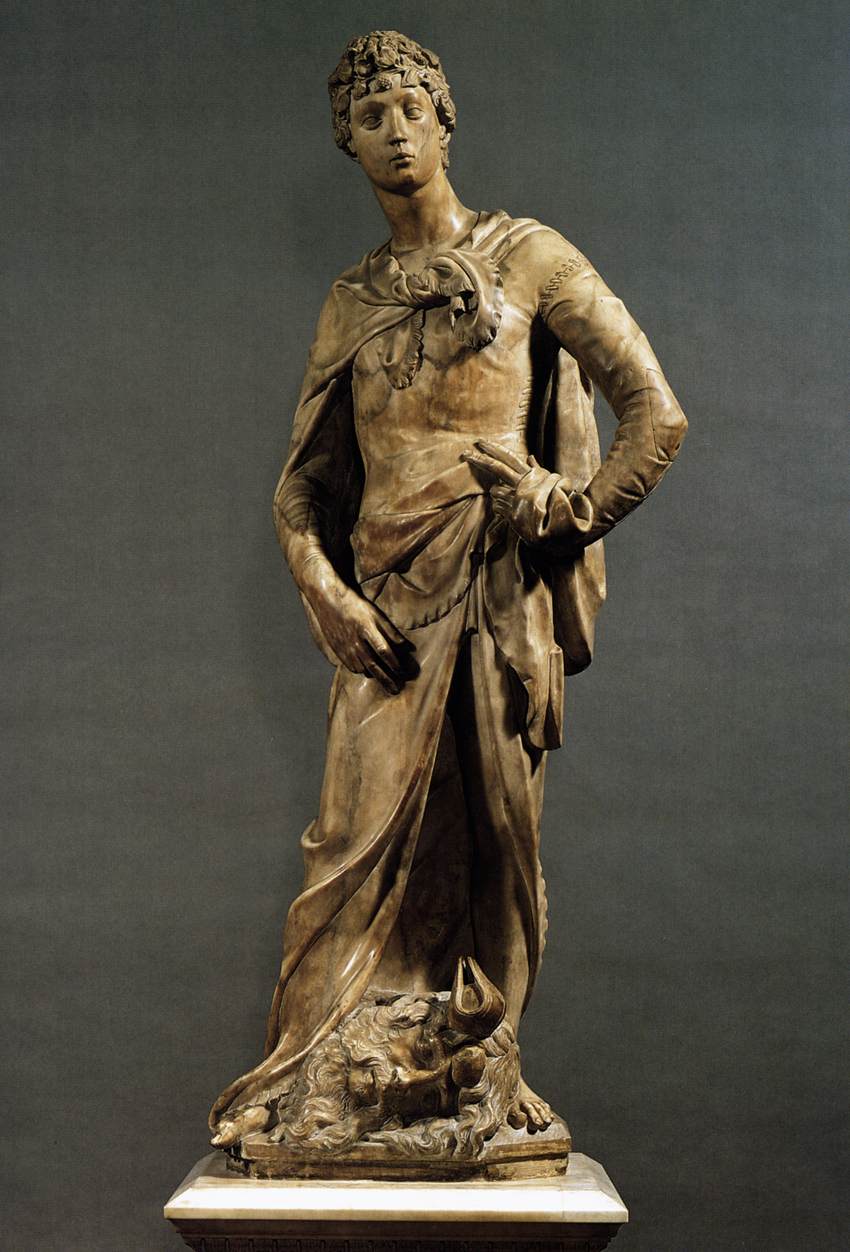
1409 David in marble (above right) commissioned for the Palazzo de Priori (town hall). Originally it was painted. Its “swaying elegance and sinuous gothic line” echoes Ghiberti. David, with his “graceful, nonchalant pose”, is not in a conventional heroic stance. The influence of ancient art is visible in Goliath’s head, which looks like that of an ancient Roman god.
 

c.1413 St Louis of Toulouse, commissioned by Guelph party. This is a gilded cast bronze. It had to be refired after casting. The drapery was built up in separate sections, and is used for expressive effect.

c. 1416 St George, commissioned by the Guild of Armourers for Orsanmichele. The “calm purpose” and “concentrated simplicity” express youthful devotion, idealism and courage. This piece shows the revelation of ancient sculpture – the sense of life in the stone. The sculpted body becomes the figure in action, convincing and dramatic. It is a style of sculpture which mirrors life itself. See also St Mark (c.1411) also for the Orsanmichele. [See discussion of St Mark on SmartHistory.]


Underneath St George we find the St George relief (1416-17). This is the first dated Renaissance example of figures being placed in a realistic setting of landscape and architecture. It anticipates the use of perspective by Brunelleschi and Masaccio. The technique of shallow carving was also an innovation. (The St George stature and relief are now in the Bargello Museum, Florence).


The later 1420s saw Donatello working on the statues for the Campanile, the great belltower next tot he Cathedral. For this he made lifesize statues of Old Testament prophets. These works show a revolutionary realism. Habbakuk (1427-36) took an obsessive eight years to carve, and Vasari records an anecdote of Donatello telling it to speak.

c.1427 Relief of The Assumption of the Virgin. This work continues the innovation we have already seen int he St George relief, where a sense of space is created through light carving, so-called shallow relief. Usually a sculptor cuts down through the marble. But Donatello reduced his implements to three tools, using the corner of a flat chisel to draw in the marble, with a point chisel to create background. There is a free, flexible level of depth. This is the technique known as schiacciato (which literally means 'squashed').


1427-29           Donatello made several works for the nearby town of Siena. This is his gilded bronze relief, Feast of Herod, for the Siena font. Notice how the perspective is used to evoke the drama, drawing us to the head of Herod. Donatello conveys the brutality of the act, and the shock of outrage of the onlookers. Salome is a sinister figure. She looks rather like a classical bacchante. This relief also compartmentalises different scenes. Possibly this was inspired by Trajan’s column. Donatello was studying and collecting ancient sculpture at this time. Avery compares this work favourably with another treatment by Donatello of the same subject: the marble Herod’s Feast (c.1439), once in the collection of Lorenzo the Magnificent (now in the Musée des Beaux Arts, Lille). Here the space overwhelms the figures, making the actors “subservient to their setting”.
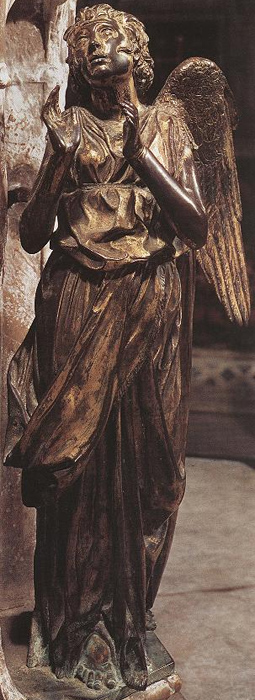
1427-29 Donatello also made for the Siena font, two bronze figures of  the virtues Faith and Hope. These  present "sculptural rhythms in drapery". The lyrical style contrasts with the dramatic treatment of the Herod panel:

1434 saw Cosimo de Medici's return from exile to Florence. Cosimo offered Donatello lodgings, a workshop and sumptuous clothing (in which the artist had very little interest, it would seem).
1428-43 Roundels for the Old Sacristy, San Lorenzo, Florence (building by Brunelleschi), showing scenes from the life of John the Baptist. Note the deft handling of perspective, the depiction of architecture and the sense of the theatrical in the depiction of the characters. There are also four roundels of the Evangelists. Are these pieces in harmony with their setting? Donatello’s highly coloured decorations contrast and perhaps conflict with Brunelleschi’s light grey and white architecture.
The roundels were made straight from the scaffolding. The plaster was applied in layers and immediately worked. Donatello drives across the composition with diagonal lines, and crops figures to suggest a depth beyond the frame. Relief is a very difficult technique. Figures must look as if they are in the round, in perspective, not flattened. Donatello’s backgrounds are lightly modelled, but still convey an effect of deep space. This relief shows St John on Patmos:


1439    Cantoria   In 1431, Luca della Robbia had been commissioned to produce a Cantoria (singers’ gallery) for the Florence Duomo. Possibly his design was influenced by the outdoor pulpit at Prato which Donatello and Michelozzo had made, in fits and starts, between 1428 and 1438. Donatello’s Cantoria (pictured) depicts a wild, bacchic dance, in a continuous scene behind the columns, with a studded mosaic background. There is a comparison of the two cantorie on this art travel site.


1430s Atys. The putti of the Cantoria are similar in spirit to the sculpture of a boy known as the Atys. It has a pagan feel, but no one knows who or what the boy symbolises.


c.1435 Annunciation, in gilded grey Tuscan sandstone (pietra serena), for the Cavalcanti Chapel, Sta Croce, Florence. Lifesize figures. The scene is like a stage. Figures are in three-quarter relief in a shallow space. The Virgin looks startled and shy. While the gestures and movements are human, the faces are idealised, like the classical Three Graces. This is different from many other Donatello works already discussed.


1443    Donatello has to abandon his studio, as Cosimo is acquiring and demolishing properties to make way for his palazzo. Donatello goes to Padua, at this time an important place of learning, and governed by Venice. For the next ten years, he works for the basilica of St Anthony.
Padua
1445-53           Gattamelata,  ‘spotted cat’. This was modelled on the bronze horses of St Mark’s, Venice. One problem which equestrian statues have to address is that a lot of weight is placed on the horse’s relatively thin legs. [See: Mary Bergstein, Donatello's"Gattamelata" and Its Humanist Audience, Renaissance Quarterly, Vol. 55, No. 3 (Autumn, 2002), pp. 833-868]


1449    Crucifix. Notice the strikingly realistic anatomy. With this work, Donatello brings the Renaissance to northern Italy.


1446                Commissioned to create sculptures for the high altar, the Altare del Santo: 6 saints, a central Virgin and Child. Donatello supervised all 29 pieces in four years. 16 were entirely by him. Note the frantic grief of the three Maries in the Entombment.
1450                The sculptures were installed. The original high altar was later demolished. It is not known for certain whether the present, reconstructed order of the statues is accurate. The Virgin and Child sculpture uses a device from Byzantine art, in which Christ is represented as if in the womb of the Virgin. 1448, Madonna and Child between St Francis and St Anthony, bronze:
 

The Heart of the Miser (1446-1450). In a number of bronze reliefs, Donatello depicts scenes from the life of St Anthony. The spaces in these are very varied, and the detailed and dramatic action, with skillful stage management of groups, suggests the influence of mystery plays. Notice the fantastic architecture in the Miracle of the Miser’s Heart. In the film, Henry Moore praises Donatello’s “inventive literary mind”. These reliefs would have started as preparatory drawings (only one survives), followed by a sketch modelling in wax and a cast in terracotta. There are a few surviving examples of these in Padua. (Image from Victoria and Albert Museum).
The Miracle of the miser's heart
After his work in Padua, Donatello returned to Florence. His works – or those of his workshop - on return include the Roundels in the Medici Palace, for example the Triumph of Eros.
Two other works located in the Palace were the earlier bronze David (c.1430), and Judith and Holofernes (1455-60). [For a detailed study of their political significance, see Sarah Blake McHam,  Donatello's Bronze "David" and "Judith" as Metaphors of Medici Rule in Florence, The Art Bulletin, Vol. 83, No. 1 (Mar., 2001), pp. 32-47


We should remember that David is a poetic allegory: Goliath represents the death of what is base at the hands of what is beautiful. This work is the first freestanding nude since antiquity (apart from Donatello’s own Crucifix in Padua). The work relates to the symbols of Platonic perfection – Love, Beauty and Virtue. [See Laurie Schneider, Donatello's Bronze David, The Art Bulletin, Vol. 55, No. 2 (Jun., 1973), pp. 213-216; and a discussion on SmartHistory site.. Judith and Holofernes (1455-60) was originally for the palace garden. Like David, it presents the triumph of beauty over vice. The original inscription helps the viewer to understand this: ‘Behold the neck of pride severed by the hand of humility’. The cushion is in the shape of a wineskin, an emblem of oriental luxury and drunkenness. The putti on the pedestal are also drunk. This is a powerful, monumental work, in part at least because it is a powerful idea: god must triumph over wrong.
The Chellini Madonna (before 1456) is a bronze roundel of the Virgin and Child mentioned as a gift by Donatello’s doctor (Giovanni Chellini Samminiati). This is hollowed on the reverse side, for casting molten glass. (Image from V&A, and see their extensive page, linked above).
c.1457             St Mary Magdalen  This shocking image has a “stark, terrible reality”. Donatello carved into a tree trunk, then added pliable materials to model the surface. Note blue eyes, golden hair, and a bone structure recalling former beauty. But it is not a despairing image: the soul has become ennobled, triumphing over the flesh. [See:  Martha Levine Dunkelman, Donatello's Mary Magdalen: A Model of Courage and Survival, Woman's Art Journal, Vol. 26, No. 2 (Autumn, 2005 - Winter, 2006), pp. 10-13]


1457    St John the Baptist, Siena Cathedral. The right forearm was added later. This continues the realist style of Judith and Mary. 


The Lamentation for the Dead Christ (c.1456), for the Siena bronze doors scheme shows a hard-hitting realism. Could it be a critique of the sweeter style of Ghiberti?
 

1460s   Bronze pulpits for San Lorenzo. It is thought that these works could be designs for the reliefs for the abortive Siena Cathedral doors scheme. They show that even in old age Donatello was unorthodox, passionate and personal. Notice the relentless diagonal in the Martyrdom of San Lorenzo (below), the feeling for deep space. However, the buttresses at the corner of one relief are clumsy (the work of an assistant?). The composition of the panels may not be as originally intended. [See: Irving Lavin, The Sources of Donatello's Pulpits in San Lorenzo: Revival and Freedom of Choice in the Early Renaissance, The Art Bulletin, Vol. 41, No. 1 (Mar., 1959), pp. 19-38]


1466 Donatello dies, and is honoured with burial at San Lorenzo, near the tomb of Cosimo, who had died in 1464.  
For more online tours of Donatello, see: