 Through the mysteries of corporate theatredom, a Donmar Warehouse production is broadcast as part of National Theatre Live. Confusing, but no matter. Whoever produced and digitally beamed it, this was strong production of Christopher Hampton's adaptation of Laclos's epistolary novel. I remembered some lines of the script vividly from the 1988 film with John Malkovich and Michelle Pfeiffer. Tonight's Valmont was Dominic West, opposite Jane Mcteer's Marquise de Merteuil. Two voices one certainly did not tire of over the two and a half hours of this production. They were as silkily smooth as any executives planning a takeover, as they planned a young girl's destruction merely as a petty act of vengeance (her prospective husband had dumped Madame de M) and a sexy teasing game. West's Valmont was all genial charm at the outset, in the second half increasingly out of his depth as he found himself in a new emotional universe. The scene when the single word 'unprecedented' triggers the fatal chain of events that leads the characters into hell was briliantly played, the smallest tilt of McTeer's regal head communicating the most violent feelings. Hampton's script offers marvellous female parts, and both Morfydd Clark (Cécilie) and Elaine Cassidy (Madame de Tourvel) charted affecting journeys from demure propriety to what another era would have called debauchery. Ed Holcroft was the naive Chevalier Danceny, drawn into a battle he could not understand. The play did not take in Merteuil's smallpox or the public humiliation at the opera, but the production communicated an air of pre-revolutionary doom in the flickering, shadowy light cast by chandeliers and Tom Scutt's set of steadily denuded, fading walls, stripped of paintings and revealing stonework beneath. I loved the stylish scene changes, balletic movement over gorgeous vocal music.
Friday, 29 January 2016
Les Liaisons Dangereuses
Through the mysteries of corporate theatredom, a Donmar Warehouse production is broadcast as part of National Theatre Live. Confusing, but no matter. Whoever produced and digitally beamed it, this was strong production of Christopher Hampton's adaptation of Laclos's epistolary novel. I remembered some lines of the script vividly from the 1988 film with John Malkovich and Michelle Pfeiffer. Tonight's Valmont was Dominic West, opposite Jane Mcteer's Marquise de Merteuil. Two voices one certainly did not tire of over the two and a half hours of this production. They were as silkily smooth as any executives planning a takeover, as they planned a young girl's destruction merely as a petty act of vengeance (her prospective husband had dumped Madame de M) and a sexy teasing game. West's Valmont was all genial charm at the outset, in the second half increasingly out of his depth as he found himself in a new emotional universe. The scene when the single word 'unprecedented' triggers the fatal chain of events that leads the characters into hell was briliantly played, the smallest tilt of McTeer's regal head communicating the most violent feelings. Hampton's script offers marvellous female parts, and both Morfydd Clark (Cécilie) and Elaine Cassidy (Madame de Tourvel) charted affecting journeys from demure propriety to what another era would have called debauchery. Ed Holcroft was the naive Chevalier Danceny, drawn into a battle he could not understand. The play did not take in Merteuil's smallpox or the public humiliation at the opera, but the production communicated an air of pre-revolutionary doom in the flickering, shadowy light cast by chandeliers and Tom Scutt's set of steadily denuded, fading walls, stripped of paintings and revealing stonework beneath. I loved the stylish scene changes, balletic movement over gorgeous vocal music.
Thursday, 21 January 2016
Ashmolean, Titian to Canaletto
 The Ashmolean's latest exhibition follows their recent Great British Drawings, and can be seen as a continuation of the British Museum's Italian Renaissance Drawings (2010). All serve as reminders of the fundamental importance of drawing in art, and of drawing's many purposes - drawings may be executed as studies of light, texture and form; or as experiments, or educational tools for a workshop; they may be intended as finished works to be bought by collectors, or made as studies for paintings (we see several squared up for transfer onto a larger surface). In this exhibition, the Ashmolean seeks to refute the assertion of Vasari in his Lives (1568) that the Venetians neglected drawing and started work directly with paint on canvas. This opinion was followed by other Florentine writers (despite the fact that the Uffizi housed an important collection of Venetian works on paper) and by later authorities, including Sir Joshua Reynolds. The notion perhaps has a particular attractiveness: while Vasari had an interest in contrasting the undisciplined Venetians - as he saw them - with the Florentines and their meticulous attention to disegno, there is also an undeniable appeal in the idea of Titian, Bellini and Tintoretto spontaneously creating work without painstaking mathematical preparation - it fits the picture of instinctive art, such as we associate with Shakespeare and Mozart.
Yet, as this exhibition make clear, the Venetian masters produced wonderful drawings, generally using chalk and charcoal rather than silverpoint. The first masters on display are Giovanni Bellini (active 1459 - d.1516) and Vittore Carpaccio (1460/6 - c.1525/6). Bellini's 'Portrait of a Man' (on loan from Christ Church) uses subtle tonal effects to create a finely modelled head with a real sense of character: the creases and folds in the face give it a 'lived-in' look, and the textures of hair and soft cap are superbly rendered. Carpaccio's studies of female heads are more ethereal - as befits sketches for angels in the altarpiece of the Glory of St Ursula - and use shimmering white highlights to convey the sense of streaming light. I was particualrly taken by the sadly vulnerable-looking dragon in the centre of Carpaccio's townscape with figures, 'The Triumph of St George'. This work also made clear the Venetians' profound sense of drama, with a variety of expressive and theatrical attitudes among the bystanders. Titian picked up on the sculptural and luminous qualities of these artists, using drawing to explore contour, volume, and the effects of transient light. Above all is the idea of public theatre. Everything, from the knotted muscles of an executioner's legs to the fall of cloth, is a source of drama: the 'Drapery study for the figure of St Bernardino' is a study in the expressive qualities of a garment's folds, as we look at the saint from behind. There is a free and creative use of materials: charcoal is dampened and rubbed to create subtle shading, blurring the transitions beneath a chiaroscuro effect and creating a hypnotic, flowing pattern. We see Bellini, Carpaccio and Titian using blue paper to bring out the range of tones in their subjects. Alongside these premier league names, it is instructive to learn about other Venetian artists, such as Domenico Campagnola, a specialist in Veneto landscapes where rustic fortifications and pastoral figures appear against distant hills; or Andrea Meldolla (Schiavone, c.1510-63), whose sinuous figures and sense of vivid composition are illustrated by 'Presentation in the Temple' and an unidentified female figure. Lorenzo Lotto (c.480-1556/7) creates in 'Head of a bearded man' one of the most memorable pictures in the show - a mass of soft, refined touches coalesce into a wonderfully characterful face, the textures of beard and skin immediately registering on our imagination.
In the second room, the Master is Jacopo Tintoretto (1518/19-1594), for whose practice figure drawing was of great importance. He drew from models, wax sculptures (some small models as would have existed in a workshop have been specially created), statues and as many copies of Michelangelo as he could acquire. Twisting and rippling torsos are displayed alongside vigorous copies of busts, where the emphasis is on volume and dramatic tension of light and shade. But these are not simply figurative exercises. There is, too, a strong feeling for character: the study of a bust of Vitellius evokes a stern and gloomy Roman personality.
After the brilliance of the earlier masters, the third room feels relatively flat. Later generations worked under the influence of Titian, Tintoretto, Veronese and Bellini, and the Baroque drawings do not seem to add much to the vocabulary, apart from taking it to even more spectacular operatic heights. Yet it is valuable to learn about the teaching practice of Palma Giovane and to come upon artists such as Bernardo Strozzi and Francesco Maffei. Moving into the eighteenth century, two of the most striking images were the 'Head of a Youth' (used as the poster for the exhibition) and 'Standing Youth Seen from Behind' , both by Giovanni Battista Piazzetta (1682-1754), where the broad touches, melting forms, psychological acuity and delight in light are applied to real-life figures. Giambattista Tiepolo's 'Study of a foreshortened head' achieves an intense drama through the orientation and lighting of the subject that we saw earlier in Tintoretto. One senses in these later artists the tools of the Old Masters being exploited with delight and fresh vision.
The exhibition ends with drawings by Canaletto among other scenes of Venice, as the fading republic becomes a consumable tourist experience. It is followed by a room of visual responses by Jenny Saville, an important contemporary artist who I last saw in Oxford's Museum of Modern Art a few years ago. I found I didn't have much energy left to take in this room, though a quick survey made clear how Saville had responded to the free and confident handling of Titian, the array of postures and the dramatic potentalities of the figure on display in the Venetian works. There's an improvisatory quality, too - palimpsests of forms and lines - that convey an energy and attack which connects Saville with the rest of the show. These days we are perhaps happier to see drawing as an end in itself, and prefer the sense of being in front of a performance on paper than a polished masterpiece in paint. A drawing does not call for the same reverence as an altarpiece does; looking at a sketch with various subject, or several goes at the same subject, is rather like listening to a pianist practise before a concert - in some ways, a more intimate and rewarding experience than the final performance. I found 'Studies for the Coronation of the Virgin' by Paolo Veronese (1528-88) particularly engaging in this respect, as you see him work his way down the paper, varying the configurations of the central group and trying out gestures and attitudes of the surrounding figures. This work, too, was lent by Christ Church; many other works were lent by the Uffizi. With the Ashmolean's own holdings, this allowed an exhibition which triumphantly disproved Vasari's assertion and allowed us to enjoy, in a different light, the achievement of Venetian art. a footnote: the descriptive panels for each work were extremely well written, and an object lesson in how the terms of art, when accurately applied, can enhance our appreciation of an image.
Thursday, 14 January 2016
Goya, The Portraits (National Gallery)
 My last engagement with Francisco de Goya y Lucientes (1746-1828) was the remarkable exhibition of his drawings of witches at the Courtauld last year. Scarcely less vivid was a showing of the Disasters of War prints in Barcelona I came upon some years ago. Where shock in art is concerned this is the real thing, making the efforts of contemporary provocatieurs seem tepid at best. This familiarity (to a degree) with the dark side of this painter's universe makes me a typically modern Goya viewer, more clued up on, and responsive to, his private nightmarish word than the official commissions that earned him a living - religious paintings, tapestry design and portraits. The last of these is the subject of the latest Sainsbury Wing exhibition. The prospect of seeing room after room of portraits of the Great and the Good does not set the pulse pounding; but this exhibition maintains and rewards attention throughout with what it reveals of a remarkable time in Spanish history, and of the relentless interests of its visual record-keeper.
The great and the good have never been less stiff or more exposed. Goya's approach as a portrait artist was precisely to put aside the expectations of pomp and circumstance. He took a strong interest in the personalities of his subjects. 'The Family of the Infante Don Luis de Borbón' (1783-4) is the product not of a formal sitting but of the artist's close familiarity with the exiled prince and his entourage. Although the composition is matching itself against the great forebear Velázquez, there is something Hogarthian in the vivid sense of character and animation in the scene. The same relaxed depiction of the person behind the title comes at us again and again, never more surprisingly than in 'Charles III in Hunting Dress' (1986-8), in which the dazzlingly ugly monarch grins at us, rifle in hand - a different image altogether from the usual portrayal of a king as soldier or wrapped in the robes of state. There was a wider cultural and political point to this: Spain was catching on to the enlightened stirrings going on over the Pyrenees, and Goya was part of this brief liberalising movement in Iberian government and high society. Thus we see young aristocrats enjoying the benefits of a modern education, the Duke of Alba nonchalantly leaning on a fortepiano while leafing through a new score, and family groups where children play, relaxed mothers display fashionable frizzed hairdos and a Rousseauian contentment prevails. The brushwork is correspondingly free and bravura, lovingly capturing the folds and textures of fashionable costumes and a range of expressions in his subjects (if the self-portrait drawing is anything to go by, sitting for Goya must have been a fairly unnerving experience).
The exposure to liberalism was to be a brief one. War with France, the Revolution, a short but profound Spanish Enlightenment, the Napoleonic Empire, Wellington's defeat of Napoleon and eventualy the restoration of the Spanish throne in the figure of the ghastly autocratic Ferdinand VII provide a narrative that gives the steady flow of portraits a compelling underlying dynamic. Certain qualities in Goya transcend the warp and woof chronicle time, such as the naturalism which makes the famous portrait of the Duchess of Alba and the double portrait of Charles IV and María Luisa such a fascinating, Shakespearean examination of human character in its many layers, pomp masking vulnerability, fancy lace mantillas at once ravishingly desirable and pathetically impotent in the face of encroaching age and illness. Friends are depicted with a total commitment to honesty: the architect Juan de Villanueva is shown with uneven eyes and crooked nose, the glint in his eyes an assurance by sitter and artist alike that friendship goes beyond surface errata, and even takes cheer in the natural deformities that nature and history bestow upon us all. In their deep sense of human character, the paintings seem out of their age, most strikingly perhaps in female subjects. Gainsborough could get nowhere near the range of feelings in the portraits of women here: 'Thérèse Louise de Sureda' (1804-6) or 'The Countess of Fernán Nuñez' (1803) are examples of the directness and autonomy of Goya's lady subjects which make orthodoxies of 'the male gaze' seem quite beside the point.
Goya's in-the-headlights frankness seems not to recognise any frontier. The pompous regalia of Fernado VII's portrait succeeds in bringing out the King's dangerous and malevolent stupidity (did Fernado see this? Goya was put through exhausting tests of his loyalty to the regime, and humiliatingly paired with an inferior as official painter to the court). The extraordinary 'Self Portrait with Doctor Arrieta', showing a Goya brought back from somewhere close to the dead, and surrounded by shadowy figures - the phantasms of the black paintings, perhaps - take this unflinching honesty into the realm of self-depiction. It is this capacity for looking at faces and recording them as they really are, for seeing the person whole, that makes the exhibition more than a collection of portraits, and turns it into a vision of life that we can take as a moral lesson. Those who knew Goya in his exile in Bordeaux - old, ill, profoundly deaf - remarked on his boundless curiosity in the world around him. There's a a black crayon self-portrait, with flowing white beard as he moves on two sticks, with the simple heading 'Aun aprendo' (I'm still learning). There was certainly much to be learned - about Goya, Spain, and looking - in this exhibition curated by Xavier Bray. I found the Spanish version of the audioguide extremely helpful. Bray and other experts warn us not to 'read in' the Goya of the Black Paintings into the portrait work, much of which was produced earlier; T J Clark in the LRB isn't so sure, noting points of tension in the background and composition that suggest inner dramas at work. I'm still at the much more basic stage of feeling I've met Spanish nobles and royals of over two centuries ago and listened in on their thoughts and conversations, seen them across the grave through the alchemy of art. How much truth, how much fiction in this vision? How much faith in the eyes and hand of the Master? Aun aprendo.
Saturday, 21 November 2015
Mr Robot
 Verily, we live in a golden age of television. My Freeview box runneth over with dramas being recorded, to be consumed from a nearby sofa unhealthily soon and close together: currently Homeland, River, The Last Kingdom, Fargo, The Returned. More to follow, I have no doubt. Meanwhile there is Amazon Prime and the brave new world of streamed series available through online retailers (I haven't dared subscribe to Netflix: probably I would give up reading altogether). Here I can report mixed results: I gave up on Hand of God after a few episodes, probably on the grounds of the sheer unpleasantness of the leading duo, the mad judge - brilliantly played by Ron Perlman, mark you - and his psycho sidekick, a pairing without the charm of Walter White and Jesse, who must have been in the mind of the production team. The Man in the High Castle scored higher on whatever undemanding barometer I was using and I look forward to the full season in November. Yesterday I tried out episode one of Black Sails, terrific stuff probably aimed at viewers less than half my age. I shall be surrendering to its frantic plot-driven charms in due course.
But my latest binge has been the hackers-take-on-the-corporate-beast saga Mr Robot. This took me back to one of the first TV series to grip me, The Changes, based on the trilogy of novels by Peter Dickinson. I used to come home from school avid to see this drama in which a collective lunacy leads to the smashing of machines and the pursuit of the technologically literate as witches. Years on, nervousness about our own Frankenstein creations grows: witness Humans, the Channel 4 series in which robots, or 'synths', produced as domestic helps, start to exhibit traits which makes them indistinguishable from their human masters (in other words, the only story you can ever really have in a drama about robots). In Mr Robot, post-2008, post-Snowden, post-Ashley Madison, machines are both enemy and friend. Enemy, when they take the form of massive databases storing personal information and the world's debt; friends, when they are laptops used by brilliant hackers to bring down the beast.
Mr Robot is the story of Eliot (Elliott?), IT worker by day in a computer security company, and hacker by night, obsessively driven to hack into anything that takes his interest, but using his powers to do good, nailing the runners of a paedophile network, for example, in the illustrative opening scene. The story leads him into battle with the dragon E Corp, which actually calls itself in some kind of postmodern metafictional irony, Evil Corp. Eliot runs into a group of hackers who are bent on deleting all records of debt (think, though: your money is itself a debt that the bank owes you; your current account is from the bank's point of view a liability) and thus freeing the world from the grip of neoliberal capitalism. In another irony, this idea is itself a debt to Fight Club, a detail much noted by Amazon reviewers. In fact, Mr Robot is full of this kind of intertextual reference and in a long line of enquiry about the collapsing categories of virtual and real (Borges saw it all coming in Tlön, Uqbar, Orbis Tertius). Mr Robot himself is the architect of this ambitious scheme, and it is suggested pretty early on that he may be a product of Eliot's imagination.
About halfway through, the plot of Mr Robot loses direction and it becomes instead a trawl through Eliot's inner demons. It goes inwards just when it needs to go outward and explore the actual world a bit more. There are other annoyances: Eliot himself fits too neatly into the caricature of the brilliant IT nerd, and the team of hackers are similarly the usual gang of the variously disenchanted, airlifted in from some eighties movie by the looks of it and strangely undisturbed in their work by the attentions of the NSA. Their brandname of fsociety is distressingly juvenile. Sympathy for Eliot largely evaporated in my case when, as part of some daring break-in scheme, he has to behave in an absolutely foul manner to a blameless employee who is only being friendly. A psychotic executive is brought in to spice things up in a sub-plot that is hard to follow. The end, as we must expect in these cases, is a submission for a second season.
Still, many good things too. Excellent performances all round. One thing I notice in series these days is a much more sophisticated use of music and sound design to build atmospheres. This was part of the shocking and moving effect of a scene involving a car and a prison. for a while I thought it was all too binary, good little guys in denim pitched against the men in suits. But then I realised that the series is smart enough to see flaws in the Great Hacking Scheme, too: namely, once you have toppled the Capitalist Monster what are you going to put in its place? (In the final scenes, I wondered where all the plebs and execs partying actually got their money from). There are two brilliant passages of rapid condensed media studies discourse on the world as we experience it being essentially fake, a mind control system created by big business for its own ends. Lyotard, Chomsky ... eventually, ideas from anywhere get packaged as entertainment. And finally there is the irony of seeing an anti-corporate drama commissioned and streamed by the corporate giant Amazon (A Corp?) for our own entertainment, pushing away the real world for a while with a commercial fiction. Illusion upon illusion. I watched this series the same week that Talktalk were humbled by a hack, first ascribed to some jihadist group but now, we are told, allegedly conducted by game-obsessed teenagers. Perhaps Dickinson's luddites were right all along. Off to the garden shed to find a mallet. Down with machines and their sinister codes, and back to a life of honest toil in the fields of Old England.
Strange Arrangements, Drifters
 A sailor is washed up on – we suppose – a desert island, and
tries to find his way around with the help of an instrument of some kind. Its
glimmering red and blue lights are the first thing we see. He meets another
castaway and, soon afterwards, another. It appears the sailor’s new companions
have whiled away their time on the island by taking refuge in their
imagination, and he soon joins them for a fantasy voyage on a raft made up of
planks and poles. Over the hour that Drifters
lasts, this fantasy world morphs and shifts; puppet characters appear, chests
divulge strange contents, and there is a spectacular sea sequence involving
huge rolls of tarpaulin (or something like it) which for a remarkable moment
rolls up into something like two giant ocean creatures who dance a curious duet.
A darker final sequence hints pretty broadly that this is no ordinary island
but some kind of Dantean circle, Davey Jones’s locker, an undersea ghost world
whose inmates must live on fantasy alone.
Drifters is quite
a feast for the senses, with atmospheric use of lighting and ambient sound. It
speaks, too, of the essence of theatre, where a paper bag can become a living
thing, and the debris of the sea can transform itself, with a little
imagination, into a forest, a cavern, a ship, a home. Drifters was a good lesson in how theatre does not need to imitate the realism of film and television. On stage, you can achieve more by going in
the other direction, using the crafts of mime, puppetry and evocative movement to create with the audience's participation an alternative world.
It was a fine masterclass in these arts. I would, though, have liked some kind
of plot. I felt I was seeing a sequence of well-though-out routines created,
presumably, through improvisation in the studio. But without some kind of
narrative arc, bringing its own drama of twists and turns, it was difficult for
the show to gather momentum or make us care greatly for the characters. Story really is a wonderful and important thing, and putting it to one side creates a challenge for performers and audience alike. As a celebration of
the imagination through theatrical means, though, Drifters undoubtedly succeeds; and I shall certainly be
looking out for the next production by Winchester-based company Strange
Arrangements.
Wednesday, 18 November 2015
John Plender, Capitalism
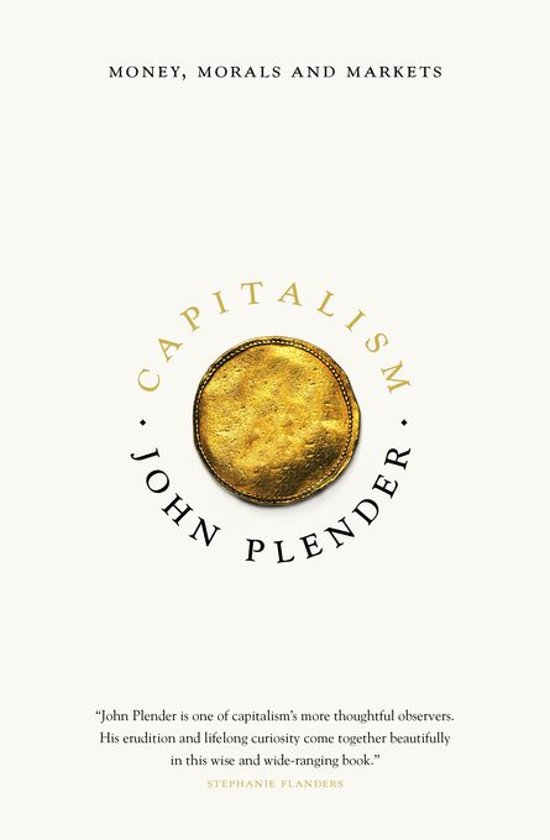 The capitalist system, which we live and breathe, rests on a
remarkable logic: a group of selfish individuals, each one seeking private happiness, produces a society where
the greatest possible number get what they want – or something like it. Through
the magic of the free market, Adam Smith’s too-oft-quoted ‘invisible hand’, selfishness
actually produces its opposite, a functioning and prosperous society broadly
advantageous to its members. Private acquisition agglomerates into public good;
from competition comes community; greed spawns gregariousness, or at any rate its mercantile analogue. This central
paradox, which has its origin in utilitarianism’s pursuit of the maximization
of pleasure across society, is quite dizzying when you think about it. How can
the pursuit of A, by the alchemy of the market, produce not-A? Yet this system,
based on the private pursuit of capital and so known as capitalism, has
achieved remarkable things. Over two centuries or so, it has raised the living
standards of most of the world and dramatically reduced global poverty. The
technology, medicine, comforts and luxuries many of us take for granted today
would have seemed a miracle even a generation ago. No other economic system is available as a
credible alternative: feudalism has disappeared into history, leaving only a
quaint residue such as the peerage system and the royal family; communist
central planning collapsed dramatically (economically speaking: central
planning in other areas, such as education, is pursued ardently across the
bureaucratised West). Other than capitalism, what economic system is going to
bring, say, a Bangladeshi or a Somalian the standard of living I enjoy –
running water, hygiene, education, all the rest of it? If you agree that they
are as entitled to these things as I am (and what rational basis could there
be for disagreement on this point?) what is there to do but to espouse the market
as the most likely source of this development? Capitalism has triumphed over
its rivals and has a long list of achievements to its credit.
Yet gung-ho, Gordon Gecko ‘Greed is Good’ celebrations of
capitalism are rare these days; and Capitalism is presently assailed by many
critics, from many shades of the political spectrum (only a very selective
observer could say they are all ‘left wing’). For one thing, the fact that it
is posited on human selfishness makes it ethically dubious, whatever the alleged long-term
beneficial consequences of this greed may be. Moral intuition and religious
systems alike persuade us that avarice is a vice, corrupting of the self and
damaging to others. And the model of a rational consumer going into a free
market , and thereby helping it to function efficiently for the good of the
majority, exposes itself to critique at every point: are we really rational
consumers? Do we not desire and buy things on a whim, yielding to the tide of
fashion, or sometimes - perhaps regularly - in an act of madness? And what does it do to us psychologically,
ethically, to think of ourselves as essentially ‘consumers’ anyway? To make us
into non-stop consumers, a massive advertising industry is necessary, playing
on every conceivable fear, anxiety and fantasy to make us think that buying
stuff will make us happy. And to make all that stuff that we are duped into
thinking we need, the planet is steadily raided for its resources, polluted and
spoiled. We are consuming the earth we live off; and if that sounds eco-hippy,
then capitalism’s purchase of the channels of information in education and the
media has been a success. And how free, we may then ask, is the alleged ‘free’
market, where government intervention and policy massively influences trade and
production, favouring some in the market at the cost of others? How can we call
it efficient, we may persist, when it is
so obviously inherently unstable, with a rollercoaster of booms, busts,
frenzies, and recessions? And rather than the greatest good of the greatest
number flowing from this market - a market so intrusive and ubiquitous we now
carry it around with us on our phones - we see instead ever-widening gaps
between the haves and the have-nots as goods are unevenly distributed, partly
because the governments that might do something to distribute wealth more
equitably are themselves owned by the rich who want to keep their treasure
hoard to themselves. Consumerism, materialism, waste and pollution, injustice
and inequality, the destruction of the planet and the trivialisation of the
human spirit. Capitalism’s defenders face too many sane and sagacious critics
to be blandly complacent.
John Plender, thankfully, is anything but complacent, and
interested in serious debate. Capitalism
leads us through the subject with great dexterity. As a writer for The Financial Times and a member of
various financial groups and forums, Plender is what one might think of as a
member of the establishment. Yet far from the closed-mindedness one associates with this rather fictitious
group, Plender shows common ground with many anti-establishment critics. He
does not believe the mess of 2007-08 has been anywhere near cleared up through
improvements in analysis, assumptions and regulation – indeed, he fears another
and bigger crash is on the cards. He points out inequitable wage differentials,
and notes the waste of human resources as the talented young are drawn into the
financial sector and away from productive parts of the economy; and his
brilliantly lucid analysis of the Eurozone crisis is pretty severe at the
behaviour of the northern countries towards the south. In an interesting
chapter on the art market, the author clearly feels commodification, the
equation of financial value with other kinds of value, has to stop somewhere. Capitalism is not a defence of the
status quo and makes clear that capitalism needs to get its house in much better
order if further gains are to be delivered and catastrophe avoided. Like
Erasmus on the Catholic Church, Plender believes the system needs to reform
from within, not be dismantled and replaced with an unclear substitute.
An attractive feature of the book is the use of literary
sources to investigate topics. It is refreshingly historically grounded. So we
have passages of Defoe and Addison on the London Exchange, Goethe’s Faust as a commentary on externalities
and social dysfunction, and apposite quotations from Dickens, de Tocqueville
and many others besides. The author is open to the ideas of many different
kinds of economist, too. Like Ha-Joon Chang, Plender thinks it is a pity that
many economists today take the Chicago school as a comprehensive explanatory model
and ignore other perspectives. Certainly some young students of economics I
meet come across as acolytes of a faith rather than serious analysts of events.
How satisfying it is to find here a range of writers being drawn on and engaged
with: across pages 282-4, for example, we come across Marx, Keynes, Friedman and
Raghuram Rajan in a discussion of public debt. Capitalism might perhaps have said something more about the
psychology induced by capitalist ideology; and somewhat surprisingly there is
no chapter specifically about environmental damage, which the author himself
mentions as one of the greatest challenges to be faced. This is also not the
book to read it you want to find out what ‘derivative’ or ‘futures market' means, since the author has to take some things for granted just to
get going (that said, some terms are defined deftly along the way). However, no
one book on this huge subject can do everything and the topics covered by these
chapters, from the nature of money itself to debt, speculation, banking and
gold are described with style and insight. I learned a lot from Capitalism and would certainly recommend
it as a guide to a subject, and debate, which is far too important to be left
to economists, establishment or otherwise.
Monday, 2 November 2015
The Glass Menagerie
 We greatly enjoyed The Glass Menagerie at the Nuffield, the first show to be directed by Sam Hodges since he took over as Director there in 2013. Tennessee Williams's 1944 play is strongly autobiographical: would-be writer Tom Wingfield (TW, note) longs to escape from a home in which everyone is in flight from reality: his mother, a suffocating, domineering southerner abandoned by her husband and taking resort in fantasy and nostalgia; his sister Laura, who has dropped out of school and business college and occupies herself going for walks, playing phonograph records and looking after her collection of glass animals, her 'glass menagerie'; and Tom himself, precariously employed in a shoe warehouse where he is known as 'Shakespeare' for his dreamy hobby of writing. The summit of this heartbreak household's ambitions is a 'gentleman caller' who will fall for Laura and spirit her away. The play leads up to this great event and its repercussions for the family. Does it end happily ever after? Remember, this is Tennessee Williams we are talking about here.
There was a strong design element to the production, credited to someone evidently so eminent that he is known simply as Ultz. The stage, framed by moving boards, resembled a film screen, picking up on Tom's escapist obsession with going to the movies. Tom himself spent most of the time either in front of the stage or in the audience, leading us through his 'memory play' as it played before us. Subdued colours and dim lighting produced a monochrome effect suggesting memory haze and early film. There were captions, slides and live streaming of Tom himself, and a set of metal steps for the fire escape from the family's apartment, also representing the escape route for Tom and a kind of bridge between past and present. Lighting and sound were used to tremendous atmospheric effect, and there were some ravishingly beautiful moments with candles, windblown curtains and the glowing glass unicorn.
There's always a danger that such directorial and designer cleverness overwhelms the play, or suggests a lack of confidence in it - as I think happened in Lyndsey Turner's Hamlet - but here the ideas were thought through and brought out Williams's poetic vision without distracting from it. Acting throughout was terrific. Dannie Lee Wynter played Tom with a caustic confidence, gradually revealing his character's insecurities and tragic inadequacy as family provider. Belinda Lang portrayed his mother Amanda with great understanding, showing a character who is at the same time insufferable yet understandable in her anxieties. The scene between Laura (Pearl Chanda) and her gentleman caller Mr O'Connor (Wilf Scolding) was totally compelling, touching and finally devastating. All in all, a remarkable piece of ensemble acting and a bold, committed production. The Nuffield moves towards Christmas fare now, but I'm very glad we caught this, and thankful I listened to two people who recommended it. Why some people in Winchester think you have to go to London to see good theatre is a mystery which passes understanding.
Subscribe to:
Posts (Atom)