
Tuesday, 16 July 2013
Waiting for Godot, Samuel Beckett

The Amen Corner, James Baldwin
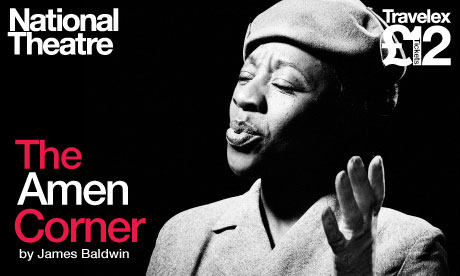 Rufus Norris's revival of James Baldwin's 1955 play has been a great summer hit for the National. That is in part owing to the wonderful music, with the London Community Gospel Choir led by the Rev Bazil Meade belting out a succession of hymns (could a Harlem community church have been that good?) and a jazz trio playing a through-composed jazz score by Tim Sutton. But The Amen Corner is a play with music, not a musical, and the drama was played with great strength and subtlety. Marianne Jean-Baptiste played Sister Margaret, dominant pastor of her church, who is confronted by the return of a prodigal and terminally ill husband and the departure of a wayward musical son. Her position in the community, meanwhile, is threatened by a rebellious congregation stirred up by a rival elder (Cecilia Noble). A two-tier set brought out the two parts of Sister Margaret's life effectively. The jazz musicians in the space above perhaps made the church hall somewhat less than realistic (especially when you can see the red light on the digital keyboard - surely it could be covered up with a bit of masking tape), and the Olivier's cosmic space was filled out with tenement scenes that were unnecessary but added atmosphere. Three-act plays are a challenge in a theatre where the convention is to have just one interval, and it was perhaps inevitable that the first half (ie two acts) felt rather long. But the third act took us to an enormously affecting conclusion, with text and music in perfect balance. And all accessible for £12, thanks to those amazing Travelex folk.
The Petrarchan Sonnet
Here's a brief guide to the form of sonnet known as the Petrarchan. Of interest, perhaps, to students of poetry and the general reader.
Like many poetic forms and terms, the sonnet is Italian in origin. It was used by the fourteenth-century Italian poet Petrarch (1304-74), and introduced to England in the sixteenth century by the poets Sir Thomas Wyatt (1503-42)and Surrey (full name Henry Howard, Earl of Surrey, ?1517-47). They made translations of Petrarch and wrote English sonnets which employed his rhyme scheme.
9. ____________ c
10. ___________ d
11. ___________ c
12. ___________ d
13. ___________ c
14. ___________ d
Like many poetic forms and terms, the sonnet is Italian in origin. It was used by the fourteenth-century Italian poet Petrarch (1304-74), and introduced to England in the sixteenth century by the poets Sir Thomas Wyatt (1503-42)and Surrey (full name Henry Howard, Earl of Surrey, ?1517-47). They made translations of Petrarch and wrote English sonnets which employed his rhyme scheme.
Basic form
The basic shape of the Petrarchan sonnet is 8 lines (the octave or octet) + 6 lines (the sestet).
The octave is composed of two quatrains,
closely linked by just two rhyme sounds: abbaabba.
The sestet has various rhyme forms, using either two or three rhyme sounds: cdcdcd, cde cde etc. Many variations are permitted, but the
sonnet should not end with a couplet. The English iambic pentameter line is the standard
metre. In graphic form, here is the rhyme scheme of a sonnet divided into octave and a sestet, the setet itself divided into two tercets liniked by rhyme.
- ___________ a
- ___________ b
- ___________ b
- ___________ a
- ___________ a
- ___________ b
- ___________ b
- ___________ a
10. ___________ d
11. ___________ c
12. ___________ d
13. ___________ c
14. ___________ d
One thing to look out for in a sonnet is the turn (Italian volta), the point between the octave and sestet, where the sonnet
moves from one rhyme group to another.
With the change in rhyme scheme may come a change in subject matter.
So in the second, shorter half, the poet may change register, comment on
the first half (perhaps presenting it as an analogy), answer it, resolve its
tensions or heighten them, or reverse
the feeling altogether, among many other strategies.
A sonnet is a little too long for simple lyrical expression,
but too short to tell a complex narrative. It therefore suits short argument, and the representation of an
internal mental / emotional experience, often involving conflicting
feelings. This figuring of an internal
passage of thought invites metaphorical
language. Originally, the predominant theme was love, with the Petrarchan lover in joy and agony,
burning and freezing at the sight of his beautiful / remote beloved. Wyatt and
Surrey were courtly poets, writing
about the delicate sensitivities of the courtly
lover. Later writers have adopted the form for a wide range of subjects.
Rhyming is harder in English than Italian, so the form also represents a
formidable technical challenge to the poet. The discipline of the form seems to
be an effective way of presenting strong emotional content.
Here are some examples of English sonnets using the
Petrarchan form.
Wyatt
The long
love that in my heart doth harbor
And in
mine heart doth keep his residence,
Into my
face presseth with bold pretense,
And there
campeth, displaying his banner.
She that
me learneth to love and to suffer,
And wills
that my trust and lust's negligence
Be reined
by reason, shame, and reverence,
With his
hardiness taketh displeasure.
Wherewith
love to the heart's forest he fleeth,
Leaving
his enterprise with pain and cry,
And there
him hideth and not appeareth.
What may
I do when my master feareth
But in
the field with him to live and die?
For good
is the life ending faithfully.
Let's look at this without reference to the Italian model. It stands or falls as a poem in English, after all. I like the way it gets on with telling its story straightaway. Each line in the first quatrain tells us about a new event, an internal experience figured in imagery. 'Long love' - the length is felt through the double stress, which lengthens the vowels and gives the liquid 'l' sound its full value ('l' does seem to have an erotic feel to it: the lovely long-legged lady whiplash; Nabokov comments on this at the start of Lolita). The poet / lover is talking about love felt for a long time, and along with this temporal sense we get a spatial one: we see a long ship in harbour (inactive, frustrated). Like a royal visitor, Love takes up residence in the heart, which we might see in line 2 as a country house (nobles were supposed to keep these vast houses just in case the monarch decided to honour them by living there with the attendant swarm of court locusts; is there a passing echo of a castle keep?). But then, in lines three to four, something happens. Bored of harbouring and residing - a passive, skulking state - Love announces himself. He presses into the lover's face: he must have made some sign (A smile? A blush? A leer? Can I buy you a drink?) to the Lady. Love is out in the open, exposed, displaying his banner like an army in its camp.
Huge faux pas! The second quatrain looks at the Lady's reaction to this boldness. She's not pleased. He should have been a proper English gentleman, reserved and repressed. She has been teaching him to love in painful discretion ('to love and to suffer') int he best traditions of courtly love, where love is a debilitating illness which can drive you crazy. The phrase 'trust and lust's negligence' doesn't quite work for me: the double rhyme is an awkward jingle, and I can see how he has neglected his 'trust' (she trusted him to keep quiet), but not his lust, whatever sense of 'lust' we take (at that time it could mean vigorous and healthy). Maybe the 'r' allteration is a little overdone, too. But the great debate with Wyatt is how much this rough metre and sound is deliberate, and how much a sign of apprenticeship. we've seen how he departs from iambic opentameter right at the start with 'The long love', and the jingly-jangly sound of these lines could possibly convey some of the nervousness of the lover. We notice, anyway, that the second quatrain, like the first, is a complete sentence; but while the first quatrain had a fresh clause in each line, each with its precise verb (harbour ... keep), this has just one. The whole construction builds to that tremendous disapproval: 'taketh displeasure'.
We're now at the volta, the turning point between the octave and the sestet, and sure enough we get a dramatic development. Love, abashed at the beloved's displeasure, flees 'into the heart's forest' (giving us the millionth pun on heart and 'hart' (deer), the Elizabethan equivalent of rhyming 'love' and 'stars above'). It's a remarkable figuring forth of an internal seizure, the actual experience of turning inwards in shame. (And it reminds me of an episode of The Simpsons, in which Lisa disappoints a suitor on camera: 'Freeze it there,' says Bart. 'You can see the exact moment when his heart breaks!'). 'Pain and cry' is the image of the internal wound, the freeze frame instant where the lover gives up. Wyatt has a cdccdd rhyme going on here, making the sestet a compact merging of triple rhymes. In the last lines Love transmutes again (Love has been a ship, a royal visitor, a herald or king displaying his banner, a hunted quarry), this time into a master whom the lover, faithful servant, must follow even unto death, as Kent follows Lear. The Lover is loyal, and with this stoical virtue, huddled under the bedclothes, a pitiful wreck, he leaves us. The poem is an elaborate game of codes, all based on the court: the visitation, battle campaigns, the accepted code of practice of courtly love, the hunt, the duty of service. All translated into the poetic code of the sonnet, which puts it all togetehr in a little drama of love and rejection. What is remarkable is that through all the elaborateness, the rhymes and alliterations and witty double senses, we do feel something real going on: the poem gets at the psychology of love in a way that reaches beyond the Renaissance community of understanding: love can take over us, be a bore even. It can be martial and predatory - a ship, a herald of war - but it can be awfully embarrassing, too, and, when dismissed, takes us over in self-pity and absurd self-dramatisation. The artifice of the sonnet is a gateway to the genuine.
Milton
When
I consider how my light is spent
Ere half my days in this dark world and wide,
And that one talent which is death to hide
Lodged with me useless, though my soul more bent
To serve therewith my Maker, and present
My true account, lest he returning chide,
"Doth God exact day-labour, light denied?"
I fondly ask. But Patience, to prevent
That murmur, soon replies: "God doth not need
Either man's work or his own gifts: who best
Bear his mild yoke, they serve him best. His state
Is kingly; thousands at his bidding speed
And post o'er land and ocean without rest:
They also serve who only stand and wait."
Wordsworth,
"London, 1802"
Milton!
thou shouldst be living at this hour:
England
hath need of thee: she is a fen
Of
stagnant waters: altar, sword, and pen,
Fireside,
the heroic wealth of hall and bower,
Have
forfeited their ancient English dower
Of inward
happiness. We are selfish men;
Oh! raise
us up, return to us again;
And give
us manners, virtue, freedom, power.
Thy soul
was like a Star, and dwelt apart;
Thou
hadst a voice whose sound was like the sea:
Pure as
the naked heavens, majestic, free,
So didst
thou travel on life's common way,
In
cheerful godliness; and yet thy heart
The
lowliest duties on herself did lay.
Amy
Lowell ‘A Fixed Idea’
|
R B Kitaj, Pallant House
 Looking at Kitaj at Pallant House I was reminded of T S
Eliot’s ‘dissociation of sensibility’ -
the idea, roughly speaking, that somewhere in our cultural history feeling and intellect became uncoupled.
For a poet like Donne, an emotional experience could take the form of an
intellectual adventure: the search for religious truth, for example, occupies
mind and heart symbiotically, and we feel that in the pulse of the
verse rhythms. But now emotion goes one
way – prompted by the stimulus of the quick hit – and intellect is left to find
its own dessicated form elsewhere. Kitaj’s paintings represent a new synthesis
of brain and emotion. Take ‘The Killer-Critic Assasinated by his Widower, Even’
(1997) – the work prompted by the recent death from an aneurism of Kitaj’s wife
Sandra, which Kitaj blamed on the negative critical reactions to his Tate
Retrospective of 1994. Clashing colour, gestural scrawl and grotesque imagery
communicate a tactile, trembling fury. Yet it’s a fury felt through a dense web
of association: the title alludes to Duchamp, the central image to Manet’s
'Assassination of Maximilian' (while the victim’s hands surely point to Goya’s 3rd
May – Kitaj had a long and intense immersion in Spanish culture). Modernist
collage points us in further directions, to revenge tragedy, to Erasmus and
Gogol and their subjects of fools and madmen. The heart’s passion quickens the
mind’s dance. It’s a language we are more used to in literature, in particular
in Eliot’s ‘The Waste Land’, at once the scrapbook of a hyper-educated memory
and the verbal reflex of mental disintegration. Densely allusive art requires
time to unpack in the mind, but like Eliot, Kitaj can deploy his art to convey
sudden sensuous beauty. ‘Degas’ (1980), shown in a room devoted to Kitaj’s
figurative pastels, is a moving and beautiful work showing the hand and eye of
an Old Master. Some excerpts of John Ashbery’s essay on the artist are
reproduced in Paris Review:
Andrew Greig, Dunsinane (Radio 3 Drama)
Macbeth ends with
regime change. A foreign army (England) helps to kill a tyrant and installs a
new King, Malcolm. But then what? Could the transfer of power really be so
smooth? Would the foreign army simply melt away, or would it need to stay to
manage the transition to the new power? How much do we know about the new
leader – the oddly empty character Malcolm – anyway? These were the questions
that occurred to Scottish playwright David Greig when he saw a number of
productions of the Scottish play in 2004. Dunsinane is his response. We start
with the English under General Siward defeating Macbeth at Dunsinane:
immediately our own certainties crumble, as we have a revisionist version of
Macbeth’s demise and his wife, the Lady Gruach, turns out to be alive. The
bluff certainties of Siward, which are fine in combat, quickly fall apart in this
new territory of clan warfare, treachery and spells. Imprisonment, suicide,
torture and infanticide follow. Malcolm understands this world, the English do
not: conflict, Malcolm explains, is the natural state of things, peace an
illusory, momentary calm sea. Greig’s play crystallises the issues of recent
British adventures abroad, principally in Iraq and Afghanistan; and it is
apposite too in the light of any ideas that, rid of Gaddafi, Libya will turn
dutifully to the Western model. Attention is focussed on the bewildered and
brutalised English squaddies, and the chief perspective is that of Siward,
holding on as long as possible to Blairite sense of mission. The play did not seem to me entirely
consistent: the squaddie humour seemed formulaic, and the ending did not quite
have the climactic feel it was looking for: hard to find a climax to a scenario
that is all to do with grinding on in a sense of ever greater futility. However,
the entire production was gripping. Powerful performances by Jonny Phillips (Siward)
and Siobhan Redmond (Gruach) brought out the bare poetry of Grieg’s script. A
welcome repeat on Radio 3’s Sunday drama slot.
Barbara Hepworth, Hospital Drawings (Pallant House)
Art and medicine have a long history. From the wounds of
Christ to Rembrandt’s ‘The Anatomy Lesson of Dr Tulp’, from miracle healings to
the casualties of war and the faces of the insane, the subjects of art invite
us to look with an eye at once compassionate and forensic at the vulnerable
body and mind. In the series of 70 drawings by Barbara Hepworth of
operations in a hospital theatre the artist and the doctor come particularly
close . These works originated in the friendship of Hepworth and Exeter orthopaedic
surgeon Norman Capener, who in 1944 treated Hepworth’s daughter Sarah, who
suffered from osteomyelitis (now treated with antibiotics, but then requiring
complex surgery). A lifelong friendship followed. Capener was himself an
amateur artist and Hepworth taught him sculpture; Capener in turn designed some
surgical instruments based on Hepworth’s sculpting tools. Between 1947 and 1949
Hepworth witnessed, and drew, operations performed by Capener and colleagues.
The drawings bring out the remarkable connections between artist and surgeon:
Capener was devising his own ‘philosophy of the hand’ and the drawings show
hands in the actions in the actions of praying, blessing, probing,
exploring - each action echoed by the
act of drawing, or rather incising, as Hepworth cut her way with a scalpel-like
pencil into a board prepared with a gesso layer. This is a technique we
associate with Renaissance drawing, and the groups of figures in these works
look like the nativities and pietàs of renaissance art: clinical procedures
assume the grace and gravitas of spiritual rituals. The quality of absolute attention – from
surgeon to patient, from artist to surgeon - draws in our own gaze, while at
the same time the white masked bodies of the doctors appear to us transfigured into the
pure shapes of Hepworth’s sculptural forms.
The Captain of Köpenick
 The Captain of Köpenick (Olivier, National Theatre), by Carl Zuckmayer. Play based on the true story of a prisoner, Wilhelm Voigt, who finds himself without papers and to all state intents and purposes thus without identity or even existence. Dressed up in a captain's uniform, however, he is able to lead some passing soldiers on an expedition to seize the contents of the treasury of the town hall. The production was held together by the amazing Anthony Sher. The first half dragged, with satirical society scenes and a sentimental subplot or two, which didn't carry much narrative power. It took off in the second half, though, with the central 'raid' scenes brought off with riotous humour. As so often in the Olivier, design concepts were needed to fill the vast spaces, and so we had huge skyscapes, dancing dummies and so forth. It all looked magnificent but rather over-produced. Somewhere in there amid all the dazzle and choreography was an ensemble play about a venal society and the Prussian reverence for uniform that lay behind the rise of Hitler. But it had the feel of a quintet being played by a symphony orchestra. Best moment was Sher, 'pots and pans'.
Subscribe to:
Posts (Atom)