Macbeth ends with
regime change. A foreign army (England) helps to kill a tyrant and installs a
new King, Malcolm. But then what? Could the transfer of power really be so
smooth? Would the foreign army simply melt away, or would it need to stay to
manage the transition to the new power? How much do we know about the new
leader – the oddly empty character Malcolm – anyway? These were the questions
that occurred to Scottish playwright David Greig when he saw a number of
productions of the Scottish play in 2004. Dunsinane is his response. We start
with the English under General Siward defeating Macbeth at Dunsinane:
immediately our own certainties crumble, as we have a revisionist version of
Macbeth’s demise and his wife, the Lady Gruach, turns out to be alive. The
bluff certainties of Siward, which are fine in combat, quickly fall apart in this
new territory of clan warfare, treachery and spells. Imprisonment, suicide,
torture and infanticide follow. Malcolm understands this world, the English do
not: conflict, Malcolm explains, is the natural state of things, peace an
illusory, momentary calm sea. Greig’s play crystallises the issues of recent
British adventures abroad, principally in Iraq and Afghanistan; and it is
apposite too in the light of any ideas that, rid of Gaddafi, Libya will turn
dutifully to the Western model. Attention is focussed on the bewildered and
brutalised English squaddies, and the chief perspective is that of Siward,
holding on as long as possible to Blairite sense of mission. The play did not seem to me entirely
consistent: the squaddie humour seemed formulaic, and the ending did not quite
have the climactic feel it was looking for: hard to find a climax to a scenario
that is all to do with grinding on in a sense of ever greater futility. However,
the entire production was gripping. Powerful performances by Jonny Phillips (Siward)
and Siobhan Redmond (Gruach) brought out the bare poetry of Grieg’s script. A
welcome repeat on Radio 3’s Sunday drama slot.
Tuesday, 16 July 2013
Barbara Hepworth, Hospital Drawings (Pallant House)
Art and medicine have a long history. From the wounds of
Christ to Rembrandt’s ‘The Anatomy Lesson of Dr Tulp’, from miracle healings to
the casualties of war and the faces of the insane, the subjects of art invite
us to look with an eye at once compassionate and forensic at the vulnerable
body and mind. In the series of 70 drawings by Barbara Hepworth of
operations in a hospital theatre the artist and the doctor come particularly
close . These works originated in the friendship of Hepworth and Exeter orthopaedic
surgeon Norman Capener, who in 1944 treated Hepworth’s daughter Sarah, who
suffered from osteomyelitis (now treated with antibiotics, but then requiring
complex surgery). A lifelong friendship followed. Capener was himself an
amateur artist and Hepworth taught him sculpture; Capener in turn designed some
surgical instruments based on Hepworth’s sculpting tools. Between 1947 and 1949
Hepworth witnessed, and drew, operations performed by Capener and colleagues.
The drawings bring out the remarkable connections between artist and surgeon:
Capener was devising his own ‘philosophy of the hand’ and the drawings show
hands in the actions in the actions of praying, blessing, probing,
exploring - each action echoed by the
act of drawing, or rather incising, as Hepworth cut her way with a scalpel-like
pencil into a board prepared with a gesso layer. This is a technique we
associate with Renaissance drawing, and the groups of figures in these works
look like the nativities and pietàs of renaissance art: clinical procedures
assume the grace and gravitas of spiritual rituals. The quality of absolute attention – from
surgeon to patient, from artist to surgeon - draws in our own gaze, while at
the same time the white masked bodies of the doctors appear to us transfigured into the
pure shapes of Hepworth’s sculptural forms.

The Captain of Köpenick
 The Captain of Köpenick (Olivier, National Theatre), by Carl Zuckmayer. Play based on the true story of a prisoner, Wilhelm Voigt, who finds himself without papers and to all state intents and purposes thus without identity or even existence. Dressed up in a captain's uniform, however, he is able to lead some passing soldiers on an expedition to seize the contents of the treasury of the town hall. The production was held together by the amazing Anthony Sher. The first half dragged, with satirical society scenes and a sentimental subplot or two, which didn't carry much narrative power. It took off in the second half, though, with the central 'raid' scenes brought off with riotous humour. As so often in the Olivier, design concepts were needed to fill the vast spaces, and so we had huge skyscapes, dancing dummies and so forth. It all looked magnificent but rather over-produced. Somewhere in there amid all the dazzle and choreography was an ensemble play about a venal society and the Prussian reverence for uniform that lay behind the rise of Hitler. But it had the feel of a quintet being played by a symphony orchestra. Best moment was Sher, 'pots and pans'.
Four Victorian Farces
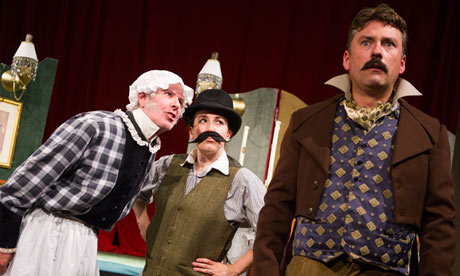 Four Victorian Farces was a touring production by the European Arts Company, who specialise in small-scale work. Each play was 20-30 minutes long, and required only a cast of three, played with great verve by Richard Latham, John O'Connor and Asta Parry. Two of the plays were by John Maddison Morton (1811-1891): Box and Cox (apparently the origin of that expression) and A Most Unwarrantable Intrusion. Curiously, amid all the caperings, misunderstandings and masquerading we associate with farce we found ourselves here in a world only a breath away from absurd drama, Monty Python and surrealism. A Most Unwarrantable Intrusion, where a Mr Snoozle is interrupted by a man who ahs apparently tried to commit suicide in his garden, seemed weirdly close to modern plays like Pinter's A Slight Ache, and even ended with a kind of meta-theatre when the actors address the writer, anticipating the worlds of Pirandello and Ionesco. The other two plays were Wanted, a Young Lady by William E Suter and Duel in the Dark by Joseph Stirling Coyne, both of which suggested that the Victorians weren't as prudish as we might think. I loved the simple staging, the sound effects (scrunching newspaper for the sound of a fire, represented by a sock - it works) and the brio of the whole adventure. How were these one-acters originally staged, I wonder? As part of some kind of variety show, perhaps? There must be an enormous amount of Victorian theatre waiting to be rediscovered. And thanks to the efforts of the University of Worcester, it can be explored here:
http://victorian.worc.ac.uk/modx/
The Misanthrope, Molière
 The Misanthrope, Moliere. Roger McGough's translation, produced by the English Touring Theatre. I'd heard this on Radio 3 before seeing it, and loved the energy and colourful characterisation. A lot hinges on what we make of Alceste's demand for authenticity and sincerity in face of the absurd falsehoods of social life. The play gives us enough room to see his stance as a form of romantic egotism, even as we applaud his ridicule of the fops around him. Seeing it was a little disappointing - we were part of a tiny Saturday afternoon audience at the Nuffield, Southampton, and the main actor had mysteriously been replaced by another, valiantly reading from a script. Nonetheless, the production rattled along, and the cast delivered. Alceste's infatuation with the flighty Célimène didn't really convince, partly the effect of McGough's script, which didn't let all the plot lines make full sense. But there was much to enjoy: great set-pieces (I loved Oronte's warm-up for the delivery of his sonnet); lovely staging and choreography to Peter Coyte's score; and a stunning final tableau. But Southampton's apparent indifference to its theatre does make me worry for its future.
This House, James Graham
 This House, James Graham. This was a recent hit, looking at the Labour Party's increasingly desperate machinations to pass legislation in the years between 1974 and 1979, with majorities so tiny that MPs needed to be helicoptered and wheelchaired in to get bills voted through. Graham's original approach was to set it in the Whips' offices: the downstage area was divided into two as we saw the engine rooms of the two parties at work. The minutiae of policy was put aside in favour of a study of the relations between these party managers, who over the years got to know each other extremely well. While the play was largely made up of local episodes - stubborn backbenchers, a member faking suicide and eventually imprisoned for fraud (who was that?), Heseltine seizing the mace - there were over-arching themes such as the changing make-up of the House, and the rise of the modern professional politician. The human dramas at the centre were compelling, and we were drawn into the author's obsession with the workings of this bizarre institution. Behind it all was the rise of Thatcher, but it didn't feel as though we were being invited to hiss at that or yearn for the past. This play transferred from the Cottesloe, and the mighty Olivier space was tackled with a scaffolded walkway, a huge Big Ben and a recreation of the House of Commons. I didn't think that having some audience on green benches worked terribly well, as they simply didn't look like MPs. But the sweep across time and events was exciting, the final scenes were touchingly played, and one had a sense that we were seeing a country in profound transformation, before the Thatcher Revolution had even started.
Monday, 15 July 2013
Beckett, Not I
 Not I, Beckett's 10-minute piece for a woman's voice, was delivered over a few evenings at the Royal Court by Lisa Dwan (who got it down to nine minutes). It was a remarkable experience. Dwan's voice stuttered into life through gutturals, into which it faded at the end. The speech itself was delivered at the speed of thought - apparently the author felt it could not be taken too fast - with the effect that images were being scrambled and unscrambled in the mind continuously. It was great to hear it in Dwan's Irish accent (I'd just been watching the Irish performance of 'Godot' on Beckett on Film and there, too, the expressions and rhythms seemed to find their natural home). It was surprisingly easy to focus on a single mouth, suspended in darkness eight feet above the stage. The performance was followed by a short film of Billie Whitelaw reminiscing about working with Beckett, and a Q & A with Dwan, James Knowlson and Benedict Nightingale, during which the demands on the performer became clear. Quite apart from dealing with breathing and projection at this extreme end of the repertoire, she is blindfolded, and harnessed to a board. Apparently earlier productions included a compassionate listener, who was later removed because of issues with lighting. Beckett said he knew such garrulous women from Ireland, but was apparently inspired also by the sight of someone waiting outside a school in Morocco (I think) and the head of John the Baptist in the painting by Caravaggio. I did wonder if, for £20, the Royal Court could have favoured us with more than ten minutes of actual theatre, but it bought an unrepeatable hour. Outside I caught a glimpse of someone I knew. But we did not speak. Beckett's poetry of absence floated through Sloane Square.
Subscribe to:
Posts (Atom)