Tuesday, 16 July 2013

Four Victorian Farces


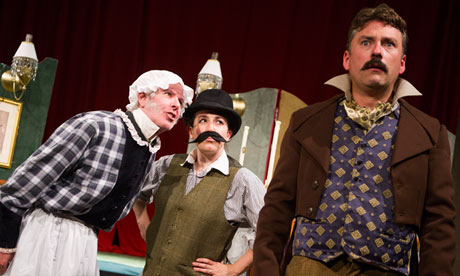
Four Victorian Farces was a touring production by the European Arts Company, who specialise in small-scale work. Each play was 20-30 minutes long, and required only a cast of three, played with great verve by Richard Latham, John O'Connor and Asta Parry. Two of the plays were by John Maddison Morton (1811-1891): Box and Cox (apparently the origin of that expression) and A Most Unwarrantable Intrusion. Curiously, amid all the caperings, misunderstandings and masquerading we associate with farce we found ourselves here in a world only a breath away from absurd drama, Monty Python and surrealism. A Most Unwarrantable Intrusion, where a Mr Snoozle is interrupted by a man who ahs apparently tried to commit suicide in his garden, seemed weirdly close to modern plays like Pinter's A Slight Ache, and even ended with a kind of meta-theatre when the actors address the writer, anticipating the worlds of Pirandello and Ionesco. The other two plays were Wanted, a Young Lady by William E Suter and Duel in the Dark by Joseph Stirling Coyne, both of which suggested that the Victorians weren't as prudish as we might think. I loved the simple staging, the sound effects (scrunching newspaper for the sound of a fire, represented by a sock - it works) and the brio of the whole adventure. How were these one-acters originally staged, I wonder? As part of some kind of variety show, perhaps? There must be an enormous amount of Victorian theatre waiting to be rediscovered. And thanks to the efforts of the University of Worcester, it can be explored here:
http://victorian.worc.ac.uk/modx/

The Misanthrope, Molière


The Misanthrope, Moliere. Roger McGough's translation, produced by the English Touring Theatre. I'd heard this on Radio 3 before seeing it, and loved the energy and colourful characterisation. A lot hinges on what we make of Alceste's demand for authenticity and sincerity in face of the absurd falsehoods of social life. The play gives us enough room to see his stance as a form of romantic egotism, even as we applaud his ridicule of the fops around him. Seeing it was a little disappointing - we were part of a tiny Saturday afternoon audience at the Nuffield, Southampton, and the main actor had mysteriously been replaced by another, valiantly reading from a script. Nonetheless, the production rattled along, and the cast delivered. Alceste's infatuation with the flighty Célimène didn't really convince, partly the effect of  McGough's script, which didn't let all the plot lines make full sense. But there was much to enjoy: great set-pieces (I loved Oronte's warm-up for the delivery of his sonnet); lovely staging and choreography to Peter Coyte's score; and a stunning final tableau. But Southampton's apparent indifference to its theatre does make me worry for its future.

This House, James Graham

This House, James Graham. This was a recent hit, looking at the Labour Party's increasingly desperate machinations to pass legislation in the years between 1974 and 1979, with majorities so tiny that MPs needed to be helicoptered and wheelchaired in to get bills voted through. Graham's original approach was to set it in the Whips' offices: the downstage area was divided into two as we saw the engine rooms of the two parties at work. The minutiae of policy was put aside in favour of a study of the relations between these party managers, who over the years got to know each other extremely well. While the play was largely made up of local episodes - stubborn backbenchers, a member faking suicide and eventually imprisoned for fraud (who was that?), Heseltine seizing the mace - there were over-arching themes such as the changing make-up of the House, and the rise of the modern professional politician. The human dramas at the centre were compelling, and we were drawn into the author's obsession with the workings of this bizarre institution. Behind it all was the rise of Thatcher, but it didn't feel as though we were being invited to hiss at that or yearn for the past. This play transferred from the Cottesloe, and the mighty Olivier space was tackled with a scaffolded walkway, a huge Big Ben and a recreation of the House of Commons. I didn't think that having some audience on green benches worked terribly well, as they simply didn't look like MPs. But the sweep across time and events was exciting, the final scenes were touchingly played, and one had a sense that we were seeing a country in profound transformation, before the Thatcher Revolution had even started.

Monday, 15 July 2013

Beckett, Not I

Not I, Beckett's 10-minute piece for a woman's voice, was delivered over a few evenings at the Royal Court by Lisa Dwan (who got it down to nine minutes). It was a remarkable experience. Dwan's voice stuttered into life through gutturals, into which it faded at the end. The speech itself was delivered at the speed of thought - apparently the author felt it could not be taken too fast - with the effect that images were being scrambled and unscrambled in the mind continuously. It was great to hear it in Dwan's Irish accent  (I'd just been watching the Irish performance of 'Godot' on Beckett on Film and there, too, the expressions and rhythms seemed to find their natural home). It was surprisingly easy to focus on a single mouth, suspended in darkness eight feet above the stage. The performance was followed by a short film of Billie Whitelaw reminiscing about working with Beckett, and a Q & A with Dwan, James Knowlson and Benedict Nightingale, during which the demands on the performer became clear. Quite apart from dealing with breathing and projection at this extreme end of the repertoire, she is blindfolded, and harnessed to a board. Apparently earlier productions included a compassionate listener, who was later removed because of issues with lighting. Beckett said he knew such garrulous women from Ireland, but was apparently inspired also by the sight of someone waiting outside a school in Morocco (I think) and the head of John the Baptist in the painting by Caravaggio. I did wonder if, for £20, the Royal Court could have favoured us with more than ten minutes of actual theatre, but it bought an unrepeatable hour. Outside I caught a glimpse of someone I knew. But we did not speak. Beckett's poetry of absence floated through Sloane Square.

Friday, 21 September 2012

Writing an Essay

When you're set an essay, the natural and human reaction is to want to get it over with. But for high-stakes writing - for exams and such - this have-a-go approach is a bit risky. So it's hugely worthwhile to put some time aside to find a guide to the method of essay writing that clicks with you. Many websites offer help with this, and not a few offer to write them for you for a fee. After a brief trawl, the online resources below seemed to me particularly useful.

Here's a hub to various resources on all kinds of writings. I haven't looked at them all. The Creative Writing Resources looks very good. Open here.

For academic essays in particular, I recommend the Purdue University Online Writing Lab. Go to 'Common Writing Assignments' for detailed advice on argumentative essays etc. Breaks it down into stages.

Plenty of universities are posting their student guides online. Here's good one from Anglia Ruskin University.

Another good one is this, by David Gauntlett of the Institute of Communication Studies at Leeds. I like his examples of concision over waffle: Essay-Writing: The Essential Guide

Here's a very practical document by Tom Davis written for English undergraduates (but useful for other subjects), with some useful links of its own. Written in 2001 so the remarks on technology are a little archaic, but the advice on putting material into paragraphs is timeless. How to Write an Essay.

See also previous blog post, Guides to Good Writing.

Thursday, 20 September 2012

T S Eliot, Poems 1920

Surely the first thing that strikes anyone on looking at the selection from Poems, 1920 is that they are extraordinarily difficult. In 'Gerontion' and the quatrain poems, Eliot uses dislocation: we seem to slide suddenly from one scene, or voice, or topic, or image to another, and the link is not at all clear. Then there is the obstacle course of quotations and allusions - in 'Burbank' a whole heap of them - which defy us to recognise and make sense of them. On top of this are difficulties in language, such as the tortuous syntax of 'Gerontion', and the abstruse vocabulary ('Polypohiloprogenitive' etc.). As if that were not enough, we have strange names to makes sense of (Princess Volupine, the 'characters' in 'Gerontion'), references to classical myth ('Sweeney among the Nightingales') and obscure theology ('Mr Eliot's Sunday Morning Service'), and a lack of clear subject matter. And the voice with which the poems are delivered seems frequently to change in tone - from ironic and sardonic to philosophical to, occasionally, lyrical (the description of the painting in 'Mr Eliot's Sunday Morning Service'). It is comforting to discover that the best-read critics and scholars have found these poems
extremely hard - even impossible - to fathom. Some have seen them as a bit of a dead end in Eliot's work (he never returned to this tight quatrain form for more than a few lines), an experimental phase between Prufrock and 'The Waste Land'.

Difficulty is itself an important aspect of Eliot's work, so we should pause and consider it. He himself took the view that modern poetry had to be complex if it was to present a truthful representation of modern experience. Here he is, in a lecture published in 1921:

It is not a permanent necessity that poets should be interested in philosophy, or in any other subject. We can only say that it appears likely that poets in our civilization, as it exists at present, must be difficult. Our civilization comprehends great variety and complexity, and this variety and complexity, playing upon a refined sensibility, must produce various and complex results. The poet must become more and more comprehensive, more allusive, more indirect, in order to force, to dislocate if necessary, language into his meaning. ('The Metaphysical Poets')

Why, we might ask following Eliot, should poetry be easy? Scientists don't expect the material world to deliver its secrets up easily; and if art is a comparable investigation into the human world of culture and civilization, then that, too is likely to be as dense and exacting as scientific research (Eliot compares the creative act to a scientific experiment in 'Tradition and the Individual Talent'). This is especially the case when that culture lies shattered into fragments after the cataclysm of World War One.

Here are some links to commentaries on the 1920 poems as a whole, and some of the individual poems.

Poems, 1920
Nigel Alderman, 'Where are the eagles and the trumpets?': the strange case of Eliot's missing quatrains - on the quatrain poems as a group. Accessible from JSTOR here.
Heather Bryant Jordan, Ara vos Prec: A Rescued Volume

Individual Poems
Critical interpretations of Gerontion
Thomas Day, analysis of 'Gerontion' in agenda poetry
Skylar Hamel, essay on The Hippopotamus
Cummings Guide, Sweeney Among the Nightingales
Gabriel Ellsworth, Analysis of 'Mr Eliot's Sunday Morning Service'
Keith Sagar, link on this page to Sagar's paper on 'Prufrock Supine and Sweeney Erect'
Moissac Tympanum


Image: Web Gallery of Art
The tympanum at Moissac, c.1115-1135, depicts Christ in majesty surrounded by the tetramorph, the symbols of the four evangelists. Beyond the tetramorph are accompanying angels. The other figures are the twenty-four elders beholding Christ, as described in St John's Revelations. The posts below show elongated figures of Peter (left) and Isaiah (right), while the central trumeau combines the figures of st Paul, Jeremiah and various fabulous beasts. Below are some links which should aid further exploration of this Romanesque masterpiece.

Superb images and brief text on paradoxplace

Andrew Tallon of Vassar College has produced some outstanding photographic resources, enabling the viewer to zoom in on details. See the bottom of his homepage.

A video of the Moissac portal led me to this wonderful blog on the Romanesque sculpture and architecture of the route to Santiago, The Joining of Heaven and Earth

Moissac is included in a useful chapter on Romanesque in the online World History of Art

Meyer Schapiro wrote a detailed study of the Moissac sculptures for his 1935 doctoral thesis. This work is available in two articles on JSTOR: 'The Romanesque sculpture of Moissac, Part I (1)' deals with the programme of capital sculptures in the cloister. The tympanum is described in detail in the second article, 'The Romanesque Sculpture of Moissac, Part 1 (II)'.  Both can be conveniently read in book form in Meyer Schapiro and David Finn (photos), The Romanesque Sculpture of Moissac (1985). Schapiro's Charles Eliot Norton lectures on various sites are published as Meyer Schapiro, Romanesque architectural sculpture (2006).