Saturday, 27 February 2016

As You Like It, National Theatre

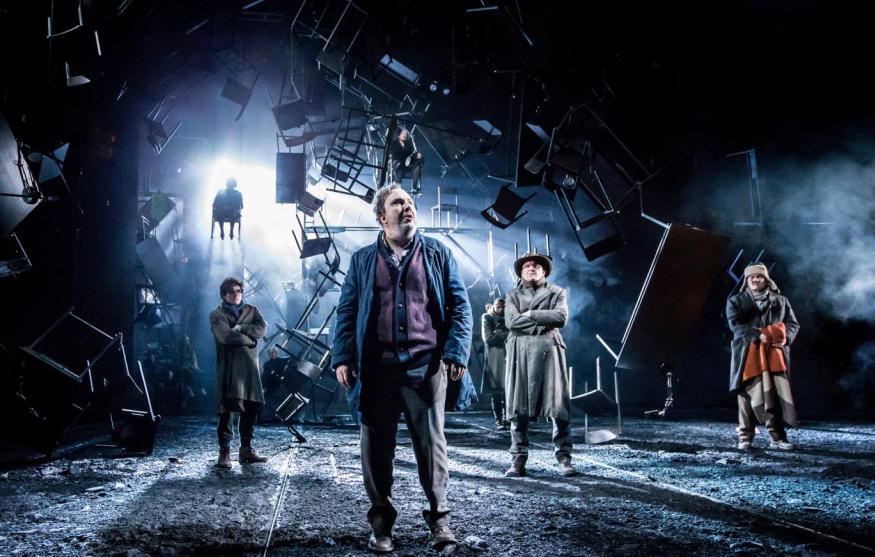
The National Theatre's new production (the first in over 30 years, forsooth) of As You Like It opens in a modern office space, where Orlando is employed in the lowly capacity of plant-sprayer. During the day, the office fills with workers doing things at PCs and having choreographed snacks and, as is common in office life these days, enjoying breaks for wrestling matches featuring the Duke's Champion, staged with all the bling and zing of the WWF. When the scene moves to Arden the chairs and desks are hauled up in an ingenious whoosh and dangle mid-air, forming an expressionist forest, like a gigantic installation sculpture - visually suggesting, perhaps, that Arden is the world of court / office turned inside out and topsy-turvy.  Backlight is splintered through this remarkable creation, shadows flicker, and there is an accompanying sculpture of sounds from animal noises to (beautiful, in Orlando Gough's score) a capella humming. As couples couple and the wafer-thin 'plot' resolves we are released from dimness into primary colours, dancing and happiness.


I start with Lizzie Clachan's set because this is what really lodges in the memory. The Olivier certainly invites such huge design-led productions, and the NT economics presumably make it possible. Perhaps West End expectations make it necessary. Every play I have seen in this space recently has had a staging hugely in excess of what the text actually requires. You start to wonder how the price of a ticket is divided: how much of a £40 seat goes to superfluous non-speaking actors who, in this case, sit first at a desk, then among the trees or pad around as sheep? (Or how about the policemen in Man and Superman who appeared for 1 minute of a 3-hour play?) How much then goes to the machinery which makes such a colossal mechanism work? Or to the creative team of 13 (what does an 'Artistic Collaborator' do?)?  We are getting close to the point where the directors outnumber the speaking actors, like the physios and psychs on a test cricket tour.


Well, all this extravagance could have overwhelmed the play itself, but the acting was thankfully strong enough to distract us from the set and its population of extras. Actually, this was a particularly clearly delivered production: every sentence was doing some work and made sense of. Joe Bannister was a likeable Orlando, Rosalie Craig a feisty Rosalind. The complicated stage business around the wrestling smothered their initial meeting, and this Rosalind was always more in control than she was giddy with Cupid's dart. Orlando's 'I can no longer live by thinking' rang out with a pathos I had not felt in it before. Celia (Patsy Ferran) and Oliver (Phillip Arditti) were miraculously convincing in their love-at-first-sight moment and generally a delight to behold. Touchstone (Mark Benton) wasn't funny, but I defy anyone to find this character funny, whoever plays him. Sixteenth-century logic-chopping wit is as dead as a Monty Python parrot. But I'm glad this rather unpleasant fool got a clonk on the nose from William at the end of that horrid little scene. Jaques (Paul Chahidi) was done interestingly, with the seven ages speech delivered as a kind of improvisation upon an idea, bringing refreshing spontaneity to this tired set piece. Much facial expression suggested some kind of condition explaining the character's melancholy. The production ended by working its charms, with no attempt to disguise the preposterous ending, and a full-scale all-singing-all-dancing finale in gorgeous costumes.


Briefly mentioned among the padding with which NT surrounds its live screenings was the fact that this was a 1599 play - that astonishing year which saw this, Julius Caesar and most likely the beginning of work on Hamlet, as Shak and Co. moved across the river and into the Globe. A feature on the history of performance in the NT was really nothing more than a few reminiscences of how awesome it is to play that space by whoever they could round up. More on 1599 would have been instructive. Mighty things were on hand at this point in Will Shak's life - meta-theatre (we need to see a production where boys are playing girls playing boys seducing men to see what got Puritans hot under the collar), fluidity of character - you are who you decide to be in the given moment - and forays across and around the frontiers of serious and comic. As for stunning sets, if we have clever people to make them and the London crowd are happy to pay pretty prices to be wowed by them, then I suppose they will continue. You can always go the Globe or Sam Wanamaker for something barer.  As you like it, indeed. But I remember warmly a recent workshop at the National itself on 'simple, effective' design and I would like to see something there soon in the Olivier or Lyttleton using a couple of tables and a chair or two. Go on, NT creatives, I dare you.

Wednesday, 24 February 2016

Sarah Kane, Cleansed

'Either love me or kill me, Graham' is one of the longer sentences in Cleansed, echoing Roland Barthes' assertion that 'being in love is like being in Auschwitz', the somewhat tasteless variation on the Petrarchan agonised lover that is said to have inspired playwright Sarah Kane. Cleansed recreates Auschwitz in the form of some kind of hospital-turned-detention camp, in which the commandant figure Tinker and his goons deal with homosexuals and drug addicts by torturing and eventually killing them - presumably cleansing a  society of its deviants, though there is no picture of any wider political or social context. Into this arena comes Grace (the name is a hint) in search of her twin brother Graham, who is killed at the start of the play. Their ghostly sibling affection survives, sort of, though it is apparently all a hallucination; and so in a way does the love of two gays and a romantic attachment which another prisoner forms for Grace herself. Tinker has a stripper in a box onto whom he projects the feelings he has repressed and which Grace arouses. The stripper professes to love Tinker near the end, though that comes over as some kind of hysteria or conditioning. Indeed the whole play is an enactment of various aspects of hysterical psychology. The moments of love, if that is what they are, are rather crudely symbolised by flowers prodding up through the floor. At the end, the flowers, shafts of light and the descent of rain seem to promise a new beginning, humanity having momentarily crawled out from under the Orwellian boot stamping on its face forever.

Like Grace, the play too seems to want to be either loved or killed. It amounts essentially to almost non-stop torture for 105 minutes. Within a couple of minutes Graham's eyeball is injected, and this is followed by acts including a tongue being cut out, limbs chewed up in a torture machine, regular beating up of prisoners, rape, suicide, throat-cutting and shooting. There is also an endless scene involving a box of chocolates. Physical violence is complemented by other items from the vocabulary of shock such as onstage sex, masturbation, book burning and a graft of male genitalia onto our understandably traumatised protagonist. Those who love Cleansed and Kane's work in general admire the lack of compromise, the deconstruction of existing theatrical form, the challenge to theatre's own limits in terms of believable spectacle and the link it gave British theatre to middle European designer-led dramatic aesthetics. Kane handily takes elements of Buchner, Bond, Beckett (the Beckett of What Where, for example, although that places all violence, Greek-style, offstage), Howard Barker, and Pinter, and follows them to a point of extreme visceral violence that could not really be surpassed. Having seem a minor walkout by Hampshire gentry from our own mild production of The Revenger's Tragedy I think I can see the motive for such an enterprise. Sock it to the ghastly comfortable middle classes! Kane must have been following a vision of some kind. There was no guarantee anyone would hail this work, or even go to see it, when it was first put on. It can't just be a matter of épater la bourgeoisie. A nineties play, Cleansed undoubtedly picks up in its imagery on the atrocities of the Bosnian war and refuses even the consolation of intellectual examination of what it is showing, for authorial commentary is nowhere in the stabbing dialogue or periods of wordless cruelty. Perhaps we do need reminding - where we least expect it, in the plush comfort of the stalls - of our darker nature. There is nothing here that is worse than Bartolomé de las Casas on the Europeans' treatment of the unfortunate natives of Hispaniola in 1492, for example, or Goya's Disasters of War. There is an interesting essay by Dan Rebellato in the programme praising Kane's unyielding vision, and I read a warm appreciation of her talents by Mark Ravenhill later.

While such supporters love her, others will kill Cleansed and its creator for much the same reasons: the destruction of form means the removal of character development and plot, with their associated arcs, and leaves us with unchanging tone, exhaustion of compassion and ultimately disinterest in the barely formed characters, repetitive rhythms and a spectacle that continually doubles back and plays variations on its own motifs rather than taking us anywhere. Like punk, it represents an energising nihilism, another kind of cleansing; yet nihilistic language cannot of itself say anything especially interesting or involving. There is no suspense, no shift of perspective, no interesting dialogue, only the thudding predictability of something disgusting about to happen as a piece of apparatus or a chair or gurney are wheeled out yet again. Is there anything transcendent or enriching in such a vision? Goya and de las Casas believed in a concept of humanity that this work appears to dismiss. Maybe we could place Cleansed in a genealogy stretching from Oedipus through, well, The Revenger's Tragedy to Artaud and absurdism, theatre as a quasi-religious expiatory ritual. But another lineage is the gladiators, bear-baiting and snuff movies, an indulgence of the instinct that makes people slow down at car crashes. In renouncing the legacy of humanism and enlightenment, revolutionary art can end up becoming an emblem of the sensation-seeking postmodern consumerism that is busy replacing that intellectual heritage with various kinds of exploitative commodification. In the history of theatre, Cleansed is radical in its formal adventure and piercing pitch. But in the context of the wider entertainment culture, it is worrying close to horror porn.

Beyond such adulation and deprecation, there is another, and sadder, way of regarding Cleansed, which is as the product of a desperately troubled mind. Sarah Kane suffered from severe depression and took her own life at the hideously young age of 28. Of course it is dangerously reductive to read an output of five plays merely in terms of the author's tragic death. Yet while conceding that important point, I admit I find it impossible not to see such work as the expression of a mind working through its own nightmares - cleansing itself, perhaps - by giving them palpable form. The same association of life and art suggests itself in the lyrics and performance of Joy Division singer Ian Curtis (much admired by Kane), however much one tries to dissociate the person who suffers and the mind that creates, or whatever it was exactly Eliot said. If this play had been witten by someone I knew, I would certainly be seriously concerned for their health. (I had a similar sensation when pondering Agnes Martin's grids at Tate Modern.)

I didn't love Cleansed, nor do I want, criticially, to kill it. The actors working with director Katie Mitchell certainly pulled off a committed and intense production. Drab design and relentless electro underscoring heightened the Bosch-like visionary feel of the work. It is certainly a young person's creation, bold in ambition, grindingly unsubtle in technique (those flowers!), an unsubtlety matched by the various clangs and beeps and buzzers of the production soundscape. The play is part of the creative career of a particular writer, and if the universe were just it would be seen as an early work. It wasn't her last play. I saw the later Crave a couple of years ago, which is strikingly different, simply four voices speaking across each other (and owing a good deal to Beckett's Play).  It is clear that Kane was setting herself interesting challenges and finding different shapes for the expressionist aesthetic. What could it have led to? Telly, is a likely guess. It's odd how some of this material now seems absorbed into the mainstream in grand guignol series like Luther and Whitechapel. Aficionados of brutality turn to film and television now: Lars von Trier's Nymphomania, Dennis Kelly's Utopia. Kane's theatre, inyerface, brutalist, whatever you want to call it, had to happen, perhaps, just as black canvases and 4'33" had to happen, following lines of enquiry to their natural terminus. But it seems quite a period piece now. It's the art of the dead end, and the problem of dead ends is that they don't go anywhere. There are no doubt special websites for those who like this sort of thing.

Monday, 22 February 2016

Botticelli, Dante's Inferno

The Courtauld is presently exhibiting thirty of Dante's drawings illustrating scenes from Dante's Divine Comedy. Dante wrote his vision of hell, purgatory and heaven when in exile from Florence, between (approximately) 1308 and 1320. Botticelli's drawings are dated to c.1480-1495, by which time the poem was a national Florentine treasure. It is thought that Botticelli's drawings were made for Lorenzo di Pierfrancesco, who is also thought to have received, variously by gift or direct commission, the same artist's Pallas Athene Training a Centaur, Primavera and Birth of Venus. Fortunate fellow, though as a Medici I suppose you felt entitled to such reminders of your magnificence. In time, the Dante drawings wound up in the collection of the 12th Duke of Hamilton, who was obliged by financial distress to sell them - along with other manuscripts - to a national collection in Berlin in 1882. The Courtauld exhibition brings together drawings and manuscripts, including the sumptuous 'Hamilton Bible', in a show entitled 'Botticelli and Treasures from the Hamilton Collection'.

It is believed that Botticelli originally planned to colour the Dante illustrations, but that at an early stage in the project this scheme was abandoned. Certainly one does not regret the absence of colour in these designs, where the formal qualities of line and composition convey an overwhelmingly vivid impression of Dante's visionary experience and its moral lessons. Often multiple events crowd the same page, as in Inferno 8 (5th Circle of Hell), where Phlegyas rows souls to the underworld, Dante berates one forlorn figure clinging onto the boat, and is subsequently embraced by Virgil, who congratulates him for his virtuous outrage. Around the poet and his guide contorted souls writhe, howl and moan. In the bottom corner, the pair arrive at the city of Dis (Abandon Hope ...), to be met by a group of grinning, winged and horned devils. There is a splendid Disney-like demon smiling straight out at us from another tower. It's hard not to smile back, and to a modern eye the whole infernal scenario has a certain amusing charm. Everywhere, hands and gestures sketch emotional states like members of  the Pina Bausch dance troupe. The Inferno drawings are so crowded with detail that one can only list some of the most memorable figures: the monster Geryon, with a man's head, dragon's body and scorpion's tale; or the terrific drawing of the simonists (Inferno 19) disappearing headfirst into holes in the ground, giving us the bizarre sight of Dante lecturing the splayed legs of Pope Nicholas III. Dante does quite a lot of berating and altogether comes over as quite a bruiser, not the gentle poetic soul of romantic representations. Presiding over this theatre of cruelty - and the Inferno is an intensely mean and cruel book - is the full-page Lucifer, whose three heads crunch up the bodies of Judas and, startlingly for those who come to the story via Shakespeare, Caesar's assassins Brutus and Cassius. These conspirators annoyed Dante and other medievals for getting in the way of a stable empire under a strong ruler.


In the Purgatory drawings, souls take on more individual characteristics. The devils drift away and there is generally more space on the page. We see the proud weighed down by stones (thus they can't stand proud, another attraction of the drawings is that with a bit of help from the label they are easy to read), and the envious with their eyes sewn shut, among whom Dante receives the metaphysical light of revelation from an angel. Punishments are mirror opposites of the sins committed: thus, the slothful in life become whirling, frenzied mobs stampeding around (Purgatory 18), and gluttons are reborn as emaciated figures resisting the temptations of water and the fruit of an upside-down tree. The Divine Comedy reads as a  legal compendium, covering all possible cases: even in heaven, we meet those who broke their vows, though through no fault of their own, a strange little lawyerly subclause one feels. As Dante enters Paradise, he is accompanied by Beatrice, and the more realized worlds of Inferno and Purgatorio fade out to leave abstract designs of cosmic spheres through which the happy couple glide. There's a lovely fade-out as we leave them, tiny couples on a cloud, disappearing from mortal view.


It's funny how things overlap. I caught this exhibition in a break from the excellent National Theatre Drama Teachers Conference over the river. On the same evening, we were given tickets to Sarah Kane's Cleansed - an updated Inferno, though here the torments and cruelty are unexplained, not drawn into any comprehensible modern scheme; nor was there anything really to recreate the tension between the delicacy of the drawing and the roughness of the content that we find in Botticelli. From faith in art and God to the modern loss of these, je suppose. And the next day, I was fortunate enough to attend a presentation by 1927 theatre company. Their work seemed in the tradition of the drawings, too: 1927 combine music, actors and animation in productions which look back to silent film and early cartoons. The expressive, opened out bodies, the eyes, and the interaction between animated and real figures of their works (Golem, for example) are pure Botticelli, pure Dante. A replacement bus service from Basingstoke made the journey through various underworlds complete.

Delacroix and the Rise of Modern Art

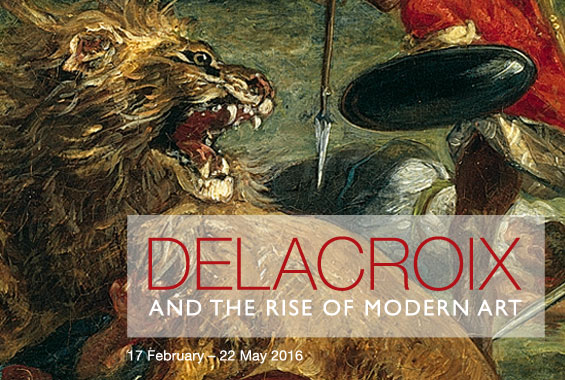
'Delacroix and the Rise of Modern Art' is, as its title implies, a show with a thesis. Delacroix, Old Master of Romanticism, was also a revolutionary artist whose stylistic verve makes him a forefather of the modern movement. At the National Gallery exhibition, we see Delacroix canvases next to works by contemporaries and later artists who picked up on some aspect of the Master's work. Colour, for instance. Delacroix immersed himself in the collours of Rubens and transported this Flemish world to France, where the dominant language was the high finish and sobre harmonies enjoined by the Academy. In this context, a work like 'The Death of Sardanapalus' (1827-8, seen here in a reduced replica made by the artist himself for his own purposes) was truly revolutionary in its energetic swirls of colour, and duly reviled when it was shown at the Salon, making Delacroix, in his own rueful words, 'the abomination of painting'. Yet to a later generation, the array of sensual tones and daring decentred composition were sources of inspiration. A genealogy can be traced from Delacroix to the Impressionists to the Post-Impressionists, at each stage colour detaching itself from realistic depiction on its way to becoming a pure expressive element, the beating heart of the image, while classical composition breaks into a million fragments. As an example of this family tree, the third room argues that Delacroix revived the genre of the floral painting, which had descended into limp decorative prettiness. From his full-blooded delight in fruit and flowers 'tis but a step to the inner world figured in van Gogh's sunflowers or the dream visions of Odilon Redon. Elsewhere we can see how van Gogh recaptured from memory the colouristic schemes of the Master in a glowing Pietà. Links are made to even later artists like Kandinsky, whose formal experiments belong to a narrative in which Delacroix's journals, concerned among many other things with the theory of optics, are a central document.

I learned a great deal from this exhibition. Delacroix looks so much like the summation of old-style grand history painting that it is refreshing to consider  him as a forerunner of later schools, his freedom from tradition underpinned by tributes from Baudelaire, Cézanne and other admirers. The paintings from Africa make a sumptuous mini-display in the second room, where whirling sufis, senatorial menfolk and the lustrous 'Women of Algiers in their Apartment' display a Moroccan experience transmuted through memory into a blazing oriental world, half real half enhanced by imagination. Here was the alternative the artist sought to biblical and ancient historical scenes. Memory, indeed, is a major theme in this exhibition: like Wordsworth, Delacroix insisted on the importance of experience re-collected, and many of the paintings from Africa were executed many years after his brief trip to Morocco in 1832.
There were art-historical detective stories to remind us of the scholarly precision end of the discipline:  A might have seen this painting by B in the private collection of C when he visited X. Such links are a reminder, too, of a now vanished world of transmission and influence. When van Gogh had only a lithograph to copy, he recaptured from memory the arrangement of complementary colours he had seen in Delacroix's other works. This kind of memory must surely be rarer in the age of mechanical reproduction.
I found the argument - Delacroix as the grandfather of modernity - pretty persuasive, although the organisers themselves say that Delacroix's journals are so complex and compendious that you can use them to prove pretty much whatever you like. Put him next to Veronese and other earlier narrative painters and you'd get another story. But both can be true, of course. The visual evidence for moderns doffing their cap to Delacroix is the most compelling, the textual is rather weaker. Despite Cézanne's flamboyant remarks about the nineteenth-century master, his work does seem to be in a very different register, although his rather dotty oil sketch of D being assumed into the heavens while contemporary artists peer up at him is saying something, however wryly, about the handover of revolutionary daring. Over the show Delacroix himself almost disappears, effaced by the storm he helped to create: there is just one painting by him in the flowers room, and in the final room a single tiny copy of a ceiling mural is overwhelmed by the cultural progeny it allegedly helped to spawn. Then there is the question of quality. The great works in the Louvre cannot be lent, and so Delacroix is not represented by many of his his masterpieces here; so the fantastic array of works by the likes of Courbet, Renoir, van Gogh, Gauguin et al. are in may cases more emphatic works than the Master's and take over our attention. The van Gogh painting of olive groves is a simply stunning piece, and doesn't gain much in interest if we consider its somewhat elusive debt to Delacroix's landscape oil sketches from England.
The exhibition is continually interesting, though I confess I didn't spend much time at the film of mural projects. My favourite picture of all was a Kandinsky, on the cusp of abstraction, where the figures and horses gradually revealed themselves after a minute or two of puzzled looking (and profitable listening to the genial audioguide). The exhibition itself also revealed its value over the two hours it took to look round. After being treated to amazing representations of Rembrandt and Goya in the Sainsbury Wing there was perhaps an initial disappointment in not seeing more Delacroix here. But that would be to miss the point of this thought-provoking and stimulating exercise in comparative looking. Baudelaire described Delacroix as a volcano concealed beneath a bouquet of flowers. In this inventive and thoughtful display, we were able to trace the range and direction of that ongoing eruption.

Friday, 29 January 2016

Les Liaisons Dangereuses

Through the mysteries of corporate theatredom, a Donmar Warehouse production is broadcast as part of National Theatre Live. Confusing, but no matter. Whoever produced and digitally beamed it, this was strong production of Christopher Hampton's adaptation of Laclos's epistolary novel. I remembered some lines of the script vividly from the 1988 film with John Malkovich and Michelle Pfeiffer. Tonight's Valmont was Dominic West, opposite Jane Mcteer's Marquise de Merteuil. Two voices one certainly did not tire of over the two and a half hours of this production. They were as silkily smooth as any executives planning a takeover, as they planned a young girl's destruction merely as a petty act of vengeance (her prospective husband had dumped Madame de M) and a sexy teasing game. West's Valmont was all genial charm at the outset, in the second half increasingly out of his depth as he found himself in a new emotional universe. The scene when the single word 'unprecedented' triggers the fatal chain of events that leads the characters into hell was briliantly played, the smallest tilt of McTeer's regal head communicating the most violent feelings. Hampton's script offers marvellous female parts, and both Morfydd Clark (Cécilie) and Elaine Cassidy (Madame de Tourvel) charted affecting journeys from demure propriety to what another era would have called debauchery. Ed Holcroft was the naive Chevalier Danceny, drawn into a battle he could not understand. The play did not take in Merteuil's smallpox or the public humiliation at the opera, but the production communicated an air of pre-revolutionary doom in the flickering, shadowy light cast by chandeliers and Tom Scutt's set of steadily denuded, fading walls, stripped of paintings and revealing stonework beneath. I loved the stylish scene changes, balletic movement over gorgeous vocal music.
Tragedy is meant to be inevitable, but in this one one had an aching sense of how things might have played out therwise. It was clear that beneath the cynicism love's embers still glowed between the lead characters. With just a modicum of moral decency Valmont and Madame de Merteuil could even have found a warm gossipy happiness together. How self-destructive vanity and social sophistication can be. I suppose that is what Laclos intended us to think. In the interval tallk we learned the interesting fact that Josie Rourke first directed this when she was nineteen, by which age she had had sex about four times. And Christopher Hampton observed that to feel the play's modernity you actually have to do it in period eighteenth-century dress and interiors. When you take the historical period away, the contemporary buzz is lost. A terrific evening and I'm grateful to my French friend C, who invited me to take up a spare ticket.

Thursday, 21 January 2016

Ashmolean, Titian to Canaletto


The Ashmolean's latest exhibition follows their recent Great British Drawings, and can be seen as a continuation of the British Museum's Italian Renaissance Drawings (2010). All serve as reminders of the fundamental importance of drawing in art, and of drawing's many purposes - drawings may be executed as studies of light, texture and form; or as experiments, or educational tools for a workshop; they may be intended as finished works to be bought by collectors, or made as studies for paintings (we see several squared up for transfer onto a larger surface). In this exhibition, the Ashmolean seeks to refute the assertion of Vasari in his Lives (1568) that the Venetians neglected drawing and started work directly with paint on canvas. This opinion was followed by other Florentine writers (despite the fact that the Uffizi housed an important collection of Venetian works on paper) and by later authorities, including Sir Joshua Reynolds. The notion perhaps has a particular attractiveness: while Vasari had an interest in contrasting the undisciplined Venetians - as he saw them - with the Florentines and their meticulous attention to disegno, there is also an undeniable appeal in the idea of Titian, Bellini and Tintoretto spontaneously creating work without painstaking mathematical preparation - it fits the picture of instinctive art, such as we associate with Shakespeare and Mozart.

Yet, as this exhibition make clear, the Venetian masters produced wonderful drawings, generally using chalk and charcoal rather than silverpoint. The first masters on display are Giovanni Bellini (active 1459 - d.1516) and Vittore Carpaccio (1460/6 - c.1525/6). Bellini's 'Portrait of a Man' (on loan from Christ Church) uses subtle tonal effects to create a finely modelled head with a real sense of character: the creases and folds in the face give it a 'lived-in' look, and the textures of hair and soft cap are superbly rendered. Carpaccio's studies of female heads are more ethereal - as befits sketches for angels in the altarpiece of the Glory of St Ursula - and use shimmering white highlights to convey the sense of streaming light. I was particualrly taken by the sadly vulnerable-looking dragon in the centre of Carpaccio's townscape with figures, 'The Triumph of St George'. This work also made clear the Venetians' profound sense of drama, with a variety of expressive and theatrical attitudes among the bystanders. Titian picked up on the sculptural and luminous qualities of these artists, using drawing to explore contour, volume, and the effects of transient light. Above all is the idea of public theatre. Everything, from the knotted muscles of an executioner's legs to the fall of cloth, is a source of drama: the 'Drapery study for the figure of St Bernardino' is a study in the expressive qualities of a garment's folds, as we look at the saint from behind. There is a free and creative use of materials: charcoal is dampened and rubbed to create subtle shading, blurring the transitions beneath a chiaroscuro effect and creating a hypnotic, flowing pattern. We see Bellini, Carpaccio and Titian using blue paper to bring out the range of tones in their subjects. Alongside these premier league names, it is instructive to learn about other Venetian artists, such as Domenico Campagnola, a specialist in Veneto landscapes where rustic fortifications and pastoral figures appear against distant hills; or Andrea Meldolla (Schiavone, c.1510-63), whose sinuous figures and sense of vivid composition are illustrated by 'Presentation in the Temple' and an unidentified female figure. Lorenzo Lotto (c.480-1556/7) creates in 'Head of a bearded man' one of the most memorable pictures in the show - a mass of soft, refined touches coalesce into a wonderfully characterful face, the textures of beard and skin immediately registering on our imagination.

In the second room, the Master is Jacopo Tintoretto (1518/19-1594), for whose practice figure drawing was of great importance. He drew from models, wax sculptures (some small models as would have existed in a workshop have been specially created), statues and as many copies of Michelangelo as he could acquire. Twisting and rippling torsos are displayed alongside vigorous copies of busts, where the emphasis is on volume and dramatic tension of light and shade. But these are not simply figurative exercises. There is, too, a strong feeling for character: the study of a bust of Vitellius evokes a stern and gloomy Roman personality.

After the brilliance of the earlier masters, the third room feels relatively flat. Later generations worked under the influence of Titian, Tintoretto, Veronese and Bellini, and the Baroque drawings do not seem to add much to the vocabulary, apart from taking it to even more spectacular operatic heights.  Yet it is valuable to learn about the teaching practice of Palma Giovane and to come upon artists such as Bernardo Strozzi and Francesco Maffei. Moving into the eighteenth century, two of the most striking images were the 'Head of a Youth' (used as the poster for the exhibition) and 'Standing Youth Seen from Behind' , both by Giovanni Battista Piazzetta (1682-1754), where the broad touches, melting forms, psychological acuity and delight in light are applied to real-life figures. Giambattista Tiepolo's 'Study of a foreshortened head' achieves an intense drama through the orientation and lighting of the subject that we saw earlier in Tintoretto. One senses in these later artists the tools of the Old Masters being exploited with delight and fresh vision.

The exhibition ends with drawings by Canaletto among other scenes of Venice, as the fading republic becomes a consumable tourist experience. It is followed by a room of visual responses by Jenny Saville, an important contemporary artist who I last saw in Oxford's Museum of Modern Art a few years ago. I found I didn't have much energy left to take in this room, though a quick survey made clear how Saville had responded to the free and confident handling of Titian, the array of postures and the dramatic potentalities of the figure on display in the Venetian works. There's an improvisatory quality, too - palimpsests of forms and lines - that convey an energy and attack which connects Saville with the rest of the show. These days we are perhaps happier to see drawing as an end in itself, and prefer the sense of being in front of a performance on paper than a polished masterpiece in paint. A drawing does not call for the same reverence as an altarpiece does; looking at a sketch with various subject, or several goes at the same subject, is rather like listening to a pianist practise before a concert - in some ways, a more intimate and rewarding experience than the final performance. I found 'Studies for the Coronation of the Virgin' by Paolo Veronese (1528-88) particularly engaging in this respect, as you see him work his way down the paper, varying the configurations of the central group and trying out gestures and attitudes of the surrounding figures. This work, too, was lent by Christ Church; many other works were lent by the Uffizi. With the Ashmolean's own holdings, this allowed an exhibition which triumphantly disproved Vasari's assertion and allowed us to enjoy, in a different light, the achievement of Venetian art. a footnote: the descriptive panels for each work were extremely well written, and an object lesson in how the terms of art, when accurately applied, can enhance our appreciation of an image.

Thursday, 14 January 2016

Goya, The Portraits (National Gallery)

My last engagement with Francisco de Goya y Lucientes (1746-1828) was the remarkable exhibition of his drawings of witches at the Courtauld last year. Scarcely less vivid was a showing of the Disasters of War prints in Barcelona I came upon some years ago. Where shock in art is concerned this is the real thing, making the efforts of contemporary provocatieurs seem tepid at best. This familiarity (to a degree) with the dark side of this painter's universe makes me a typically modern Goya viewer, more clued up on, and responsive to, his private nightmarish word than the official commissions that earned him a living - religious paintings, tapestry design and portraits. The last of these is the subject of the latest Sainsbury Wing exhibition. The prospect of seeing room after room of portraits of the Great and the Good does not set the pulse pounding; but this exhibition maintains and rewards attention throughout with what it reveals of a remarkable time in Spanish history, and of the relentless interests of its visual record-keeper.

The great and the good have never been less stiff or more exposed. Goya's approach as a portrait artist was precisely to put aside the expectations of pomp and circumstance. He took a strong interest in the personalities of his subjects. 'The Family of the Infante Don Luis de Borbón' (1783-4) is the product not of a formal sitting but of the artist's close familiarity with the exiled prince and his entourage. Although the composition is matching itself against the great forebear Velázquez, there is something Hogarthian in the vivid sense of character and animation in the scene. The same relaxed depiction of the person behind the title comes at us again and again, never more surprisingly than in 'Charles III in Hunting Dress' (1986-8), in which the dazzlingly ugly monarch grins at us, rifle in hand - a different image altogether from the usual portrayal of a king as soldier or wrapped in the robes of state. There was a wider cultural and political point to this: Spain was catching on to the enlightened stirrings going on over the Pyrenees, and Goya was part of this brief liberalising movement in Iberian government and high society. Thus we see young aristocrats enjoying the benefits of a modern education, the Duke of Alba nonchalantly leaning on a fortepiano while leafing through a new score, and family groups where children play, relaxed mothers display fashionable frizzed hairdos and a Rousseauian contentment prevails. The brushwork is correspondingly free and bravura, lovingly capturing the folds and textures of fashionable costumes and a range of expressions in his subjects (if the self-portrait drawing is anything to go by, sitting for Goya must have been a fairly unnerving experience).

The exposure to liberalism was to be a brief one. War with France, the Revolution, a short but profound Spanish Enlightenment, the Napoleonic Empire, Wellington's defeat of Napoleon and eventualy the restoration of the Spanish throne in the figure of the ghastly autocratic Ferdinand VII provide a narrative that gives the steady flow of portraits a compelling underlying dynamic. Certain qualities in Goya transcend the warp and woof chronicle time, such as the naturalism which makes the famous portrait of the Duchess of Alba and the double portrait of Charles IV and María Luisa such a fascinating, Shakespearean examination of human character in its many layers, pomp masking vulnerability, fancy lace mantillas at once ravishingly desirable and pathetically impotent in the face of encroaching age and illness. Friends are depicted with a total commitment to honesty: the architect Juan de Villanueva is shown with uneven eyes and crooked nose, the glint in his eyes an assurance by sitter and artist alike that friendship goes beyond surface errata, and even takes cheer in the natural deformities that nature and history bestow upon us all. In their deep sense of human character, the paintings seem out of their age, most strikingly perhaps in female subjects. Gainsborough could get nowhere near the range of feelings in the portraits of women here: 'Thérèse Louise de Sureda' (1804-6) or 'The Countess of Fernán Nuñez' (1803) are examples of the directness and autonomy of Goya's lady subjects which make orthodoxies of 'the male gaze' seem quite beside the point.

Goya's in-the-headlights frankness seems not to recognise any frontier. The pompous regalia of Fernado VII's portrait succeeds in bringing out the King's dangerous and malevolent stupidity (did Fernado see this? Goya was put through exhausting tests of his loyalty to the regime, and humiliatingly paired with an inferior as official painter to the court). The extraordinary 'Self Portrait with Doctor Arrieta', showing a Goya brought back from somewhere close to the dead, and surrounded by shadowy figures - the phantasms of the black paintings, perhaps - take this unflinching honesty into the realm of self-depiction. It is this capacity for looking at faces and recording them as they really are, for seeing the person whole, that makes the exhibition more than a collection of portraits, and turns it into a vision of life that we can take as a moral lesson. Those who knew Goya in his exile in Bordeaux - old, ill, profoundly deaf - remarked on his boundless curiosity in the world around him. There's a a black crayon self-portrait, with flowing white beard as he moves on two sticks, with the simple heading 'Aun aprendo' (I'm still learning). There was certainly much to be learned - about Goya, Spain, and looking - in this exhibition curated by Xavier Bray. I found the Spanish version of the audioguide extremely helpful. Bray and other experts warn us not to 'read in' the Goya of the Black Paintings into the portrait work, much of which was produced earlier; T J Clark in the LRB isn't so sure, noting points of tension in the background and composition that suggest inner dramas at work. I'm still at the much more basic stage of feeling I've met Spanish nobles and royals of over two centuries ago and listened in on their thoughts and conversations, seen them across the grave through the alchemy of art. How much truth, how much fiction in this vision? How much faith in the eyes and hand of the Master? Aun aprendo.